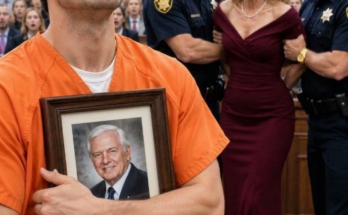
My Twelve-Year-Old Daughter Put the Groom in the Hospital at Her Mother’s Wedding. When I Learned What She Was Really Trying to Stop, I Realized the Wrong Person Had Been on Trial.
PART 3 — FULL STORY / COMPLETE ENDING
My phone buzzed at 4:16 in the morning in a barracks room outside Stuttgart, Germany.
There are calls a soldier learns to recognize before answering.
A commanding officer before dawn is one of them.
I was awake before my hand reached the phone.
“Daniel, there’s been an incident involving Ava.”
I sat up.
“What happened?”
“Your ex-wife got married yesterday.”
“I know.”
“The groom is in the hospital.”
I waited.
Then Colonel Hayes said:
“Your daughter put him there.”
I laughed.
Not because anything was funny.
Because the sentence made no sense.
“Ava?”
“Yes.”
“My twelve-year-old daughter?”
“She assaulted him during the reception.”
My first question was immediate.
“What did he do?”
Hayes hesitated.
“I don’t have that information.”
“What did he do to her?”
“Nobody has reported that he touched Ava.”
The wording caught me.
Not nothing happened.
Not she’s safe.
Nobody had reported it.
“What about Tommy?”
Silence.
My son was seven.
My stomach tightened.
“I’m coming home.”
Thirty-one hours later, I stood outside the Connecticut house where my children lived with their mother, Diane.
The wedding decorations were still up.
White roses wilted beside the porch.
A wooden sign leaned near the driveway:
DIANE & WADE — FOREVER BEGINS TODAY
Near the steps was a dark stain.
Wade Mercer’s blood.
The door opened before I knocked.
Diane looked exhausted.
“Where are the kids?”
“Ava’s inside.”
“And Tommy?”
“He’s resting.”
“Where?”
“Daniel, can we please not start like this?”
That answer told me enough.
Inside, the living room was filled with relatives from both families.
And in the center sat Wade.
The groom.
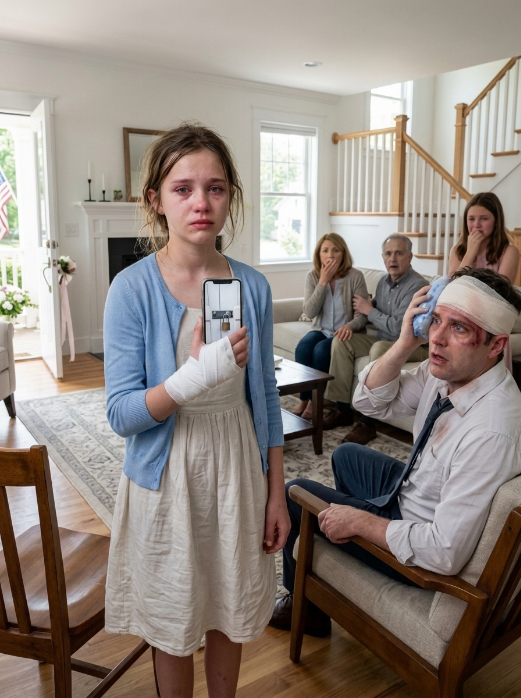
His face was swollen and bandaged.
Then I saw Ava.
She sat alone beside the staircase, still wearing her pale-blue wedding dress.
Grass stained the hem.
One shoulder was torn.
Her right hand was wrapped in gauze.
She looked at me.
She did not run to me.
That frightened me more than Wade’s injuries.
The last time I returned from deployment, Ava had nearly knocked me over hugging me.
Now she sat perfectly still.
Children do not become that still because they feel powerful.
They become that still when adults have taught them that speaking changes nothing.
Diane folded her arms.
“We’re pressing charges.”
I looked around.
Eight adults.
Everyone had an opinion.
Nobody was sitting beside my daughter.
I crossed the room and crouched in front of her.
“Hey, Bug.”
Her lower lip trembled.
“Hi, Dad.”
“Can I hug you?”
She nodded.
For one second she stayed rigid.
Then she collapsed against me.
I sat directly in front of her.
“Tell me what happened.”
Diane protested that eighty people had witnessed the attack.
“I didn’t ask eighty people.”
I looked at Ava.
“You tell me from the beginning. Nobody interrupts you.”
Then she said the words that changed everything.
“Wade has been hurting Tommy for six months.”
The room erupted.
Diane denied it.
Relatives called Ava dramatic.
Wade tried to speak.
Ava kept looking at me.
“He locks Tommy in rooms.”
“He gives him time-outs,” Diane said.
“He locks the door from the outside.”
“Ava—”
“He grabs him.”
“Stop.”
“He hits him.”
Diane moved toward her.
Ava flinched.
Tiny.
Almost invisible.
But I saw it.
Ava reached for her phone.
“There are pictures.”
A hidden folder opened.
The first photograph showed Tommy’s bedroom door.
Above the handle was a metal hasp designed to take a padlock from the hallway side.
The next showed marks around Tommy’s wrist.
Another showed bruising beneath his shoulder.
Another showed him sleeping curled on the floor.
A blanket had been pushed beneath the door.
Ava said Wade sometimes took away his bed as punishment.
Another photograph showed almost no dinner.
Then Wade made the mistake that changed the room.
“Tommy has behavioral problems.”
I turned toward him.
“Explain the bruises.”
“He falls. Kids bruise. The boy is clumsy.”
Nobody had yet told him which injuries I was asking about.
But he already knew.
Ava looked at Diane.
“I told you.”
Diane whispered:
“You said Wade was too strict.”
“I said he locked Tommy up.”
“You said he sent him to his room.”
“I showed you the lock.”
Then Ava turned to the other adults.
She had told them too.
Her grandfather had laughed it off.
Her uncle said Wade was teaching Tommy to be a man.
Her aunt called Ava dramatic.
Her grandmother said children needed discipline.
Then Wade’s father, Frank, saw the photograph of the door.
His face turned gray.
He took Ava’s phone and enlarged the metal hasp.
His fingers shook.
Then he seized his wife Patricia’s wrist.
“Not again, Patricia.”
Wade snapped:
“Dad.”
Frank’s expression was not surprise.
It was recognition.
Then Ava looked back at me.
Tears finally appeared.
“We’re children,” she said.
“And every adult in this room chose him over us.”
I thought that was the whole truth.
It wasn’t.
Ava’s face suddenly changed.
“But that’s not why I hit him.”
“What do you mean?”
She looked toward the staircase.
“Because Tommy is still—”
A crash sounded upstairs.
Then a child screamed.
“Dad!”
I ran.
Tommy’s bedroom was empty.
Ava led me toward a linen closet at the end of the corridor.
Behind shelves and towels was a concealed panel.
Behind that—
an old service staircase.
It descended between the walls.
At the bottom was a narrow corridor and a small reinforced door.
A sliding bolt had been installed outside.
My son was screaming behind it.
“Tommy!”
The bolt was secured by a padlock.
“WHERE IS THE KEY?”
Nobody answered.
Frank whispered:
“Wade.”
Wade stood at the top of the stairs.
Ava crouched beside the door.
“Tommy?”
His crying quieted.
“Ava?”
“I’m here.”
“I knew you’d come.”
She pressed her forehead against the wood.
Then Tommy whispered:
“He said you were dead.”
Diane made a broken sound behind me.
Frank demanded Wade hand over the key.
Wade smiled through his injured jaw.
“You going to put me in the little room if I don’t?”
Frank physically recoiled.
Again—
recognition.
History.
I ran to the garage, returned with tools, and forced the door open.
Tommy sat on the concrete floor.
Barefoot.
Still in his little wedding clothes.
His cheek was swollen.
There were marks on his wrists and neck.
He ran into my arms.
“Dad!”
“I got you.”
He shook against me.
Diane reached toward him.
Tommy recoiled.
“No!”
He reached for Ava instead.
Then he looked at Wade.
“He said Ava was next.”
Every adult turned.
Tommy buried his face against me.
“He said after the wedding we were going to learn how families work.”
I put Tommy in Ava’s arms.
Then I started toward Wade.
Frank stepped between us.
“If you hit him, he wins.”
“I don’t care.”
“Ava will.”
I looked at my daughter.
She was watching me.
Her expression said everything:
Please don’t become another adult who makes this about his anger.
I stepped back.
Then called the police myself.
Detective Lena Ortiz arrived with patrol officers, paramedics, and eventually child services.
She looked at Ava.
Tommy.
The hidden room.
Wade.
Then said:
“Everyone sits down.”
Paramedics documented Tommy’s condition.
Detectives photographed the lock, the room, Ava’s injured hand, and Wade’s injuries.
Ortiz later told me what had happened at the reception.
Wade locked Tommy downstairs because Tommy refused to call him Dad.
Ava followed.
She demanded the key.
She begged.
Wade refused.
She threatened to tell the guests.
He grabbed her.
She hit him once.
Then Wade struck her.
Several adults saw it.
He grabbed Ava again.
She kicked his knee.
He fell against a stone planter.
Then she got on top of him.
And kept hitting him.
Not because she had suddenly lost her mind.
She was shouting the same question over and over:
“WHERE IS THE KEY?”
Eight adults had watched a twelve-year-old girl desperately trying to free her little brother.
Yet the story that reached Germany was:
A dangerous child attacked the groom.
That night, Ava and Tommy came with me to a hotel.
At 1:47 a.m., I found Ava crying on the bathroom floor.
“Are you mad at me?”
“For hitting him?”
She nodded.
“No.”
“I didn’t stop.”
“I know.”
“I wanted him to hurt.”
Then she looked directly at me.
“Everybody says I lost control.”
She wiped her face.
“But I didn’t.”
“What do you mean?”
“I knew exactly what I was doing.”
Her voice cracked.
“I thought if I hurt him enough, he’d finally tell me where the key was.”
Then she told me she had asked adults for help for months.
Her mother.
Grandparents.
Relatives.
Even a teacher.
She took photographs because people demanded proof.
Then people told her the photographs did not prove enough.
I asked why she had never called me.
The question came out wrong.
Ava flinched.
I corrected myself immediately.
“You don’t have to defend yourself.”
But she answered.
“Mom said you were in Germany. She said if I made trouble, your commander might think you couldn’t handle deployment and it could hurt your career.”
I closed my eyes.
My twelve-year-old daughter had decided enduring fear in silence was a reasonable price for protecting my career.
I pulled her against me.
“You could burn my entire career to the ground and I would still come for you.”
She began crying harder.
“I should’ve told you.”
“I should’ve made it easier to tell me.”
Then, for the first time since I arrived, she sounded twelve.
“I missed you.”
“I missed you too.”
From the bedroom came Tommy’s sleepy voice.
“Ava?”
She stood immediately.
“I’m here.”
And I realized that while I had been overseas, my daughter had stopped being Tommy’s sister.
She had become his bodyguard.
No child should have to earn that promotion.