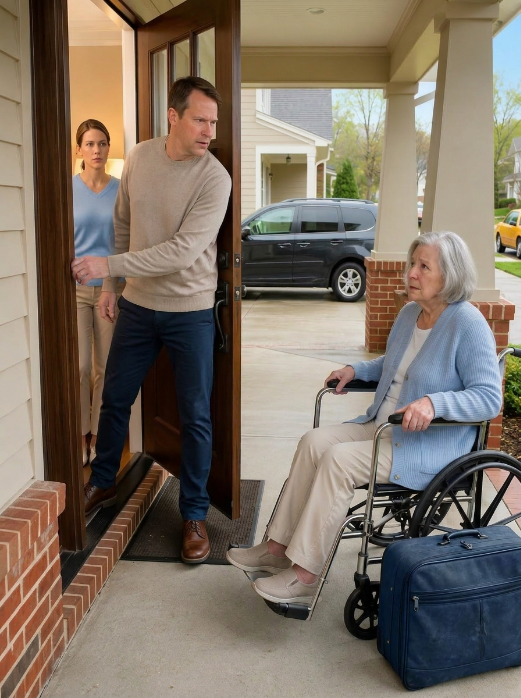
I came to my son’s house in a wheelchair, begging for a place to stay.
He looked at me like I was a burden and closed the door in my face.
The next morning, I found an old card that had belonged to my late husband and took it to the bank.
When the manager saw it, he stood so fast his chair fell backward.
“Ma’am,” he whispered, “there is something you need to see.”
Eight months after my husband, Arthur, died, I still caught myself listening for him in the quietest parts of the day.
Arthur and I had been married for forty-three years.
We were never wealthy.
At least, that was what I believed.
We paid our bills, saved carefully, and helped our son Daniel whenever we could.
When Daniel and Melissa needed help buying their house, Arthur reached for the checkbook before Daniel even finished explaining the problem.
“We’re helping our son build something,” Arthur told me afterward. “That matters more than a repayment schedule.”
Then Arthur died.
Eight months later, I fell outside a grocery store on a rainy afternoon and shattered my hip.
Three surgeries followed.
Then months of rehabilitation.
By the time I returned home, the wheelchair was part of my daily life.
Our two-story house became a prison.
The bedroom was upstairs.
The full bathroom was upstairs.
Most of my clothes were upstairs.
I slept on the couch.
Neighbors helped with groceries and prescriptions.
But my son lived less than thirty minutes away.
Daniel visited twice.
Each visit became shorter.
When I finally admitted I could no longer manage alone, I called him.
“Daniel, I need help.”
“What kind of help?”
“I need somewhere to stay. Just temporarily.”
He said he would speak with Melissa.
He never called back.
So the next afternoon, I packed one suitcase and went to his house.
Daniel opened the door with irritation already on his face.
“Mom, what are you doing here?”
“I came to ask my family for help.”
“You can’t just show up.”
He stepped outside and almost closed the door behind him.
Through the gap, I saw Melissa watching.
My grandchildren appeared briefly before being hurried away.
“I can’t manage my house anymore,” I said. “I only need a week or two.”
Daniel sighed.
“Melissa has dinner planned. The kids have homework. We have a routine.”
A routine without room for his mother.
I reminded him Arthur and I had helped them purchase the house.
“That was a loan,” Daniel replied. “We paid it back.”
We both knew they had repaid only a small portion.
Then Melissa came outside.
“The guest room is being renovated.”
Through the doorway, I could see the perfectly made bed.
No tools.
No paint.
No renovation.
Daniel suggested assisted living.
“That costs about three thousand dollars a month,” I said. “I receive eight hundred.”
Melissa smiled.
“I’m sure there are government programs for someone in your situation.”
Someone in my situation.
Not her children’s grandmother.
Not Daniel’s mother.
Just a problem that should belong to somebody else.
I turned my wheelchair around.
“Don’t worry. I’ll figure something out.”
Daniel called after me.
“Mom, don’t be like that.”
“Like what?”
“Realistic.”
That word stayed with me all the way home.
That night, I slept on the couch.
Before morning, I accepted something I had spent months refusing to believe.
I was alone.
The following day, I decided to clean Arthur’s office.
Inside his desk were receipts, old cards, bank statements, and labeled folders.
Then I found the file containing the money we had given Daniel.
The repayment record showed exactly what I remembered.
A few payments.
Then nothing.
Arthur had never written an angry note beside the missing balance.
He had simply stopped recording payments when they stopped arriving.
I continued searching.
At the back of the lowest drawer, my fingers touched a heavy card.
Arthur’s name was printed on the front.
On the back was an account number and four handwritten words:
EMERGENCY ACCESS ONLY.
I took it to the bank the next morning.
The branch manager examined the card, entered the number, checked my identification, and suddenly stood so quickly that his chair rolled backward into a cabinet.
“Ma’am,” he whispered, “there is something you need to see.”
He closed his office door.
Then he asked the teller outside to hold all calls.
“My name is Martin Collins,” he said. “I need to verify several things before I show you anything.”
He asked for my identification again.
My marriage certificate.
Arthur’s date of death.
Then he handed me a blank page.
“Sign your full legal name exactly as you normally would.”
My fingers trembled.
“I’m sorry. I recently broke my hip.”
“You have nothing to apologize for.”
It was such a simple sentence.
But after Daniel’s doorstep, kindness felt almost shocking.
Martin compared my signature to a document on his computer.
Then his shoulders relaxed.
“Mrs. Bennett, your husband established a private financial arrangement with this bank fourteen years ago.”
I frowned.
“What arrangement?”
“A trust.”
“Arthur didn’t have a trust.”
Martin turned the monitor toward me.
At the top were the words:
ARTHUR AND HELEN BENNETT FAMILY SECURITY TRUST
Directly underneath was my name.
SOLE SURVIVING BENEFICIARY: HELEN MARIE BENNETT
I stared at the screen.
“I don’t understand.”
Martin opened another page.
Then another.
There were investment accounts.
Treasury securities.
Dividend funds.
A fully paid long-term-care policy.
And an emergency cash reserve.
My eyes moved toward the total.
Then stopped.
“Is that correct?”
“Yes.”
I counted the digits again.
$1,842,611.
I looked at Martin.
“There’s some mistake.”
“There isn’t.”
“We never had this kind of money.”
“Your husband did not keep it in ordinary savings.”
Martin explained that more than thirty years earlier, Arthur had invested a modest amount in a regional medical-equipment company started by one of his former coworkers.
The company grew.
Arthur reinvested every dividend.
Years later, the business was sold.
Instead of changing our lifestyle, Arthur moved most of his proceeds into conservative investments.
He continued working.
We stayed in the same house.
We drove ordinary cars.
He never touched most of the money.
“Why didn’t he tell me?”
Martin hesitated.
“He did intend to.”
My chest tightened.
“Then why didn’t he?”
“Mrs. Bennett, there is something else.”
He opened a secured file.
Arthur had left instructions.
If I ever arrived at the bank carrying that card, the bank was to contact his attorney immediately.
The card was not merely account access.
It was a signal.
Martin read Arthur’s instructions aloud.
If Helen presents this card herself, assume she has reached a situation in which she feels she has nowhere safe to turn. Do not send her away with only an account balance. Contact Margaret Ellis. Arrange immediate housing assistance if necessary.
I covered my mouth.
Arthur had known me too well.
Martin continued.
“Your husband updated these instructions approximately eleven months before he died.”
“Why?”
“He left a recording explaining that.”
Twenty minutes later, Arthur’s attorney, Margaret Ellis, joined us by secure video.
She was a woman in her early sixties with silver hair and kind eyes.
“Helen,” she said. “Arthur made me promise not to contact you unless you found the card.”
“Why would he make you do that?”
“Because he knew what you would do if someone simply told you that you had money.”
“What?”
“You would give it away.”
Despite everything, I almost laughed.
She was right.
Margaret continued.
“Arthur worried especially about Daniel.”
My smile disappeared.
“He loved Daniel.”
“Very much.”
“Then why?”
“Love and trust are not always identical.”
She opened another document.
Arthur had noticed Daniel and Melissa repeatedly asking for financial help.
The house deposit.
A vehicle.
Credit-card debt.
A business idea that never materialized.
Arthur had helped more often than I realized.
But during the final two years of his life, he had become concerned that Daniel had begun treating his parents’ savings as part of his own future.
“He never told me.”
“He didn’t want you caught between your husband and your son.”
Margaret paused.
“But he did tell me something.”
“What?”
“That if Daniel ever learned you had substantial savings before you were emotionally ready to control them yourself, you would spend the rest of your life being asked to prove your love with money.”
I looked down at my wheelchair.
Then I remembered Daniel’s front porch.
Melissa’s smile.
Someone in your situation.
Martin placed a box of tissues beside me.
Margaret said gently:
“Arthur did not hide this money because he didn’t trust you.”
“He hid it because he trusted your heart more than your ability to say no.”
Then she asked:
“Would you like to see his recording?”
I nodded.
Arthur appeared on the screen.
Healthy.
Smiling.
Alive.
For a moment, I forgot how to breathe.
“Helen,” he said, “if you’re watching this, then I was right about something I desperately hoped I’d be wrong about.”
Tears filled my eyes.
“I know you’re angry with me for keeping this quiet.”
I laughed through my tears.
“Very.”
On-screen, Arthur smiled as though he had heard me.
“This money isn’t a secret fortune. It’s forty years of saying no to things we didn’t need so the person I love would never have to beg anyone for a safe place to sleep.”
My tears fell faster.
Then his face became serious.
“Especially Daniel.”
I closed my eyes.
“Do not punish our son because he disappoints you. But do not reward him for disappointing you either.”
I stared at the screen.
“You are his mother.”
Arthur paused.
“You are not his emergency fund.”
Then came the sentence that changed everything.
“Helen, if someone only has room for you when you are useful to them, do not buy yourself a chair at their table.”
I began sobbing.
Martin quietly looked away.
Arthur continued.
“Build another table.”