The judge asked the nine-year-old boy which parent he wanted to live with.
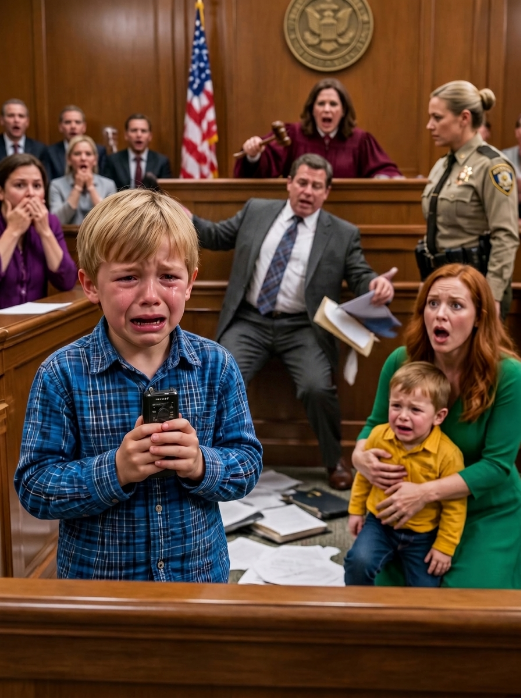
But when Lucas Carter slowly reached into his jacket pocket, his wealthy father’s face turned white.
The courtroom smelled of old documents, coffee, and wet coats from the rain outside.
Emily Carter sat quietly, her fingers locked together in her lap.
A faint mark remained where her wedding ring had once been.
Across from her sat Daniel Carter.
Perfect suit.
Perfect hair.
Perfect posture.
His lawyer’s table was stacked with bank statements, investment records, school plans, insurance documents, and everything else money could arrange neatly enough to resemble good parenting.
Emily’s side looked much simpler.
A few folders.
A notebook.
A worn handbag.
And two nine-year-old boys whose entire lives were being discussed by adults in expensive clothes.
Lucas and Mason were twins, but nobody who knew them well would have mistaken one for the other.
Mason wore every emotion on his face.
When people argued, he became quiet.
When somebody raised a voice, his shoulders pulled inward.
Lucas had learned something different.
He watched.
He remembered.
He kept his reactions hidden.
Daniel’s attorney stood.
“Your Honor, my client has demonstrated that he can provide the children with financial stability, excellent schools, comprehensive medical care, and a structured environment.”
Then she looked toward Emily.
“Mrs. Carter has not maintained steady employment during the marriage and has demonstrated significant emotional distress.”
Emily felt something twist inside her.
She had not maintained steady employment because Daniel had insisted she stay home with the boys.
She had handled school pickups.
Doctor appointments.
Fevers.
Homework.
Meals.
Laundry.
Parent-teacher meetings.
Every invisible task that made their household function.
Now the same years Daniel once praised were being presented as proof that she was incapable of supporting herself.
Daniel lowered his head.
“I never wanted this fight,” he said.
His voice was soft.
Measured.
“I just want what’s best for my sons.”
Emily nearly stood.
“That isn’t true.”
The judge struck the gavel.
“Mrs. Carter.”
Emily sat back down.
Daniel looked toward her.
There was the smallest curve near the corner of his mouth.
He knew exactly what he was doing.
Money was not his greatest advantage.
Composure was.
For years, Daniel had learned how to make Emily’s fear look irrational simply by remaining calm while causing it.
He could threaten her in a whisper.
Then when she reacted, he would point at her reaction as proof that she was unstable.
During their marriage, Emily had slowly learned to doubt herself.
Was he really threatening her?
Had she misunderstood?
Was she exaggerating?
Then Daniel filed for divorce.
Emily had not fought over the condominium.
The luxury SUV.
The club membership.
Most of the furniture.
She wanted only one thing.
Lucas and Mason.
That was when Daniel became relentless.
He wanted primary custody.
Not because he had suddenly become interested in the daily work of raising two children.
But because losing the boys was the one thing he knew could break Emily completely.
Then the judge looked toward the twins.
Her voice softened.
“Lucas. Mason.”
Both boys looked up.
“I know this is difficult. But I need you to answer honestly.”
She paused.
“Where do you feel safest?”
Mason looked at Lucas.
Lucas looked at his father.
Daniel gave them the smallest reassuring nod.
Nobody else would have noticed.
Lucas did.
Then the judge asked:
“With your mother or your father?”
The courtroom became completely still.
Lucas stood.
At nine years old, he looked far too serious.
“Your Honor?”
“Yes, Lucas?”
“Before you decide, there’s something you should know.”
Emily’s heart began pounding.
Daniel shifted in his chair.
Lucas reached into his jacket pocket.
Slowly.
Carefully.
Then removed a small black digital recorder.
Daniel’s face drained of color.
“Lucas.”
The boy flinched.
The judge immediately looked toward Daniel.
“Sit down, Mr. Carter.”
Daniel’s lawyer stood.
“Your Honor, we have no idea where that device came from or whether—”
The judge raised one hand.
“Neither do I. Which is why nobody is going to make assumptions.”
Then she turned toward Lucas.
“Where did you get it?”
“It’s Dad’s.”
Daniel closed his eyes.
“He uses it for meetings.”
“Did you steal it?”
Lucas hesitated.
“I took it.”
“Why?”
Lucas pressed his fingers against the recorder.
“Because nobody believes us when Dad talks quietly.”
Emily stopped breathing.
The judge leaned forward.
“What do you mean?”
Lucas looked toward his mother.
She could see fear in his face now.
Not fear of the judge.
Fear that he had already said too much.
Emily whispered:
“It’s okay.”
Daniel immediately protested.
“Your Honor, she is coaching him.”
“I heard two words, Mr. Carter.”
The judge’s voice hardened.
“You will remain silent.”
Then she looked back at Lucas.
“Does your mother know you brought this?”
“No.”
“Did she tell you to record your father?”
“No.”
“What is on it?”
Lucas swallowed.
“Dad practicing what we had to say today.”
Mason started crying.
Then Lucas said:
“He told us if we chose Mom, she would lose everything.”
Daniel shook his head.
“This is unbelievable.”
The judge struck the gavel again.
Lucas continued.
“He said he could make people think Mom was crazy.”
Emily looked at Daniel.
For years, he had said almost the same thing to her.
But always privately.
Always somewhere nobody else could hear.
Then Mason reached inside his sleeve.
He removed a folded sheet of paper.
“What is that?” the judge asked.
“A note from Mrs. Patel.”
Their school counselor.
Mason’s hands trembled as he passed it forward.
The note described a meeting three weeks earlier.
Mason had arrived at school crying.
He told the counselor his father had kept both boys in the garage for more than an hour, repeatedly practicing answers they were supposed to give during the custody hearing.
Daniel told them they needed to choose him.
Mason had been afraid to explain more.
The judge read the note twice.
Then looked toward Daniel.
“You were aware the children had spoken with their counselor?”
“No.”
His attorney touched his arm.
“Do not answer anything further without me.”
The recorder was marked for review.
Because the situation involved minor children and disputed evidence, the judge ordered a short recess while counsel discussed how to proceed.
When court resumed, the judge permitted a limited portion to be played while reserving broader evidentiary questions for later.
The first voice was Daniel’s.
Calm.
Low.
Familiar.
“You will tell the judge you want to live with me.”
Lucas answered:
“But what if we want Mom?”
A pause.
Then Daniel:
“You don’t understand what your mother is like.”
Mason’s small voice followed.
“She takes care of us.”
Daniel’s tone changed.
“Listen to me. If you embarrass me in court, I’ll make sure your mother loses you for good.”
Emily closed her eyes.
Then came another sentence.
“I have better lawyers. I have money. Your mother has nothing.”
Daniel stood.
“This is out of context!”
The judge slammed the gavel.
“Sit down.”
“I was explaining the legal situation to my children.”
“You were explaining that their answer could cause their mother to lose them.”
“That is not what I meant.”
The judge stared at him.
“For the moment, I am less interested in what you meant than in what two frightened nine-year-olds believed you meant.”
Daniel sat.
His perfect expression was gone.
For the first time that morning, he looked afraid.