For four years, I sent nearly $100,000 home while serving overseas.
Every transfer meant the same thing to me.
Keep the house running.
Keep Gwen safe.
Make sure the people I loved did not struggle because I was thousands of miles away.
When my unit finally received emergency leave, I told no one I was coming home.
I wanted to surprise my wife.
For four years, Gwen had been the face I carried through every miserable night.
I imagined her running toward me.
Reality looked nothing like that.
The house had changed dramatically.
A second floor.
An expensive gate.
A new truck.
Showroom furniture.
For one moment, I felt proud.
Maybe the sacrifices had built something good.
Then I walked behind the house.
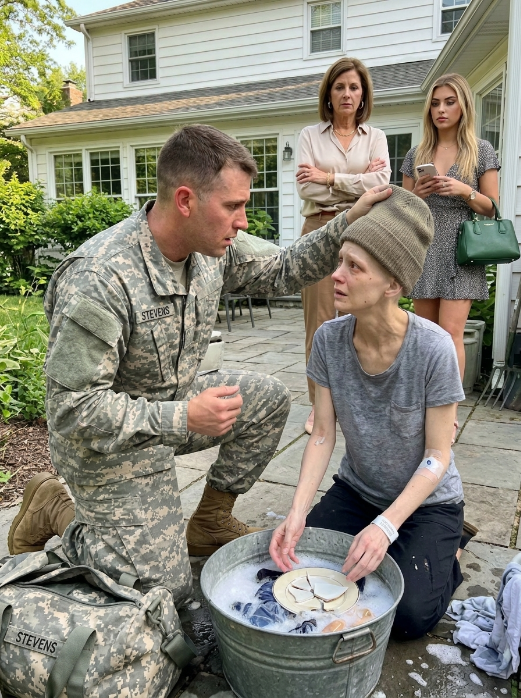
Gwen was kneeling beside an old washbasin.
Her clothes hung from her body.
A knitted cap covered her head.
She was gathering pieces of a broken plate from the dirt.
Then Paige’s voice came from inside.
“That bald woman shouldn’t even show her face when we have guests!”
Gwen froze.
Then she saw me.
Instead of running toward me, she stepped backward and covered her head.
I lifted the cap gently.
Her hair was gone.
Small cuts covered her scalp.
My mother, Margaret, walked outside wearing silk and gold jewelry.
Paige followed carrying an expensive phone and designer bag.
“You don’t need to overreact,” Margaret said. “Gwen ruined her own hair.”
“She’s dramatic,” Paige added. “She wastes your money.”
Then Gwen’s sleeve slipped.
I saw medical tape.
An IV mark.
Something was very wrong.
I wanted answers.
Instead, I smiled.
“I came home with good news.”
Their attention sharpened immediately.
“The Department of Defense approved nearly $400,000 in additional compensation and benefits.”
It was a lie.
A deliberate one.
“I just need financial records showing the properties, investments, and purchases connected to my money.”
Margaret began talking about renovations.
Paige wanted another truck.
Neither asked why Gwen looked sick.
That night, Gwen led me to the damp storage room where she had been sleeping.
There was a narrow bed.
A cracked ceiling.
Boxes pushed against the walls.
“You sleep here?”
“It’s okay.”
“No.”
I sat beside her.
“What happened?”
Her hands trembled as she opened her blouse enough for me to see the biopsy scar.
“I have breast cancer.”
Everything inside me stopped.
“They found the tumor five months ago.”
Five months.
While I was sending money home.
While Margaret assured me everything was fine.
While Paige bought new things.
“Why didn’t you tell me?”
“I tried.”
Gwen had needed $300 to see a specialist.
Margaret refused.
She accused Gwen of pretending to be sick.
She said contacting me would interfere with my deployment.
Paige monitored her phone calls.
Sometimes Mother kept the phone entirely.
The money I sent home was controlled by Margaret.
Gwen’s requests became accusations.
When she became visibly thinner, they told people she was dieting for attention.
Then Gwen told me about her hair.
She had no money.
No one would help.
So she cut it off.
Sold it for $150.
And used that money to reach medical care and begin the biopsy process.
My wife had sold her hair to discover whether she had cancer while almost $100,000 of my money passed through the same household.
I pulled her against me.
She felt frighteningly light.
“I’m here now.”
The next morning, I began gathering records.
Margaret eagerly provided them because she believed they would help me unlock the imaginary $400,000.
By noon, documents covered the table.
Renovation invoices.
Vehicle records.
Furniture.
Electronics.
Personal expenses.
Dates.
Amounts.
Then Gwen silently placed a hospital statement beside my hand.
It was from the same week as one of Paige’s expensive purchases.
Thousands had been available.
Three hundred dollars had not been available for Gwen.
Margaret kept explaining.
“This renovation was necessary.”
“This furniture improved the house.”
“Paige needed reliable transportation.”
Every explanation became another piece of evidence.
Then Mother tapped the paperwork proudly.
“You see? We didn’t waste your money.”
I looked at Gwen.
Then at Margaret.
“I see a lot.”
That evening, I told Gwen:
“You’re not sleeping in that room again.”
The following morning, I carried her bag upstairs.
Margaret confronted me.
“She’s perfectly comfortable downstairs.”
“She’s my wife.”
“I know that.”
“Then act like it.”
The words slipped out before I could stop them.
Margaret stared at me.
For one dangerous moment, I thought she realized the game was over.
Then I added:
“The benefits review may involve our household arrangements. I need everything looking normal.”
Her shoulders relaxed.
Money rescued my cover story again.
Gwen followed me upstairs.
Later, she sat beside the window with sunlight touching her bare head.
Her cap rested on the bed.
For the first time, she did not put it back on.
I spent the afternoon finishing my reconstruction of four years of transfers.
The truth was worse than I expected.
Money I intended for Gwen’s food, household expenses, and security had been redirected into improvements and purchases controlled by Margaret.
Paige benefited repeatedly.
Some funds had gone toward the truck.
Some into electronics and personal spending.
Some into renovations that had nothing to do with necessity.
There were also cash withdrawals that neither woman had explained.
I did not know yet whether every expenditure was legally improper.
That would be for professionals to determine.
But morally, the picture was already complete.
They had lived comfortably on money I sent to support my wife.
And when Gwen became seriously ill, they made her beg.
I made two calls.
One to an attorney.
One to Gwen’s hospital.
The lawyer would review the property ownership, accounts, transfers, and anything signed or changed while I was overseas.
The hospital call mattered more.
Gwen needed treatment.
Not tomorrow.
Not after the family argument.
Now.
Within forty-eight hours, she had an oncology appointment arranged.
When I told her, she stared at me.
“How are we paying?”
I almost broke.
“You never ask that before asking whether you’re going to live.”
Tears filled her eyes.
“I got used to it.”
That sentence stayed with me.