At Breakfast, My Sister Asked for My Credit Card Like It Already Belonged to Her—When I Said No, She Threw Hot Coffee Across My Face
At breakfast, my sister asked for my credit card like it already belonged to her.
That should have been the first warning.
Not the request itself.
Britney had spent years treating other people’s money like an extension cord she could plug into whenever her own lights went out.
The warning was the way she asked.
Flat.
Certain.
As if the answer had already been decided before I entered my parents’ kitchen.
I had come home expecting ten quiet days before reporting back south.
Ten days to sleep past sunrise.
Eat my mother’s food.
Stand barefoot in the kitchen I had known since high school.
And stop measuring my life in inventory sheets, movement orders, serial numbers, and signatures.
I had spent ten years in Army logistics.
Nothing was casual.
Missing equipment became paperwork.
An incorrect signature became a problem.
A rushed favor could become something everyone later pretended they never asked for.
I knew that better than most.
Still, when I arrived at my parents’ house and saw the faded American flag in the porch planter, part of me believed I could simply be their son and Britney’s brother for a few days.
That hope lasted until breakfast.
Britney was already awake.
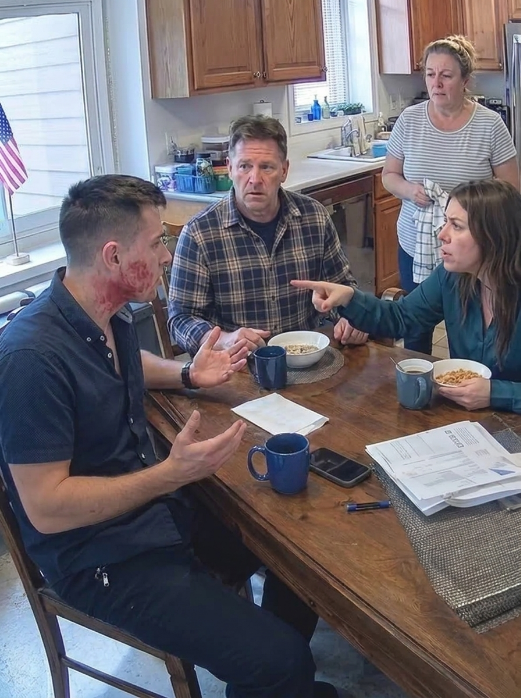
She sat at the old oak table in a hoodie, stirring sugar into her coffee.
The television near the refrigerator was too loud.
Dad ate eggs.
Mom stood beside the stove.
Then Britney said:
“The bank denied my car loan.”
I waited.
She rolled her eyes.
“My credit is only bad because of one stupid thing.”
There had been many stupid things.
I said nothing.
“You’ve got excellent credit,” she continued. “Just let me use your card for a little while. I’ll pay it off.”
“No.”
Britney blinked.
“What do you mean?”
“I mean no. I’m not putting a car on my credit card. I’m not co-signing either.”
Mom exhaled.
“Family helps family.”
Dad looked up.
“You make good Army money.”
“It isn’t about income.”
Britney slapped her spoon against the table.
“It’s temporary.”
“That’s what you said in 2019.”
The kitchen changed.
Everyone remembered.
Four thousand dollars to keep Britney from getting evicted.
Then there had been the store-card problem.
My name somehow became connected to one of her financial disasters.
I spent weeks making sure it never reached my credit file.
I did not embarrass her at Christmas.
I never demanded public gratitude.
I handled it quietly.
Apparently, that taught everyone that I would continue doing it forever.
“That was different,” Britney snapped.
“It’s always different.”
Mom placed breakfast on the table.
“You don’t have to be cold.”
“I’m not being cold.”
I looked at Britney.
“I’m saying no.”
“To your sister.”
“Especially to my sister.”
Britney shoved backward.
The chair screeched across the tile.
Then she grabbed her mug.
Her wrist snapped.
Coffee flew across the table.
It hit my cheek first.
Then my jaw and neck.
Heat spread beneath my collar.
My shirt soaked through.
For several seconds, nobody moved.
Mom’s hand hovered over the napkin holder.
Dad’s fork froze.
The television kept talking about morning traffic.
Britney stood there breathing hard.
No apology.
No shock.
She looked like she believed what she had done was simply another part of the argument.
Mom grabbed a towel.
“Britney!”
But even her tone sounded more irritated than horrified.
Dad muttered:
“Everybody calm down.”
That was the moment I knew exactly how this would go if I stayed.
By dinner, Britney had “lost her temper.”
Tomorrow, it would become an accident.
By next Christmas, I would somehow be equally responsible because I had “provoked her.”
So I took my keys.
No screaming.
No retaliation.
No scene they could later use to make us equally wrong.
At urgent care, the room smelled of antiseptic and bad coffee.
A nurse examined my face and neck.
At 9:18 a.m., my chart read:
Minor thermal burn from hot liquid.
She asked whether I felt safe going home.
For a second, I nearly said yes automatically.
Then:
“I’m going back for my bag.”
In the parking lot, I photographed everything.
My cheek.
My neck.
My shirt.
Then I saved the medical summary.
When I returned home, the kitchen had already been reset.
Floor wiped.
Chair pushed back.
Coffee gone.
Like nothing happened.
Mom met me.
“Britney lost her temper.”
“She threw hot coffee at my face.”
“You know how she gets when she’s stressed.”
I stared at her.
“Do you hear yourself?”
Her mouth tightened.
“Don’t make me the enemy.”
I walked toward the guest room.
Dad appeared at the doorway while I packed.
“We shouldn’t let something small split the family.”
I looked at him.
“Small?”
“You know what I mean.”
“I do.”
That was why I left.
Britney appeared in the hallway.
“So you’re really going to punish everyone over money?”
Still money.
Not the burn.
Not what she had done.
The real offense in her mind remained that I had refused to finance her.
I carried my bag outside.
Mom said:
“Call when you cool off.”
I looked back.
“I am cool.”
Then I drove away.
Before Denver disappeared behind me, I froze my credit with every bureau.
I removed Britney from my phone plan.
Saved messages.
Downloaded paperwork.
Stored photographs.
Documented account alerts.
Not because I wanted revenge.
Because documentation is what survives when memory becomes inconvenient.
For the next several weeks, my family tested whether distance would make me easier to control.
Mom:
Are you eating?
Then:
Britney has been under a lot of stress.
Dad:
Your mother doesn’t sleep when things are tense.
That one almost worked.
Mom’s anxiety had been used as a leash in our family for years.
If she was upset, someone needed to surrender.
Usually me.
This time, I did not.
Then Britney contacted me from another number.
You didn’t have to take me off the plan.
Later:
You made everything worse.
And finally:
I hope your credit score keeps you warm.
I saved every message.
Six weeks after the coffee, I was eating lunch at Fort Carson when my phone lit up at 12:43 p.m.
Mom:
Your sister needs to talk to you right now. It’s serious.
Dad:
Call us. The bank is asking questions.
And suddenly, I understood.
The coffee was no longer what they feared.