The first sign that something was wrong was how quiet the house had become.
Not the normal kind of quiet that settles over a place before dawn, when the coffee pot is still cold and everyone else is asleep. This quiet felt different. It was strained and watchful, as if the walls themselves were waiting for someone to say something they had all been avoiding.
Maya Bennett stood barefoot in the kitchen, one hand wrapped around a mug of coffee that had already gone lukewarm. She was staring at the back door while the early morning light thinned across the floorboards. Outside, the yard was gray with spring fog. The old swing at the edge of the porch moved once in the wind and then stilled.
Behind her, nails clicked against the hardwood.
Ranger.
The retired military dog came into the kitchen slowly, his muzzle more silver than black now, his joints stiff from age and old injuries. He paused beside Daniel’s empty chair, lifted his nose, and looked toward the hallway.
Maya followed his gaze.
“Still not up?” she murmured, though there was no one there to answer.
Daniel usually rose early, even on the bad days. Especially on the bad days. Sleep had never stayed easy with him after he came home from service, and over the years he had developed the habit of surrendering to the morning before the morning could ambush him. He would sit on the porch with Ranger and a cup of coffee, watching the light come in over the pines behind the property. Some days he talked. Most days he didn’t. But he was there.
Today, his bedroom door stood open.
The bed was made.
And Daniel was nowhere in the house.
At first Maya told herself not to overreact. Her younger brother had been restless lately. He might have gone for a walk. He might have driven into town for gas or groceries. He might have headed to the hardware store even though he had no money to spare and no project he was likely to finish.
But Daniel’s boots were gone while his truck remained in the driveway.
His keys were missing.
His phone was not.
It sat on the nightstand beside the bed, screen dark, as if he had simply forgotten it. Daniel never forgot his phone. He did not always answer it, but he carried it like armor.
Maya picked it up and turned it over in her hands. The battery was nearly full. No new messages. No draft note. No explanation.
Her chest tightened.
“Daniel?” she called again, louder this time.
Ranger moved past her, down the hall, then back again, circling in a way that made her pulse kick harder. He stopped at the back door and let out a low sound in his throat. Not a bark. Something thinner. More urgent.
Maya opened the door.
The dog stepped outside, looked left toward the porch steps, then right toward the side yard. He sniffed hard, paced once, then turned and stared directly at her.
The coffee mug slipped from her hand and cracked in the sink.
By nine o’clock she had called Daniel’s closest friend, two neighbors, and the county sheriff’s office.
By noon she had walked the property line twice.
By two o’clock her mother, Linda, had driven in from the next town over, red-eyed and angry in the way frightened people often are when fear has nowhere to go.
“He wouldn’t do this,” Linda said for the fourth time, standing in Daniel’s bedroom with her arms wrapped around herself. “He would not just vanish.”
Maya looked at the neatly folded blanket at the end of the bed. At the framed military photo on the dresser, the one Daniel hated but their father had once loved. At the dog bed in the corner that Ranger no longer used because he preferred the floor beside Daniel’s door.
“He might not have meant to,” Maya said quietly.
Her mother turned to face her. “What is that supposed to mean?”
It meant a hundred things Maya had not known how to say for months.
It meant Daniel had been growing harder to reach.
It meant he had started canceling appointments.
It meant there were nights when she heard him on the porch at three in the morning, breathing like each inhale was work.
It meant she had found unopened mail from the VA on the kitchen table and quietly stacked it by his chair, hoping he would deal with it when he was ready.
It meant that last Tuesday he had stared at the grocery store parking lot for nearly five full minutes before forcing himself out of the truck, and when he came back he had looked exhausted in a way no simple errand should have caused.
It meant Maya had seen the warning signs and still let herself believe that tomorrow would be the day he finally talked.
But she did not say any of that.
“He’s not okay,” she answered instead.
Linda’s face crumpled, though she fought it. She was a woman who had spent years surviving by staying composed. Emotion embarrassed her, especially her own. “Then why didn’t he tell us?”
Maya swallowed.
“Maybe he didn’t know how.”
The first deputy arrived just after three. He was kind enough, middle-aged, practical, with the careful tone of a man who had learned not to promise more than he could deliver.
He took notes in the kitchen while Maya answered questions and Ranger paced circles near the back door.
Age: thirty-eight.
Height: six-one.
Last seen: the previous night around ten-thirty, when Maya heard Daniel moving around in the kitchen.
Medical history: she hesitated, then gave the answer Daniel hated but needed. Anxiety. Depression. Trauma related to combat service. Periods of isolation. Trouble sleeping. Trouble with crowds. Some better months, some worse.
“Any indication he planned to harm himself?” the deputy asked.
Maya’s throat closed.
“I don’t know,” she whispered. “He didn’t say anything. He just… lately he’s been tired in a way that scared me.”
The deputy nodded, wrote that down, and glanced toward Ranger.
“And the dog?”
“Retired military working dog,” Maya said. “They served together.”
The deputy’s expression shifted slightly. He looked at Ranger with new attention.
As if hearing his name in the silence, Ranger came forward, pressed his head hard against Maya’s thigh, then returned to the back door.
“He keeps doing that,” she said. “Like he wants out.”
“Let him out,” the deputy said.
She opened the door again. Ranger moved to the porch, then immediately down the steps. His nose stayed low to the ground. He crossed the side yard, paused near the old split-rail fence, then trotted toward the tree line behind the house.
Maya followed him halfway before the deputy called after her.
“Ma’am, wait.”
She stopped. Ranger looked back, impatient and tense.
The deputy joined her at the edge of the yard. “Dogs grieve too,” he said gently. “He may just be agitated because the routine changed.”
Maya knew he meant well. She also knew Ranger.
This was not routine.
Still, she nodded because she had no proof, only instinct.
By evening a few volunteers had checked the roads, nearby gas stations, and the two places Daniel sometimes fished. No one had seen him. The sheriff’s office entered his information. They told the family to call if anything changed.
But after they left, something did.
Ranger refused dinner.
The dog who had never once ignored food in his entire working life sniffed his bowl and walked away.
Then he went to the back door and began scratching.
Maya let him out.
He trotted to the tree line again.
She called him back.
He returned reluctantly, then repeated the same pattern ten minutes later.
And ten minutes after that.
By nightfall the dog was trembling with frustration.
Linda sat at the kitchen table with her face in her hands. “Maya, please. Sit down. You’ve been moving all day.”
“I can’t sit down.”
“You need to.”
“No, Mom, Daniel needs to come home.”
Linda flinched.
The words hung between them, heavier than either of them intended.
Maya exhaled and crouched beside Ranger, who stood rigid at the back door, ears tilted, body pointed toward the woods.
“What is it?” she whispered, cupping his graying face. “What are you trying to tell me?”
The dog licked her wrist once, then leaned his weight against her.
There was a time, years before, when Ranger had not trusted anyone but Daniel. After they first came home from service, the dog had startled at slammed doors and hated fireworks and slept with one eye open. Daniel, who understood the feeling too well, had built his world around predictability for both of them. Same feeding time. Same walking route. Same command words. Same porch chair at sunrise.
Maya had watched the two of them recover in uneven, imperfect steps. Daniel improved when Ranger did. Ranger settled when Daniel was calm. They had become, in some quiet fundamental way, each other’s proof that survival was still possible.
Now the dog’s whole body seemed fixed on one impossible message.
Find him.
The next morning Maya clipped on Ranger’s leash before sunrise.
Linda met her in the kitchen, still in yesterday’s clothes. “What are you doing?”
“I’m going where he wants to go.”
“With that dog?”
“With Daniel’s dog.”
Linda’s mouth tightened. “The sheriff said—”
“I know what the sheriff said.”
“Maya, this is not a search team.”
“No,” Maya said, fastening her jacket with shaking hands. “It’s the one thing in this house that has not doubted where Daniel is.”
For a second her mother looked like she might argue again. Then her face softened with exhausted defeat.
“I’m coming.”
The air outside was damp and cool. Ranger surged forward the moment they stepped off the porch, pulling harder than Maya expected from an aging dog with scar tissue in one hind leg. He moved with purpose across the yard, straight through the gap in the fence, and into the woods.
The first stretch of trail was familiar enough. Daniel used to walk there with Ranger in the mornings, following a path that curved along the creek bed behind three neighboring properties before opening into a patch of state land. But after a quarter mile, Ranger veered left where Daniel rarely went. Brush snagged at Maya’s jeans. Wet branches tapped Linda’s arms. Twice they nearly lost footing in the mud.
“Slow down,” Linda gasped.
“I’m trying,” Maya said, though the leash was burning against her palm.
Ranger was not wandering. He was tracking.
Every few yards he lowered his nose, made a quick correction, and pushed ahead. When Maya tugged back to catch her breath, he whined sharply and leaned into the harness with surprising force.
They walked almost a mile before Linda had to stop.
“I can’t,” she said, bent over with her hands on her knees. “I can’t keep this pace.”
Maya looked around. The woods had thickened. Pines gave way to tangled undergrowth and old hardwoods. Somewhere nearby water moved over stone. There was no road noise, no houses, no sign anyone had been through this area recently.
Ranger turned in a tight circle, then pulled again.
“Maya,” Linda said more softly, “what if he’s just confused?”
Maya stared at the dog. At the set of his shoulders. At the way his ears twitched toward something distant.
“He’s not confused.”
“How can you know?”
“Because he only looks like that when he’s working.”
Linda went silent.
She had not seen Ranger in the field the way Daniel had, but she had seen enough over the years. The sharpness in him now was not memory. It was function. Old training waking up under newer grief.
They kept going.
At one point Ranger stopped beside a patch of flattened weeds near a shallow embankment. He sniffed intensely, circled, then moved on. Maya crouched and found the faint impression of a boot in the soft dirt.
Her breath caught.
“Mom,” she said.
Linda came beside her. The print was partial, blurred by moisture, but human.
Fresh? Old? Maya could not tell.
Still, it was enough to turn fear into motion.
She called the sheriff’s office from the trailhead when they finally came back out two hours later, soaked and scratched and empty-handed except for the memory of that boot mark and the certainty that Ranger had been onto something.
The sheriff sent two deputies to meet them.
This time, when Maya described the dog’s behavior, they listened more carefully.
One deputy, younger than the first and more openly skeptical, folded his arms. “Even if he’s following Daniel’s scent, it could be from any walk they’ve taken before.”
“Daniel hasn’t been back there in weeks,” Maya said.
“How do you know?”
“Because I live with him.”
The older deputy crouched to examine Ranger, who stood restless and intent, tail low but moving slightly at the tip. “How old is he?”
“Twelve,” Maya said.
“Still able to work?”
“Not officially. But yes.”
The deputy nodded once. “Let’s see where he goes.”
By late afternoon they had a small search moving through the woods behind the Bennett property. Not a dramatic one. No helicopters. No flood of vehicles. Just deputies, volunteers, Maya, and Linda, all following an old dog through terrain people had dismissed as unlikely.
Ranger led them to the flattened weeds.
Then farther.
Past the creek bend.
Up a narrow rise choked with brush.
And finally toward a section of abandoned logging road that disappeared into denser woods on the far side of state land.
“This place isn’t on the usual walking route,” one volunteer said.
Maya thought of Daniel, who had once told her that sometimes he liked rougher trails because they required more concentration. Less room for memories. Less room for his mind to turn on itself.
The logging road ended at a rusted gate, half-fallen and wrapped with vines. Beyond it stood the remains of an old fire lookout station, unused for years. The tower itself had been dismantled, but a small maintenance shed still sat nearby, tilted and weathered, its roof sagging on one side.
“No one would come out here,” Linda whispered.
Ranger went wild.
Not barking. Not exactly. He made a broken sound from deep in his chest and lunged so hard that Maya nearly lost the leash.
One of the deputies moved first, pushing through the brush toward the shed.
“Daniel!” Maya shouted before she could stop herself. “Daniel!”
No answer.
The deputy yanked at the shed door. It stuck.
Then from inside came the faintest sound.
A scrape.
All motion changed at once.
The second deputy stepped forward to help, and together they forced the swollen door open with a groan of old wood.
The smell that drifted out was damp earth, rust, stale air, and something human—sweat, exhaustion, fear.
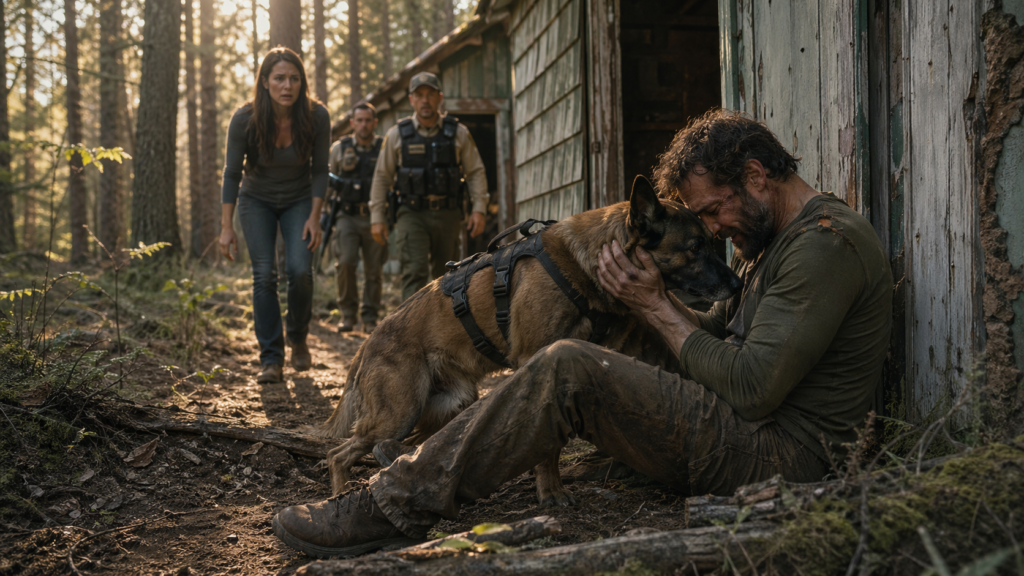
Daniel was inside.
He was sitting on the dirt floor against the back wall, knees drawn up, one arm hanging loose over them. His face was pale beneath a heavy beard Maya had been trying to convince him to trim for weeks. There was dried mud on his jeans and blood on one sleeve where he had apparently scraped himself. A backpack lay beside him, half open. An empty water bottle had rolled near the door.
For one terrible second he did not seem to recognize them.
His eyes were open but far away.
Ranger tore free of Maya’s grip and went to him with a sound Maya would remember for the rest of her life.
Not a bark.
Not a cry.
Something older and deeper, as if relief itself had found a voice.
Daniel flinched at first, instinctively, then looked down.
“Ranger,” he said, and the word cracked apart in his throat.
The dog climbed over his legs, pressing in close, licking at his face, nudging under his hand until Daniel finally lifted it and buried his fingers in the thick fur around Ranger’s neck.
Maya sank to her knees just outside the doorway because her body had stopped holding her up.
“Oh, thank God,” Linda sobbed behind her.
The deputies approached carefully, voices low.
“Daniel, can you tell me if you’re hurt?”
He blinked, slow and dazed. “No.”
“Have you been here all night?”
A long pause.
“I think so.”
One deputy crouched. “Can you stand?”
Daniel looked from the deputy to Maya, then to his mother, then back to Ranger. Shame moved over his face with awful clarity.
“I didn’t mean to…” He swallowed hard. “I just needed the noise to stop.”
Maya’s eyes filled.
She had heard many explanations in her life. Some clean, some painful, some defensive. Nothing had broken her heart quite like that sentence.
Because she knew what he meant.
Not voices. Not sounds around him.
The noise inside.
The pressure. The memories. The relentless weight of being expected to continue functioning when every day already felt like an act of endurance.
He had not come here to make them suffer.
He had come because he could not figure out how to keep carrying himself.
When they tried to help him stand, his legs buckled. He had not eaten much, and he was badly dehydrated. An EMT crew was called in. Daniel did not protest, but he barely spoke.
He only kept one hand on Ranger the entire time.
At the hospital, the fluorescent lights made him look even more worn down. Maya sat beside his bed while Linda handled paperwork with hands that would not stop shaking. Ranger, after firm but compassionate negotiation with staff and one very understanding nurse supervisor, was allowed to wait just outside the room for part of the evening because Daniel’s agitation rose sharply whenever the dog was moved too far away.
A doctor came in. Then a mental health crisis counselor. Then another nurse.
Questions.
Soft voices.
Choices explained gently and clearly.
Daniel answered when he could.
Sometimes he stared at the blanket instead.
Sometimes he looked at Maya with an apology in his eyes so deep it almost undid her.
When they were finally alone for a few minutes, she sat on the edge of the chair and said the thing she had needed him to understand.
“You do not have to apologize for being found.”
He closed his eyes.
A tear slipped sideways into his hair.
“I scared you.”
“Yes,” Maya said honestly.
He nodded once. “I didn’t want to.”
“I know.”
He breathed in shakily. “I thought if I walked long enough maybe I’d feel less trapped.”
“And did you?”
His mouth trembled with a humorless near-laugh. “No.”
She reached for his hand.
“Then we try something else.”
He looked at her then, really looked, like a man who had expected anger and did not know what to do with mercy.
Over the next several days, facts came together in fragments.
Daniel had left the house in the early morning before sunrise. He had not taken his phone because he did not want to be called back before he figured himself out. He had walked farther than he intended, then farther still, following old service habits: movement, distance, isolation. At some point he ended up near the abandoned lookout station, a place he had stumbled upon years earlier during a hunting trip and remembered because no one ever came there. He sat down to rest. Hours passed. The temperature dropped overnight. His thoughts spiraled. By the time he realized how weak he felt, getting back had stopped seeming simple.
He was not intoxicated.
He was not hiding from his family.
He was a man in acute emotional crisis who had gone silent in the most dangerous possible way: gradually, politely, almost invisibly.
And he would likely not have been found so soon if Ranger had not refused to accept the version of events that others found easier to believe.
The story spread quietly at first.
Among neighbors.
Among sheriff’s deputies.
At the diner in town.
The old military dog who led searchers to the missing veteran. The kind of story people repeated with tears in their eyes and hands over their hearts.
But Maya hated how neat strangers made it sound.
They wanted loyalty, miracle, reunion.
Those things were true, yes.
But the truth was also messier.
Daniel came home from the hospital tired, embarrassed, and fragile. He agreed to outpatient treatment and safety planning and follow-up care, but agreeing was not the same as feeling hopeful. Some mornings he still sat on the porch in the same chair, staring at the tree line with a face that gave little away.
Ranger never left his side.
If Daniel stood up, Ranger rose too.
If Daniel went to the bathroom in the middle of the night, Ranger followed.
If a nightmare woke him, the dog was already there, head under his shaking hand.
One afternoon a week after Daniel returned, Maya found him in the garage sorting through an old plastic storage bin. Medals. Service patches. Folded letters. A photo of him and his unit. Another of him kneeling beside a much younger Ranger in harness and goggles, both of them lean and alert and impossibly alive with the intensity of a world they had survived without ever really leaving.
“You okay?” she asked.
Daniel held the photo for a long moment.
“No,” he said. Then after a pause: “But I’m here.”
It was not a perfect answer.
It was the first honest one.
Maya leaned against the doorframe. “That counts.”
He looked down at the picture. “You know what the worst part is?”
She waited.
“Everybody thinks the hard part is coming home.” His thumb moved across the edge of the photo. “But for some of us, the hard part is staying.”
She felt that in her chest.
He went on, voice rough. “Over there, everything was simple in the worst possible way. Bad things happened, but the mission was clear. The role was clear. Ranger knew what to do. I knew what to do. Then you get back here and people tell you this is the good part now. You’re safe now. Just build a life. Just move on. Like it’s a switch. Like your body didn’t learn years of alarms it can’t shut off.”
He finally looked up at her.
“I got tired of failing at normal.”
Maya crossed the room and sat on an overturned bucket beside him.
“You were never failing at normal,” she said. “You were surviving something most people can’t see.”
He looked unconvinced.
That was the problem with invisible wounds. They often made their owners distrust their own pain.
The counselor Daniel began seeing twice a week, a woman named Dr. Helena Pierce, did not offer easy slogans. Maya appreciated that immediately. Daniel did too, though he would never have admitted it that first week.
Dr. Pierce spoke to him like a whole person, not a cautionary headline or a fragile symbol. She asked careful questions. She taught him to identify the early signs of spiraling before the thoughts turned into motion. She helped him and Maya build routines around the most dangerous hours of the day. She included Ranger in conversations when it made sense because, as she gently pointed out, bonds of safety are still safety.
“This dog is not a cure,” she told Daniel during one session Maya attended. “But he is part of your nervous system’s map back to trust. That matters.”
Daniel glanced at Ranger, who lay across his boots in the office as if guarding them both.
“He always did his job,” Daniel said softly.
Dr. Pierce tilted her head. “Maybe he still is.”
The town’s local paper called two weeks later asking if the family would speak. Maya almost said no immediately. Daniel hated attention. He did not need strangers turning his worst moment into public inspiration.
But then the editor explained that they wanted to focus on veteran mental health resources and the importance of taking behavioral changes seriously, especially when someone insists they are “fine.”
Daniel listened from the porch as Maya relayed the request.
When she finished, he remained quiet a long time.
Finally he said, “Only if it helps someone before they disappear.”
So they did the interview together.
No dramatic photos.
No staged reunion shots.
Just Daniel in a denim shirt on the porch with Ranger at his feet, Maya beside him, both of them speaking more honestly than either expected.
Daniel told the reporter that crisis does not always look loud.
Sometimes it looks like canceled plans, ignored messages, too much sleep or too little, unopened mail, loss of appetite, long silences, and a person insisting they are merely tired.
Sometimes it looks like being praised for holding yourself together while privately running out of ways to do so.
Maya spoke about families too.
About how love can become clumsy under stress.
About how saying “Tell me what you need” is not the same as building safe, specific ways for someone to answer.
About how often relatives mistake withdrawal for stubbornness because fear is easier to translate into frustration.
Linda, to Maya’s surprise, asked to add something of her own.
“I thought if I stayed strong enough,” she told the reporter, hands folded tightly in her lap, “my son would follow my example and keep going. I did not understand that what he needed was not my strength. He needed my softness.”
After the article ran, letters started appearing in the mailbox.
A wife whose husband had changed after deployment and refused help.
A father who still did not know how to speak to his adult daughter after she came home from service.
A veteran who wrote only one sentence: I saw myself in the part where he said he got tired of failing at normal.
Daniel read them slowly, sometimes one a day. He did not always know how to respond. But he kept them in a shoebox by the couch.
Ranger slept beneath it.
Summer came in with heat and cicadas and a greener kind of hope than the family had dared to trust in spring. Daniel’s progress was not linear. There were setbacks. A panic episode in the grocery store. A missed appointment he later rescheduled. One bad night after fireworks he had forgotten were planned at the fairgrounds twenty miles away.
But there were good moments too.
He started walking Ranger again in the early mornings, first just to the end of the driveway, then around the property, then halfway into the woods before turning back.
He repaired the broken porch rail he had been ignoring for two years.
He began helping at a local veteran outreach center one afternoon a week, mostly with quiet tasks: carrying supplies, setting up chairs, fixing shelves. Being useful without being overwhelmed. It suited him.
One afternoon Maya stopped by the center to pick him up and found him kneeling beside a younger former Marine named Eli, both of them trying to convince an anxious shelter dog to take a treat.
Daniel glanced up at her with a look she had not seen in months.
Not joy exactly.
But presence.
His shoulders were lower. His face was open. For that moment, he was somewhere in his life instead of only enduring it.
On the drive home she said carefully, “You looked good in there.”
He stared out the window. “Don’t ruin it.”
She laughed, surprised into it.
A tiny smile touched his mouth.
At home, Linda had started visiting once a week with casseroles no one needed and practical excuses no one believed. She had changed in subtle ways since the search. Softer entrances. Fewer forced reassurances. More listening.
One evening she found Daniel and Maya on the porch while Ranger snored between them.
She stood there for a moment, hands clasped around a pie dish.
“I owe you both something,” she said.
Daniel looked wary.
Linda swallowed. “When your father came back from the first Gulf deployment, he was not the same. I knew that. But in those days people did not talk about it the way they do now. At least not where we were. He shut down, and I told myself it was stress and pride and time would fix it. Then when you came home carrying some of the same shadows, I repeated the same mistake. I thought if I named it, it would make it more real.”
Daniel said nothing.
Tears filled Linda’s eyes. “I am sorry I made silence our family language.”
The porch went still.
Maya glanced at her brother, afraid the moment might close him off.
Instead Daniel looked down at Ranger and rubbed the dog’s shoulder once.
“Me too,” he said.
It was not a sweeping reconciliation. Not a speech. Not a tidy movie moment.
It was better.
It was true.
That fall, the county veterans’ council announced they wanted to honor Ranger at a small community event. Daniel tried to refuse. Maya overruled him. Linda backed her up. Even Dr. Pierce, when Daniel complained during a session, had the audacity to smile and say, “You don’t have to enjoy being appreciated for it to be good for you.”
So he went.
The event was held in the park pavilion on a cool Saturday morning with folding chairs, weak coffee, and the sort of homemade sheet cake every small town seems to produce on important days. There were flags on the stage, a microphone with terrible feedback, and more people than Daniel expected.
The sheriff spoke first, thanking volunteers and quietly acknowledging that the search had ended the way families pray for. Then he called Ranger “a retired working dog who never forgot his partner.” The crowd applauded while Ranger, wearing a new red service vest Maya had ordered online, blinked in dignified confusion.
When Daniel’s name was called, he froze.
Maya touched his elbow. “You can just stand there,” she whispered. “You don’t have to say anything.”
But when he reached the front and accepted the plaque meant for Ranger, he looked at the crowd for a long moment. Families. Veterans. Teenagers. Deputies. People from town. Strangers too.
Then he cleared his throat.
“I’m not good at speeches,” he said, to a few warm chuckles.
He looked down at Ranger.
“This dog saved my life more than once. Some of those times happened overseas. Some of them happened right here.” His voice tightened, but he kept going. “People like to tell stories like this as if loyalty is magic. It isn’t. It’s presence. It’s staying. It’s refusing to turn away when somebody is not at their best.”
The pavilion fell completely silent.
Daniel lifted his gaze again.
“If someone you love is withdrawing, don’t assume they just want space. Sometimes they do. But sometimes they need help and don’t know how to ask without feeling like a burden. I’m here because my family kept looking, and because this old dog wouldn’t let them stop.”
Maya pressed her lips together hard, fighting tears.
Daniel’s hand shook once on the plaque.
“And if you’re the one struggling,” he said more quietly, “please don’t wait until disappearing feels easier than speaking. Say something before the dark starts sounding reasonable.”
No one clapped right away.
Not because they were unmoved.
Because the truth had landed too honestly.
Then the sound rose all at once, filling the pavilion with something deeper than celebration.
Respect.
Afterward, a line formed.
A teenager approached Daniel first to say her father had been home for three years and still paced at night.
An older man in a Navy cap said only, “Thank you for saying it plain.”
A woman hugged Maya and whispered that her brother had vanished two winters earlier and never been found, and she was glad their story ended differently.
Through it all Ranger sat beside Daniel’s leg, accepting gentle pets like a seasoned public servant.
On the drive home, Daniel was quiet in the passenger seat, the plaque laid across his lap, Ranger sprawled in the back.
Maya glanced over. “You okay?”
He stared out at the passing trees. “Tired.”
“The bad kind?”
He thought about it.
“No,” he said finally. “The honest kind.”
That winter, snow came early.
It dusted the porch rail Daniel had fixed, covered the driveway, and softened the woods behind the house into a white hush. On the first heavy snowfall of the season, Maya looked out the kitchen window and saw Daniel standing near the tree line with Ranger beside him.
She watched them for a minute before pulling on boots and stepping outside.
Daniel turned when he heard her.
His cheeks were pink from the cold. Ranger’s muzzle was white with melted snow.
“You okay?” Maya asked.
Daniel nodded toward the woods. “I was thinking about that day.”
She came to stand beside him.
From here, the trees looked almost innocent. It was hard to believe how much terror had hidden among them that spring.
“I still don’t know why he found that exact path,” Daniel said, looking down at Ranger.
Maya smiled faintly. “Because he’s smarter than all of us?”
Daniel’s mouth twitched.
Then he grew serious again. “No. I mean it. I went far enough that nobody should have guessed.”
Maya considered this.
“I think he knew you weren’t leaving,” she said. “Not really. I think some part of him understood you were lost, not gone.”
Daniel looked at her, eyes bright in the cold.
“That’s a big distinction.”
“Life-changing one.”
For a moment none of them moved.
Then Daniel crouched with effort and took Ranger’s old face in both hands.
“Still searching for me, huh?” he murmured.
Ranger leaned into him with total certainty.
The dog had grown slower in recent months. Stairs took more time. Long walks had shortened again. There were more naps in warm patches of sun, more careful rising, more soft groans at day’s end.
But his eyes remained fixed and faithful.
Watchful.
Present.
The kind of presence that asks for nothing but truth.
By the next spring, nearly a year after Daniel disappeared into the woods, the Bennett house no longer felt like a place waiting for disaster. It felt lived in again.
Not perfect. Not healed in the shiny, completed way people like to imagine healing.
But inhabited.
There were calendars on the fridge with appointments actually kept. Ranger’s medications lined up neatly beside Daniel’s coffee supplies. Maya had stopped listening at three in the morning for movement on the porch because when Daniel could not sleep now, he usually said so.
Sometimes he even knocked on her door and asked, “You up?”
She always was after that.
One Saturday morning, the two of them drove Ranger to the lake for a slow walk along the accessible path near the water. Daniel carried a folding stool so he could sit when the dog needed rest. Families passed with strollers and fishing poles. Wind rippled across the lake surface in bright silver folds.
At one point Ranger stopped and lowered himself in a patch of sun. Daniel sat beside him on the stool, hand resting on the dog’s back.
Maya watched them from a few feet away.
“Do you ever think,” Daniel said after a while, “that he stayed alive long enough just to drag me back?”
Maya smiled through the sting in her eyes. “Probably. He seems like the stubborn type.”
“He learned from me.”
“No,” she said. “I think you learned from him.”
Daniel looked down at Ranger.
The old dog’s eyes were half closed, peaceful.
“I used to think strength meant handling it alone,” Daniel said.
“And now?”
He exhaled slowly. “Now I think strength might be letting yourself be found.”
Maya turned that sentence over in her heart.
It felt like the truest thing he had ever said.
A few weeks later, Daniel framed the photo of himself and Ranger from their working days. But instead of putting it beside the military memorabilia, he hung it in the hallway near the kitchen, where people passed it every day.
Below it he placed a newer photo Maya had taken on her phone after the community event: Daniel older, thinner, softer around the eyes, one hand on Ranger’s shoulder, both of them facing the camera with the calm expression of survivors who no longer need to prove they survived.
Two versions of the same bond.
Two kinds of rescue.
Visitors noticed the pictures and usually commented on how handsome Ranger had been in service.
Daniel would nod.
Then sometimes, if he was feeling brave, he would say, “Yeah. But his best work came later.”
And every person who heard it understood, whether they knew the full story or not.
Because there are rescues that happen in chaos, fast and visible and dramatic.
And then there are rescues that happen in silence.
A family paying attention.
A sister trusting what an old dog is trying to say.
A mother learning softness too late to avoid pain but not too late to change.
A man admitting he is not okay before the dark closes fully around him.
A retired K9, stiff with age and memory, refusing food, refusing rest, refusing every comforting lie until someone follows.
People would probably keep telling the story for years as the one about the missing veteran found because his old military dog never stopped searching.
That was true.
But for Maya, the real story was slightly different.
Daniel had not been found in a single afternoon at an abandoned shed deep in the woods.
He had been found again and again afterward.
At the hospital, when he expected shame and was met with care.
At the kitchen table, when silence finally gave way to truth.
At the outreach center, where usefulness opened a small door back into purpose.
At the park pavilion, where his pain became language that might help someone else stay.
And at home, every ordinary day since, with Ranger somewhere nearby, watching the doors, listening for footsteps, ready as ever to lead the people he loved back toward each other.