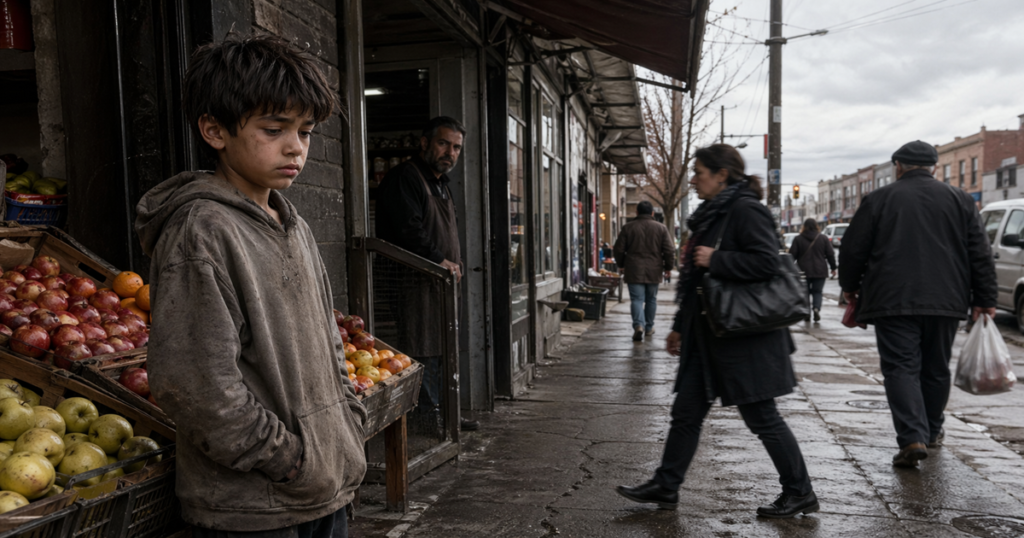
The first time Mara Bennett noticed the boy, he was standing outside Vale Street Market pretending not to stare at the oranges.
He had mastered the art of looking away while watching something with all the hunger in his body. His chin tilted toward the sky as if he were interested in the peeling church poster across the street, but his eyes flicked again and again toward the produce display arranged in bright pyramids by the entrance. He stood so still that at first Mara thought he was waiting for someone.
Then she saw his hands.
Children who are waiting usually fidget. They scratch their knees, kick the curb, swing their arms. This boy held his hands tightly together near his stomach, fingers woven hard enough to whiten the knuckles. It was the posture of someone holding himself back.
Mara had been coming to Vale Street Market for six years, ever since she took over her late sister’s apartment on Wexler Avenue. She came every Thursday after work for onions, bread, coffee, and whatever fruit was cheapest that week. She knew the cashiers, the delivery drivers, the old men who complained about tomato prices, and the owner, Samir Haddad, who wore pressed shirts with rolled sleeves and treated bruised peaches like personal insults.
She had also heard about the boy.
Everybody had.
“That little one in the gray hoodie?” the florist next door had said one rainy afternoon. “Quick hands. Don’t let the face fool you.”
“A troublemaker,” another woman had added while choosing avocados. “Too young to be doing what he’s doing. Which means he’s been taught.”
Mara didn’t like the way people spoke about children as if they came into the world already finished.
Still, she had listened.
It was hard not to when the stories repeated themselves from one part of the neighborhood to another. A missing banana. A loaf gone from the bakery shelf. A handful of cough drops taken from a pharmacy counter while the clerk was busy with a customer. Nothing large. Nothing dramatic. Just enough to build a reputation.
The boy shifted his weight.
Samir came out of the market carrying a crate of cucumbers and followed Mara’s line of sight.
“Him again,” he muttered.
“You know his name?” Mara asked.
Samir snorted. “I know he’s got sticky fingers.”
“That’s not what I asked.”
Samir balanced the crate against his hip. “Eli. Or Elijah. Something like that. Lives over in Ash Building, I think. Third floor? Maybe fourth. Who knows. He pops up, things disappear, then he vanishes.”
Mara watched the boy glance toward the automatic door each time a customer entered or left.
“Has anyone talked to him?” she asked.
Samir laughed without humor. “Talked to him? I’ve chased him twice. That counts.”
“That isn’t talking.”
Samir set the crate down. “Mara, I run a business. I don’t have time to play detective with every kid who decides the rules don’t apply to him.”
Before she could answer, the doors slid open and an elderly woman pushing a cart came out too slowly. A young father with a toddler followed impatiently behind her, fumbling for his phone. In that moment of clutter and movement, the boy moved.
It happened in a blink.
One step in.
A hand out.
Two apples gone.
Then he was already running.
“Hey!” Samir shouted.
The father jerked around. The elderly woman gasped. Samir lunged forward, but by the time he reached the sidewalk the boy was halfway across the street, hood flapping, narrow legs pumping, one apple tucked under each arm.
“Thief!” someone yelled from inside the store.
The word cut through the air sharper than the traffic.
People turned. Heads lifted. A teenage cashier came to the door and pointed. Two boys outside the laundromat laughed.
Mara expected the child to look back, maybe with guilt, maybe fear. Instead he kept his face forward and ran as if something behind him were worse than the people shouting.
He disappeared between the alley beside the closed tailor shop and the pharmacy parking lot.
Samir cursed under his breath.
Mara stood very still with her reusable shopping bag hanging from one hand. The whole scene had lasted perhaps six seconds. Yet something about it disturbed her in a way she could not immediately explain.
Not the theft. The urgency.
Not once had the boy looked excited, sneaky, or triumphant.
He had looked desperate.
That evening, as rain tapped against her kitchen window, Mara found herself thinking about his shoes.
One sole had peeled away at the front like a loose tongue.
No child wearing shoes like that should have been invisible to an entire neighborhood.
The next Thursday, Mara saw him again.
This time he was near Bell’s Pharmacy, close enough to the front window to study the rotating stand of discount items: toothpaste, tissues, pain relievers, children’s cough syrup. He was pretending to read a faded bus schedule taped to the pole, but his attention kept slipping to the medicine display.
Mara had just parked two buildings down and was walking toward the pharmacy when Mrs. Bell pushed open the glass door holding a box of receipts.
The pharmacist was in her sixties and wore her silver hair pinned in a tight twist that never moved, even in wind. She had the sort of face that seemed stern until she smiled, which she did often with adults and almost never with children.
She saw Eli and narrowed her eyes.
“You,” she said.
The boy stepped back.
“Come here.”
He didn’t.
Mrs. Bell set the receipt box on a nearby chair and pointed with two fingers. “I said come here.”
Mara slowed without meaning to.
“I didn’t do anything,” the boy said. His voice was softer than she expected, hoarse in a way that made him sound like he had recently been sick.
Mrs. Bell folded her arms. “Then you won’t mind emptying your pockets.”
A couple leaving the café next door paused to watch.
The boy’s throat moved. “I didn’t take anything.”
“Then empty them.”
His hands drifted to the front of his hoodie but stopped. He looked from Mrs. Bell to the small gathering eyes around him. Shame moved across his face like a shadow.
Mara felt a tightening in her chest.
“This is unnecessary,” she said, stepping forward.
Mrs. Bell looked at her. “Excuse me?”
“You haven’t seen him take anything.”
“I’ve had things go missing three times this month.”
“That still isn’t proof.”
Mrs. Bell drew herself taller. “This is my business, Mara.”
“And he’s a child.”
“He’s old enough to steal.”
The boy flinched at the word.
Mara turned to him. “Did you take anything?”
His eyes met hers for one brief second. They were not defiant. They were frightened, exhausted, and carrying a kind of loneliness she recognized from hospital waiting rooms and family funerals.
Then he looked away.
“No,” he whispered.
Mrs. Bell made a small noise of disbelief. “Empty your pockets.”
The boy reached into one pocket slowly and pulled out a crumpled tissue, a rusted key, and two loose crackers wrapped in a napkin. From the other pocket he brought a flattened juice box and a pencil sharpened down to almost nothing.
“That all?” Mrs. Bell asked.
He nodded.
She stared at him a moment longer, lips thin with suspicion. “Then stay away from my window.”
He gathered his things and shoved them back into his pockets so fast the pencil nearly fell.
Mara wanted to say something kind, but before she could, he turned and walked away with the particular stiffness of a child trying not to run from humiliation.
Mrs. Bell picked up the receipt box. “It’s always the same. People make excuses, then wonder why the behavior gets worse.”
“Maybe because nobody’s asking why,” Mara said.
Mrs. Bell gave her a weary look. “You schoolteachers think every bad choice is a cry for help.”
Mara almost corrected her. She was not a teacher anymore. She had left the classroom three years ago to work as a reading specialist at the county library, where the budget was smaller and the heartbreak quieter. But there was no point.
She watched Eli disappear around the corner.
That night, she dreamed of her sister.
Nina had been seventeen the first time she stole food. A ham sandwich from a gas station cooler. Their mother was asleep in the car outside with a bottle tucked between the seats, and Mara, then nine, had been too hungry to ask questions. Nina had come back with the sandwich hidden under her jacket and split it into tiny careful halves as if she were serving a feast.
Years later, after jobs and marriages and the slow scattering of family, Mara had once asked her sister if she was ashamed.
Nina had shrugged and said, “I was more ashamed that you were hungry.”
Mara woke before dawn with that sentence in her ears.
By Saturday, the neighborhood had another story.
A woman at the bus stop said Eli had been caught taking coins from the donation jar at St. Matthew’s Church.
A barber said he saw the boy reach into a delivery van when the driver’s back was turned.
The woman in apartment 2C said her grandson’s lunch disappeared from the school cubby, and who else could it have been?
Rumor in a place like theirs moved faster than truth because rumor asked less of people. It didn’t require patience or mercy or context. It only required a villain.
On Monday afternoon, Mara saw Eli behind the library.
It was nearly closing time. She had just carried a box of damaged books out to the recycling bin when she noticed movement near the narrow strip of overgrown hedges behind the building. Eli was kneeling in the dirt with his backpack open.
At first she thought he was hiding.
Then she saw him take out half a sandwich wrapped in wax paper, one apple with a bruise on its side, and a small plastic bottle of water. He tucked them carefully under the hedge behind a loose brick in the wall.
Not stealing.
Storing.
Mara stayed where she was.
He closed the backpack, stood, and froze when he noticed her.
For one suspended moment neither of them moved.
Then he grabbed the backpack straps and took a step backward.
“It’s okay,” Mara said quietly.
His eyes darted toward the alley. Escape route.
“I’m not going to chase you.”
He said nothing.
She nodded toward the hedge. “Is that for later?”
Silence.
“Or for someone else?”
His face changed almost imperceptibly, and that was answer enough.
Mara set the book box down. “Eli?”
He tightened his hold on the straps. “How do you know my name?”
“People talk.”
He looked ashamed again, but this time anger mixed with it. “They always do.”
Mara took that in and wished she could deny it.
“I’m Mara,” she said. “I work here.”
He glanced at the library badge clipped to her sweater.
“You can read there for free,” she added, because she didn’t know what else might make the place feel less threatening.
“I know.”
“You’ve been inside?”
He nodded once.
“What do you like?”
For the first time, confusion displaced fear on his face. It was as though the question itself was suspicious.
“Books,” he said finally.
A small laugh escaped her before she could stop it. “I suppose that was obvious.”
He didn’t smile.
She looked again at the hidden food. “Is someone hungry?”
He shook his head too fast. “I have to go.”
“Eli—”
But he was already backing away, then turning, then running down the alley behind the library, shoulders hunched as if he expected to be called back and condemned.
Mara waited until he was gone.
Then she crouched near the hedge and looked at the food without touching it. The sandwich was plain white bread and cheese. The apple, likely one of Samir’s. The water bottle had a hotel label from the free basket at the clinic reception desk.
Each item was ordinary.
Together they felt like evidence of a life nobody had bothered to see.
The next day she took the longer route home and walked past Ash Building.
It stood at the end of a side street most people avoided unless they lived there. The brick exterior had once been red but had weathered into a tired brown-gray. Three windows were boarded. The buzzer panel by the entrance hung loose, one corner snapped. There was graffiti on the side wall and weeds growing up through the cracked front steps.
Children still lived there. Mara could tell by the chalk marks on the pavement and a pink bicycle missing both training wheels and a seat cover. Poverty always carried these strange mixtures of neglect and stubborn ordinary life.
She stood across the street pretending to check her phone.
On the third floor, one window had a torn blue curtain clipped shut with clothespins. After a minute, the curtain shifted.
A small face appeared.
Not Eli.
A younger child. A girl, maybe six or seven, with enormous dark eyes and tangled hair. She looked out cautiously, then disappeared.
A minute later Eli emerged from the building carrying two plastic grocery bags. He walked with purpose, not the restless drifting of a child set loose after school. There was work in his posture.
He headed toward the corner laundromat.
Mara followed at a distance.
Inside, he hoisted one of the bags onto a folding table and took out clothes: tiny socks, a woman’s faded cardigan, towels, a pair of jeans too small for any adult man. He sorted them with practiced speed. When he realized he had no detergent, he stood still for a long time beside the vending machine.
One of the laundromat attendants, a broad woman named Denise with bright red nails and a permanent expression of mild impatience, saw him.
“You short again?” she asked.
Eli said nothing.
Denise sighed, reached under the counter, and tossed him a single detergent pod. “One load.”
He caught it.
“Don’t think I’m doing this every week,” she said.
He nodded.
As Mara watched from the back corner beside the dryers, she understood something that made her feel suddenly cold.
Children did not wash women’s cardigans and tiny socks because they were pretending to be grown. They did it because nobody else was there.
That evening she called the school district office.
She still had friends in administration. It took only two transfers and one favor from an old colleague to confirm that Eli Mercer was enrolled at Roosevelt Elementary in fifth grade and that his listed emergency contact numbers had been disconnected for months. Attendance was irregular. Notes had gone unanswered. One home visit request had been filed, but the district social worker covering that zone had been out on medical leave and the caseload was backed up.
“What about the family?” Mara asked.
The secretary lowered her voice. “Mother listed as Lena Mercer. No father on current forms. There was an aunt once, but that address got returned. Why?”
Mara looked out her window into the dark courtyard of her apartment building. “I think something’s wrong.”
The secretary was quiet for a moment. “With that child?”
“With all of it.”
On Wednesday, the terrible truth began to come into view.
It was just after noon at Vale Street Market, the busiest hour of the day. Mara had come during lunch because she was out of coffee filters. The store was crowded, carts knocking lightly into one another, babies fussing, the overhead radio playing old pop songs too softly to hide the sound of people complaining about prices.
Samir was at register two. Mara was halfway down the canned goods aisle when a shout rose near the entrance.
“He’s got my wallet!”
Heads turned.
A man in a dark suit shoved past the display of bottled tea and pointed toward the door. Eli, pale and wild-eyed, was trying to squeeze through the crowded opening.
“Stop him!”
The shout electrified the room. Samir lunged from behind the register. The suited man grabbed at Eli’s backpack. The bag twisted. Eli stumbled. A woman screamed as a rack of chips tipped sideways.
Then everything happened at once.
Samir caught the boy by the arm.
The suited man seized the backpack.
Eli fought with a strength born entirely of panic.
“Let go!” he cried. “Please!”
The backpack split open.
Its contents hit the floor.
Not a wallet.
Not stolen electronics.
Not cash.
A bottle of children’s fever medicine.
A package of saltines.
A can of condensed soup.
A half loaf of bread.
Bandages.
A thermometer still in torn packaging.
And beneath it all, a folded note written in large shaky letters on lined paper.
Mara moved before she thought.
Samir was still holding Eli’s arm. The boy’s face had gone white. He was breathing in short, ragged bursts, looking not at the people around him but at the medicine rolling away across the tile.
“Please,” he said again, and there was nothing criminal in it. Only terror. “Please give it back.”
The suited man looked down, confused and embarrassed. “My wallet’s gone.”
A cashier found it under a stack of sale flyers by the entry basket.
The whole store went silent.
Samir slowly released Eli’s arm.
The boy dropped to his knees and snatched up the medicine, then the bread, then the thermometer. His hands were shaking so badly he could barely grip them. When he reached for the note, Mara got there first.
She looked down.
It was written in pencil.
Maddy hot. Wake hard. Medicine before 1. Soup if she cries. Don’t tell anybody. They take us away.
The handwriting was a child’s, but the burden inside it was not.
Mara’s throat tightened so hard she couldn’t speak.
She held the paper out to Eli. He stared at it, then at her, his whole small body braced as if for the final blow.
“Who is Maddy?” Mara asked softly.
His eyes filled instantly.
He snatched the note and stood up too fast. “I have to go.”
“Eli—”
He backed away. “I have to go now.”
Mara understood before anyone else did.
Not later.
Not after explaining.
Not after being forgiven.
Now.
Because someone was waiting.
Sick.
Alone.
She turned to Samir. “Call an ambulance.”
He blinked. “For who?”
“Not here. At Ash Building. I think there’s a child up there.”
Eli’s face changed from panic to horror.
“No!” he shouted, louder than she had yet heard him speak. “No, no, no, please, they’ll take her, they’ll take her—”
He bolted.
Mara ran after him.
She had not run like that in years, not since before the arthritis in her left knee started complaining during rainstorms, but adrenaline made quick work of age and common sense. She burst onto the sidewalk just in time to see Eli dart between parked cars and cut through the alley by the tailor shop.
“Mara!” Samir called behind her.
She kept going.
By the time she reached Ash Building, Eli was already inside. Mara hit the front door hard enough to make it slam against the peeling lobby wall and took the stairs two at a time, guided by the sound of feet overhead.
Third floor.
Apartment 3B.
The door stood open six inches.
Mara stopped at the threshold.
The apartment smelled of stale air, dishwater, and sickness.
It was small even by neighborhood standards: a narrow living room with a sagging couch, a card table with one bent leg, a lamp without a shade, and a pile of children’s books stacked beside a milk crate. The kitchen beyond it contained almost nothing on the counter except a chipped mug, a spoon, and three prescription bottles. The blinds were closed. The room felt dim even in daylight.
Eli was kneeling on a thin mattress laid on the floor near the radiator.
A little girl lay there under two blankets, cheeks flushed deep pink, lips dry. She could not have been older than six. The blue-curtained window Mara had seen from the street was just above her head. Beside the mattress stood a bowl of cloudy water and a washcloth.
“Madeline,” Eli said urgently, touching her shoulder. “Maddy, I’m back.”
The child stirred weakly.
Mara stepped closer. “Oh God.”
On the couch, half-hidden under a blanket, was an adult woman.
At first Mara thought she was asleep.
Then she saw the unmoving chest, the grayness around the mouth, the frightening stillness that no sleep ever carries.
“Mara?” Eli said, hearing her breath catch.
She forced herself toward the couch. The woman—Lena, she assumed—was cold.
Not newly. Not warm enough to mistake.
Mara’s hands trembled as she pressed two fingers to the neck anyway, though she already knew. Her eyes landed on the half-empty glass by the sofa leg, the unpaid bills, the inhaler on the floor just beyond reach, the phone with a cracked screen and no charger attached.
How long?
She turned to Eli, who was trying to pour water into a spoon for his sister.
“Eli,” she said carefully, “when did your mom wake up last?”
He did not answer.
“When did you last talk to her?”
He stared at the spoon. Water sloshed over the side.
Finally he whispered, “Sunday night.”
Mara felt the room tilt.
It was Wednesday.
“She said she was tired,” he continued in a hollow monotone, eyes fixed on his task. “She said to make Maddy be quiet and she’d get up after a little while. Then she didn’t. I thought maybe if I waited…” His voice cracked. “I thought maybe if I got the medicine first…”
Maddy moaned softly.
Mara was already pulling out her phone.
“No!” Eli cried. He stood up so fast the spoon clattered across the floor. “Please don’t call them. Please don’t. They’ll separate us. Mom said if people came, they’d split us up and put us with strangers and Maddy cries when she doesn’t know people and I promised I’d take care of her.”
He was crying now, but silently, with the terrible effort of a child who had taught himself not to make noise because no adult came when he did.
Mara called anyway.
Her voice was steady only because she forced it to be. Emergency services. Child with high fever. Possible deceased adult. Immediate response needed.
Then she knelt so she was eye level with him.
“Listen to me,” she said. “You did not fail her.”
He shook his head violently.
“You hear me? You did not fail her.”
“I took things,” he said, as if confession were all he had left. “I know it was bad. I know it was stealing. But Maddy was hot and she kept asking for juice and the church was closed and the lady at the clinic said we needed insurance and Mom wouldn’t wake up and I didn’t know what to do.”
The sentences tumbled out half-broken, half-drowned in breath.
Mara wanted to take his face in both hands and hold the world still for him.
Instead she said the truest thing she could find.
“You are ten years old. None of this should ever have been yours to carry.”
Sirens arrived in under seven minutes.
Those seven minutes stretched like seven winters.
Mara soaked the washcloth and placed it on Maddy’s forehead while Eli sat beside her, one hand on the blanket as if fearing she would disappear if he let go. He answered questions in fragments. Their mother had been sick on and off for months. She worked cleaning offices at night until her breathing got worse. Sometimes she was kind and soft-spoken, he said. Sometimes she slept for long hours and forgot things. There was no father. An aunt had helped once but moved away. A neighbor used to check in, but she left after rent went up. Their mother didn’t trust “systems.” She trusted Eli.
That word nearly undid Mara.
Trusted.
As if the world had looked at a ten-year-old and decided he was sturdy enough to become a wall.
The paramedics entered with careful urgency. Two police officers followed behind them, along with a woman from emergency child services wearing a navy coat and the exhausted face of someone who had seen too much pain at close range.
The room filled with movement, clipped instructions, rustling plastic, a blood pressure cuff, questions, the low radio crackle from the hallway.
Maddy was carried out on a stretcher, small and frighteningly limp.
Eli tried to climb after her.
“They’re helping her,” Mara said, holding him by the shoulders.
“I have to go with her.”
“You will.”
“I have to.”
“You will.”
When the child services worker asked his name, he answered in a whisper.
When she asked if there were other relatives, he stared at the floor.
When one of the officers glanced toward the groceries and quietly asked, “Did he steal those?” Mara turned on him with such sharpness that he stepped back.
“He kept his sister alive with them,” she said.
Nobody asked that question again.
The hours that followed moved in pieces.
Hospital waiting room.
Paper cups of bad coffee.
Eli refusing crackers because “Maddy likes those.”
A nurse saying the girl was severely dehydrated, feverish, but stable.
A social worker explaining emergency placement.
Eli going rigid at the word placement as if she had threatened exile.
Mara listened, asked questions, translated bureaucratic language into human language whenever she could. She learned that Lena Mercer had a history of untreated asthma and likely worsened it by delaying care. She learned there was no current custody order involving anyone else. She learned that unless a relative or approved emergency guardian could be found immediately, the children would go into temporary foster care that night.
“No,” Eli said flatly.
The social worker, whose name tag read Corinne Hall, spoke gently. “I know this is frightening.”
“You can’t split us.”
“We will try very hard not to.”
“Try means maybe.”
Corinne’s expression tightened with compassion. “It means I can’t promise until I secure a placement that takes both children.”
Eli’s hands curled into fists.
Mara looked at Corinne. “What if there’s an adult willing to take them temporarily?”
Corinne turned. “Are you related?”
“No.”
“Do you know the family well?”
“No.”
Corinne’s eyes held practical skepticism. “Then emergency approval is difficult.”
“I have a home. A clean record. Stable employment. I used to teach in this district.”
Corinne studied her. “That helps, but it isn’t immediate.”
Mara glanced at Eli. He was sitting in the plastic chair as stiff as a board, his feet not touching the floor, his face hollowed by shock. Every time a nurse passed the doorway, his eyes lifted in case it was news about Maddy.
“Then start the process,” Mara said.
Corinne did not answer right away.
Finally she nodded. “I can make calls.”
By midnight, Maddy was sleeping in a pediatric ward with IV fluids and cooling compresses. Eli had not left her side until a nurse almost physically guided him to the waiting area to eat half a turkey sandwich. Mara sat with him under fluorescent lights that made everyone look washed out and older.
He held the sandwich without taking another bite.
“Do they hate me?” he asked suddenly.
Mara looked at him. “Who?”
“The people at the market. The pharmacy. Everybody.”
It was one of those questions children ask with terrifying directness because they are too young to disguise the wound.
“No,” Mara said.
He looked unconvinced.
“Some of them were wrong about you,” she continued. “That’s different.”
“They kept saying it.”
“I know.”
He swallowed hard. “Maybe if I looked cleaner.”
The sentence landed like a blow.
Mara leaned back slowly, afraid that any sudden kindness might make him retreat. “Eli, listen to me. Hungry children are judged by people who have never been hungry enough to understand them. Sick families are judged by people who have never had to choose between medicine and rent. What happened to you was not because you deserved it.”
He stared at the sandwich.
After a while he said, “Mom told me never to let people see our apartment.”
“Why?”
“She said if they knew how bad it got, they’d say she wasn’t a good mom.”
Mara thought of the inhaler on the floor, the silence of the apartment, the unpaid bills, the frightened little girl burning with fever. Human beings could fail each other in so many ways that blame often arrived long after help had already vanished.
“She loved you,” Mara said carefully.
He nodded once, tears gathering but not falling. “She tried.”
It was, Mara thought, the most honest sentence a child could say about a parent.
By three in the morning, Corinne returned with a clipboard and a possibility.
The county would allow the siblings to remain together in emergency kin-like care if Mara passed a preliminary background screen, agreed to home inspection within forty-eight hours, and understood that the arrangement was temporary pending full review.
Temporary.
The word should have sounded small.
Instead it sounded like hope.
When Corinne asked Eli if he was comfortable staying with Mara “for tonight and maybe a little longer,” he looked at Mara as if searching for a trick.
“Will Maddy come too?” he asked.
“Yes,” Mara said. “When the doctor says she can leave.”
He was quiet for a long time.
Then he asked, “Can I still see my books?”
The question almost made Mara smile through the ache in her chest. “Yes.”
He nodded.
That was all.
The neighborhood found out by morning.
Not the full truth at first, of course. Truth never travels as neatly as gossip. But by noon everyone on Vale Street knew that the “thief boy” had been living alone with his little sister for days after their mother died. By evening, people knew he had been stealing food and medicine, not money. By the next day, the story had spread to school parents, church volunteers, the laundromat, the barber shop, and the café where people often discussed the failures of other people’s families over expensive coffee.
The mood shifted from suspicion to horror so quickly it almost offended Mara.
Judgment had been easy when Eli was only a silhouette carrying other people’s assumptions. Compassion arrived only when the details became dramatic enough to satisfy the neighborhood’s appetite for tragedy.
Samir came by Mara’s apartment on Saturday carrying three bags of groceries and a face lined with shame.
“I should have seen,” he said at the door.
Mara looked at him for a long moment before stepping aside to let him in. Maddy was asleep on the couch under a soft blanket, her fever finally broken. Eli sat at the table doing a math worksheet one of the nurses had given him “to feel normal,” though he still checked every few minutes to make sure his sister was breathing evenly.
Samir set the grocery bags on the counter. Soup, fruit, bread, milk, eggs, tea.
“I’m not here to make myself feel better,” he said quietly.
“That’s convenient,” Mara replied.
He exhaled. “I deserve that.”
Eli looked up when he heard the voice and went rigid.
Samir turned toward him slowly. For once the man who could argue for ten minutes over produce invoices seemed unable to find words.
Finally he said, “I’m sorry, Eli.”
The boy said nothing.
Samir’s gaze dropped. “I should’ve asked your name before I shouted anything else. I should’ve paid attention.” He swallowed. “If there’s anything you need from the store, you come by and ask. No running.”
Eli stared at his worksheet. “Okay.”
It wasn’t forgiveness. Not yet. Perhaps not for a long time. But it was the first honest thing Samir had offered him.
Mrs. Bell sent a pharmacy bag with fever reducers, bandages, cough drops, and a note written in tight script:
For Madeline. No charge.
Denise from the laundromat brought a basket of washed clothes folded with military precision. The church started a fund. The school principal visited with a counselor and enough supplies to fill two backpacks. A retired carpenter from the next block fixed the broken latch on Mara’s spare bedroom window when he heard children would be sleeping there.
People brought casseroles, blankets, stuffed animals, notebooks, and apologies.
Mara accepted the useful things and had little patience for the rest.
Because Eli noticed everything.
He noticed when people softened their voices around him as if poverty had damaged his hearing.
He noticed when strangers crouched too low and spoke too sweetly, performing tenderness instead of offering it.
He noticed when they said “brave little man,” a phrase that made him look ill.
Bravery, Mara learned, was another burden often forced onto children who survived what should never have happened to them.
The funeral was held the following Thursday.
Lena Mercer’s family tree turned out to be small and frayed. One cousin came from two towns over. An aunt sent flowers but did not attend. A former coworker from the cleaning company stood in the back and cried through most of the service. The church was half-full of neighborhood people who had not known Lena well but now knew too much about the silence she had died in.
Eli wore a borrowed navy sweater and shoes donated by Samir’s teenage son. Maddy, still thin and solemn from the hospital, wore a yellow dress from a church clothing closet and clung to Eli’s hand with fierce determination.
At the graveside, wind tugged at the minister’s pages.
Maddy asked in a small clear voice, “Will Mommy be cold?”
The adults around her broke in different ways.
Mara knelt and wrapped an arm around her. “No, sweetheart.”
Eli stared at the coffin with an expression too old for his face. When the service ended and people began drifting toward their cars, he remained where he was.
Mara stayed beside him.
After a while he said, “I was mad at her.”
“That makes sense.”
“I was scared, and I was mad, and then she was gone.” He did not look at Mara. “Does that make me bad?”
“No.”
His jaw worked. “I kept thinking if I had gotten the medicine faster…”
She turned toward him fully. “No.”
“I should’ve found help sooner.”
“You were doing the best you could with no adult helping you.”
“I’m supposed to take care of Maddy.”
“You are her brother,” Mara said softly. “Not her father. Not her doctor. Not the one responsible for holding the whole roof up.”
At last he looked at her. “Then why did it feel like if I stopped moving, everything would fall?”
Mara had no simple answer.
So she told him the truth.
“Because sometimes children are left in impossible places, and they do more than anyone should ever ask of them. That doesn’t mean it was theirs to fix.”
He stood in silence, shoulders quivering once before he mastered them.
When they walked back to the car, Maddy slipped one hand into Mara’s and the other into Eli’s, as if making a bridge she refused to let break.
In the weeks that followed, life did not become easier so much as more structured.
There were meetings with child services, caseworkers, school counselors, trauma specialists, and a family court judge who spoke kindly but used too many words. Mara filled out forms until her wrist cramped. She converted her small home office into a bedroom with two twin beds, one blue comforter, one green, and glow-in-the-dark stars Maddy insisted on placing across the ceiling herself.
Eli had nightmares.
At first Mara only knew because she heard his footsteps in the hallway at odd hours. She would find him sitting on the kitchen floor with a glass of water, back against the cabinets, as if he couldn’t bear to be in a room with beds and blankets and people who might stop breathing. He always said he was “fine.” He never was.
Maddy stopped eating if Eli left the room too long.
At school, Eli’s teacher reported that he finished every assignment early but hid food in his desk. Crackers. Apple slices. A dinner roll from lunch. He denied doing it even when crumbs gave him away. Mara did not scold him. She bought a small basket for his bedroom and filled it every evening with snacks he was allowed to keep. It took three months before the desk-hiding stopped.
Maddy, who once barely spoke above a whisper, developed a habit of narrating where Mara was going.
“Bathroom only.”
“Kitchen only.”
“Mailbox only.”
Not control. Fear of disappearance.
Mara learned that healing in children often looked inconvenient before it looked beautiful.
One evening in November, nearly four months after the hospital, Eli came home from school with a split lip.
He put his backpack down too carefully, which told Mara at once that something had happened.
“What is it?” she asked.
“Nothing.”
She waited.
He glanced toward Maddy, who was drawing on the living room rug, then said, “Can we talk in the kitchen?”
There, under the warm light above the sink, he admitted that a boy from his class had cornered him near the bike rack and said his mother called Eli “that little thief from the market.” Eli told him to shut up. The boy shoved him. Eli shoved back. They both got sent to the principal.
“Did you tell the principal what he said?” Mara asked.
“No.”
“Why not?”
He stared at the floor tile. “Because then it becomes the whole story again.”
Mara felt both admiration and grief at the wisdom inside that sentence.
She cleaned his lip gently.
After a while he asked, “Will it always be the first thing people know?”
Mara put the washcloth down.
“Not if the people who do know better start speaking differently.”
He frowned slightly. “What does that mean?”
“It means sometimes a story becomes powerful because the wrong version gets repeated the most.” She met his eyes. “And sometimes the only way to change it is to tell the truth out loud.”
He seemed to consider that.
The chance came sooner than either of them expected.
St. Matthew’s Church hosted a winter community dinner every year, half fundraiser, half tradition. Tables filled the fellowship hall. Local businesses donated food. Families came in holiday sweaters. Children ran between chairs until someone’s grandmother snapped them back into line.
Mara almost didn’t go. Crowds still made Maddy anxious, and Eli disliked being looked at too closely. But the school choir was singing, and Maddy had been practicing one line of “Silent Night” for days, pronouncing each word like a treasure.
So they went.
The hall smelled of roast chicken, coffee, and cinnamon rolls. Paper snowflakes hung from the rafters. Samir was there with his wife. Denise from the laundromat stood by the dessert table laughing too loudly. Mrs. Bell sat near the front in a red cardigan, hands folded over her purse.
At first everything was ordinary enough.
Then Mara overheard two women near the coffee urn.
“Is that him?”
“The little boy from the news post?”
“I heard he was stealing for months.”
“Well, yes, but still…”
Still.
That word again. The cushion people placed under their judgment to make it sound reasonable.
Mara turned before she could talk herself out of it.
“Yes,” she said clearly. “That is Eli. He is in fifth grade, reads three levels above his age, helps his sister with her spelling words, and likes books about weather patterns. He also kept her alive while adults failed them both. Since we’re sharing information, let’s be accurate.”
The women stared at her, startled.
The room had not gone silent exactly, but it had thinned.
Samir set down the tray he was carrying.
Mrs. Bell looked over.
Mara had not planned a speech. Yet once the truth opened inside her, it kept moving.
“You all know the version where a boy took bread and medicine. Many of you repeated it. Some of you added to it. Very few of you asked where he went when he ran.” She took a breath. “A child should not have to earn compassion by proving he was desperate enough.”
Nobody interrupted.
Across the room, Eli stood very still beside the coat rack, face pale with alarm.
Mara softened her voice. “He is not a cautionary tale. He is a child. So is his sister. If you want to help, help without turning their pain into gossip. If you want to apologize, do it with consistency, not spectacle.”
The silence that followed was not comfortable, which meant perhaps it was useful.
Later, while Maddy sang with the schoolchildren in a wavering but determined little voice, Samir approached Eli and asked if he would help choose the market’s new children’s book corner in January. Mrs. Bell offered to sponsor his library card fines “for life,” which made Maddy giggle because she thought it sounded like a prison sentence. Denise promised free laundry whenever he outgrew another pair of pants.
These were small things.
But small things, done steadily, can begin to stitch dignity back into places that shame once tore.
By spring, the court approved Mara as the children’s permanent guardian.
The hearing lasted twenty-two minutes.
The emotional weight of it lasted far longer.
Judge Holloway, a woman with gentle eyes and a reputation for impatient honesty, reviewed the case file, confirmed placement reports, asked Eli and Maddy if they felt safe in Mara’s home, and then turned to Mara.
“Do you understand,” she said, “that guardianship is not temporary caretaking but legal responsibility for these children’s welfare, education, and general well-being?”
Mara looked at the two small heads beside her.
“Yes.”
“Do you accept that responsibility?”
Her answer came without strain.
“Yes.”
Maddy smiled because she thought this part was easy.
Eli did not smile until the judge signed the final document.
Then, quietly, as if he were afraid joy might scare it off, he let out one breath that sounded like the end of a very long storm.
Outside the courthouse, they ate grilled cheese sandwiches at a diner with cracked red booths and a jukebox that worked only when kicked. Maddy dunked fries into ketchup and announced she wanted a goldfish someday. Mara said maybe. Eli asked for extra pickles and finished every bite on his plate without once glancing around to see if there would be more later.
On the way home, rain brushed the windshield.
From the back seat Maddy asked, “Can we still call you Mara?”
Mara laughed. “Of course.”
Maddy considered this. “Can we call you something else too, if we want?”
Mara’s hands tightened around the steering wheel.
“Yes,” she said, keeping her voice steady. “If you want.”
Maddy seemed satisfied.
Eli looked out the window for a long while before speaking.
“Some people at school still know.”
“I know.”
He traced a finger through the fog on the glass. “I think I don’t care as much now.”
Mara glanced at him in the mirror. “Why?”
He shrugged, embarrassed by his own answer. “Because now there’s more to know.”
There it was.
The whole fight, in one sentence.
Not erasing the terrible truth.
Outgrowing the wrong version of it.
The following fall, Vale Street Market held a back-to-school drive for local families. Samir set up a folding table near the entrance piled with notebooks, pencils, glue sticks, and backpacks donated by customers. He asked Eli if he wanted to help hand things out.
Eli hesitated.
Mara saw the old instinct flicker in him: stay small, stay hidden, avoid the eyes.
Then Maddy, now sturdier and louder and missing one front tooth, tugged his sleeve and said, “You should. You know where the good pencils are.”
So he did.
He stood at the table in a clean green sweatshirt, hair freshly cut, new sneakers planted firmly on the sidewalk, and helped little kids choose folders by color. He told one nervous boy starting third grade that the mechanical pencils jammed too much and the plain yellow ones were better. He showed a girl how to test backpack zippers before taking one. He carried extra boxes from the storeroom without being asked.
People greeted him by name.
Not all of them had earned that right, Mara thought. But Eli, in his growing quiet strength, had decided not every debt needed collecting.
Near the end of the event, an older woman approached the table with a granddaughter in tow. She looked at Eli and then at Samir.
“Isn’t that the—”
Samir cut in smoothly. “That’s Eli. He volunteers here.”
The woman blinked, redirected by tone if not conscience.
“Oh,” she said. “How nice.”
Eli handed the granddaughter a pack of crayons and said, “The blue runs out first, so maybe use it wisely.”
The child nodded solemnly.
After they left, Samir leaned closer and murmured, “Thought you could use a better introduction.”
Eli’s mouth twitched.
Not quite a smile.
But close.
That winter, Mara found something in the back of Eli’s desk drawer while looking for tape.
It was the old lined paper note from the market, folded so many times the creases had nearly worn through.
Maddy hot. Wake hard. Medicine before 1. Soup if she cries. Don’t tell anybody. They take us away.
She did not mention finding it.
Some relics are not meant to be taken, only understood.
Months later, on a quiet Saturday, Eli sat at the kitchen table doing homework while Maddy built a fort from couch cushions in the living room. Rain tapped softly at the windows. The apartment smelled like tomato soup and laundry detergent.
Without looking up from his worksheet, Eli said, “Do you think Mom knew I was scared?”
Mara dried a plate and thought carefully before answering.
“Yes.”
He was quiet.
“Do you think she was scared too?”
“Yes.”
He nodded as if the answer fit something he had long suspected.
After a while he said, “I’m trying not to be mad anymore.”
“You don’t have to rush that.”
“I know.” He erased a math problem until the paper thinned. “But I don’t want to only remember the bad part.”
Mara set the dish down and sat across from him.
“What’s a good part?” she asked.
He looked surprised, then thoughtful.
“She used to sing when she cleaned,” he said. “Badly.”
Mara smiled.
“And she let us eat cereal for dinner sometimes.” A pause. “And one time she carried Maddy three blocks because Maddy said the sidewalk was too tired.”
“That sounds like her?”
He nodded. “A little.”
Mara reached for his pencil and slid it back toward him when it rolled away.
People often think the healing moment in a story is dramatic. A courtroom victory. A public apology. A single revelation that turns pain into peace.
But most healing, Mara had learned, arrives disguised as ordinary life finally becoming safe enough to hold memory without collapsing under it.
A snack basket untouched because there will be dinner.
A child asleep through the night.
A fever medicine bottle bought at full price and left unused because nobody is that sick.
A question about a dead mother asked at a kitchen table instead of swallowed in fear.
By the time Eli turned twelve, the neighborhood told a different story when newcomers asked about him.
Not always perfectly. Not always with the nuance it deserved. But different.
“That’s Eli,” they’d say. “He’s been through a lot.”
Or, “He helps at the library sometimes.”
Or, “He watches out for his little sister.”
Or, if Samir was feeling especially proud, “Smart kid. Good with inventory.”
The old label had not vanished entirely. Some words, once thrown at children, cling longer than they should.
But it no longer stood alone.
One June afternoon, nearly two years after Mara first saw him outside the market staring at oranges, Eli came home with a permission slip for the school writing contest. The theme was A Day That Changed Everything.
He placed it on the counter and said, “I’m not writing about that.”
Mara scanned the page. “You don’t have to.”
“I know.” He opened the fridge, considered the strawberries, and took three. “I’m writing about the first day Maddy laughed again.”
Mara looked up.
He shrugged, chewing. “That changed everything too.”
There was wisdom in that, deeper than many adults ever reach.
The world had called him a thief because it saw him taking.
It had not seen what he was trying to keep from being lost.
A sister.
A little dignity.
A scrap of control inside chaos.
One more day.
Then one more.
Then one more.
Sometimes the terrible truth is not only the thing being hidden.
Sometimes it is how many people can watch a child struggle and still choose the easiest explanation.
And sometimes grace begins the moment someone stops asking, “What did he take?”
And starts asking, “What was he carrying alone?”