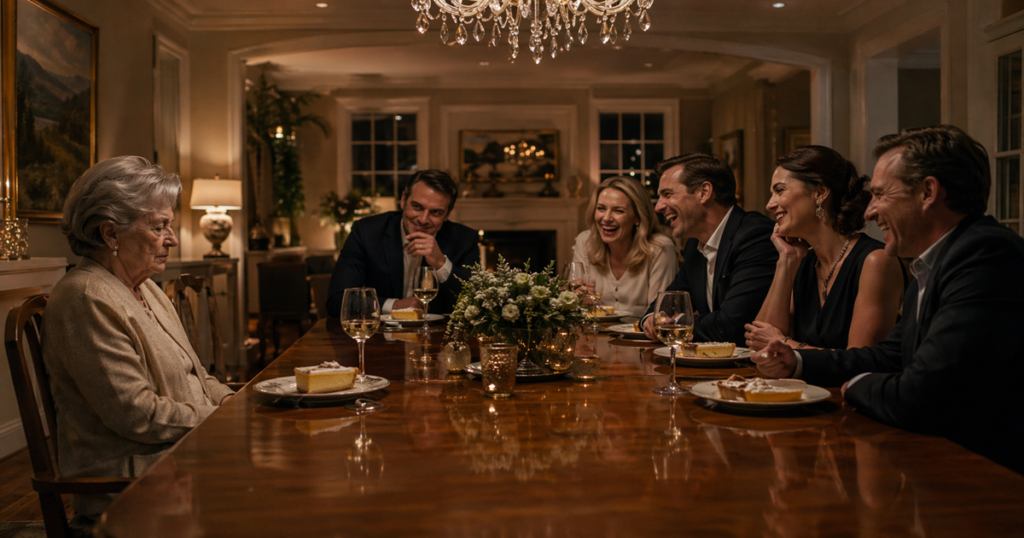
The first thing Helen noticed that evening was that someone had moved her chair.
It used to sit on the left side of the dining table, near the window where the late light softened everything in gold. From there, she could see the jacaranda tree outside and, if she leaned just a little, the stone birdbath her husband had installed twenty-three years ago because she liked watching robins wash their wings.
Now the chair had been placed at the far end of the table, half turned toward the kitchen doorway, out of the center of conversation and just near enough to the buffet cabinet that anyone standing to refill a drink would brush past her shoulder.
She paused in the doorway with one hand resting lightly on the frame.
Nothing in the room had changed enough for a stranger to notice. The cream curtains were still tied back with the braided cords she had sewn herself. The antique wall clock still carried the same soft brass pendulum swing. The blue china platter still sat in the middle of the polished oak table, though tonight it held store-bought bread instead of the rolls she used to bake on Sundays.
But Helen noticed the chair.
She always noticed small changes. That had been one of the things her late husband, Arthur, loved about her. “You see the room the way other people see weather,” he used to say. “You know the moment the air shifts.”
Tonight the air had shifted long before the guests arrived.
“Mom?” called her son, Daniel, from the kitchen. “Are you coming in?”
She straightened. “Yes.”
Daniel appeared with a bottle of red wine in one hand and an expression of forced brightness on his face. He was fifty-two now, broad through the middle in a way Arthur never had been, with thinning hair at the temples and the permanent tiredness of a man who had spent too many years trying to keep everyone pleased and failing more often than not.
“You can sit here,” he said, tapping the chair at the end.
Helen looked at it, then at him.
“This wasn’t my place before.”
“It’s just easier tonight,” he replied too quickly. “More room for everyone.”
More room for everyone.
She had heard that phrase often in the last six months. Ever since Daniel and his wife, Vanessa, had begun hosting more dinners, more “casual gatherings,” more evenings where people came into the house carrying expensive desserts and louder opinions. Easier tonight. Better for the flow. More room for everyone.
Helen gave a small nod and sat down.
She moved carefully, not because she was fragile, though they all assumed that now, but because sudden movements made her left knee ache. Arthritis, the doctor had said, with the sympathy reserved for things that could not be reversed. She folded her hands in her lap until the first guests began to arrive.
Vanessa’s sister, Marisa, came first, wearing a fitted cream dress and the look of someone entering a hotel she expected to review harshly. She kissed the air beside Vanessa’s cheek, brushed past Daniel, and glanced at Helen with a smile so polished it reflected nothing sincere.
“Helen,” she said. “You look comfortable.”
Comfortable. Helen had learned that certain words became insults when paired with the right tone.
Then came Marisa’s husband, Greg, who smelled faintly of cologne and car leather and always treated every room as though he had improved it simply by entering. After him came a younger couple Helen had met twice before—friends of Vanessa’s from some charity board or business mixer—and then Vanessa’s oldest nephew, Ryan, recently divorced and newly opinionated about everyone else’s life.
The house grew noisy in the way it often did now: wine glasses clinking, Vanessa laughing half a second too loudly at comments that were not very funny, Daniel asking whether anyone needed ice, feet crossing the entry hall Helen had once scrubbed on her knees when the children were small and money was tight.
No one asked if she needed anything.
That was all right. She had become used to invisible needs.
Vanessa floated in and out of the dining room in a silk blouse the color of wet sand, her dark hair pinned back loosely, diamond studs bright at her ears. She looked beautiful, Helen thought. Controlled. Effortless. The kind of beautiful that required planning but pretended not to.
Vanessa had always been skilled at pretending.
She married Daniel twenty-six years earlier, when Helen was still working part-time at the public library and Arthur was alive and stubborn and full of plans. Vanessa entered their family smiling warmly, bringing flowers, asking Helen for recipes, calling Arthur “Dad” by the second Christmas. She had seemed grateful then. Respectful. Eager to belong.
For a while, perhaps she had been.
Or perhaps Helen had simply wanted peace badly enough to mistake performance for affection.
Dinner began twenty minutes late because Ryan took a phone call on the front step and Vanessa refused to serve the roast until everyone was seated. By then the vegetables had softened too much and the gravy had formed a skin.
Helen would have fixed all of it once. She would have whisked the gravy smooth, reheated the plates, brought the meal out hot and timed to the minute. She had hosted dozens of dinners in this room through decades of birthdays, funerals, graduations, reconciliations, and holidays when money barely stretched but love somehow did.
Now she watched while Vanessa apologized theatrically for the delay and Greg joked about starving to death before the first serving.
“Not really starving,” Helen said quietly, almost to herself.
No one heard her.
The opening minutes passed smoothly enough. Plates were filled. Wine was poured. Marisa complimented the table runner. Greg launched into a story about property taxes in the city. The younger couple—Nina and Scott, Helen recalled after a moment—nodded at every pause with the hungry politeness of people eager to be invited again.
Helen cut her meat into small pieces. The knife shook slightly in her hand. She saw Ryan notice.
He was sitting two places down, long legs spread, expensive watch catching the light. He had the sour restlessness of a man who felt cheated by life and believed the bill should be sent to somebody else. He was not cruel in obvious ways. Not at first. He preferred humor. Little jabs wrapped in a grin. Mockery disguised as observation.
He leaned toward Scott and said just loudly enough, “My grandmother used to cut everything into tiny squares too. Said it made chewing feel less like work.”
A few people smiled.
Helen continued cutting.
Vanessa glanced up, then away.
Daniel drank from his glass.
The conversation drifted to renovations. Greg had recently remodeled a second bathroom and spoke of contractors with the tired superiority of a man who believed cost alone was proof of taste.
Vanessa sighed and looked around the dining room. “This place could use updating too, honestly. It has great bones, but there’s so much that’s… preserved.”
Preserved. Another pretty word.
Marisa laughed. “That’s a kind way to say frozen in time.”
“Some things age well,” Helen said.
Greg smiled without warmth. “And some things just age.”
There was a beat of silence after that, brief but real. Just enough time for decency to enter the room if anyone had invited it.
No one did.
Vanessa lifted her fork. “Greg means houses. Don’t be dramatic.”
Helen met her daughter-in-law’s eyes. “Do I sound dramatic to you?”
Vanessa smiled, but her jaw tightened. “Not at all.”
The meal continued.
Helen took small bites and listened as the younger people discussed schools, real estate, retirement communities, and a neighbor who had moved her father into assisted living after he began wandering at night. The story passed around the table with varying degrees of pity and practicality.
“It’s hard,” Nina said. “But at some point, families have to think realistically.”
“Yes,” Marisa agreed. “People hold on to houses far too long. It becomes emotional instead of practical.”
Greg dabbed his mouth with a napkin. “And the burden almost always lands on the next generation.”
Helen’s hands paused.
Burden.
The word hung in the air like a smell.
She did not look at Daniel immediately. When she did, he was staring at his plate.
In the years after Arthur died, Helen had become familiar with silence as a form of betrayal. Not loud betrayal. Not dramatic betrayal. The quieter kind. The kind that sat beside insult and pretended not to hear it. The kind that let other people reduce a human life to inconvenience because disagreeing might make dinner uncomfortable.
Arthur had been gone nine years.
Nine years since the stroke in the garden. Nine years since the ambulance lights washed blue over the front porch. Nine years since Helen had stood in this same hall barefoot and shaking while Daniel drove behind the ambulance in his own car and Vanessa stayed home “to manage the calls.”
Arthur never came back from the hospital.
What came back instead were casseroles, condolence cards, legal folders, half-finished projects in the garage, and the terrifying practical knowledge that grief still expected bills to be paid.
Helen had kept the house because Arthur had asked her to.
Not with dramatic solemnity. Not from a hospital bed. Earlier than that, one spring morning while repainting the guest room. He had been kneeling in old jeans with a brush in hand, his hair silver at the edges, and he said, almost casually, “Whatever happens first, don’t let anyone push you out of this place.”
She laughed then. “Who would push me out?”
“You’d be surprised what grief makes people practical about.”
Arthur always noticed currents under calm water.
At the time, Helen brushed off the remark. They were healthy enough. Busy enough. Still making plans. He was planting tomatoes that year. She was cataloging donations at the library. Their grandchildren were young. Death belonged to other families.
But after he was gone, the sentence returned.
Don’t let anyone push you out of this place.
And so she stayed. Through the first year of raw absence. Through the second year when people stopped checking in. Through winters when the gutters clogged and she climbed only the first two ladder steps before calling someone else. Through springs when the garden bloomed without him and felt disloyal for doing so.
Daniel visited often after Arthur died. Vanessa too. At first with kindness. Groceries. Offers to help. Suggestions that Helen not be alone so much.
Then, five years ago, when Daniel’s business went through a rough season and Vanessa said they were “reassessing priorities,” the suggestions shifted.
Wouldn’t it make sense, they wondered, to live together for a while?
Just temporarily.
It would be good for everyone.
You’d have company.
We’d save on expenses.
The grandchildren could visit more easily.
Helen was lonely then. Not foolish, but lonely. There is a difference, though lonely people are often judged as though there isn’t.
She agreed to let Daniel and Vanessa move in after they sold their smaller house.
Temporarily had stretched into permanence with astonishing ease.
The grandchildren were grown and visited rarely. Expenses were indeed lower for Daniel and Vanessa. Company, Helen learned, was not the same thing as companionship. Over time, they filled the house not with warmth but with possession. Their shoes by the door. Their framed photos on side tables. Vanessa’s wines in the rack Arthur built. Daniel’s tools in the garage drawer where Helen still kept Arthur’s measuring tape.
They never quite said the house was theirs.
They simply behaved as though time would do the paperwork.
“Helen?” Vanessa’s voice pulled her back to the table. “Would you like some more potatoes?”
“No, thank you.”
“Oh, come on. You barely ate.”
“I ate what I wanted.”
Marisa gave a small laugh. “My mother does that too. Two bites, then says she’s full. But an hour later she’s rummaging through the kitchen for biscuits.”
A few people chuckled.
Helen looked at her. “And do you laugh when she hears you?”
Marisa blinked.
Greg smirked into his wine.
Vanessa rushed in with false lightness. “Helen’s in a mood tonight.”
“No,” Helen said. “I’m listening tonight.”
That quieted the table for all of five seconds.
Ryan leaned back in his chair. “Listening is underrated. You find out what people really think when they don’t know you’re paying attention.”
Scott laughed uncertainly, unsure whether he was meant to.
“Yes,” Helen said. “You do.”
The roast plates were cleared. Vanessa disappeared to fetch dessert with Nina trailing behind to help. In the kitchen, cupboard doors opened and shut. Cutlery clinked against plates. Marisa used the pause to tell a story about someone they knew whose aunt refused to leave a four-bedroom home after her husband died, even though “she barely used two rooms.”
“She said the house was full of memories,” Marisa said, rolling her eyes. “I always think that’s code for refusing to accept reality.”
Greg pointed his fork toward her. “Exactly. Sentiment is expensive.”
“Especially for the people who have to deal with it later,” Ryan added.
Helen folded her napkin.
She had learned, with age, that humiliation rarely arrived as one clean blow. It came by accumulation. A glance. A joke. A correction. A practical comment spoken as if you were not there. Each one small enough to deny if challenged. Together, they formed a structure.
Vanessa returned carrying slices of lemon tart on small white plates, each topped with a curl of cream. She set one before Helen last, though Helen used to be the first person served in this room, either out of respect or habit or Arthur’s firm belief that “the woman who made the meal sits down before anyone else starts acting important.”
There would be no one saying that now.
Vanessa set the final plate down and resumed her seat. “I swear, organizing anything in this house is impossible. There’s nowhere sensible to put half the serving things.”
Helen looked at the sideboard. “They’ve been in the same drawers for thirty years.”
Vanessa gave an airy laugh. “Exactly my point.”
Nina smiled as if that settled it.
Marisa picked up her dessert fork. “Honestly, once a house reaches a certain age, it needs a full reset. New storage, new systems, new furniture. Otherwise it starts feeling like a museum.”
Greg said, “Or a waiting room.”
Ryan snorted.
Vanessa glanced around, enjoying the momentum now. “Well, some of us have tried to modernize. But every little thing becomes a discussion.”
Helen’s voice remained soft. “Because every little thing is in my house.”
It was the first time all evening she had used the phrase aloud.
Not our house. Not the house.
My house.
The temperature in the room seemed to change.
Vanessa smiled thinly. “Helen, no one is trying to upset you.”
“Then why continue after you see that I’m upset?”
No one answered.
Daniel finally cleared his throat. “Let’s not make this into something.”
Helen turned to him. “What is it already?”
He looked away.
That hurt more than the others.
Children do not stop being your children because they grow old enough to disappoint you with adult skill. The injury simply changes shape. When Daniel was six, he once hid behind Helen’s skirt while a neighbor scolded him for trampling flowers. When he was twelve, he cried in her lap after being cut from a football team. When he was nineteen, he arrived home from college one night with heartbreak written all over him because a girl had told him he lacked direction. Helen sat up until two in the morning making tea and reminding him that uncertainty was not failure.
She had defended him from pain before he knew what defense was.
Now he could not defend her from dinner conversation.
Marisa broke the silence with a shrug. “No one means anything personal. We’re just talking.”
“Talking is personal when the person you’re talking about is in the room,” Helen said.
Greg leaned back, impatient now. “With respect, Helen, everyone has to face practical realities eventually.”
“There’s that word again,” she replied.
Vanessa sighed. “Because it matters.”
Helen looked at her dessert but did not touch it. “Practical for whom?”
“For the family,” Vanessa said.
The family.
An interesting phrase, Helen thought, considering how selectively it was used. Family when Helen’s savings covered the roof repair after a storm. Family when her pension helped during Daniel’s bad quarter at work. Family when Vanessa wanted to host friends in a “beautiful established home.” Family when Christmas dinner required a table long enough to impress guests.
But when Helen wanted quiet, respect, the right to keep a cabinet arranged as it had always been, then suddenly family became management.
Ryan swirled the last of his wine. “No offense, but it’s obvious things can’t stay like this forever.”
Helen turned to him. “Like what?”
He hesitated, then shrugged with the confidence of someone accustomed to saying ugly things and blaming honesty afterward.
“You living here as if nothing changes.”
A silence followed so complete that the clock on the wall seemed louder than before.
Tick.
Tick.
Tick.
Helen set her spoon down carefully on the edge of the plate.
Her hands were steady now.
“Living here,” she repeated. “As if nothing changes.”
Ryan spread his hands. “I’m just saying what everyone is thinking.”
“No,” Helen said. “You’re saying what rude people say when decent people are too cowardly to stop them.”
Nina stared into her tart. Scott suddenly found the table runner fascinating.
Vanessa’s face hardened. “That’s enough.”
Helen lifted her eyes to Vanessa’s. “Is it?”
Vanessa inhaled slowly, controlling herself for an audience. “I’ve worked very hard to make this household function. Very hard. And if you’re going to twist a dinner conversation into an attack—”
“A dinner conversation?” Helen said. “Is that what you call it when guests discuss where an old woman should live while she’s still sitting in her own dining room?”
Marisa muttered, “Own is a strong word.”
Helen looked at her. “Is it?”
Greg intervened with a low laugh. “Well, let’s be honest. Once the younger generation is doing the maintenance, the cooking, the bills—”
Helen turned sharply. “The bills?”
Daniel finally spoke, too late and too weak. “Mom—”
“No,” she said, not raising her voice, which made the word land harder. “Let’s be very honest tonight.”
Vanessa’s lips flattened. “No one is trying to disrespect you.”
“You already have.”
Vanessa sat straighter. “I think you’re being unfair.”
Helen studied her for a long moment.
Unfair.
There it was. The favorite shield of people who had grown comfortable with another person’s silence.
“You want fairness?” Helen asked. “Then perhaps this is the right moment.”
Vanessa folded her arms. “For what?”
Helen looked around the table.
At the lemon tart she did not want.
At the guests who had eaten from her plates and insulted her under her own ceiling.
At Daniel, who seemed suddenly smaller than the man she had raised.
At the room Arthur had painted, the floorboards he had sanded, the table they had bought secondhand when Daniel was nine because money was tight and family mattered more than appearance.
Then she asked, very quietly, “Which paperwork did you mean?”
Vanessa froze.
It was subtle, but Helen saw it. A stillness that did not come from confusion. It came from exposure.
“What?” Vanessa said.
“A few minutes ago,” Helen replied. “You said that once the paperwork was sorted, the house would finally be run properly. Which paperwork?”
No one moved.
Marisa looked from Vanessa to Daniel.
Greg’s expression sharpened with interest.
Daniel’s face lost color.
Vanessa gave a small laugh, but it cracked on the way out. “Oh, for goodness’ sake. It was just a figure of speech.”
“No,” Helen said. “It wasn’t.”
Daniel rubbed his forehead. “Mom, maybe not in front of everyone.”
“In front of everyone is exactly where this began.”
Vanessa’s eyes flashed. “You’re embarrassing yourself.”
Helen sat straighter in her chair. “At my age, Vanessa, embarrassment is much easier to survive than disrespect.”
Ryan shifted, suddenly wishing perhaps that he had been somewhere else for dessert.
Helen turned her gaze to Daniel. “Did you tell her I signed something?”
“No,” he said too quickly.
Vanessa looked at him.
Helen did not miss it.
“Did either of you,” Helen continued, “speak to Mr. Talbot without me?”
Mr. Talbot had been the family solicitor for nearly forty years. He drafted Arthur’s will, handled the probate, and once helped Helen challenge a predatory roofing contractor who assumed widowhood made her easy to frighten.
Daniel’s silence said enough.
Marisa frowned. “What is this about?”
Vanessa answered before Helen could. “Nothing. Truly. Helen is confused.”
The word struck the table like a dropped glass.
Confused.
Helen felt something inside her go still.
There are moments in life when hurt burns hot. And there are moments when it turns cold and clean, so clean that all sentiment drains away and leaves only clarity.
This was the second kind.
She reached into the pocket of her cardigan and withdrew a folded envelope.
Vanessa’s eyes widened.
Daniel whispered, “Mom…”
Helen placed the envelope on the tablecloth beside her plate.
“I was going to wait,” she said. “I didn’t want ugliness. I thought perhaps dignity would still be possible. But dignity requires at least two willing parties.”
Greg stared at the envelope. “What’s in that?”
Helen kept her gaze on Daniel. “An answer.”
Vanessa’s voice sharpened. “This is ridiculous.”
“No,” Helen said. “Ridiculous was tonight. This is overdue.”
She unfolded the paper with careful fingers. Not trembling fingers. Just old fingers. Hands that had buttoned school uniforms, bandaged knees, signed checks, buried a husband, and held more weight over the years than any of these people around the table knew.
“It is true,” she said, her voice steady, “that things cannot stay like this forever.”
No one interrupted.
“When Arthur died, he left this house entirely to me. Not jointly. Not informally. To me. Years later, when Daniel and Vanessa needed a place to regroup, I allowed them to move in. Allowed. There was never any transfer. Never any co-ownership. Never any promise that this house would become theirs by habit, pressure, or assumption.”
Greg shifted in his chair.
Marisa’s mouth parted slightly.
Vanessa’s face had gone rigid.
Helen continued. “Three months ago, Mr. Talbot called me because someone from his office received an inquiry about future title arrangements. That was the phrase used. Future title arrangements. I had not made such an inquiry. So I asked questions.”
Daniel closed his eyes.
Helen looked at him not with anger now, but with a sadness so old it felt tired. “You should have asked me directly.”
He whispered, “We were only trying to plan.”
“No. You were trying to prepare the conversation without me.”
Vanessa leaned forward. “This is unfair. We have invested years here. We have paid for repairs, groceries, improvements—”
“With my agreement,” Helen said. “And often with my money supplementing yours.”
Vanessa flushed. “That is not true.”
“It is documented.”
Again Helen touched the paper.
“Would you like totals?” she asked.
The silence that followed was answer enough.
“When the furnace failed two winters ago,” Helen went on, “I paid the larger share from my savings because Daniel said cash flow was tight. When the roof needed patching after the storm, I paid for that too. The dining chairs were reupholstered with funds from my account. The garden wall repair came from my account. Even half the groceries during the first year you lived here came from my account, though I was told repeatedly that arrangement was temporary.”
Vanessa’s mouth opened, then closed.
Daniel looked as if he wanted the floorboards to give way beneath him.
Helen took a breath.
“I met with Mr. Talbot last week. Since there appeared to be growing confusion in this house, I chose to settle the matter formally.”
Marisa whispered, “Settle what matter?”
Helen turned the final page over.
“I have established a trust. The house remains mine for the duration of my life. That was never in question. Upon my death, it will not pass automatically to Daniel.”
Vanessa made a sharp sound. “What?”
Daniel stared. “Mom…”
“No,” Helen said. “Listen now. You should all listen, since you’ve all had so much to say tonight.”
Her voice never rose. That was part of what made the room feel suddenly small.
“The property will be sold. The proceeds will be divided into three parts. One part will fund long-term educational grants for my grandchildren and any great-grandchildren who may come later. One part will go to St. Anne’s Community Housing Fund, which helps widows and elderly residents remain in their homes safely. And one part will go into a care endowment for women over seventy who are displaced by family coercion or financial pressure.”
No one breathed.
Vanessa’s face had gone pale with fury. “You cannot be serious.”
Helen met her eyes. “I have never been more serious.”
Greg looked at Daniel. “You didn’t know?”
Daniel’s voice was faint. “No.”
Vanessa turned on him. “You said she would never—”
She stopped.
Too late.
That sentence landed in the middle of the table like a confession.
Helen tilted her head slightly. “He said I would never what?”
Vanessa stood abruptly, napkin falling to the floor. “I am not doing this.”
“No,” Helen replied. “You already did this.”
Vanessa pushed her chair back. “After everything I have done in this house—”
“In this house,” Helen said evenly. “Thank you for finally using the correct phrase.”
Daniel stood too. “Mom, please. Can we talk privately?”
Helen looked around at the assembled guests. “Why? Privacy was not considered necessary when my usefulness, memory, and right to remain here became dinner entertainment.”
No one could meet her eyes now except Marisa, whose expression had shifted from superiority to something closer to shame.
Nina whispered to Scott, “We should go.”
Not yet, Helen thought, though she did not say it. Let them sit in it a moment longer. Let discomfort finally belong to the right people.
Vanessa was near the doorway when Helen spoke again.
“There is one more thing.”
Vanessa stopped without turning.
“I have also revised my living arrangements.”
Daniel frowned. “What does that mean?”
“It means,” Helen said, “that I will no longer continue under this roof as if gratitude must be purchased by silence.”
Vanessa turned back. “What are you saying?”
“I’m saying that Mr. Talbot has prepared a formal occupancy notice.”
Daniel’s eyes widened. “Occupancy notice?”
“Yes.”
For the first time all evening, Greg looked genuinely alarmed.
Helen rested both hands on the table. “You and Vanessa will have ninety days to find another place to live.”
The room erupted.
Vanessa’s voice rose first. “Absolutely not.”
Daniel followed. “Mom, you can’t do that.”
“I can.”
“You wouldn’t throw us out.”
Helen felt the old ache in her chest then—not doubt, not regret, but the pain of seeing exactly how entitled dependence had become.
“I am not throwing you out tonight,” she said. “I am ending an arrangement that has become harmful.”
Vanessa laughed in disbelief. “Harmful? You live in comfort. You have meals. You have company. This is how you repay us?”
Company.
The word nearly made Helen smile.
“Do not mistake occupancy for care,” she said.
Daniel pressed both palms to the back of his chair. “Mom, this is because of one bad dinner conversation.”
“No. This is because of many things. Tonight only removed the last excuse.”
Marisa spoke softly now, the sharpness drained from her voice. “Helen…”
Helen turned to her.
Marisa swallowed. “I didn’t realize.”
“Yes,” Helen said. “That is often the beginning of regret.”
For a long moment, the only sound was the clock.
Then Daniel said, in a voice Helen had not heard from him since boyhood, “Where are we supposed to go?”
And there it was.
Not I’m sorry.
Not I should have stopped them.
Not how could I let this happen.
Where are we supposed to go?
Helen closed her eyes briefly, not from weakness but to steady herself against the grief of that sentence.
When she opened them, she saw not her grown son but the child he had once been—and the man he had chosen to become.
“You are both employed,” she said. “You have savings. You have options. You are not being abandoned. You are being asked to stand on your own feet. Many people do it without first humiliating the person who sheltered them.”
Vanessa scoffed. “Sheltered us. That’s dramatic.”
Helen looked at her. “You began the evening by treating me as though I were an inconvenient old woman taking up space in a house waiting to be managed. Now you dislike the word sheltered. Perhaps accuracy only feels dramatic when it does not flatter you.”
Scott stood. “We really should—”
“Yes,” Helen said. “You should.”
The guests began collecting bags and murmuring awkward goodnights that did not deserve the name. Nina looked near tears. Greg muttered something to Marisa under his breath. Ryan avoided Helen entirely, his earlier confidence stripped down to embarrassed resentment.
Only Marisa approached Helen directly before leaving.
She stopped beside the chair and said quietly, “I was cruel tonight.”
Helen looked up at her.
“Yes.”
Marisa blinked, perhaps expecting the easier absolution polite society often provides. When it did not come, her eyes lowered.
“I’m sorry,” she said.
Helen studied her face. There was discomfort there, yes, but also a flicker of honesty. Perhaps that was enough for the moment.
“Then be different next time,” Helen replied.
Marisa nodded and left.
Soon only the family remained: Helen, Daniel, Vanessa, and the wreckage of dessert.
Vanessa began gathering plates with furious efficiency, the kind that was less about cleaning than surviving rage through movement. Porcelain knocked harder than necessary against porcelain.
“Leave them,” Helen said.
Vanessa did not.
“Leave them.”
This time the steel in Helen’s voice stopped her.
Vanessa set the plates down.
Daniel sat again slowly, as if his knees no longer trusted him. He looked exhausted. Older than the hour before.
“Did you really mean the ninety days?” he asked.
“Yes.”
He rubbed his eyes. “You’ve been planning this.”
“I’ve been protecting myself.”
He looked up at that. “From me?”
Helen did not answer at once.
When she finally spoke, her voice had softened—not weakened, softened.
“From what happens to people when the love they once trusted is replaced by convenience.”
Daniel’s face crumpled slightly. “I never wanted you to feel that way.”
“And yet here we are.”
Vanessa folded her arms tightly. “So that’s it? After all these years, one performance over dessert and suddenly we’re villains?”
Helen almost laughed at the word performance. How revealing Vanessa remained, even now.
“This was not sudden,” Helen said. “And if you think tonight was a performance, then you still do not understand what happened here.”
“What happened,” Vanessa snapped, “is that you humiliated us in front of our guests.”
Helen looked at the untouched tart before her. “You mistook me for someone who would let you continue.”
Daniel stared at the tablecloth.
“I should have said something earlier,” he murmured.
“Yes.”
He winced.
“When Greg started,” Helen continued, “when Ryan joked, when Vanessa implied decisions were being made around me—at any point, you could have said enough. You could have reminded them that I am your mother. That I am in my own home. That respect is not optional simply because a person is old.”
His voice broke. “I know.”
“Do you?”
Tears stood in his eyes then, though they did not fall. Daniel had always cried reluctantly, ashamed of it even as a boy.
“I got used to…” He stopped.
“What?”
He exhaled hard. “I got used to things being easier if I stayed quiet.”
Helen looked at him for a long time.
There was truth in that. Painful truth. Common truth.
Entire families rot around that habit.
Vanessa turned sharply toward him. “You are not going to sit there and accept this.”
Daniel did not answer.
She stepped closer. “Say something.”
He remained still.
For the first time, Helen saw fear beneath Vanessa’s anger. Not the fear of homelessness—Vanessa would land on her feet; women like her always had plans—but the deeper fear of losing control of a story she had already told herself too many times. In Vanessa’s version, she and Daniel had carried an aging woman. They had tolerated inconvenience. They had earned the right to reorganize the future.
Now the story had turned, and she did not know who she was in it.
“Helen,” Vanessa said more quietly, attempting a new tone, “surely we can talk about this when emotions aren’t high.”
Helen almost admired the speed of the adjustment. First outrage, then reasonableness, once outrage failed.
“We can discuss logistics tomorrow,” Helen said. “The decision is not emotional. It is final.”
Vanessa’s composure cracked. “You are punishing us.”
“I am correcting a boundary I failed to protect soon enough.”
Daniel finally stood again. He looked between them both, hollowed by the shape of the evening.
“I’m sorry,” he said.
The words came late, but they came.
Helen believed he meant them, though meaning and repair were not the same.
She nodded once. “I know you are.”
Vanessa turned toward him in disbelief. “That’s it? You’re apologizing?”
He looked at her with something tired and new in his face. “What would you call tonight?”
Vanessa opened her mouth, closed it, then turned away.
There was nothing more to say then that would not simply bruise the same wound from different angles. Helen rose slowly from her chair. Daniel moved automatically to help her, but she steadied herself before he reached her.
“I can manage,” she said.
The words were about more than standing.
She went to the sink and rinsed her spoon. Not because it needed rinsing, but because habit soothed her. The kitchen smelled faintly of lemon zest and roasted meat gone cool. On the windowsill above the sink stood the small ceramic basil pot Arthur once painted badly, insisting the green leaves looked “happy enough to forgive the brushwork.”
Helen rested her fingers briefly on the rim.
“Tomorrow,” she said without turning, “I’ll ask Mr. Talbot to send the documents over again so there’s no confusion.”
Then she walked upstairs.
She expected not to sleep. Yet exhaustion, when it finally came, took her under quickly and without dreams.
In the morning the house felt different.
Not peaceful. Aftershocks rarely allow peace that soon. But honest.
Helen woke at six-thirty, dressed carefully, and went downstairs before anyone else. She made tea in the blue pot Arthur favored and opened the back door to let the morning air in. The jacaranda tree stirred softly in the garden. A few purple blossoms had fallen overnight and lay scattered across the flagstones like scraps of old silk.
She stood there a long time with her mug warming both hands.
When Daniel entered the kitchen at seven-ten, he looked as though he had slept in his clothes.
“Morning,” he said.
“Morning.”
He hesitated. “Can we talk?”
“We are talking.”
He almost smiled at that, the ghost of a familiar expression from better years.
“I was awful,” he said.
Helen turned from the garden. “You were weak.”
He nodded. “That too.”
It was easier for some people to confess cruelty than weakness. Cruelty suggested action. Weakness exposed character.
Daniel sat at the kitchen table. “Vanessa is furious.”
“I know.”
“She says you blindsided us.”
Helen poured a second cup without asking and set it before him. “Did I?”
He stared into the tea. “No.”
The truth sat between them, simple and expensive.
“I kept telling myself it wasn’t as bad as it sounded,” he said at last. “That people were joking. That you were tougher than they realized. That stepping in would turn it into a bigger fight.”
Helen leaned against the counter. “And was it worth the peace you bought with my silence?”
He looked down. “No.”
“No,” she agreed.
He rubbed his hands together. “I don’t know when I became this person.”
Helen’s expression softened then, because beneath everything else, this question was real.
“It doesn’t happen all at once,” she said. “That’s why people don’t notice. They excuse one thing, then another. They trade courage for ease in tiny amounts until the exchange rate ruins them.”
Daniel swallowed hard.
“I should have protected you.”
“Yes.”
He nodded again, accepting the wound instead of asking her to bandage it.
After a moment he said, “Are you really giving the money away?”
“Not all of it. Some will still support your children.”
He looked up. “Why not me?”
Helen did not answer immediately.
Because you treated inheritance like weather, she thought. Because you let your wife speak around me as though my death were an administrative hurdle. Because love is not proved by blood alone. Because a house should not reward entitlement.
Instead she said, “Because I want what Arthur and I built to do some good where it is needed most.”
Daniel closed his eyes.
“I understand.”
She believed he partly did.
Vanessa came down an hour later dressed impeccably for someone clearly preparing for battle. But something in the kitchen stopped her short: perhaps the quiet between Helen and Daniel, perhaps the visible fact that yesterday had not dissolved overnight into embarrassment and retreat.
She looked from one to the other. “You’ve been discussing me, I assume.”
“No,” Helen said. “We’ve been discussing choices.”
Vanessa gave a brittle laugh. “How noble.”
Helen set her cup in the sink. “Would you like tea?”
The offer destabilized Vanessa more than hostility might have.
“No.”
“As you wish.”
Vanessa turned to Daniel. “I hope you’re not encouraging this.”
Daniel met her gaze. “It’s already decided.”
“What does that mean?”
“It means,” he said slowly, “we need to start figuring out where we’re going.”
Vanessa stared at him.
For a moment Helen saw all the years of their marriage compress into one look—alliances made through shared justifications, resentments carried jointly, assumptions mistaken for inevitability. Vanessa had expected Daniel to resist, to fight, to pressure, to plead on their behalf. She had expected him to return to the old pattern: let tension settle, wait for Helen to soften, resume control through discomfort.
Instead he sounded tired. Older. Not strong exactly, but no longer entirely absent.
Vanessa turned to Helen. “You’ve manipulated him.”
“No,” Helen said. “I stopped allowing him to hide behind me.”
The next weeks were not graceful.
Boxes appeared in hallways. Estate agents were called. Vanessa alternated between frosty civility and bursts of anger sharp enough to scrape paint. More than once Helen overheard her on the phone reframing the situation for friends: Helen had become unstable, oversensitive, influenced by outsiders, vindictive in old age.
Helen let her talk.
Truth does not always need immediate defense. Sometimes it simply waits for behavior to confirm it.
Mr. Talbot came by in person the following Tuesday. He sat in the sitting room with his hat on his knees and went over the documents with formal patience. Daniel attended. Vanessa did not.
When everything was signed and witnessed properly, Mr. Talbot rose to leave and said quietly to Helen at the door, “Arthur would be proud of your spine.”
Helen almost wept at that, but she only nodded.
“Thank you for calling me when you did,” she said.
He gave a small, grave smile. “I didn’t call because of paperwork, Helen. I called because I’ve seen too many decent women reduced to guests in their own homes.”
After he left, Helen stood alone in the hall and allowed herself one minute of grief—not for losing Daniel, not exactly, but for the version of him she had hoped still existed untouched beneath habit.
Yet grief and relief can live in the same room. She was learning that too.
One Saturday afternoon, two weeks into the ninety days, Daniel found Helen in the garden trimming dead stems from the rose bushes.
“You shouldn’t be kneeling like that,” he said.
“Then fetch the small stool.”
He did.
He handed it to her and stood awkwardly while she settled herself.
After a while he said, “Vanessa wants to move closer to her sister.”
Helen clipped a stem. “All right.”
“I may not.”
That made her look up.
He exhaled. “I don’t know what happens to us after this.”
The pronoun held more than logistics.
Helen set the shears in her lap. “That is not a question I can answer for you.”
He nodded. “I know.”
The breeze lifted a strand of gray hair from her cheek. Daniel noticed and, for one fleeting second, looked like the boy who used to reach up to tuck it back with sticky fingers after eating jam toast.
“I was angry at you,” he admitted. “The first two days, I kept thinking you’d overreacted. Then every time Vanessa told the story to someone else, she changed it. Each time, you sounded crueler and she sounded more noble. And I realized…” He gave a humorless laugh. “I realized that wasn’t new. She’s been narrating reality for a long time, and I’ve been grateful enough not to question the script.”
Helen listened.
“And I let that happen,” he said. “Maybe because it was easier. Maybe because I didn’t want to see what that said about me.”
She resumed trimming, gently.
“What it says about you,” she replied, “depends on what you do after seeing it.”
He was quiet for so long she thought the conversation had ended.
Then he said, “I don’t expect forgiveness just because I finally understand.”
“No,” Helen said. “You shouldn’t.”
And yet, in the weeks that followed, something small began.
Not repair. Repair would take longer than packing boxes and shared tea. Something smaller and more honest: acknowledgment.
Daniel started knocking before entering Helen’s room. He asked before moving things. He corrected Vanessa once, sharply, when she referred to “our house” in front of a moving company representative.
The correction stunned all three of them.
Vanessa left for her sister’s two days later and stayed nearly a week.
When she returned, she and Daniel moved through the house like careful diplomats in hostile territory. They spoke mostly about practical matters. Lease applications. Storage units. What would fit in the new townhouse Vanessa had located across town.
On the eighty-sixth day, the final van was loaded.
Helen stood in the front hall while Daniel carried the last box to the door. The house looked bigger already, as homes often do when other people’s assumptions leave with the furniture.
Vanessa came back inside once more to collect her handbag from the console table.
She paused near Helen.
For a moment Helen thought she might offer an apology. A real one. Not polished, not strategic. Something human.
Instead Vanessa said, “I hope this makes you happy.”
Helen considered her.
At one time, she might have answered defensively. Or kindly. Or with a wounded explanation.
Now she said only, “It makes me peaceful.”
Vanessa looked away first.
She left.
Daniel returned from the driveway a final time and stood uncertainly by the door.
The room held years between them. Childhood fevers. Teenage arguments. Christmas mornings. Arthur’s funeral suit hanging once on the banister while Helen stitched a loose button in tears. So much life had passed through this hall that saying goodbye to one version of a relationship felt impossible to do cleanly.
“I was a poor son,” Daniel said.
Helen’s throat tightened.
“At times,” she answered.
He accepted that.
“I’d like,” he said slowly, “if you ever want… I’d like a chance to do better than that.”
She looked at him for a long moment.
“Doing better begins before being welcomed back,” she said.
He nodded, eyes wet. “I know.”
Then he leaned forward, hesitant as a child asking permission, and kissed her cheek.
She let him.
After he left, the house became very quiet.
Not lonely. Quiet.
There was a difference.
Helen walked room to room that afternoon, opening windows, touching chair backs, straightening small things that were not even crooked. In the dining room she moved her chair back to the place by the window.
Then she sat in it and looked out at the jacaranda tree.
The light came in just as it used to—soft, gold, forgiving.
On the table before her she placed a notebook and began writing down ideas for the community housing fund Mr. Talbot had helped her establish. Safety rail grants. Emergency legal consultations. Small bridge funds for older women whose families controlled the home but not the kindness within it. She wrote slowly, carefully. Her handwriting had thinned with age, but it remained steady.
Near evening, the doorbell rang.
She opened the door to find Marisa standing on the porch with a paper bag in both hands.
“Helen,” she said awkwardly. “I was nearby.”
Helen waited.
Marisa lifted the bag slightly. “I brought scones. From the bakery on Birch. The good one.”
Helen almost smiled.
“That is the good one.”
Marisa nodded, relieved to have found safe ground. “I won’t stay long. I just…” She swallowed. “I’ve thought about that dinner more times than I want to admit.”
“So have I.”
“I was awful.”
“Yes.”
Marisa gave a tiny, self-conscious exhale. “I deserved that.”
Perhaps she did.
Helen looked at the bag, then stepped aside. “You may come in for tea. But only if you can manage a conversation without diagnosing where other people belong.”
To her credit, Marisa laughed softly. “I think I can.”
They sat in the kitchen with tea and warm scones, and for the first time in all the years Helen had known her, Marisa spoke without performance. She talked about her own mother—a difficult woman, proud and impossible, now in a care facility after a fall. She admitted she had turned impatience into personality because it made guilt easier to carry.
Helen listened. Age had not made her endlessly forgiving, but it had made her curious about the machinery inside people.
Before leaving, Marisa stood by the back door and said, “I don’t know if this means anything, but I’m glad you said what you said.”
“It means more if you remember it elsewhere,” Helen replied.
Marisa nodded. “I will.”
When evening settled fully, Helen carried her tea into the dining room and sat once more by the window.
The house creaked the way old houses do as temperatures dropped. The clock marked each passing second without hurry. Somewhere in the neighborhood, a dog barked twice and then stopped.
Helen rested her palm on the oak table.
She thought of Arthur.
Of his paintbrush in the guest room.
Of his hands in garden dirt.
Of the way he would have stood from his chair the first moment someone mocked her and ended the matter before dessert was plated.
She missed him then with a tenderness so full it no longer tore.
“I did it,” she said softly into the room.
And in the silence that followed, she felt no supernatural sign, no dramatic answer, only the grounded, human comfort of a promise kept.
She had not let them push her out.
Days turned into weeks.
Spring moved further in. The jacaranda tree scattered itself gloriously across the yard. Helen hired a local carpenter to fix the loose stair rail and a young woman from the church to help with heavy grocery deliveries on Thursdays. She attended the first planning lunch for the housing fund at St. Anne’s and, to her own surprise, discovered she enjoyed being listened to by people who did not confuse age with irrelevance.
Daniel called every Sunday.
At first the conversations were brief and formal. Then longer. He told her he had rented a small duplex on the other side of town. Vanessa had chosen not to move with him permanently. They were “taking space,” which seemed a modern phrase for an old fracture.
Helen did not pry.
One Sunday, three months after the dinner, Daniel said, “I told a man at work to stop speaking over one of the older women in accounting.”
Helen stirred sugar into her tea. “And?”
“And I heard your voice in my head before I did it.”
She smiled despite herself. “That must have been irritating.”
He laughed, and for the first time in a long while it sounded like her son.
“Very.”
Another time he asked if he could come by and help repaint the garden bench Arthur had built. Helen said yes. They worked side by side in the backyard, not talking much, which was perhaps the kindest thing available between them then. Not every wound requires words every minute. Sometimes shared labor makes a bridge language cannot yet hold.
By autumn, the house felt fully like itself again.
Not unchanged. Nothing honest ever returns unchanged. But restored to the right center of gravity.
Helen hosted a small dinner in October. Only six people. Mr. Talbot, Marisa, the young church volunteer named Elsie, a widow from St. Anne’s named Ruth, Daniel, and Helen herself.
She cooked the meal.
Not because she had to prove anything, and not because labor defines worth, but because she wanted the room to smell of thyme and butter and roasted carrots the way it once had when love still felt uncomplicated. She set the table with the blue china platter, polished the silver, lit two candles, and placed her own chair by the window where it belonged.
During dessert, Ruth told a story about confronting a nephew who had tried to pressure her into selling her bungalow. Everyone laughed—not cruel laughter, but the released laughter of people who recognize survival in one another.
Daniel watched his mother that evening with an expression Helen could not fully name. Grief perhaps. Admiration. Shame still, yes, but gentled by effort.
As the plates were cleared, he said quietly, “The room feels different now.”
Helen looked around.
“It feels truthful,” she said.
He nodded.
After the guests left, he stayed to wash dishes. At the sink, hands in warm water, he said, “I used to think ownership was about whose name things ended up under.”
Helen dried a plate and placed it carefully in the rack.
“And now?”
He looked at the dark window above the sink, where both their reflections floated faintly.
“Now I think maybe it’s also about who protected what mattered.”
Helen did not answer for a moment.
Then she handed him another plate.
“Yes,” she said. “It is.”
That night, after he went home, Helen walked once more through the quiet house.
The front hall.
The sitting room.
The dining room.
Her fingers brushed the wallpaper edge Arthur once insisted on hanging himself, though he swore all the while at the corners. She paused by the staircase and listened to the silence upstairs.
Not empty.
Earned.
She returned to the dining room and sat in her chair by the window.
Outside, the jacaranda branches moved in the dark.
Inside, the house held steady around her—not as property alone, not as inheritance bait, not as a burden to be managed, but as the shape of a life that had not yet surrendered its meaning.
People had laughed at her.
Measured her usefulness.
Discussed her future over dessert as though she were already absent.
They had mistaken softness for surrender. Age for confusion. Silence for permission.
They were wrong.
And sometimes, Helen thought, that was enough.
Not revenge.
Not triumph in the ugly sense.
Just truth arriving at the table before it was too late.