The first thing Isaiah noticed when he walked into Bellamy Market was the cold.
Not the normal kind that came from air-conditioning in late September, but that overworked kind that made the front of the store feel sharper than the afternoon outside. It hit the sweat on his neck and cooled it too fast. He paused just past the sliding doors, adjusted the strap of his backpack, and glanced toward the cashier lanes.
The store smelled like floor cleaner, oranges, and hot chicken from the deli in the back. A child somewhere near produce was crying in tired little bursts. A cashier called for a price check on canned tomatoes. The ordinary sounds of other people’s ordinary lives.
Isaiah liked ordinary. Ordinary meant nothing was going wrong.
He moved toward the drinks aisle, reaching into his hoodie pocket for the crumpled five-dollar bill his mother had pressed into his hand before he left.
“Get the bread if it’s on sale,” she had said from the couch, one hand resting on her side. “And don’t let me forget ginger ale. Your uncle says it helps, but I think he just likes hearing himself talk.”
Isaiah had smiled at that. His mother, Denise, had been tired all week. She worked double shifts at the assisted living center, and the tendon in her ankle had been bothering her again. Even when she sat down, she looked like she was bracing against the next thing.
“I got it,” he had told her. “Bread. Ginger ale. And cereal if the price ain’t crazy.”
“Store brand,” she said.
“Yeah, yeah.”
“And Isaiah?”
He had looked back from the door.
“Come straight home.”
He knew what she meant. She always said it gently, but the meaning underneath never changed. Keep your head down. Don’t get pulled into anything. Don’t be in the wrong place when other people start making decisions about who belongs there and who does not.
He hated that she had to say it. He hated even more that she was not wrong.
Now, inside the market, he grabbed a basket and walked to the cooler. He picked up a bottle of ginger ale, checked the price, and put it in the basket. Bread was on sale, not the cheapest kind but close enough. He stood in front of the cereal section longer than he meant to, comparing ounces, because when money was tight every box carried its own argument.
He finally chose one and turned into the main aisle that led toward the front.
That was when he saw the woman.
She was maybe late sixties, dressed neatly in a cream-colored cardigan despite the warm weather, with a brown leather purse looped over one shoulder and both hands on the handle of a cart. She moved carefully, like someone who had once walked fast for everyone else and now had no choice but to slow down for herself.
She was near the seasonal display, studying labels on cough drops.
Across from her, half-hidden by a tower of paper towels, stood a man Isaiah had noticed a minute earlier near the entrance but had not thought much about. White. Mid-thirties maybe. Ball cap pulled low. Gray work jacket even though it was too warm for one. He had that restless way of looking around without turning his head much, the way people do when they do not want to be remembered.
Something about him tightened Isaiah’s shoulders.
The man moved closer to the woman, almost casually, as if browsing. Then he looked toward the registers. Then the door.
Isaiah slowed.
The woman lifted a box from the shelf. Her purse slipped further down her arm.
The man stepped in.
It happened quickly but not so quickly that it looked like an accident.
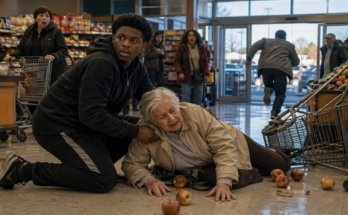
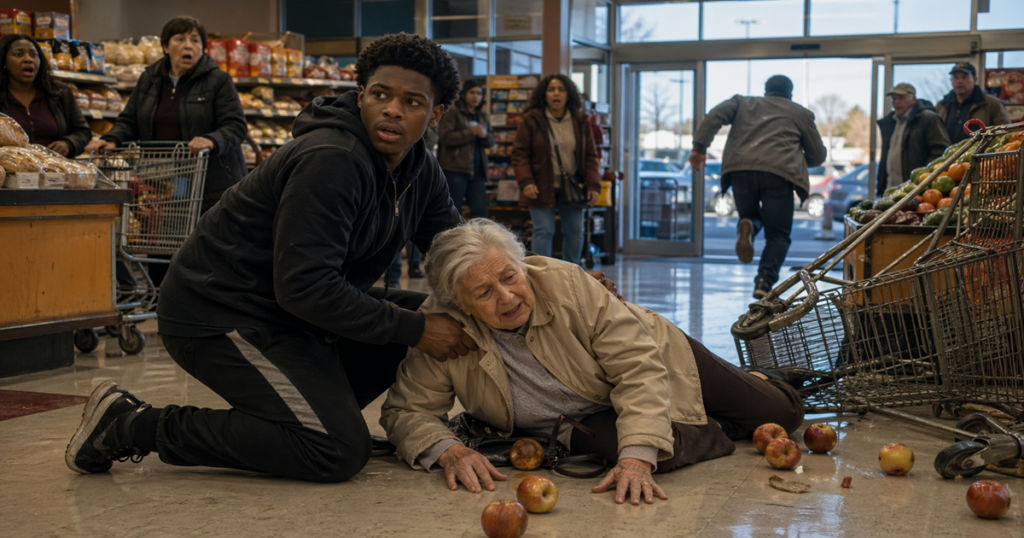
His hand shot toward her purse. She gasped and tried to pull back. The cart jerked sideways. One wheel caught against the corner of a display. The purse strap twisted. The woman lost her balance and stumbled hard into the metal shelving. A row of cough syrup bottles rattled and fell.
Her head struck something with a sound Isaiah would hear later when he was trying to sleep.
The man yanked once more, freed the purse, and ran.
For one frozen second the whole aisle seemed to go silent around Isaiah.
Then everything happened at once.
The woman collapsed to one knee, one hand against the shelf, the other reaching at air. Her cart tipped. Apples rolled out across the floor.
Isaiah dropped his basket and ran toward her.
“Ma’am!”
The man was already heading for the front, moving fast.
Isaiah looked up in time to see him shove past a woman carrying flowers. Then the automatic doors opened. The man disappeared into the late afternoon glare.
Isaiah’s body leaned forward instinctively, half a step after him. But the older woman made a broken sound, and he stopped.
He chose her.
He knelt beside her. “Ma’am, can you hear me?”
Blood was already rising in a thin red line near her temple. Her eyes looked stunned more than unconscious, as if the world had shifted and she had not caught up yet.
People were turning now. A clerk from the next aisle hurried over. Someone shouted, “Call 911!”
Isaiah reached for the fallen cart and pushed it aside so she would have room.
Then a voice cracked through the air like a slap.
“That’s him!”
He looked up.
A woman near register three was pointing straight at him. She was clutching her purse to her chest with both hands, face pale and sharp. “I saw him! He was right there!”
For a second Isaiah did not understand. He actually turned his head, thinking she meant someone behind him.
But all the eyes in the front of the store were already moving toward him.
“No,” he said, standing halfway. “No, the guy ran out—”
“He was over there the whole time,” the woman said louder, as if volume could make memory cleaner. “I saw him near that lady.”
A man in a polo shirt stepped closer, placing himself between Isaiah and the exit without saying a word. Another shopper pulled her child to her side. Somewhere behind the registers, a cashier whispered, “Oh my God.”
Isaiah felt the blood drain from his face.
“He took her purse?” someone asked.
“I think so,” another voice answered.
“I didn’t take anything,” Isaiah said, but his voice came out thinner than he wanted. “There was another man. He ran out the door.”
Nobody moved.
Nobody asked which way the man had run.
Nobody looked outside.
The older woman on the floor groaned softly.
Isaiah pointed toward the entrance. “He had on a gray jacket and a cap. He went that way. Somebody needs to—”
The store manager, a short man with a trimmed beard and a radio clipped to his belt, came hurrying over from customer service. His eyes flicked to the injured woman, then to Isaiah, then to the broken items on the floor.
“What happened?”
“That boy attacked her,” the pointing woman said immediately.
“No, I didn’t!” Isaiah’s chest tightened. “I came to help her.”
The manager held up one hand, but it was the kind of gesture people use to calm a situation they have already decided they understand. “Everybody just settle down.”
Isaiah could feel his heartbeat in his throat. He looked at the injured woman, wanting her to speak, but she seemed dazed and lost in pain.
“I didn’t do this,” he said again, more urgently now. “A man grabbed her bag. He pushed her. He ran out.”
The man in the polo shirt stared at Isaiah’s backpack. “Then why were you on top of her?”
“I was helping her up!”
Nobody answered that. The silence around him was crowded with something worse than shouting. Assumption. Suspicion. A story being written in real time by people who found it easy to believe.
The cashier at register two, a young Latina woman with neat braids and tired eyes, stepped out from behind her lane. “I saw someone go out the door,” she said carefully.
All heads turned toward her.
The pointing woman frowned. “Well, I saw him in the aisle.”
The cashier swallowed. “I’m just saying I saw a man run out.”
“What man?” asked the manager.
“I don’t know. White guy, maybe? Jacket on.” She glanced at Isaiah, then quickly away. “It happened fast.”
Isaiah clung to that like a rope.
“Yes,” he said. “Yes. Him. That’s who did it.”
The manager pressed his lips together. “Police are on the way.”
Isaiah’s stomach dropped.
He had done nothing wrong. He knew that. But knowing it and surviving other people’s certainty were not the same thing.
He thought of his mother at home. He thought of how this would sound if someone called before he did. He thought of all the stories that started with a misunderstanding and turned into something that would not wash off.
The older woman moved again, trying to sit up. Isaiah instinctively bent toward her.
“Don’t touch her,” the man in the polo said sharply.
Isaiah froze.
The words burned deeper than they should have, maybe because of the way they were said. Not like a practical instruction. Like a judgment. Like contamination.
He took a step back and lifted both hands where everyone could see them.
The manager knelt by the woman. “Ma’am? Can you hear me? Ambulance is coming.”
Her mouth moved, but no sound came out.
The automatic doors opened again and two officers entered within seconds of each other, one older and broad-shouldered, one younger and alert-eyed. Their belts seemed to carry half the room’s authority with them. The store noise shifted around their arrival. People straightened. Voices hushed. Fear took a more official shape.
“Who called it in?” the older officer asked.
“I did,” said the manager. “Possible robbery and assault. Victim injured.”
The pointing woman lifted her hand as if eager to be useful. “That’s him. He was right there.”
The younger officer turned to Isaiah immediately. “Step away from the woman.”
“I already did,” Isaiah said, barely hearing his own voice.
The officer approached him. “Set the backpack down.”
Isaiah hesitated only a second before sliding it off his shoulder and lowering it to the floor. His fingers had started trembling.
The older officer was with the victim now, asking for her name.
The younger one looked at Isaiah with professional caution, but beneath it Isaiah recognized the thing he had seen before in adults who thought they were staying neutral while leaning in one direction. “Name?”
“Isaiah Turner.”
“Age?”
“Seventeen.”
“Did you touch her?”
“To help her up. The other guy—”
“Answer the question.”
Isaiah stared at him. “Yes. To help her.”
The officer nodded once, as though confirming something. “What other guy?”
“The one who grabbed her purse.”
“Did anyone else see that?” he asked the room.
The pointing woman spoke first. “I saw this boy near her. Next thing I know, she’s on the floor.”
The cashier from register two raised her hand halfway. “I saw someone run out.”
The younger officer looked at her. “You saw the suspect leave?”
“I saw a man run out. I didn’t see the whole thing.”
The officer glanced back at Isaiah. “And you’re saying someone else committed the robbery.”
“Yes.”
“Can you describe him?”
Isaiah forced himself to breathe. “White male. Maybe thirty-five. Gray jacket. Dark cap. Medium build. He grabbed her purse and ran.”
The older officer looked up from beside the victim. “Any cameras in that aisle?”
The manager answered quickly. “Yes. Aisle cam and one facing front seasonal.”
Relief flashed through Isaiah so suddenly it almost made him dizzy.
“Then check them,” he said.
The younger officer did not react. “We will.”
The older woman finally whispered something. The older officer leaned closer.
“What’s that, ma’am?”
“Bag,” she said weakly. “He took my bag.”
The older officer exchanged a look with his partner.
“Did you see who took it?” he asked her gently.
Her eyes wandered. “Man,” she murmured. “Fast.”
“What man?” the pointing woman asked too quickly, like she was trying to steer the answer.
The older officer held up a hand for silence.
Paramedics arrived then, their movements brisk and controlled. They crouched beside the woman, checked her pupils, wrapped gauze near her temple, asked questions in calm voices. The room shifted again, giving medical urgency its place.
Isaiah stood near the gum display with his hands still half-raised before finally letting them fall. He felt seventeen and seven years old at the same time.
The younger officer asked him to stand near customer service while they sorted out statements. He did not handcuff him, but the implication hovered close enough that Isaiah could feel it. Several people kept watching him. None of them looked ashamed.
A little girl in a denim jacket stared openly from beside her mother. The mother tugged her closer and whispered something Isaiah could not hear. He did not want to know.
The cashier who had spoken up passed him once carrying a pack of bottled water for the paramedics. Their eyes met for a brief second.
“You okay?” she whispered.
Isaiah almost laughed at the impossibility of the question.
“No,” he said softly.
She gave the smallest nod, like she understood that more than he expected.
At customer service, the younger officer took Isaiah’s statement again, slower this time, writing in a small notebook.
“Why were you in the aisle?”
“Shopping.”
“What did you buy?”
“Nothing yet. It’s in the basket on the floor.”
“Why did you move toward the victim?”
“Because she fell.”
“Did you chase the suspect?”
“No. I started to, but she looked hurt.”
The officer wrote that down.
“You know the victim?”
“No.”
“You know anyone else here?”
“No.”
“Ever been arrested?”
Isaiah lifted his eyes. “No.”
The officer nodded, but something inside Isaiah hardened at the fact that the question had come at all.
Across the room, the older officer spoke with the manager and then disappeared into the back office to review footage. Minutes stretched. The injured woman, now on a stretcher, was conscious enough to answer basic questions. Her name, Isaiah learned, was Eleanor Whitmore.
The pointing woman gave her statement twice, each version sounding more confident than the last.
“I just knew something wasn’t right,” she said at one point, not quietly enough.
Isaiah looked at the floor tiles and counted the blue specks in the waxed pattern because he did not trust himself to look at her without saying something that would worsen his situation.
He wanted his mother.
He did not call her yet because he did not know what to say. Ma, I’m at Bellamy Market and I got accused of robbing an old woman while trying to help her. No, I’m not joking. No, I don’t know when I’m coming home. No, I didn’t do anything wrong. Yes, that still might not matter.
He swallowed hard and pushed his thumbnail into the side of his finger until the pain sharpened him.
The older officer finally returned from the back office with a different expression.
Not warm. Not apologetic. But changed.
He walked straight to his partner and spoke low enough that most people could not hear. Isaiah caught only fragments.
“…another individual…”
“…clear on camera…”
“…teen approaches after…”
The younger officer looked over at Isaiah, then down at his notebook, then back up again. Some of the stiffness in his shoulders loosened.
The older officer approached Isaiah directly.
“Mr. Turner,” he said.
Isaiah hated how relieved he felt hearing his name spoken formally instead of “the boy.”
“We reviewed preliminary camera footage. It appears your account is consistent with what happened.”
For a second Isaiah just stared. The words took time to land because fear had already built a full house inside him.
“So I can go?”
“We still need a formal witness statement,” the officer said. “But no, you are not under arrest.”
Not under arrest.
The phrase should have been a comfort. Instead it made his knees weak with anger.
Because for several long minutes in a crowded store, he had been close enough to that possibility to taste it.
The pointing woman, whose name turned out to be Linda Carver, had clearly heard enough to understand what was changing. Color rose high in her cheeks.
“Well,” she said defensively, “I was trying to help.”
Isaiah turned toward her before he could stop himself.
“By accusing me?”
His voice was not loud, but it cut through the space.
Linda stiffened. “I said what I thought I saw.”
“You didn’t see anything,” he said.
The younger officer started to step in, perhaps expecting escalation. But Isaiah stayed where he was, hands at his sides, chin trembling with the effort of holding himself together.
“You saw me helping her,” he said. “And that was enough for you.”
Linda looked away. “I was scared.”
Isaiah laughed once, a short bitter sound. “Yeah. Me too.”
The room went still.
Nobody had a response ready for that. Not the manager. Not Linda. Not the man in the polo shirt, who suddenly found the candy rack fascinating. Fear was easier to understand when it belonged to everyone except the person they had chosen.
The older officer cleared his throat. “Mr. Turner, let’s finish your statement in the office.”
The back office was small and smelled like burnt coffee and printer toner. There were safety posters on the wall and a whiteboard listing employee break times. The older officer introduced himself as Sergeant Doyle. His partner was Officer Chen.
Doyle offered Isaiah a paper cup of water. He took it, though his hand shook hard enough to ripple the surface.
“Your mother or father need to be called?” Doyle asked.
“My mom,” Isaiah said. Then after a pause, “Can I tell her myself?”
Doyle nodded.
Isaiah stepped into the hallway and called home.
His mother answered on the second ring. “Why are you whispering?”
He closed his eyes.
“Ma.”
Something in his voice must have told her the rest before he did. “What happened?”
By the time he finished explaining, her breathing had changed.
“I’m coming,” she said.
“You’re supposed to stay off your ankle.”
“Isaiah.”
He stopped talking.
“I am coming.”
She arrived twenty-seven minutes later in loose house shoes, hair wrapped in a scarf she had tied too quickly, face pale with the kind of fear that had skipped straight past panic and hardened into purpose. Isaiah saw her through the office window before she entered. He stood so fast his chair scraped the floor.
The moment she reached him, she put both hands on his face.
“You okay?” she asked.
He nodded, then shook his head, then nodded again. The contradiction made her mouth tremble.
She pulled him into her arms. He had grown taller than her a year ago, but in that moment he folded into her like he was still small enough to hide there.
When she let go, she turned to the officers.
“What happened?”
Doyle explained, to his credit, without dressing it up. A robbery. A fall. Confusion at the scene. Preliminary footage confirming that Isaiah was a witness, not a suspect.
“Confusion,” Denise repeated. Not loudly. Somehow that made it worse.
Officer Chen shifted. “We understand this was upsetting.”
Denise looked at him with a steadiness Isaiah recognized from hospital bills, school meetings, and landlords who mistook politeness for weakness. “My son was publicly accused of hurting someone while trying to help her.”
No one corrected her.
Doyle handed her a copy of a victim-witness form and explained that Isaiah’s testimony might be needed if the suspect was identified.
“Was the man caught?” Denise asked.
“Not yet,” Doyle said. “But we have video and a description.”
Isaiah gave his statement once more, this time with his mother beside him. He described the purse strap, the motion of the shove, the cap, the jacket, the way the suspect favored his left leg slightly as he ran. Doyle wrote it all down.
When they were finally allowed to leave, the store had mostly returned to business. That almost felt offensive. Bread still sat on shelves. Register lights still blinked. Somebody was laughing near frozen foods.
Isaiah’s abandoned basket had been placed near customer service. The ginger ale was warm now.
As mother and son passed the front lanes, Linda Carver stood by the magazine rack pretending to browse. She looked up once, saw them, and then looked down again.
Denise stopped.
Isaiah felt it before he understood it.
His mother turned to Linda and said, in a voice so calm that several nearby people heard every word, “You could have ruined his life.”
Linda’s head jerked up. “I said I was mistaken.”
Denise took one step closer. “No. You were comfortable.”
Linda opened her mouth, but nothing came out.
Denise held her gaze for one long second, then turned away.
They walked home with the groceries because Denise insisted the air would do them good. The sky had gone dim lavender above the rooftops. Leaves skittered along the curb. Isaiah carried both bags and kept replaying the store in his head, not the robbery but the faces. The certainty. The ease.
“Ma,” he said after two blocks, “what if there weren’t cameras?”
She did not answer immediately. That frightened him more than any speech could have.
When she finally spoke, her voice sounded tired in a way that came from much older pain.
“But there were.”
He knew that was not really an answer.
At home, his uncle Marcus was waiting on the porch, broad-shouldered and silent. Denise must have called him from the store. He worked maintenance nights and wore the smell of machine oil the way some men wore cologne.
He listened without interrupting while Isaiah retold the whole thing at the kitchen table. Denise made tea nobody drank.
When Isaiah finished, Marcus leaned back in his chair and looked at the ceiling for a while.
“You did right,” he said finally.
“It didn’t matter.”
“It mattered to that woman on the floor.”
Isaiah stared at the cereal box between them. “For like ten minutes, it mattered less than what I looked like.”
Marcus did not deny it. “That’s true too.”
That night Isaiah lay awake long after the apartment fell quiet. Every time he closed his eyes, he saw Linda’s finger pointed at him. Not the real criminal. Him. That single gesture had changed the temperature of the whole room.
He wondered how many people in that store would tell the story later as proof of how stressful things had been for everyone, how confusing, how unfortunate. He wondered how many would ever admit what had really happened in them before it happened around him.
Three days later Sergeant Doyle called.
They had identified the suspect.
A patrol officer responding to an unrelated disturbance had recognized the description from the market bulletin. The man’s name was Aaron Pike. He had prior arrests for theft and one for assault during a robbery charge that had later been reduced in a plea deal. Eleanor Whitmore’s purse had been recovered from a dumpster behind a strip mall eight blocks away. Her wallet was empty, but her medication and family photos were still inside.
Doyle asked if Isaiah would be willing to come to the station and review a photo lineup for the formal case file.
Denise did not let him go alone.
The station smelled like stale air and old paper. Isaiah identified Pike within seconds. The eyes were the same as the ones he remembered above the collar of the gray jacket. Restless. Flat. Unhurried in their own meanness.
“Positive?” Doyle asked.
“Yes.”
After that came another call, then another. The district attorney’s office wanted to interview Isaiah. Then Eleanor Whitmore’s daughter wanted to thank him. Then Bellamy Market’s corporate office reached out through the store manager and asked whether Isaiah and his family would be open to “a conversation.”
That phrase made Denise laugh without humor.
“What kind of conversation?” she asked over speakerphone.
The regional representative stumbled into language about regret, concern, misunderstanding, community values, and training review.
Denise cut in. “My son is not a public relations opportunity.”
The call ended quickly after that.
But Isaiah did agree to speak with Eleanor Whitmore.
They met at her daughter’s home two weeks later. Eleanor had stitches near her temple and a bruise yellowing along one cheekbone. She wore a soft blue sweater and sat in an armchair by the window with a blanket over her knees. Her daughter, Patricia, brought sweet tea and then gave them space while staying within sight.
Eleanor looked at Isaiah for a long moment, eyes wet.
“I remember your face,” she said.
He shifted in his seat. “I’m glad you’re doing better.”
“You were the one who knelt beside me.”
“Yes, ma’am.”
She nodded slowly. “I couldn’t talk right away. Everything was spinning. But I remember hearing your voice.”
Isaiah swallowed.
“I’m sorry that happened after,” she said. “What they did to you.”
He had not expected her apology to hurt. It did, because it was the first one that sounded like it understood the shape of the wound.
“You don’t have to apologize,” he said.
“But I want to.”
He looked down at his hands.
Eleanor drew a breath. “There is a kind of danger in being old. People think your fear is wisdom. They trust it without asking what fed it.” She glanced toward the window. “I’ve been thinking about that.”
Isaiah looked up then.
“I did not accuse you,” she said quietly. “But I did not defend you either. Not when I was finally able to understand what they were saying.”
He said nothing.
“I wish I had.”
The silence between them was not easy, but it was honest.
Finally Isaiah said, “I kept thinking… if there weren’t cameras, would anybody have listened?”
Eleanor’s face folded around the answer before she gave it. “Not enough people.”
That was the moment he believed she really knew.
Before he left, she asked if he would let her write a letter on his behalf if the case went to court. “Not for the robbery,” she said. “For what happened before the truth.”
He did not understand then how much that letter would matter.
Aaron Pike was charged with robbery and aggravated assault because Eleanor’s fall had caused a concussion. The prosecutor, Assistant District Attorney Monica Reyes, met with Isaiah and his family twice before the hearing. She was sharp-eyed, composed, and spoke plainly, which Isaiah appreciated.
“You are a key witness,” she told him. “But I also want you prepared. Defense may try to suggest uncertainty. They may ask about distance, angle, timing, whether you were distracted.”
Isaiah nodded.
“That part I can handle,” he said.
Monica studied him a moment. “There may also be questions about what happened immediately after. Not because you did anything wrong, but because the defense could try to muddy witness perception.”
Denise leaned forward. “Meaning?”
“Meaning,” Monica said carefully, “if the room was confused enough to accuse Isaiah, they may argue the room was confused enough not to know who did what.”
Marcus, who had come along this time, muttered, “Convenient.”
Monica did not disagree.
Court was set for late November.
By then the story had spread locally, first as a police blotter item, then as a neighborhood article after someone leaked that the key witness had initially been mistaken for the suspect. A small community blog ran a headline that was more honest than polished: Teen Who Helped Robbery Victim Was Wrongly Accused Before Cameras Cleared Him.
Comments underneath were exactly what Denise expected and Isaiah feared. Some were supportive. Some were gross. Some insisted race had nothing to do with anything, usually in sentences that proved the opposite. Denise forbade him from reading more after the first night, when he sat awake scrolling with a face that looked older by morning.
The day of the hearing, Isaiah wore the only button-down shirt he owned that still fit his shoulders properly. Denise ironed it twice. Marcus drove. The courthouse rose gray and square against a sky that looked undecided.
Inside, everything echoed. Shoes on tile. Voices under high ceilings. Papers being shuffled. Doors clicking open and shut. Isaiah felt strangely small there, not in height but in power.
Aaron Pike sat at the defense table in a borrowed suit, looking cleaner than he had in the market footage. Seeing him in that room, upright and almost respectable, made Isaiah’s jaw clench. It was strange what neat hair and a tie could do for public imagination.
Monica called Isaiah after Eleanor testified.
He walked to the witness stand on legs that felt disconnected from him. He swore to tell the truth. He sat. The wood chair was harder than he expected.
Monica’s questions were steady and simple at first. Where were you on September twenty-second? Why were you at Bellamy Market? What did you observe near the seasonal display?
He answered clearly.
As he spoke, the store replayed in his mind with brutal vividness. The pull of the purse. The crack of Eleanor’s head. The rush of Aaron Pike toward the door.
When Monica asked, “Can you identify the man you saw take Ms. Whitmore’s purse?” Isaiah pointed directly at Pike.
“That’s him.”
Pike did not look at him.
The defense attorney, a narrow man named Willis Grant, stood for cross-examination with a polite expression Isaiah mistrusted immediately.
“Mr. Turner,” he began, “you were shopping alone that day?”
“Yes.”
“You had headphones in?”
“One earbud. No music playing.”
“So your attention was divided.”
“No.”
Grant gave a small smile. “You had one earbud in.”
“I could still see.”
A few people shifted in the courtroom. Monica hid a smile behind her hand.
Grant changed course. “You say the incident happened quickly.”
“Yes.”
“And you admit you did not chase the person who ran.”
“Because Ms. Whitmore was hurt.”
“Of course.” Grant nodded as though praising virtue. “But that means you only saw the fleeing person for a moment.”
“I saw him before that too.”
“From some distance.”
“From across the aisle.”
Grant paced slowly. “And after the event, there was confusion in the store, correct?”
Isaiah felt the trap opening.
“There were people saying things,” he answered.
“People believed you might have been involved.”
Monica rose. “Objection. Mischaracterizes.”
“Sustained,” the judge said.
Grant lifted a hand. “Withdrawn. Let me rephrase. Multiple bystanders were uncertain about what they had seen.”
Isaiah took a breath. “Some people were.”
“And in chaotic situations,” Grant said lightly, “good people can make mistakes.”
Isaiah looked at him then. Really looked.
Grant was not talking about the market anymore. He was talking about the case he wanted to build from it. Blur the room, blur the memory, blur the truth.
“Yes,” Isaiah said slowly. “Good people can make mistakes.”
Grant waited, sensing something in Isaiah’s tone but not yet sure whether it helped him.
Isaiah continued.
“But what happened to me in that store wasn’t just confusion.”
The courtroom went still.
Grant’s smile thinned. “Mr. Turner, just answer the question asked.”
Isaiah kept his eyes on him. “You want me to say because some people accused me, nobody really saw what happened. But that’s not true. I saw what happened. I was there. I watched your client grab her purse. I watched him shove her hard enough to knock her into the shelf. I watched him run.”
Grant opened his mouth.
“And then,” Isaiah said, his voice stronger now, “I watched people look at me helping her and decide that made more sense to them.”
Monica did not object. She did not need to.
The judge, an older woman with silver hair and a face carved by long patience, leaned slightly forward.
Grant tried again. “Mr. Turner, are you suggesting these bystanders were motivated by prejudice?”
Denise stiffened in the gallery. Marcus muttered under his breath. Monica rose halfway, but Isaiah answered before she could.
“I’m saying they were wrong fast,” he said. “Faster than they were interested in the truth.”
The judge let the words sit.
Grant’s next questions lost their rhythm after that. He poked at timing, angles, line of sight. Isaiah answered each one. Calmly. Precisely. By the end, Grant looked less like a man uncovering uncertainty and more like someone irritated that certainty had not behaved.
When Isaiah stepped down from the stand, he did not look at the gallery. But he felt his mother’s pride like heat.
Eleanor’s letter was introduced later during sentencing, after Pike accepted a plea rather than risk trial. The judge permitted it because Monica argued that the broader harm at the scene formed part of the victim impact surrounding the case.
Patricia read it aloud because Eleanor tired easily.
In the letter, Eleanor wrote about memory, fear, and public assumption. She wrote about lying on the floor of Bellamy Market and hearing a boy’s voice trying to help her. She wrote that the boy’s kindness had been met with suspicion before truth had been given a chance to breathe. She wrote that a community should fear not only robbery, but the ease with which innocence can become believable guilt when wrapped in the wrong skin.
No one in the courtroom moved while it was being read.
Pike received seven years.
That should have been the end of it.
But life does not end where justice paperwork does.
In December, Bellamy Market announced mandatory bias and emergency response training for staff at all regional locations. A local reporter asked Denise whether the family considered that a victory.
Denise answered, “Training is not repair. It is a start.”
Isaiah stopped going into that store altogether.
At school, some people treated him differently after the article. A few classmates offered awkward support. One teacher asked whether he wanted to speak at a student forum about community trust and public assumption. He almost said no.
Then he thought of the question that still woke him some nights.
What if there weren’t cameras?
He said yes.
The forum was held in the school library on a Thursday evening. Folding chairs. Coffee in paper urns. Parents, teachers, students, and a few community members. Isaiah wore his dark sweater and sat beside the school counselor, Mrs. Hale, who had organized it.
He had prepared notes, but when he stood at the microphone they suddenly felt too neat for the thing he wanted to say.
So he set them aside.
“I keep hearing people call what happened a misunderstanding,” he began.
The room quieted.
“And maybe that word helps some folks sleep better. But misunderstanding sounds small. It sounds harmless. Like directions got mixed up.”
He looked down for a second, then back up.
“I was helping somebody who got hurt. And a whole room got ready to believe I caused it before they even asked what I saw.”
No one shifted now. No coughing. No whispering.
“I’m not telling you this because I want pity. I’m telling you because some of you probably think you would never do that. Maybe not out loud. Maybe not with your finger pointed. But you might still do it in your head. And in real life, sometimes that’s all it takes for the wrong story to win.”
Mrs. Hale’s eyes shone.
Isaiah continued more softly. “I used to think the worst part was being accused. But it wasn’t. The worst part was realizing how normal it felt to everybody else at first.”
Afterward, people lined up to talk to him. Some thanked him. Some apologized for the town, as if they represented it. One boy from the basketball team admitted that if he had been in the store, he did not know what he would have thought, and that scared him.
“That’s honest,” Isaiah said. “Start there.”
A week later Linda Carver wrote him a letter.
It arrived in a plain envelope with shaky handwriting and no return address, though he recognized the name immediately inside. Denise offered to throw it away unopened. Isaiah almost let her.
But later that night he read it at the kitchen table.
Linda wrote that she had watched the forum online after her sister sent her the link. She wrote that she had been angry at first because she felt publicly shamed, then realized shame was not the worst thing that had happened that day. She admitted she had seen him kneeling and somehow felt more alarmed by him than by the man who had already fled. She did not ask forgiveness directly. She wrote, I am trying to understand what in me moved that quickly and why I trusted it.
Isaiah read the letter twice.
Marcus asked, “What you gonna do with it?”
Isaiah folded it carefully. “Keep it.”
“Why?”
He looked at the envelope.
“Because at least it tells the truth now.”
Winter turned. Eleanor Whitmore recovered slowly but fully enough to return to church and her volunteer shifts at the library. In spring, she invited Isaiah and Denise to a small luncheon honoring local helpers. Isaiah almost refused because he did not want to become a symbol dressed up for people’s comfort.
But Eleanor called him herself.
“You do not have to come if it feels wrong,” she said. “I just want one afternoon where the first story told about you in a room is the true one.”
So he went.
It was held in a church fellowship hall with pale yellow walls and too many casseroles. People shook his hand. An elderly man slapped him on the shoulder harder than necessary and said, “Young people like you give me hope,” which Isaiah found well-meaning but exhausting. Still, when Eleanor stood and thanked him publicly, her voice steady and warm, he felt something loosen.
Not healing exactly. But room for it.
On the drive home Denise looked out the window and said, “You know, being right doesn’t always come with peace.”
Isaiah nodded. “I know.”
“But sometimes,” she said, turning toward him, “it comes with witness. People saw you today.”
He thought about that.
For months he had felt defined by the worst version of other people’s first instincts. Yet here he was, in a car with the woman he saved and the mother who never stopped standing up before he asked. The truth had not erased what happened. But it had refused to stay buried beneath it.
By summer, Isaiah got a part-time job at the public library shelving books and helping with children’s reading programs. Patricia Whitmore had mentioned the opening to him, and Eleanor put in a word. The first week he worked there, he caught himself smiling at the quiet order of returned books, the scratch of carts over carpet, the way people lowered their voices without being told.
One Tuesday afternoon, a little boy knocked over a display and immediately looked terrified.
Isaiah crouched beside him. “Hey, it’s okay. We’ll fix it.”
The boy’s grandmother hurried over, apologizing. She was white, flustered, and embarrassed.
Isaiah helped restack the books. The boy clung to his grandmother’s hand and kept peeking at him.
When they were done, the grandmother said, “Thank you for being kind.”
It was such a simple sentence that it should not have mattered.
But it did.
Not because it absolved the world. Not because one polite exchange repaired public judgment or history or fear.
It mattered because it was clean. No suspicion tucked inside it. No hesitation. No flinch.
Just the truth of what had happened in that small moment.
After they walked away, Isaiah stood there holding a crooked pile of picture books and realized that his chest no longer tightened every time a stranger looked at him in a public place. Not always, anyway. Not first.
Healing, he was learning, was not a door you walked through once. It was something quieter. A thousand moments that did not become what they could have become.
On the anniversary of the robbery, Isaiah went back to Bellamy Market for the first time.
He did not tell Denise until afterward because he knew she would worry. He went alone on a Saturday morning when the sun was bright and the parking lot busy. He stood outside for a full minute before entering, listening to carts rattle and doors sigh open.
Inside, the store looked almost exactly the same.
Same chill near the entrance. Same smell of produce and detergent. Same seasonal display, though now it held discounted school supplies instead of cough drops.
He walked to the aisle where Eleanor had fallen.
He stood there longer than he meant to.
An employee stocking soup glanced at him once, then went back to work. No alarm. No story. Just a teenager standing still in a grocery store.
Isaiah breathed.
He could see it all overlaid on the present if he let himself—the struggle, the blood, the finger pointed at him—but he also saw the shelves as they were now, orderly and quiet. Time had not erased what happened here. It had simply refused to let the moment stay alone.
He bought bread, ginger ale, and cereal.
At checkout, the cashier was the same woman with braids who had spoken up that day. Her name tag read MARISOL.
When she recognized him, her face opened in surprise. “Hey.”
“Hey.”
She scanned the bread and smiled. “You doing okay?”
He considered the question.
“Better,” he said.
She nodded as if that was enough. “I’m glad.”
He paid, took the bag, and headed for the door.
Just before he reached it, he turned back once and looked across the store. People moved through aisles with lists and children and coupons and ordinary worries. No one was staring at him.
Outside, the air was warm and carried the smell of cut grass from the lot next door. Isaiah stood in the sunlight with the grocery bag against his hip and realized he was not shaking.
He thought of the question that had followed him for a year.
What if there weren’t cameras?
He still did not have a good answer to that.
Maybe he never would.
But he had a better one now to place beside it.
What if the witness kept speaking anyway?
What if the truth had a face people were forced to see?
What if surviving a public lie did not end with silence, but with someone refusing to let the lie become the final version?
Isaiah started walking home.
At the corner, his phone buzzed with a message from Denise.
Don’t forget the ginger ale.
He laughed out loud, right there on the sidewalk.
Got it, he texted back.
Then he kept going, grocery bag in hand, shoulders easier than they used to be, carrying something heavier than bread and lighter than anger.
Not innocence. He had always had that.
Something closer to voice.