The first thing Daniel noticed when the plane touched down was how quiet his own body suddenly felt.
For months, he had lived inside noise.
Noise from engines. Noise from radios. Noise from boots on concrete, from metal doors, from men trying to sound stronger than they felt. Even in sleep there had been noise. The kind that stayed in the muscles long after the sound itself was gone.
But as the plane rolled toward the terminal, a strange stillness took over him.
He closed his eyes for a second and let out a breath he felt he had been holding for half a year.
Home.
The word did not come into his mind gently. It hit him with warmth, with hunger, with the aching sweetness of something almost too good to touch.
Across the aisle, a younger soldier named Reyes was already texting his girlfriend with both thumbs, smiling down at the screen like a boy who had forgotten there was anyone else on the plane.
Daniel looked away and smiled faintly.
He reached into the breast pocket of his jacket and touched the folded note he had carried with him for weeks. It was not an official paper. Not a letter from command. Just a small list he had written in the back of a pocket notebook late one night when he could not sleep.
Flowers.
Ella’s favorite dark chocolate.
The blue velvet gift box.
Don’t tell her.
Watch her face.
He had read that list more times than he wanted to admit.
“Man,” Reyes said, glancing at him, “you look like you’re about to cry before you even get off the plane.”
Daniel gave a quiet laugh. “Maybe I am.”
Reyes grinned. “Your wife picking you up?”
Daniel shook his head. “No. I changed my travel home at the last minute. I want to surprise her.”
“That’s either going to be the best idea you’ve ever had or the worst.”
Daniel smiled again, but this time something deeper moved behind it. “It’ll be the best.”
He believed that when he said it.
He believed it with the clean certainty of a man who had spent too much time trusting one image just to get through the day.
Ella opening the door.
Her face going pale in surprise.
Her laugh, then tears.
Her arms around his neck.
Her head against his chest.
Maybe music playing low in the house. Maybe the smell of the lavender candle she liked to burn in the evenings. Maybe dinner left half-finished because neither of them would care anymore.
He had built the scene in his head so many times that it felt more like memory than hope.
At baggage claim, he stood with the other men in a line that barely moved. He checked his phone and saw a message from Ella that had come in three hours earlier.
Miss you today. Call when you can. Love you.
He stared at it for a moment.
Then he smiled and slipped the phone into his pocket without replying.
He wanted her next look, next word, next touch to be in person.
At the small airport shop outside security, he bought the chocolates and a bouquet of white lilies mixed with pale roses. Not red. Ella always said red roses felt like a performance, like something people bought because movies told them to. She liked soft colors. Things that looked quiet. Honest.
He had already bought the real gift two weeks earlier from a jewelry store near the base. It was a delicate gold bracelet with a tiny engraved charm shaped like a crescent moon. On the back were four words:
Still you. Still us.
It was simple. Personal. Maybe even foolishly sentimental.
But Daniel had not been embarrassed to buy it. He had wanted to give her something that said what the distance could not erase.
By the time he loaded his bag into the trunk of a rental car, the sun was already dropping low. The sky was turning that pale amber color that always made him think of late summer evenings back home.
He drove with the windows cracked open for a while just to feel ordinary air on his skin.
No uniformed drivers.
No checkpoints.
No waiting for instructions.
Just him, a long road, and the simple miracle of heading toward his own front door.
He passed places he knew by heart.
The exit for the diner where he and Ella had once eaten pancakes at midnight after a power outage.
The gas station where they had laughed over a broken windshield wiper in the rain.
The grocery store where she had once argued with him for ten full minutes because he kept buying cheap coffee that tasted, in her words, “like punishment.”
He could see her so clearly in his mind that his chest tightened.
Ella had never been loud. She was not the kind of woman who filled every room with her voice. She was warm in smaller ways. In the way she tucked her feet under herself on the couch. In the way she touched his back when she passed him in the kitchen. In the way she laughed with her whole face instead of her whole body.
They had been married six years.
Not young anymore, not old. Long enough to have built habits. Long enough to know each other’s moods by footsteps alone.
Their life had not been perfect, but Daniel had thought it was real. Thought that mattered more.
He and Ella had met when he was twenty-six and she was twenty-four. He had been in town for a training cycle and she had been helping her older sister run a booth at a neighborhood street fair. He bought lemonade he did not want just to keep talking to her. She had seen straight through it.
“You hate lemons,” she had said after the first sip.
He blinked. “How do you know that?”
“You made the face.”
He laughed. “That obvious?”
“Painfully.”
She gave him a napkin with a little smile that made him feel, somehow, caught and understood at the same time.
He had called her three days later. She let him take her to dinner after pretending to think about it longer than necessary.
The truth was, Daniel had trusted her from the start in a way he rarely trusted anyone. He had grown up in a house where silence usually meant anger was waiting behind it. His father was a hard man whose love only appeared under conditions. His mother was soft but tired, always moving around the edge of the room like she did not want to disturb anything.
Ella had felt different.
Clear.
Steady.
She asked questions and listened to the answers. She did not punish honesty. She had a quiet strength he leaned toward before he even knew it.
During his second deployment after they married, she wrote him actual letters even though texting was easier. She said letters felt more permanent, like they had weight. He kept them bundled in a rubber band in the top drawer of his nightstand.
Sometimes, on the worst nights, he would unfold one and read her handwriting slowly.
Come back to me whole.
Or if you can’t, come back to me anyway.
He remembered the first time he read that line. He had sat on the edge of a narrow bunk under a dim light, pressing the paper flat with both hands because something about it made his throat close.
He had loved her fiercely for that.
He still did, driving through the growing dusk with flowers on the passenger seat.
A mile from the house, he turned into Whitmore Avenue, the street where they had bought their first home together. It was not large. It had peeling white trim and a porch light that flickered when it rained. The front garden never looked the way Ella wanted it to because Daniel was terrible with plants and she worked too much to keep up with it. But it was theirs.
He slowed as he approached the house.
The porch light was on.
So were the living room lamps.
Good, he thought.
She’s home.
He parked at the curb instead of the driveway because he wanted to walk up quietly. He did not want the car engine to give him away.
He checked himself in the rearview mirror. He looked older. Leaner. More tired around the eyes than the last time he had stood in this town. But he looked like himself.
He stepped out, lifted the flowers carefully, took the duffel bag in his other hand, and stood for just a moment under the darkening sky.
He could hear the neighborhood in fragments.
A distant lawn sprinkler.
A dog barking two houses over.
A television somewhere through an open window.
Ordinary sounds.
Home sounds.
He climbed the porch steps, smiling before he even reached the door.
The spare key was still hidden where they always kept it, beneath the third ceramic planter to the right. He felt absurdly happy finding it there, as if the untouched key itself proved something.
Nothing had changed.
He slipped it into the lock as quietly as he could.
When the door opened, he stepped inside and called softly, “Ella?”
No answer.
A lamp glowed warm in the living room beyond the narrow hallway. He could hear the low murmur of a television, then a laugh.
A man’s laugh.
Daniel stopped.
At first his mind did not make meaning out of it. It simply rejected it.
He stood very still, flowers in one hand, duffel bag weighing the other shoulder down, and listened.
Then he heard Ella’s voice.
Low. Familiar. Close.
Followed by another sound. Softer. Intimate in a way that made the air leave his body.
He did not remember dropping the duffel. He only heard it hit the hardwood floor with a heavy, ugly thud.
The television volume cut off.
There was sudden movement in the living room.
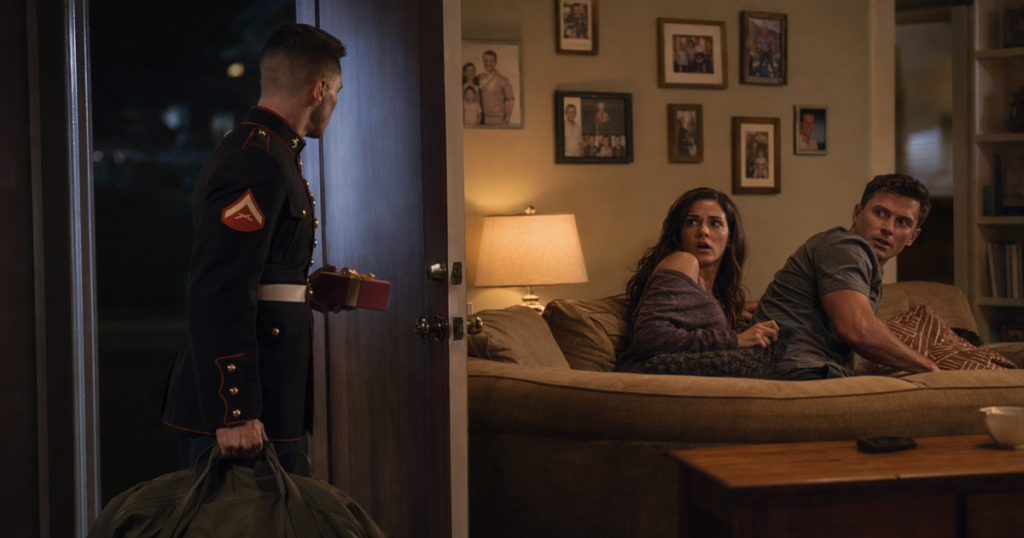
And then Daniel stepped forward and saw them.
Ella was on the couch, turned halfway toward a man Daniel had never seen before. They were too close. Close enough that no explanation in the world could clean the image into something harmless.
The man’s hand had been on her leg. Ella’s face was flushed, startled, a blanket half-fallen to the floor beside them. Two wine glasses stood on the coffee table. A pair of men’s shoes lay near the rug.
For one suspended second, no one moved.
Daniel felt as if something inside him had shattered without making a sound.
Ella stood first.
“Daniel—”
Her voice broke on his name.
The stranger rose half a second later, tense, confused, then guarded.
Daniel looked at Ella.
Only Ella.
Everything around him blurred. The room, the lights, the stranger, the sound of his own breathing. All of it narrowed into her face.
She looked shocked. Pale. Guilty.
He had never seen guilt on her face before.
The flowers slipped from his hand and hit the floor. White lilies scattered sideways across the hardwood, one petal catching near the leg of the coffee table.
Daniel opened his mouth, but no words came.
He had imagined this doorway so many times.
In every version, she ran to him.
In this one, she looked like someone caught between two collapsing walls.
“Daniel,” she said again, stepping forward, “I can explain.”
He finally found his voice.
“No.”
It came out quiet, rough, almost unrecognizable.
The man on the other side of the couch took a step back. “Look, I didn’t know—”
Daniel turned his head just enough to look at him.
It was not a dramatic movement. Not threatening. But whatever was in Daniel’s face made the man stop speaking.
Ella pressed a hand to her chest. “Please. Please listen to me.”
“How long?” Daniel asked.
He did not raise his voice.
That frightened her more than shouting would have.
“Daniel—”
“How long?”
The stranger looked away. Ella did not answer. Her eyes filled, but he could not feel anything from that. Not yet. Maybe not ever.
“Tell me,” he said.
She swallowed. “A few months.”
The room tilted.
Daniel laughed once, and the sound was so empty it startled even him.
“A few months.”
He repeated it like he was testing a language he no longer understood.
The man reached for his shoes. “I should go.”
Daniel did not stop him. He did not speak as the man grabbed his jacket, slipped past the edge of the room, and moved quickly toward the front door. There was a muttered apology Daniel barely heard. Then the door opened, closed, and the house was left with only the two people who had once called each other everything.
Ella took one hesitant step toward him. “I never wanted you to find out like this.”
Daniel looked at her and finally the pain came fully alive.
That sentence. Of all possible sentences.
Not I never wanted to hurt you.
Not I’m sorry.
Not I was wrong.
He stared at her with a kind of disbelief deeper than anger.
“Find out like this?” he repeated.
Tears slid down her face. “I know how bad that sounds.”
He nodded once. “You do.”
She looked at the flowers on the floor and covered her mouth with one hand.
The sight of them seemed to reach her only then. The flowers. The uniform. The duffel bag. The open front door. The homecoming she had not known she was destroying.
Daniel slowly set the small velvet box on the entry table as if it had become too heavy to hold.
Ella saw it.
Her shoulders folded inward.
“Oh God.”
He did not cry then. The wound was too new, too sharp, too bright.
Instead, he stood with a strange terrible calm and asked, “Was any of it true?”
She stared at him. “What?”
“Us.” His voice broke on the single word. “Was any of it true?”
She shook her head immediately. “Yes. Yes, of course it was.”
“Was?” he said.
The way he said it made her flinch.
He took a step into the room, not toward her but toward the center of the life they had built. The framed wedding photo above the mantel. The couch they picked after visiting six stores because Ella wanted one soft enough for movie nights. The throw blanket his mother had sent them on their third anniversary. The mug on the side table with the tiny chip in the handle.
So many ordinary things.
So much trust living inside those things.
“How does this happen?” he asked. “How do you go from writing me that you miss me to this?”
She wiped at her tears with trembling fingers. “I was lonely.”
The answer landed badly.
Daniel looked away for the first time, pressing his tongue hard to the inside of his cheek.
“Lonely,” he repeated.
“I know that doesn’t excuse anything.”
“No,” he said. “It doesn’t.”
She shook her head again, desperately now. “I’m not saying it does. I’m not saying that. I just— I need you to understand I was falling apart here too.”
He turned back to her. “So you found someone else to hold you together?”
She closed her eyes.
The silence that followed was not empty. It was full of everything neither of them could fix.
When she finally spoke, her voice was small. “His name is Aaron.”
Daniel almost smiled at the uselessness of the detail.
“I don’t care.”
She pressed both hands to her temples. “Please stop looking at me like that.”
He swallowed hard. “Like what?”
“Like I’m a stranger.”
Daniel stood still for a long moment.
Then he said the cruelest truth he could find. “Right now, you are.”
That was when she broke and began to cry openly.
She sank onto the edge of the couch, shoulders shaking, and for one split second an old instinct rose in him. The instinct to cross the room. To kneel in front of her. To say her name softly and ask what was wrong.
But the instinct died before it reached his feet.
He picked up his duffel bag from the floor.
Ella looked up fast. “What are you doing?”
“What does it look like?”
“Daniel, don’t leave. Not like this.”
He stared at her. “You really don’t get to decide how this part happens.”
“Please.” She stood again. “Please, just talk to me.”
“Now?” His voice rose for the first time. Not a scream, but a cracked, burning thing. “Now you want to talk?”
She stepped back as if struck.
He breathed in hard, trying to hold himself together.
“I spent months wanting this door,” he said. “Months. Do you understand that? I counted days to come back to you. I imagined your face. I bought you—”
He stopped and looked toward the small blue box on the entry table.
Ella followed his eyes and began crying harder.
Daniel laughed again, but this time there was anger in it.
“I was standing outside smiling like an idiot.”
“Daniel, I’m sorry.”
“I know.”
“No, I mean it.”
“I know that too.”
He grabbed the car keys from his pocket.
Ella moved toward him again. “Where are you going?”
“Anywhere else.”
“You’ve been traveling all day.”
He let out a hollow breath. “Thank you for your concern.”
She winced.
He walked to the door.
“Daniel.”
Her voice stopped him at the threshold, but he did not turn around.
“I did love you.”
The sentence hit him in the spine.
For a long second he could not move.
Then he said, without looking back, “That makes it worse.”
And he left.
The hotel room smelled faintly of old carpet and industrial detergent. The air conditioner rattled every time it kicked on. A neon sign from the parking lot flashed weak red light through the gap in the curtains.
Daniel sat on the edge of the bed still wearing half his uniform and stared at the wall.
His phone had been buzzing on and off for nearly an hour.
Ella.
Ella.
Ella.
Then messages.
Please answer.
Please tell me where you are.
I’m sorry.
Please.
He put the phone face down and leaned forward, elbows on knees, hands clasped so tightly his knuckles whitened.
He had thought pain would come like a burst.
Instead it came in waves that kept changing shape.
Shock.
Humiliation.
Grief.
Anger.
A strange almost physical nausea every time the image replayed in his head.
Aaron’s hand on her leg.
Wine glasses.
The blanket.
The way she said, I can explain.
He stood abruptly and paced to the window.
Outside, headlights slid through the lot. Somewhere, a door slammed. A television laughed through a thin wall.
Ordinary life was continuing. That offended him.
He wanted the whole world to stop for one hour and acknowledge what had just happened.
He called the only person he trusted enough to hear him breathe badly and know something was wrong before he spoke.
His older sister, Marissa.
She answered on the second ring. “Danny?”
He had not heard her call him that in years. Not because she did not, but because life had stretched thin between them: jobs, cities, deployments, obligations. Yet the name undid something in him instantly.
He sat back down on the bed.
“Hey,” he said.
And she knew.
“What happened?”
Daniel tried to answer and found that his throat no longer worked.
Marissa did not rush the silence.
When he finally spoke, the words came unevenly.
“I came home early.”
“Yes.”
“I wanted to surprise her.”
A pause.
Then softly: “And?”
He closed his eyes.
“She wasn’t alone.”
There was a long silence on the line. Not empty. Just careful.
Then Marissa said, “Where are you?”
“At a motel off I-7.”
“Are you alone?”
“Yes.”
“Have you been drinking?”
“No.”
“Good.” Her voice stayed calm. “Stay there tonight.”
He let out a laugh that sounded broken. “That’s the plan.”
She waited again, then asked, “Do you want to tell me everything?”
“No.”
“Okay.”
That nearly made him cry.
Not being pushed.
Not being asked for detail.
Just being held in place by a voice that knew grief could make language feel like glass.
“Did she know you were coming?” Marissa asked.
“No.”
“I’m sorry.”
He stared at the cheap framed print on the wall. Some pale painting of boats no one would ever really look at.
“I keep thinking,” he said slowly, “if I had called first, maybe I would never know.”
Marissa was quiet for a moment. “You would know eventually.”
He said nothing.
She continued, “And if you didn’t, you’d still be living inside something false.”
He pressed the heel of his hand into one eye.
“It doesn’t feel better.”
“It won’t tonight.”
After a while, she said, “Do you want me to come tomorrow?”
“No, you’ve got the kids.”
“I can still come.”
He looked at the dark window. “Maybe tomorrow afternoon.”
“All right.”
She paused. “Daniel?”
“Yeah?”
“Don’t make any big decisions tonight.”
He nodded before remembering she could not see it. “Okay.”
“And don’t go back there alone if you think it’ll break you open worse.”
He drew in a slow breath. “Okay.”
After the call ended, he sat in silence until midnight. Then one in the morning. Then something past two.
At some point he opened the velvet box.
The bracelet caught the motel lamp light and gleamed softly against the cheap bedding.
Still you. Still us.
Daniel closed the box and put it in the trash.
Then, almost immediately, he took it back out.
He did not know why. Pride maybe. Memory. Or maybe because some objects should not be punished for belonging to a story that failed.
By morning, he felt as if he had aged ten years.
He showered. Changed clothes. Shaved because the man in the mirror looked too much like someone unraveling.
There were twenty-three messages from Ella.
Two voicemails.
One from his mother, who almost never called before noon. That meant Ella had reached out to her.
Daniel listened to none of them.
Instead he drove to Marissa’s house on the other side of town.
When she opened the door, she took one look at his face and wrapped her arms around him without a word.
For a second he stood stiffly, then he let himself lean.
Her kitchen smelled like coffee and toast and the peanut butter crackers her youngest son always left open. The room was cluttered in a way Daniel found comforting. Shoes by the back door. Crayon marks on the fridge calendar. A damp dish towel draped over the sink.
Real life.
Unpolished, imperfect, honest.
Marissa set a mug in front of him and sat across the table. She did not ask whether he wanted sugar. She already knew he took coffee black when he was upset, even though he always pretended it was just preference.
He wrapped his hands around the cup and stared into it.
“She called me,” Marissa said after a while.
Daniel’s jaw tightened. “Of course she did.”
“She was crying.”
He gave no answer.
“I didn’t say much.”
He looked up then. “What did you say?”
Marissa leaned back. “That this wasn’t my conversation to have.”
He nodded once. Gratitude moving under the surface of his exhaustion.
After a moment she said, “Do you want the harsh truth, the gentle truth, or no truth at all?”
A weak tired smile touched his mouth. “Still talking like a big sister.”
“Choose.”
He rubbed his face. “Gentle truth.”
Marissa studied him. “You can still love someone and leave them.”
The words settled heavily between them.
Daniel looked down at the coffee.
“She says she loves me.”
Marissa’s expression did not shift. “People say a lot of true things too late.”
That landed with terrible accuracy.
He took a sip and nearly burned his tongue, but welcomed the feeling.
“She said she was lonely.”
Marissa was quiet. Then: “Maybe she was.”
He looked up sharply.
She held his gaze. “Loneliness is real. So is betrayal. One does not erase the other.”
Daniel leaned back in the chair and looked toward the window over the sink. Marissa’s yard was full of bright plastic toys and two bicycles left half-fallen in the grass.
“I keep trying to find the part where I missed something,” he said.
She did not rush to answer.
“Maybe you did,” she said finally. “Maybe you didn’t. Either way, her choices are still her choices.”
He swallowed.
“What do I do now?”
Marissa exhaled softly. “You breathe. You eat something. You sleep. Then you decide whether you want a conversation for closure, for answers, or for logistics. But you don’t go back there hoping to repair it before you even understand what broke.”
He nodded slowly.
There was movement in the hallway, and a small boy in dinosaur pajamas appeared rubbing his eyes.
“Uncle Danny?”
Daniel forced softness into his face. “Hey, buddy.”
The boy padded over and climbed into Daniel’s lap as if grief had not redrawn the shape of the world overnight. He just wanted closeness, cereal, cartoons, morning.
Daniel held him automatically and closed his eyes for half a second.
That simple innocent weight nearly shattered him.
He had wanted children with Ella.
They had talked about it seriously in the last year. Names. School districts. Whether they wanted a dog first or a baby first. Whether the guest room would become a nursery or stay an office one more year.
He felt sick again.
Marissa must have read something in his face because she stood and gently lifted her son from Daniel’s lap.
“Come on,” she told the boy. “Let Uncle Danny finish his coffee.”
After she settled the children in front of a cartoon and returned, Daniel spoke in a lower voice.
“We were trying.”
Marissa froze.
“For a baby?” she asked carefully.
He nodded.
Her face changed. Not with shock exactly, but with the kind of sorrow that comes when pain reveals another layer beneath itself.
“Oh, Danny.”
He stared at the tabletop. “We had been talking about appointments. Timing. All that.”
Marissa sat down slowly. “Does she know—”
“I don’t know what she knows anymore.”
The second day passed in fragments.
Phone calls he ignored.
A text from his commanding officer welcoming him back and asking him to confirm safe arrival.
A brief stop at a pharmacy because Marissa insisted he looked like he had not slept in a week.
A walk around the block in late afternoon because the walls of the house felt too close after too many quiet hours.
By evening, he knew he could not stay suspended forever.
He texted Ella one sentence.
We need to talk tomorrow. Noon. House.
Her reply came instantly.
Okay. I’ll be there. I’m sorry.
He read it and put the phone down.
The next morning, clouds hung low over the neighborhood. The air felt damp and metallic, like rain was thinking about arriving but had not decided yet.
Daniel parked in the driveway this time.
The sight of his own house made his stomach tighten so violently he had to sit in the car for nearly a full minute before getting out.
At the front door, his hand hovered before the knob.
He went inside.
The house smelled different.
Cleaner. Not in a comforting way. In the frantic way people clean when they are trying to scrub meaning off surfaces.
Ella was standing in the living room.
No makeup. Hair tied back. Sweater too big for her frame. She looked like she had not slept at all.
For a second neither of them spoke.
Then she said quietly, “Thank you for coming.”
Daniel remained near the doorway. “I live here.”
Her eyes dropped.
He noticed the coffee table had been cleared. The wine glasses were gone. The blanket folded. The room looked orderly, almost painfully so.
As if that could help.
“Do you want coffee?” she asked.
“No.”
She nodded, hands clasped tightly in front of her.
He had once known every shift in her expression. Now he watched her like a man translating a language he used to speak fluently.
“Say what you need to say,” he told her.
She inhaled, shaky and slow. “I’m sorry.”
He waited.
She continued. “I know sorry is small. I know it doesn’t fix anything. I know what I did was cruel. I know that.”
Daniel said nothing.
“Aaron and I met four months ago,” she said. “At work.”
He flinched almost imperceptibly.
“It wasn’t supposed to happen,” she added.
That made him laugh once. Not kindly.
“That line should be retired forever.”
Pain flickered across her face. “You’re right.”
She looked down at her hands.
“At first it was just talking. Lunch breaks. Complaining about work. Complaining about being tired. Complaining about missing you.”
Daniel’s jaw flexed.
“I felt ashamed even then,” she said. “Because I knew I was leaning in the wrong direction. But I kept telling myself it was nothing. That I was just lonely. That I needed someone to talk to because every day felt the same and I didn’t know how to say how angry I was at this life without sounding selfish.”
He finally spoke.
“Angry at me?”
Her eyes filled. “Sometimes. Yes.”
He nodded slowly. It hurt, but it did not surprise him as much as he wanted it to.
She continued in a trembling voice, “Not because you were there. Because you were gone. Because I hated what it turned me into here. Waiting. Smiling for everyone. Saying I was proud. Being proud. And also resenting everything.”
Daniel looked at her steadily.
“You could have told me that.”
“I know.”
“You didn’t.”
“I know.”
The repetition wore on him like sandpaper.
“Did you love him?” he asked.
She shook her head immediately. “No.”
“Did you tell him you loved him?”
“No.”
“Did he know about me?”
“Yes.”
He looked away then, out the window toward the dead patch of yard where they had once tried and failed to grow tomatoes.
“What exactly are you asking for?” he said.
Her mouth opened, then closed. She was silent for so long he turned back to her.
Finally she said, “I don’t know if I have the right to ask for anything.”
That, at least, sounded honest.
Daniel crossed his arms. “Start there.”
She wiped a tear from her cheek. “I don’t want our marriage to end.”
The words entered the room carefully, like something fragile placed on glass.
Daniel felt exhaustion wash through him.
Not rage. Not shock.
Just a deep, heavy tiredness.
“You should have wanted that before.”
She nodded, crying again.
“I did. I do. I was stupid. Weak. Selfish. I know all those words fit. I know they do.”
He studied her.
It would have been easier if she had lied. Easier if she had turned cold, defensive, cruel. Easier if she had blamed him so completely that he could gather his pain into one clean direction.
But she was not doing that.
She was standing there broken and guilty and still, somehow, familiar.
That made it harder.
“You don’t get to ask me to carry your guilt for you,” he said.
“I’m not asking that.”
“Good.”
She took a careful breath. “I’m asking whether there is any chance at all that this is the worst thing I have done, not the total truth of who I am.”
Daniel stared at her.
It was the kind of sentence that might have moved him once. Maybe even yesterday morning, before the door opened and life split in two.
Now he did not know what to do with it.
He walked into the kitchen and leaned one hand against the counter. Ella did not follow. That, too, he noticed.
On the fridge was the small magnetic notepad where they used to leave each other reminders.
Buy milk.
Call plumber.
Dinner with Tara Friday?
A newer note sat half-torn under the magnet.
Pick up dry cleaning.
Nothing else.
Nothing that showed the collapse of a marriage. Nothing that warned of the version of his life waiting in the next room.
“Did you ever think about telling me?” he asked, still facing away.
“Yes.”
“Why didn’t you?”
She answered after a long silence.
“Because once I said it out loud, everything would become real.”
He turned around.
“It became real anyway.”
She nodded.
Rain began tapping lightly against the window.
Daniel looked at her for a long time.
Then he asked the question he had not wanted to ask.
“Did you bring him here often?”
Her face folded.
He knew the answer before she spoke.
“A few times,” she whispered.
He closed his eyes.
That hurt worse than the image itself.
Not the betrayal in abstract, but its placement. Their couch. Their cups. Their room. The physical invasion of trust into the spaces where his own life had been kept.
When he opened his eyes again, they were wet.
Ella saw and covered her mouth, sobbing softly now.
“I’m sorry,” she said again.
Daniel shook his head once. “Stop saying it like repetition changes the size of it.”
She lowered her hand and forced herself quiet.
The rain grew heavier.
A memory hit him without warning.
One winter night three years earlier, a storm had knocked the power out across the neighborhood. They had sat on this same kitchen floor under blankets eating cereal by flashlight because all the food in the fridge would spoil anyway if the outage lasted. Ella had laughed because Daniel kept dramatically announcing the end of civilization. Later they had fallen asleep on the couch in their coats, cold but happy, lit only by the occasional sweep of passing headlights.
He looked at the woman before him and felt grief for more than betrayal.
He grieved the ordinary tenderness that now had nowhere safe to live.
“I don’t know who you are in this story,” he said quietly.
She cried harder.
“I don’t know who I am either,” she whispered.
That was the first thing she said that made him feel something close to pity.
And pity, he found, was dangerous. It softened edges he needed intact.
He straightened.
“I’m going to stay with Marissa for now.”
Ella nodded weakly.
“I’ll come by for my things later. Or you can leave for a few hours and I’ll pack what I need.”
“Okay.”
“We need to talk to a lawyer.”
She closed her eyes at that, but nodded again.
A hard silence followed.
Finally she said, “Is there really nothing I can say?”
Daniel thought about it.
Then he answered with the only truth he had.
“There are things you can say. I’m just not the man who can hear them today.”
She looked as if that sentence might stay with her for the rest of her life.
He left again, this time more slowly.
Not because he wanted to stay.
Because part of him understood this might be the last time he walked out of that house as her husband in anything but paperwork.
The weeks that followed were not dramatic from the outside.
No screaming matches in the street.
No plates thrown.
No public scenes.
Pain rarely looks the way people expect. Sometimes it is legal forms. Forwarded bank statements. Separate sleeping arrangements. Silent meals in other people’s homes. The humiliation of answering gentle questions with practiced vagueness.
Daniel moved into Marissa’s spare room.
He returned to base processing and administrative meetings he barely remembered afterward.
At night he lay awake staring at the ceiling, replaying details like a man pressing on a bruise just to prove it still hurts.
Ella wrote him two letters.
Real letters, handwritten, left in sealed envelopes with Marissa after Daniel refused to answer more texts.
He read the first one in his truck outside a grocery store and had to pull himself together before going inside.
It was not manipulative. That almost made it worse.
She wrote about loneliness without making it noble. Wrote about selfishness without dressing it up as confusion. Wrote that she understood trust was not an object dropped once and picked up later, unchanged.
She wrote that Aaron was no longer in her life.
Daniel did not feel relief.
She wrote that every room in the house now felt like evidence.
That he had once made the place feel safe simply by existing inside it.
That she knew memory had turned against them both.
The second letter came a week later and was shorter.
She wrote:
I keep thinking the worst part is that I hurt you.
Then I realize the worst part is that I injured the part of you that believed in me.
I don’t know how to ask forgiveness for that.
He folded the letter very carefully after reading it and sat with it in his hands for a long time.
He still did not answer.
But he did not throw it away.
One Sunday afternoon, nearly a month after he came home, Daniel met his mother for lunch.
She had always liked Ella. Sometimes more openly than she had liked her own son, Daniel used to joke.
Now she sat across from him in a small diner twisting her napkin into tighter and tighter shapes.
“She called me,” his mother said softly.
“I know.”
“She sounded destroyed.”
Daniel looked out the window. “I was there for the cause.”
His mother winced. “Daniel.”
He turned back. “What?”
“She made a terrible choice.”
He said nothing.
“She also loved you very much.”
Anger rose so suddenly he almost stood.
“Please don’t do that.”
“Do what?”
“Don’t take something broken and polish it into something easier for everyone else to look at.”
His mother lowered her eyes.
The old boy inside him, the one who had spent years swallowing hurt to keep peace at the table, stirred violently.
“You always do this,” he said, keeping his voice low only because the waitress was nearby. “You always find the softer version for the person who caused the damage.”
His mother stared at him.
Then, quietly, she said, “Because I know what it costs to live as the person who caused damage.”
The words stopped him cold.
Daniel sat back.
His parents had been married thirty-one years before his father died. Their marriage had looked stable from the outside in the stale, duty-bound way some marriages do. Daniel knew they fought. Knew there had been hard seasons. But there were many things his parents never discussed in front of their children.
His mother met his eyes with a strange old sadness.
“Your father was not faithful to me,” she said.
Daniel felt his heartbeat in his throat.
“What?”
“It happened more than once.”
He stared at her.
She spoke with an evenness that suggested the pain had long since cooled into bone.
“You were young. I never told you. Marissa found out when she was older, but I asked her to keep it from you.”
Daniel could not speak.
His mother went on. “I stayed. Not because it was easy. Not because it was noble. Because I was scared, because I had two children, because I had no money of my own, because I still loved him, because I hated him, because people are not simple when they break each other.”
Daniel felt the room shift around him.
“You knew what this was,” he said quietly.
“Yes.”
“And you never told me.”
She looked at him steadily. “Would it have helped you?”
He did not know.
Maybe it would have made betrayal less abstract.
Or maybe it would have made him distrust love before he had even learned how to offer it.
His mother took a breath. “I’m not telling you to stay with Ella.”
“Then why are you telling me this now?”
“Because pain sometimes makes us believe there is only one morally clean response. Leave immediately. Stay immediately. Forgive immediately. Punish immediately. Life is uglier than that. I wanted you to know you are allowed to not know yet.”
Daniel looked down at the table and felt, unexpectedly, exhausted all over again.
He went to therapy because Marissa refused to let him call it “just talking to some stranger” and instead scheduled the first appointment herself, then texted him the address.
The therapist’s office smelled like cedar and tea. Her name was Dr. Levine. She wore simple silver earrings and had a way of waiting through silence that made Daniel feel both irritated and seen.
On the third session, she asked, “What exactly was destroyed?”
Daniel frowned. “My marriage.”
She tilted her head slightly. “Only that?”
He understood the question immediately and hated it.
He stared at the rug.
“Pride,” he said after a while. “Trust. The part of me that thought loyalty guaranteed something.”
Dr. Levine nodded. “That last one matters.”
Daniel rubbed his hands together. “I did everything right.”
“Did you?”
He looked up sharply.
She held her ground. “I’m not asking whether you deserved this. You did not. I’m asking whether ‘doing everything right’ is a real human condition or a form of bargaining after harm.”
He leaned back, annoyed despite himself.
After a moment he said, “I stayed faithful.”
“Yes.”
“I came home.”
“Yes.”
“I loved her.”
“Yes.”
Dr. Levine folded her hands. “None of those things are meaningless. But none of them ever made you all-powerful over another person’s choices.”
Daniel looked away.
That sentence stayed with him all week.
Not because it was comforting.
Because it was true.
Months passed.
Not cleanly. Not heroically.
Some days Daniel felt steadier, almost normal. Then he would see a woman with Ella’s hair in a checkout line and his chest would tighten so hard he had to leave his cart and walk outside.
The divorce paperwork began.
He and Ella met twice with lawyers, once together to review shared assets and once separately to sign preliminary documents. They were polite in the numb, stunned way people often are when emotion has been forced into administrative language.
At one meeting, Ella slid a folder toward him.
“I listed everything from the joint account and the mortgage records.”
“Thanks.”
Their fingers almost touched over the table. Both pulled back.
Her wedding ring was gone.
His had been in his dresser drawer for weeks.
She looked thinner. Older around the eyes. He knew he did too.
On the way out of the office, rain had started unexpectedly, and they stood under the awning for a moment because neither had brought an umbrella.
This would once have been a trivial shared inconvenience. An excuse to laugh and run to the car.
Now they stood with six inches of air between them and a whole ruined life in that space.
Ella looked out at the rain and said quietly, “I still think about the flowers.”
Daniel did not answer.
After a second she added, “I know I don’t deserve to say that.”
He kept his eyes on the street. “No.”
She nodded.
Then, after a long silence, he said something he had not planned to say.
“I almost called first.”
She turned toward him.
“The night I came home,” he said. “I almost called from the airport.”
Something broke across her face.
“If you had,” she whispered, “I would have answered.”
He laughed once without humor. “That’s the tragedy, isn’t it?”
Neither said another word until the rain lightened enough to cross the parking lot.
Near the end of the year, Daniel returned to the house for the first time since moving the last of his things out.
It was not their house anymore. It was being prepared for sale.
Ella had already moved into a small apartment across town.
The real estate agent had asked them both to come sign one final document about repairs and staging authorization.
The place was half-empty.
Without furniture, the rooms looked exposed and strangely smaller. Sunlight fell hard across the bare floors, revealing scratches, dust, nail holes where framed photos used to hang.
Daniel stood in the living room and felt the absence like weather.
He heard Ella’s footsteps behind him but did not turn right away.
“It feels different,” she said.
He nodded. “It is.”
There was a pause.
Then she asked, “Do you ever miss it? Not me. Just… this.”
He considered the question honestly.
“Yes,” he said. “I miss who I was here.”
When he finally looked at her, she was crying silently.
He did not move closer.
But he did not move away either.
That tiny stillness between them held more truth than most of their recent conversations.
After the documents were signed, the agent stepped outside to take a call, leaving them alone in the kitchen.
Ella stood near the counter, fingers resting on the worn edge where Daniel used to stand cutting vegetables while she talked about her day.
“I started therapy too,” she said quietly.
He nodded once. “Good.”
“I didn’t do it to impress you.”
“I didn’t assume you did.”
She looked at him with tired gratitude.
“I keep trying to understand how I became someone capable of that,” she said.
Daniel answered more gently than he expected. “Have you learned anything?”
She gave a sad half-smile. “Too much and not enough.”
For the first time in many months, something like peace passed between them. Not reconciliation. Not hope. Just two damaged people standing honestly in the ruins.
Then Ella said, “I know I probably lost the right to ask this, but I need to know. Did you ever hate me?”
Daniel thought for a long time.
“When I first saw you that night,” he said, “I think part of me did.”
She closed her eyes.
He continued. “But hate is too simple for what came after.”
She nodded slowly, tears slipping down her face.
“What came after?” she asked.
He looked around the kitchen one last time.
“Grief,” he said.
The house sold in early spring.
Daniel moved into a small apartment near the river, close to base but far enough from Whitmore Avenue that he did not have to accidentally pass the old life on errands.
He bought secondhand furniture, cooked simple meals, and learned the quiet habits of living alone without waiting for them to end.
He kept going to therapy.
He ran in the mornings.
He called Marissa more often.
He visited his mother without old resentment sitting quite so heavily between them.
Healing did not look impressive. It looked repetitive.
Sleep.
Work.
Paperwork.
Honesty.
Loneliness.
More honesty.
One evening, nearly ten months after the night at the door, he received a message from Ella.
Not dramatic. Not emotional.
Just:
I heard your unit is sending people out again. I won’t cross any line you don’t want crossed. I just wanted to say I hope you come back safe.
He stared at the message for a long time.
Then he replied:
Thank you.
Nothing more.
But his hand shook slightly after sending it.
That spring, while helping Marissa clean out her garage, Daniel found an old box of childhood photos. In one, he and Marissa were sitting cross-legged on a front step eating popsicles, both squinting into the sun. In another, his mother was younger than he had ever allowed her to seem in memory, smiling with tired eyes while holding them both at the beach.
So much of life, he realized, survives in pieces. Not whole narratives. Fragments. Images. Conversations. Regrets. Acts of care that come too late to save one thing but early enough to save another.
That night, he thought about calling Ella.
Not to reconcile.
Not to revisit.
Just to say that he finally understood something about human ruin and human weakness and the terrible softness of still wishing someone well after they had broken you.
But he did not call.
Some truths do not need witnesses.
Nearly a year after the divorce was finalized, Daniel ran into Ella by accident at a bookstore downtown.
He was in the history section, holding a hardcover he had no real intention of buying, when he heard her voice asking a clerk whether they had more copies of a certain novel in back.
He turned before he could decide not to.
She looked up.
For a moment both simply stared.
Time had not erased familiarity. It had only thinned its claims.
“Hi,” she said.
“Hi.”
She looked healthy in a quieter way than before. Stronger maybe. Or simply sad in a more integrated form.
“You look well,” she said.
He gave a small shrug. “I’m doing okay.”
She nodded. “I’m glad.”
A silence followed, but it was not cruel.
She held up the book in her hand. “I’m buying this for my niece. She has to read it for school and apparently I’m the cool aunt now.”
Daniel smiled despite himself. “Congratulations.”
That made her smile too. Briefly.
Then she glanced at the book in his hand. “Still buying books you may never read?”
He looked down and laughed softly.
“You remember that.”
“I remember a lot.”
The sentence might once have cut. Now it just sounded true.
He shifted the book to his other hand. “How are you?”
She thought about it before answering. “Better than I was. Not as good as I hoped I’d be by now.”
He nodded. “That sounds honest.”
She smiled sadly. “Therapy taught me that line.”
He almost said, Same.
Instead, he asked, “You still in the apartment?”
“No. I moved closer to my office. Smaller place. Fewer ghosts.”
He let that sit between them.
Then she said, “I heard from your mom that you might be taking classes.”
He raised an eyebrow. “My mom is still running an informal news network?”
A faint laugh escaped her. “Apparently.”
“Yeah,” he said. “Maybe. Logistics and operations. I’m thinking ahead.”
“I think that’s good.”
He looked at her for a long second.
There was no dramatic swell of regret. No impossible desire to rewind. No fantasy that enough pain had made them new people fit for an old promise.
There was simply history.
And tenderness transformed into something smaller, cleaner, sadder.
“I’m glad you’re okay,” he said.
Ella’s eyes filled slightly, though she blinked it back. “I’m glad you are too.”
A customer brushed past them with an apologetic smile, breaking the moment.
Daniel stepped slightly aside.
Ella held her book against her chest.
“Well,” she said, “I should go.”
“Yeah.”
She hesitated. “Take care of yourself, Daniel.”
“You too.”
She turned and walked toward the register.
He watched her only long enough to confirm that this was real, that he could stand in the same room with her and not come apart.
Then he put the history book back on the shelf and walked out into the afternoon sun.
Outside, the air was cool and bright.
Cars moved steadily through the intersection. Someone down the block was laughing too loudly. A cyclist passed, head bent into the wind. The city was doing what it had done on the worst night of his life and every day since.
Continuing.
Daniel stood on the sidewalk and looked up at the clear open sky.
He thought about the man he had been when he stepped onto the porch with flowers in one hand and a gift in the other. Full of certainty. Full of loyalty. Full of a future he believed was waiting obediently where he left it.
That man was gone.
But not everything he carried had died with him.
He still knew how to love.
He still knew how to stay soft without staying blind.
He still knew the difference between grief and bitterness, even if learning it had cost him more than he wanted to admit.
Some heartbreaks destroy a life.
Others destroy only the version that could not continue.
Standing there in the clean afternoon light, Daniel realized that survival had never meant pretending the wound was smaller than it was.
It meant refusing to build a home inside the wound.
He took a long breath.
Then he started walking.