newborn kept crying – and what I saw left me shaken. On the screen, my mother rushed into the
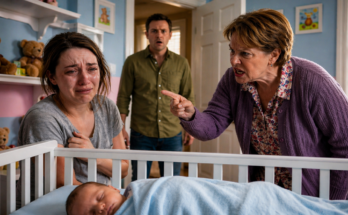
nursery, leaned in, and said, “You live off my son and still complain?” Then she grabbed my
exhausted wife by the hair beside the crib. My wife did not scream – she just froze. When I reviewed
the saved footage, I discovered weeks of mistreatment. She thought I would never find out – until I got
in my car and decided her time under my roof was over.
Chapter 1: The Glass-Walled Tomb
I used to believe silence was the sound of peace. In the high-stakes world of international corporate
acquisitions, I spent my days navigating loud boardrooms and relentless pressure. My life was built on
calculations, negotiations, and control. When I returned to our home – a sprawling, glass-walled
sanctuary in the hills of Westchester – I longed for stillness. I thought the quiet inside our house was
proof of the safety I had built for my wife, Elena, and our newborn son, Leo.
I was wrong. I had spent my career identifying hidden liabilities in billion-dollar deals, yet I was blind to
the collapse happening inside my own home. I did not understand that silence was not peace; it was a
heavy cover, a place where truth could disappear.
Over the last six months, Elena had become a shadow of herself. Once a brilliant, sharp-witted
architect known for her unapologetic strength, she was now a woman with hollow eyes and whispered
apologies. She said she was tired. The specialists suggested postpartum fatigue. But I saw the way
her hands trembled when she reached for a glass of water. I saw the way she looked at my mother,
Martha Vance, with a fear that felt almost primal.
Martha had moved in “to help” after the birth. She was the matriarch of the Vance legacy, a woman
who wore her heritage like armor and treated vulnerability like a flaw. She moved through the house
like a ruler of perfection, her presence marked by the soft clink of pearls and the scent of expensive
lilies and hairspray.
“She is fragile, David,” my mother would whisper in the hallway, her voice soft but cutting. “Some
women are simply not built for the pressure of the Vance name. Motherhood is a test, darling. Do not
worry. I am here to keep the house from falling apart while you are out conquering the world.”
I felt a constant guilt. I prided myself on precision, yet I let my mother’s version of events become my
reality. I wanted to help Elena, but every time I tried to hold her, she pulled away. “I am fine, David.
Just go to work,” she would say, her voice emptied of its former spark.
Finally, desperate to understand why my son cried with such rhythmic distress every time I pulled out
of the driveway, I did something I never thought I would do. I turned to the same kind of technology I
used to secure my executive suites.
I installed the Guardian Cam.
It was a state-of-the-art, 4K, audio-sensitive device disguised as a small hand-carved wooden owl
sitting on the nursery bookshelf. I told myself it was for Elena’s protection – an extra set of eyes so she
could rest while the baby slept. I did not realize it would uncover something much darker.
As I pulled out of the driveway on the morning of the Heidigger merger, I glanced at the side mirror
and saw my mother standing at the nursery window. She was not waving goodbye. She was smiling –
a sharp, unsettling expression – before pulling the heavy curtains shut with sudden force.
Chapter 2: The Predator’s Theater
The executive parking lot at Vance Global was a sea of polished chrome and ego. Usually, this was
my arena. But that morning, I sat in my car with the engine idling, my hands gripping the steering
wheel so tightly my knuckles turned white.
My phone buzzed. A high-priority motion alert from the Guardian Cam.
I expected an ordinary scene at home. I expected the quiet, uneventful peace of a nursery. Instead,
the screen lit up with something I will never forget.
The nursery door flew open with such force that the wooden owl rattled on its shelf. Martha marched
in, her face completely changed. The polished, saintly mask of the devoted grandmother had fallen
away, revealing a coldness I had never seen in thirty-two years.
Elena was sitting in the rocking chair, her hair unkempt, holding a crying Leo against her chest. She
looked small, as if the room itself was pressing down on her.
“You are a burden, Elena,” my mother’s voice cut through the phone speakers. “You live in this house,
you wear the jewelry my son bought you, you spend the money he works for, and you still dare to sit
there and say you are tired?”
“He has been crying for three hours, Martha,” Elena whispered, her voice breaking. “I think he has a
fever. Please, let me call the pediatrician. I need to know he is okay.”
“You will call no one,” Martha snapped, stepping closer. “You are incapable. If David knew how
useless you were, he would have ended this long ago. I am the only reason he has not realized he
married someone who cannot handle this life.”
Then my heart stopped.
Martha reached out and grabbed Elena by the hair with a practiced cruelty. She pulled Elena’s head
back so hard I heard the strain through the microphone. Leo cried even harder. I waited for Elena to
fight back. I waited for her to scream or push her away.
But she did not. Elena simply closed her eyes as one tear rolled down her cheek. Her body went still
in the kind of surrender that only comes from fear that has lasted too long.
“Look at me when I am speaking to you,” Martha said, tightening her grip. “You live off my son, and
you still dare to complain? Maybe today is the day I show him the ‘medical records’ I have been
preparing.”
A wave of anger rose inside me – cold, immediate, and overwhelming. I was not just angry. I was
horrified by my own role in it. My silence had made room for this. My absence had given her power.
Then Martha pulled a small, unmarked pill bottle from her pocket. She looked toward the wooden owl
- not because she knew it was a camera, but as if she were checking her reflection – and began to
laugh. “Time for your afternoon nap, Elena. Let us see how David likes finding his wife passed out on
the job again.”
Chapter 3: The Audit of Souls
I did not go to the merger meeting. I did not care about the billions on the table. I drove to a quiet,
secluded park three miles away, parked beneath a wide, bare oak tree, and opened the Guardian
Cam’s cloud storage.
If I was going to expose someone this dangerous – a woman who shared my own blood – I needed
more than a single clip. I needed a full record. I needed proof of everything she had done.
I started scrolling back through the last seventy-two hours. What I found was a chilling pattern of
calculated cruelty, a step-by-step breakdown of how someone could slowly wear another person
down.
I watched a clip from Tuesday night, when I was supposedly at a celebratory business dinner. Martha
was in the nursery, but she was not trying to comfort the baby. She stood over Leo’s crib and made
loud, sudden claps every time his eyes began to close, deliberately startling him awake. She was
keeping a newborn from sleeping, creating a cycle of exhaustion for his mother. Then she would walk
into our bedroom and scold Elena for being “too lazy” to keep the baby quiet while I was at work.
Then I saw the emotional manipulation.
“David told me he is staying late because he cannot stand the sight of you anymore,” Martha told
Elena in a clip from Wednesday morning. “He said you have become a burden, Elena. A liability to the
Vance legacy. He is only staying for the boy. If you tell him a word of this, I will make sure the court
sees the ‘psychiatric history’ I have been building on you. I have friends on the board of health, Elena.
One call, and they will believe me – and I will be the one raising my grandson.”
She had been building a false story of mental instability. She had been planting empty pill bottles in
the bathroom trash for me to find. She had been the one making the baby cry, creating a crisis that
only she could solve.
But the most disturbing evidence was the drugging.
I watched in frozen shock as my mother walked into the kitchen after I left. She pulled two white
tablets from her purse and crushed them into a fine powder with a silver spoon. She stirred the
powder into Elena’s morning water with calm, deliberate movements, as if she were preparing tea.
“Sleep,” Martha whispered to the empty, sunlit kitchen. “Sleep so I can show David how you neglect
his son. Sleep until you forget who you are.”
My stomach turned. She was not just controlling; she was committing a crime. She was chemically
sedating my wife in order to take over our family.
I spent the next two hours downloading the clips, encrypting them, and sending them to three different
places: my private cloud, my personal attorney, and a high-ranking contact in the District Attorney’s
office. I was not just building a divorce case. I was building a legal case.
I looked at the clock. 2:45 p.m. My mother would be preparing her “afternoon tea,” and Elena would
likely be in the nursery, trying to fight off the sedative Martha had slipped into her drink.
I shifted the car into drive. I did not feel like a husband anymore. I did not feel like a son. I felt like
someone bringing the truth home.
As I pulled into our driveway, I saw a white van parked across the street. The driver did not look like a
delivery man. He was holding a long-lens camera pointed directly at my front door. In that moment, I
realized my mother was not only setting Elena up – she was hiring a private investigator to document
the “neglect” she herself had created.
Chapter 4: The Homecoming of the Storm
The drive from the park to the house was a blur of cold, controlled calculation. I did not speed. I did
not yell. I focused on evidence. In my world, the person with the strongest documentation usually
wins.
When I stepped into the house, the silence was there to greet me – thick, heavy, and false. This time, I
knew what the glass walls had been hiding. I walked into the living room, where the scent of lilies felt
almost unbearable, like a funeral parlor trying to disguise itself as a home.
“David! You are home early, darling! What a wonderful surprise!” Martha appeared from the hallway,
her pearls gleaming in the afternoon light, her smile polished and false. “Is everything all right with the
merger? Elena is having another difficult afternoon, I am afraid. She is in the nursery, quite out of it. I
have had to take over with Leo again. It is a tragedy, truly. We may need to discuss… options.”
I did not answer her. I did not even look at her. I walked straight to the wall-mounted television in the
living room – the one we usually used for casual entertainment – pressed the input button, and synced
my phone.
“David? What are you doing? You look pale,” Martha said, and for the first time, I heard the nervous
edge in her voice. “Perhaps you should sit down. I will make you some tea. You have been working
too hard.”
“I do not want your tea, Mother,” I said, my voice cold and steady. “I want you to watch the Vance
legacy in action.”
Then I hit play.
The screen flickered to life. There was Martha, in clear detail, pulling Elena by the hair only hours
earlier. The audio echoed through the room: “You live off my son… you are a burden.”
Then the next clip: Martha startling the baby awake.
Then the final blow: Martha dropping white pills into the water glass.
My mother’s face turned pale. The color drained from her lips. Her hand flew to her throat, clutching
the pearls so tightly the string looked as if it might snap.
“It is not what it looks like,” she stammered, her voice high and thin. “She provoked me. She is
mentally unstable, David. I was trying to protect the legacy. You cannot trust a recording. It can be
faked. It is AI. It is a deepfake.”
“The metadata is encrypted and time-stamped, Mother,” I said, stepping toward her. “I saw you drug
my wife. I saw you assault the mother of my child. I saw you intentionally torment a newborn. You did
not protect the legacy. You destroyed it for the sake of control.”
Elena appeared in the hallway, leaning against the doorframe for support. Her eyes were unfocused
from the sedative, her movements slow, but she saw the screen. She saw the truth laid out in front of
her. A small, broken sob escaped her, the sound of months of fear finally cracking open.
Before my mother could speak again, the front door opened. It was not the police. It was the private
investigator from the van across the street, holding a manila folder.
“Mrs. Vance, I have the photos of the neglect you requested, but… David? Why are you here?”
Chapter 5: The Fall of the Matriarch
Martha Vance changed instantly, from polished social queen to cornered animal. She snatched the
folder from the investigator, her eyes wild.
“See!” she shouted, waving the photos at me. “Look at her. Look at her slumped in the chair. Look at
her ignoring the baby. These are the proofs. The court will see these, not your little spy-camera toys.”
I took the folder from her shaking hands and handed it back to the investigator. “Leave,” I told him.
“Your contract is terminated. If you show these photos to anyone, I will make sure your license is
reviewed before dinner.”
The man saw the anger in my eyes and quickly left.
“David, please,” Martha cried, her voice breaking. “I did it for you. I did it for the family. She is not one
of us. She is weak. I was only trying to make you see that you deserve better.”
“You did not do it for me,” I said, turning away from her. “You did it for control. You wanted a house
where you were the only one in power. But this is my house, Martha. And in this house, there is only
one outcome.”
I walked to Elena. I picked her up – she was so light, so fragile – and carried her toward our bedroom.
As I passed through the living room, I did not look back at the woman who had raised me.
“The show is over, Martha,” I said. “And the audit is finally complete.”
A black sedan pulled into the driveway. Two detectives stepped out. They were followed by an
ambulance.
“You drugged a nursing mother, Martha,” I said quietly as the detectives entered. “That is a felony.
You assaulted her on camera. That is a felony. You tried to build a false case against her. That is
another felony. You wanted a legacy? Here it is. The Vance matriarch in handcuffs. I have already
contacted the board of the Westchester Arts Council. By tomorrow, your name will be removed from
every building you ever donated to.”
“David, please! I am your mother!” she cried as the handcuffs closed around her wrists.
“No,” I said, looking toward the officers. “You are a liability I can no longer allow in this home.”
The neighbors – the same people she had spent decades trying to impress with her perfect life – stood
on their manicured lawns and watched as the queen of the hill was led away. Her social standing
collapsed in full public view.
As they placed Martha in the police car, she turned to me one last time, a twisted smile on her face.
“You think you won, David? Check the safe in the basement. I was not the only one recording things
in this house. Ask Elena about the architect’s secret from before the wedding.”
Chapter 6: The Light in the Nursery
One year later.
The nursery was no longer a room of shadows. It was full of sunlight, fresh lavender, and the beautiful
chaos of a toddler learning to walk.
Leo was taking his first wobbly steps across the rug, laughing while Elena cheered him on. She
looked radiant. The hollow eyes were gone, replaced by the sharp, brilliant architect I had fallen in
love with. She had just signed a contract to design a new wing for the city’s children’s hospital – a
project she was calling The Sanctuary.
The Guardian Cam was gone. We did not need a hidden eye anymore. We had rebuilt our home on
truth, and truth did not need to hide.
I stood at the window and looked out at the gardens. I had sold my mother’s estate and donated every
dollar of the proceeds to a foundation for mothers suffering from domestic and psychological abuse.
Martha was serving a suspended sentence in a high-end but closely monitored psychiatric facility – a
golden cage of her own making, a place where she had no one left to control and no one left to
impress. She spent her days writing letters to a son who never replied.
As for the “secret” she had mentioned during her arrest, it was nothing more than one final lie – an
attempt to plant one last seed of doubt. I opened the safe that night and found nothing except my
father’s old blueprints and a love letter Elena had written to me years before. Martha’s power was
gone, and all she had left was the poison in her own mind.
I sat on the floor beside my wife and son. The house finally felt like a home. The silence was no
longer a shroud. It was simply quiet.
That morning, I had received a letter from Martha’s lawyer – a weak, rambling plea for a legacy visit so
she could see her grandson.
I did not even open it. I dropped it into the fireplace and watched the expensive cream-colored
stationery curl into black ash.
Legacies are important, Martha, I thought as I watched my wife and son laugh together. But they are
not built on fear. They are not built on the pain you cause or the lies you tell. They are built on the
courage to protect the people you love, even from your own blood.
Elena looked up and saw me watching them. She smiled – a real, vibrant smile that reached her eyes.
“Ready for the party, David? The guests will be here soon.”
I walked over and took her hand, helping her to her feet. The woman my mother had tried to reduce
with insults had not been broken. She had become stronger than ever.
“I have been ready for a long time,” I said.
As we walked into the garden to celebrate Leo’s birthday, I noticed a small, hand-painted wooden box
on the porch. It was from a woman Elena had helped through her foundation. Inside was a simple
note:
“Because you listened when the world was silent.”
I closed the box and tucked it under my arm. The audit was over. The books were finally balanced.
And for the first time in my life, the silence of my home truly meant peace.