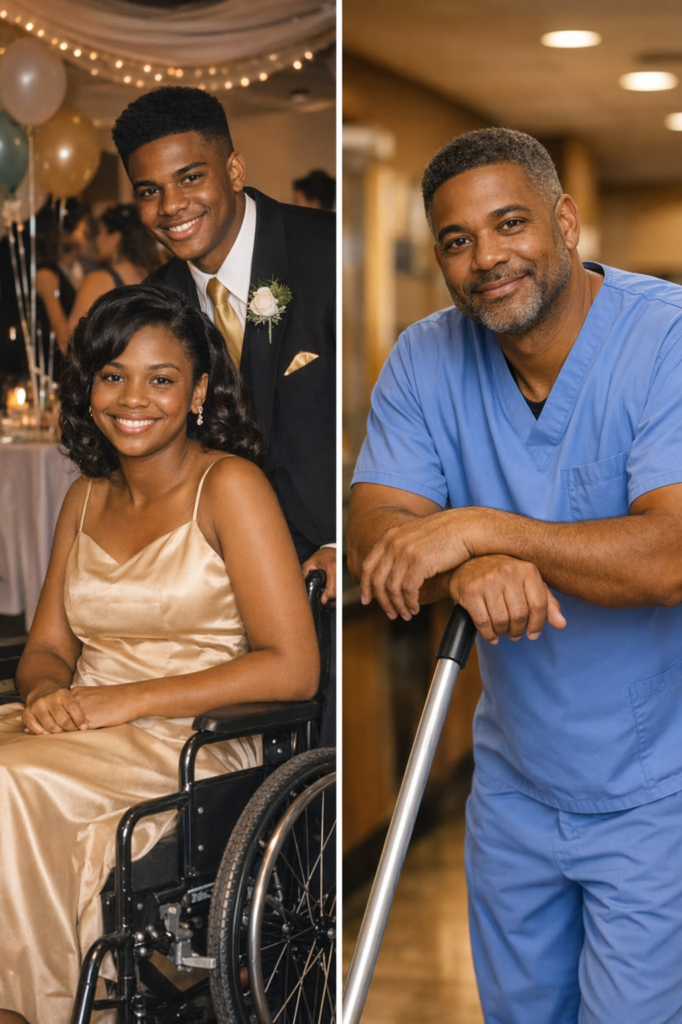
At prom, only one boy asked me to dance because I was in a wheelchair.
Thirty years later, I met him again… and changed his life.
I wasn’t always in a wheelchair.
Before everything changed, I was just a normal seventeen-year-old girl with normal dreams. I had posters on my bedroom wall, a messy desk full of school notes, and a prom dress magazine hidden under my pillow because I didn’t want anyone to know how excited I was.
I used to run everywhere.
Down the school hallway.
Across the soccer field.
Up the stairs two at a time when I was late for class.
I never thought about my legs. I never thanked them. I never imagined that one day, standing up would become the biggest wish in my heart.
Six months before prom, another driver ran a red light and changed my life completely.
One moment, I was in the passenger seat of my mother’s car, talking about the color of the dress I wanted to wear. I remember laughing because my mom kept suggesting pink, and I kept telling her I wanted dark blue.
The next moment, there was a loud crash, bright lights, and then nothing.
When I woke up, everything felt strange.
The room was white.
My mother was crying beside my bed.
My father stood near the window with both hands pressed over his mouth.
At first, I didn’t understand.
Then I tried to move.
My upper body shifted, but my legs did not respond.
I remember looking at my mother and asking, “Why can’t I feel them?”
She tried to answer, but no words came out.
That was the moment I knew my life had split into two parts.
Before.
And after.
The months that followed were the hardest months of my young life.
There were hospital rooms, doctor visits, therapy sessions, and nights when I cried quietly so my parents wouldn’t hear me. Everyone kept telling me I was strong, but I didn’t feel strong. I felt lost.
I watched my friends continue with school, dates, college plans, and prom excitement.
They still visited me at first.
They brought cards, flowers, and stories from class.
But little by little, the visits became shorter.
Then they became phone calls.
Then messages.
Then silence.
I didn’t blame them. Not really.
They were seventeen. They didn’t know what to say to a girl whose whole future had suddenly changed.
But knowing that didn’t make it hurt less.
By the time prom came, I didn’t want to go.
My dress was still hanging in my closet, dark blue with small silver details along the neckline. My mother had bought it before the accident. Every time I saw it, I felt like it belonged to another girl.
A girl who could walk into prom with her friends.
A girl who could stand for photos.
A girl who could dance.
The afternoon of prom, I told my mom, “I’m not going.”
She was sitting on the edge of my bed, holding the dress across her lap.
“You should go,” she said softly.
I shook my head.
“Everyone will stare.”
She reached for my hand.
“Maybe they will,” she said. “But that doesn’t mean you should disappear.”
I looked away.
“I don’t belong there anymore.”
My mother’s eyes filled with tears, but her voice stayed gentle.
“You deserve one beautiful night, sweetheart. Not because everything is easy. Because you are still here.”
I didn’t answer for a long time.
Then I looked at the dress again.
And somehow, I said yes.
That night, my father drove us to the school gym.
He helped me out of the car carefully. My mother adjusted my dress so it fell neatly over my legs. She brushed a loose piece of hair behind my ear and smiled like she was trying to be brave for both of us.
“You look beautiful,” she whispered.
I wanted to believe her.
But when I entered the gym, all I could feel were eyes.
The music was loud.
The lights were soft and colorful.
Girls in sparkling dresses stood in groups, laughing. Boys in suits adjusted their ties and pretended not to be nervous. Teachers stood near the walls, smiling proudly.
For a moment, everything looked exactly like I had imagined.
Except I wasn’t standing in the middle of it.
I was sitting at the edge.
My friends waved when they saw me, but the wave was awkward. One of them came over and hugged me too tightly. Another told me my dress was pretty. Then they drifted back to the dance floor.
I told myself it was okay.
I told myself I didn’t care.
But every song made the truth harder to ignore.
I watched everyone dance.
I watched couples hold hands.
I watched the life I thought I was supposed to have continue right in front of me.
Some people avoided looking at me.
Some smiled with pity.
Some acted like I wasn’t there at all.
After an hour, I wanted to leave.
I was already reaching for the wheels of my chair when a shadow fell across my dress.
I looked up.
Marcus Reed was standing in front of me.
Everyone knew Marcus.
He was the school’s golden boy. Star quarterback. Homecoming king. The kind of person teachers trusted, girls admired, and boys wanted to be around.
We had never been close.
We had shared a few classes, passed each other in the hallway, maybe smiled once or twice. That was all.
So when he stood in front of me that night, I thought maybe he needed to get past me.
Instead, he bent slightly and said, “Hey.”
I swallowed.
“Hi.”
He looked nervous, which surprised me.
Then he held out his hand.
“Would you like to dance?”
For a second, I thought I had heard him wrong.
I looked behind me, thinking maybe he was talking to someone else.
But there was no one there.
Only me.
My face grew warm.
“I… I can’t,” I whispered.
His expression didn’t change.
He didn’t look uncomfortable.
He didn’t apologize.
He didn’t make me feel smaller.
He simply smiled and said, “Then we’ll figure it out.”
Before I could argue, he gently took my hands.
Not in a way that felt sorry for me.
Not in a way that felt like charity.
Just gently.
Like I was a girl at prom, and he was asking me to dance.
The song playing was slow.
Marcus stepped behind my chair and moved it carefully in a small circle. Then he came around to face me, still holding my hands. He moved with the music, guiding me slowly, letting me follow in the only way I could.
At first, people stared.
I felt every look.
But Marcus didn’t look at them.
He looked at me.
“You’re doing great,” he said.
I almost laughed.
“I’m sitting down.”
“So?” he said. “Still counts.”
Something inside me broke open then.
Not in a painful way.
In a healing way.
For ten minutes, I forgot the hospital.
I forgot the pity.
I forgot the empty space where my old life used to be.
For ten minutes, I wasn’t the girl people avoided.
I wasn’t the accident.
I wasn’t the wheelchair.
I was just a girl in a blue dress, dancing at prom.
When the song ended, the gym was quiet for a second.
Then someone clapped.
Then another.
Then more.
I looked down because I didn’t want anyone to see me cry.
Marcus leaned close and whispered, “Don’t let them make you feel invisible.”
I never forgot those words.
After graduation, life moved in different directions.
Marcus left town for college.
I began a long road of recovery.
The doctors said progress would be slow.
They were right.
There were painful therapy sessions, difficult mornings, and days when I wanted to stop trying. There were times I hated the mirror. Times I hated the chair. Times I hated the version of myself I had become.
But my mother’s words stayed with me.
You are still here.
And Marcus’s words stayed too.
Don’t let them make you feel invisible.
So I fought.
Not all at once.
Not perfectly.
But little by little.
One day, I stood for three seconds.
Then ten.
Then one minute.
The first time I took a step with assistance, my father cried so hard he had to sit down.
The first time I walked across a room with braces, my mother covered her face and whispered, “Thank you.”
I never became the girl I used to be.
But I became someone new.
Someone stronger.
Someone who understood pain, kindness, loneliness, and courage in a way I never had before.
Years passed.
I went to college.
I studied social work.
Then I became a counselor for people rebuilding their lives after loss, injury, and major life changes. Later, I helped open a small foundation that provided support, therapy funding, mobility equipment, and job training for people who had been forgotten by the system.
I built a good life.
A meaningful life.
I even learned to love parts of myself I once thought were broken.
But I never saw Marcus again.
Sometimes, I wondered where he was.
I imagined he had become a coach, a businessman, maybe a father with kids who inherited his kind eyes.
In my mind, he always had a good life.
People like Marcus were supposed to have good lives.
That was what I believed.
Until the day I met him again.
Thirty years after prom, I walked into a small café on the edge of town.
I had returned to visit my parents. My mother had passed a few years earlier, and my father had recently moved into a smaller home. I was helping him sort through old boxes, old photos, and old memories.
That morning, I needed a quiet place to breathe.
The café was simple but warm.
Small tables.
Old wooden chairs.
The smell of fresh coffee and cinnamon.
A bell above the door that rang whenever someone walked in.
I ordered a coffee and turned toward an empty table near the window.
That was when my foot caught the edge of a loose floor mat.
I didn’t fall completely, but I stumbled hard.
The coffee slipped from my hand.
The cup hit the floor.
Hot coffee splashed across my fingers and spilled everywhere.
People turned to look.
A few gasped.
Someone said, “Oh no.”
But for a moment, nobody moved.
Then a man hurried from the back.
“Hey, don’t worry,” he said. “I’ve got it.”
He grabbed a towel first and handed it to me.
“Are your hands okay?”
I nodded, embarrassed.
“I’m fine. I’m so sorry.”
“No need to apologize,” he said. “This mat has been causing trouble all week.”
His voice was gentle.
Familiar.
But I didn’t recognize it right away.
He was wearing faded blue scrubs, the kind workers sometimes wear in care homes or clinics. His hair was gray at the temples. His face looked tired, and he walked with a clear limp, like every step required effort.
He cleaned the floor carefully.
Then, before I could stop him, he went to the counter and bought me another coffee.
I noticed his hands when he paid.
He counted coins slowly.
One by one.
Nickels.
Dimes.
Quarters.
The cashier looked uncomfortable, but he smiled like it didn’t bother him.
Something in my chest tightened.
When he turned back and placed the coffee in front of me, I finally saw him clearly.
The jawline.
The eyes.
The same calm kindness.
My breath caught.
“Marcus?” I whispered.
He paused.
His eyebrows drew together.
“I’m sorry?”
I stared at him, unable to speak for a moment.
He didn’t recognize me.
Of course he didn’t.
Thirty years had passed.
I was no longer the shy girl in the wheelchair with the blue dress.
I was a grown woman with silver in my hair, confidence in my posture, and a life he knew nothing about.
I almost told him right then.
But something stopped me.
There was sadness around him.
Not just tiredness.
Something deeper.
So instead, I smiled and said, “Thank you for helping me.”
He gave a small nod.
“Anyone would have.”
But I knew that wasn’t true.
Not everyone helps.
Not everyone sees people.
He did.
He always had.
After he walked away, I watched him move through the café.
He wiped tables.
Carried trays.
Swept near the door.
Smiled at customers who barely looked at him.
Once, he paused near the counter and pressed a hand against his leg like he was in pain. Then he took a breath and kept working.
I asked the young woman at the counter, “Does he work here full-time?”
She looked toward him and lowered her voice.
“Marcus? He works mornings here and evenings at the assisted living center. He’s a good man.”
I kept my voice casual.
“Family?”
She hesitated.
“I don’t know everything. I think his wife passed years ago. He took care of his son for a long time. Medical bills, I heard. He never talks about it much.”
My heart sank.
Before I left, I placed a generous tip under my cup.
Then I wrote a note on the napkin.
Thank you for the coffee.
But I didn’t sign my name.
That night, I couldn’t sleep.
I sat in my childhood bedroom, surrounded by boxes of old memories, and thought about prom.
About that dance.
About a seventeen-year-old boy who had no reason to be kind, but chose kindness anyway.
He had given me ten minutes of dignity when I needed it most.
And now, thirty years later, life had brought him back to me when he needed someone too.
The next morning, I returned to the café.
Marcus was outside, taking trash bags to the back.
He was moving slowly, favoring one leg.
“Marcus,” I said.
He turned.
“Yes, ma’am?”
I stepped closer.
“My name is Emily Carter.”
He smiled politely, but his face remained blank.
“We went to high school together,” I said.
His eyes searched my face.
I continued, “Prom night. Dark blue dress. Wheelchair.”
The change in his expression was immediate.
His lips parted slightly.
His eyes widened.
Then he whispered, “Emily?”
I nodded.
For a moment, neither of us spoke.
The noise of the street seemed to fade.
He looked at me from head to toe, not in shock, but in wonder.
“You’re walking,” he said softly.
“I am.”
His eyes filled.
“I always wondered what happened to you.”
“I wondered the same about you,” I said.
He looked down, embarrassed.
“Well,” he said with a small laugh that didn’t reach his eyes, “life happened.”
I took a step closer.
“I never thanked you properly.”
He shook his head.
“For what?”
“For asking me to dance.”
His face softened.
“Emily, that was one dance.”
“No,” I said. “It wasn’t.”
He looked at me.
I felt my throat tighten, but I kept going.
“That night, I felt invisible. I felt like everyone saw the chair and forgot there was a person sitting in it. But you saw me. You made me feel human again. I carried that moment through every painful day that came after.”
Marcus looked away, blinking quickly.
“I didn’t know.”
“I know,” I said. “That’s what made it matter.”
His hands froze around the trash bag.
Then he whispered, “I’m glad.”
There was something heavy in his voice.
A sorrow he had learned to hide.
I asked gently, “What happened to you, Marcus?”
He smiled faintly.
“Long story.”
“I have time.”
He looked at me for a long moment.
Then he leaned against the brick wall and told me.
After high school, he had earned a football scholarship. For a while, everything looked bright. Then an injury ended his chance at a professional career. He came home, worked different jobs, got married, and had a son.
His wife became ill when their son was young.
Marcus cared for both of them.
He worked days, nights, weekends, anything he could do.
After his wife passed, his son needed support too. There were bills, debts, and years of trying to keep everything together.
“I don’t regret taking care of them,” he said. “Not for one second. But life doesn’t pause just because you’re doing your best.”
His house was gone.
His savings were gone.
His health had suffered.
Now he worked two jobs and rented a small room behind a friend’s garage.
He said all of this without asking for pity.
That hurt me even more.
Because I knew that kind of pride.
The kind people wear when they have been carrying too much for too long.
I asked, “Do you still work in caregiving?”
His face changed slightly.
“Yes. At night. I help residents at a care home. Mostly people with mobility issues.”
I smiled sadly.
“Of course you do.”
He shrugged.
“I guess I know how to help people feel less alone.”
I looked at him and knew exactly what I was going to do.
That afternoon, I made calls.
The foundation I had built had grown over the years. We helped people with medical support, housing transitions, job placement, and emergency grants. We also funded training programs for caregivers who wanted better careers but couldn’t afford certification.
Marcus qualified for almost everything.
But I didn’t want to simply hand him money and make him feel small.
He had given me dignity.
I wanted to return it the same way.
So I arranged a meeting.
Not as charity.
As an opportunity.
The next day, I returned to the café again.
Marcus was wiping a table near the window.
When he saw me, he smiled.
“Back again?”
“Yes,” I said. “I need to talk to you.”
He looked worried.
“Everything okay?”
I handed him a folder.
He stared at it.
“What’s this?”
“An offer.”
He opened it slowly.
Inside was a paid training opportunity through my foundation, a caregiving coordinator position, temporary housing support, medical evaluation coverage for his leg, and a grant to clear the urgent debts that were keeping him trapped.
His eyes moved across the pages.
Then stopped.
He looked up at me.
“Emily… what is this?”
“It’s not a handout,” I said quickly. “It’s a door. You still have to walk through it.”
His jaw tightened.
“I can’t accept this.”
“Yes, you can.”
He shook his head.
“No. You don’t owe me anything.”
I stepped closer.
“You’re right. I don’t owe you. But I remember you.”
His eyes filled again.
I continued, “Thirty years ago, you saw me when everyone else looked away. You gave me a moment of kindness that helped me survive years of pain. You didn’t ask for anything back. Now I’m in a position to help you. Please don’t take that away from me.”
He looked down at the folder.
His hands were trembling.
“I’m not used to being helped,” he said quietly.
“I know.”
“I’ve always been the one helping.”
“I know that too.”
He gave a broken little laugh.
Then he sat down slowly, as if his legs couldn’t hold him anymore.
For a long time, he said nothing.
Then he covered his face with one hand.
“I’m tired, Emily.”
Those three words carried thirty years of struggle.
I sat across from him.
“You don’t have to carry everything alone anymore.”
That was the beginning.
Marcus joined the program.
At first, he was uncomfortable.
He apologized constantly.
He tried to refuse the housing support.
He insisted he could still work double shifts.
But slowly, he began to accept that help did not mean weakness.
It meant someone cared enough to stand beside him.
He saw a specialist for his leg.
He began physical therapy.
He moved out of the small rented room and into a clean apartment near the care center.
He completed his certification and became a care coordinator, helping families who felt lost in the same system that had once overwhelmed him.
And he was good at it.
Not just good.
Remarkable.
Because Marcus understood people.
He remembered names.
He noticed fear.
He spoke gently to elderly patients, to injured workers, to young people who had suddenly lost the life they knew.
One afternoon, I visited the center and saw him kneeling beside a teenage girl in a wheelchair.
She had her arms crossed and her face turned away from everyone.
Her mother stood nearby, exhausted and worried.
Marcus said something I couldn’t hear.
The girl didn’t respond.
Then he smiled and said, “You don’t have to disappear just because life changed.”
I froze.
He had carried the lesson too.
Later, he saw me standing in the hallway.
“You heard that?” he asked.
I nodded.
He smiled.
“I guess some words stay with us.”
Months passed.
Then a year.
Marcus became part of the foundation’s outreach program. He spoke at schools, care centers, and community events. He never made himself sound like a hero. He only told people that one small act of kindness could follow someone for the rest of their life.
One evening, our foundation hosted a fundraising dinner.
It was held in a hotel ballroom, with soft lights, round tables, and music playing quietly in the background.
I was speaking that night.
So was Marcus.
Before the event began, I stood near the side of the room, watching people arrive.
Then Marcus came over.
He wore a dark suit.
His limp was still there, but he stood taller now.
Healthier.
Lighter.
He looked around the ballroom and shook his head.
“Hard to believe, isn’t it?”
“What?”
“That life can circle back like this.”
I smiled.
“Yes.”
The music changed.
A slow song began to play.
Marcus looked at me.
Then he held out his hand.
“Emily Carter,” he said softly, “would you like to dance?”
For a moment, I couldn’t speak.
Thirty years disappeared.
I saw the school gym.
The blue dress.
The boy who refused to let me feel invisible.
This time, I placed my hand in his.
“Yes,” I said. “I would.”
We stepped onto the dance floor.
Slowly.
Carefully.
Not perfectly.
But together.
People watched us, but this time, I wasn’t afraid of their eyes.
Marcus smiled.
“You’re doing great,” he said.
I laughed through tears.
“I’m standing this time.”
He nodded.
“Still counts.”
And as we moved under the soft lights, I realized something.
Kindness does not always arrive loudly.
Sometimes it is one dance.
One hand held out.
One person who sees you when everyone else looks away.
And sometimes, years later, that same kindness finds its way home.
Marcus once changed my life without knowing it.
Thirty years later, I had the chance to change his.
But the truth is, we saved each other in different seasons of life.
He gave me hope when I thought my story was over.
And I gave him help when he thought no one remembered.
That is the power of one good heart.
It may look small in the moment.
But it can echo for a lifetime.
- The Letter My Grandmother Left Before the Family Trust Burned Open
- My Sister Called Me Legally Stupid, Then Her Lawyer Learned Who I Was
- My Mother Left Me Protection, Not Obligation
- MY PARENTS KICKED MY 14-YEAR-OLD DAUGHTER OUT—THEN I CAME HOME WITH PROOF THE HOUSE WAS MINE
- GRANDPA STOPPED EATING WHEN HE FOUND OUT I PAID RENT WHILE MY SISTER LIVED FREE