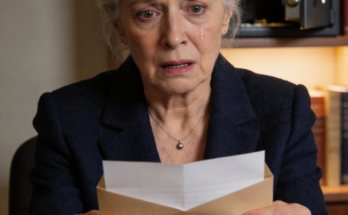
I flew across the country to see my son.
I had imagined that moment so many times while sitting alone in my little kitchen, watching the kettle steam and listening to the quiet hum of the refrigerator. I had pictured Nick opening the door, smiling the way he used to when he was a boy, maybe saying, “Mom, you made it,” before wrapping his arms around me.
I pictured my grandkids running toward me, even if they were shy at first. I pictured their little hands opening the small gifts I had packed carefully in my suitcase. I pictured laughter, dinner, stories, and maybe a few moments where I could feel like I still had a place in my son’s life.
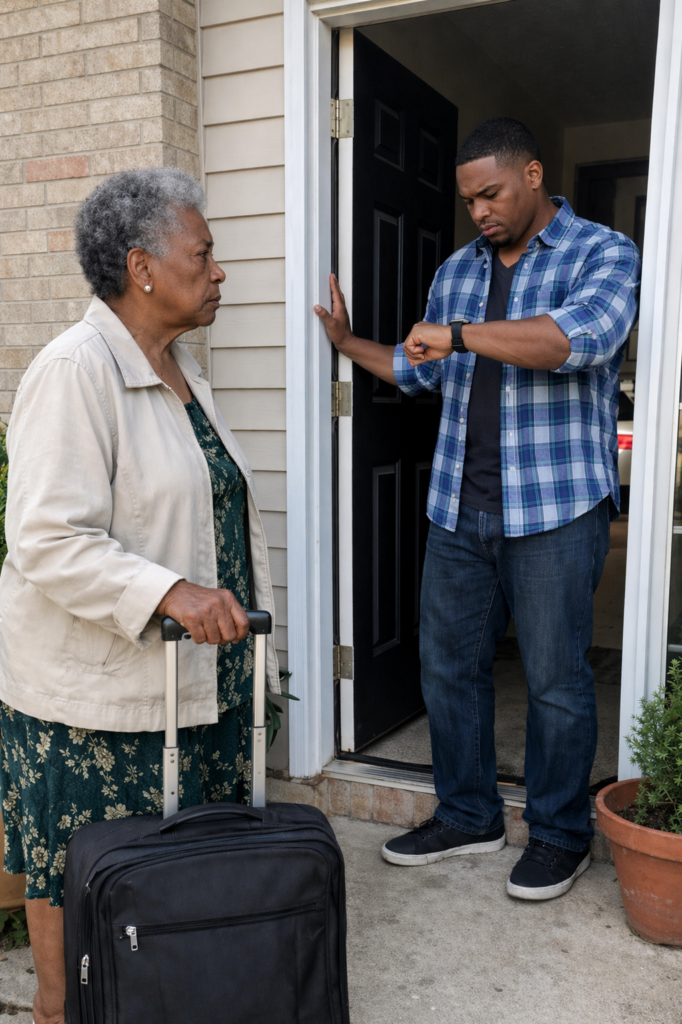
But when Nick opened the door, he didn’t smile.
He didn’t hug me.
He only looked down at his watch.
“You’re 15 minutes early,” he said. “Just wait outside.”
At first, I honestly thought he was joking.
I stood there with my suitcase beside me, my purse hanging from my shoulder, and the travel tiredness still sitting heavy in my bones. I had been on a plane for hours. Before that, I had woken up before sunrise, checked my bags twice, made sure the gifts were wrapped, and arrived at the airport early because I was afraid of missing the flight.
I was 69 years old, and travel did not feel as easy as it once had.
But none of that mattered to me.
I was going to see my son.
I hadn’t seen Nick in almost a year. We spoke on the phone sometimes, but never for long. He was always busy. There was always work, the kids, errands, Linda, house problems, meetings, or something else pulling him away.
I tried not to take it personally.
A mother learns to make excuses for her children long after they stop asking her to.
A month before the trip, during one of our short phone calls, I had told him gently, “I miss you, honey.”
There had been a pause on the other end of the line.
Then he said, “Mom, you can come anytime.”
Those words stayed with me.
You can come anytime.
So I did.
I booked the flight weeks in advance. I confirmed the date with him. I wrote the arrival time on a small note and stuck it to my refrigerator. I packed slowly, carefully, as if every folded blouse and every small gift mattered.
For my granddaughter, I brought a little bracelet with tiny blue stones because Nick once told me she liked blue.
For my grandson, I brought a small toy car because I remembered Nick loving cars when he was little.
I also packed a framed photo of Nick as a boy, standing in our old backyard with chocolate on his face and a grin so wide it looked like sunshine.
I didn’t know if he would want it.
But I wanted to bring something from home.
When the Uber pulled up to Nick’s house, my heart was beating faster than it should have. His neighborhood looked quiet and clean, with trimmed lawns and wide driveways. His house was nicer than I expected. I felt proud when I saw it.
My son had built a good life.
I smoothed my dress before walking to the front door. It was the nicest dress I owned, soft navy with small white flowers. I had bought it especially for this visit. I wanted to look presentable. I wanted Linda to see that I had made an effort. I wanted the children to think their grandmother looked nice.
I rang the bell.
A few seconds later, Nick opened the door.
For one bright second, I forgot everything else.
There he was.
My son.
Older, of course. A little tired around the eyes. His hair shorter than I remembered. But still Nick. Still the boy I had raised, the boy who used to run into my arms after school, the boy who once cried because he thought I would disappear if I went to the grocery store without him.
“Hi, honey,” I said.
But he didn’t step forward.
He looked at his watch.
“Mom,” he said, his voice low. “We said 4 o’clock. It’s only 3:45 now.”
“I know,” I said softly, trying to laugh a little. “The Uber got here faster than expected. I just couldn’t wait to see you and the kids.”
I smiled.
It was not a strong smile. It was the kind of smile a mother gives when she feels something is wrong but does not want to make anyone uncomfortable.
Nick didn’t smile back.
Behind him, I could hear voices.
Someone laughed.
Music played somewhere inside the house. It sounded like people were already there, moving around, talking, enjoying themselves.
“Linda is still setting up,” he said quietly. “The house isn’t ready. Wait outside, okay? Just 15 minutes.”
I blinked.
For a moment, I thought I had misunderstood.
“Outside?” I asked.
He glanced over his shoulder, then back at me.
“Just for a few minutes,” he said. “Please, Mom. It’s not a big deal.”
Then he closed the door.
Not hard.
Not angrily.
Just closed it.
And somehow that made it worse.
I stood there on the porch, staring at the door, my hand still resting on the handle of my suitcase.
The laughter inside continued.
The music grew a little louder.
I told myself not to be dramatic.
It was only 15 minutes.
Maybe Linda really was still getting things ready. Maybe there were decorations or food on the counter. Maybe Nick was stressed. Maybe he didn’t mean to sound cold.
Mothers are good at making pain smaller.
We fold it neatly. We put it away. We tell ourselves it was not meant the way it felt.
So I waited.
Five minutes passed.
Then ten.
I watched a car drive slowly down the street. A neighbor watered plants across the road. A dog barked somewhere behind a fence.
My feet began to hurt.
The porch had a small step, so I lowered myself carefully and sat on my suitcase. My legs ached from the flight, and my back felt stiff from sitting too long.
I looked down at my hands.
They looked older than I felt.
Thin skin. Blue veins. The same hands that had buttoned Nick’s school shirts. The same hands that had packed his lunches. The same hands that had held his feverish forehead when he was sick. The same hands that had signed loan papers, mailed birthday cards, and written checks when he needed help starting over.
Fifteen minutes passed.
No one opened the door.
No one came out.
No one called my name.
Inside, I heard another burst of laughter.
That was when something inside me shifted.
It was not anger at first.
It was clarity.
Quiet, painful clarity.
I wasn’t early.
I just wasn’t expected.
Not really.
Maybe he had told me I could come because it was easier than saying no. Maybe Linda didn’t want me there. Maybe they had forgotten what time I was arriving. Maybe they remembered and simply didn’t care enough to make room for me.
Whatever the reason was, I suddenly understood that I was sitting outside my own son’s home like a stranger waiting for permission to be noticed.
I picked up my phone.
Nick’s contact was already open from earlier, when I had texted him from the airport.
Landed. See you soon, honey.
He had replied with only one word.
Okay.
I stared at his name.
My thumb hovered over the call button.
Then I locked the screen.
I didn’t knock again.
I didn’t ring the bell.
I didn’t wait for someone to remember me.
I stood up slowly, gripped my suitcase handle, and walked down the driveway.
The wheels made a soft uneven sound against the concrete.
For some reason, that sound almost broke me.
At the corner, I opened my phone again and called a cab.
When the driver arrived, he got out to help me with my suitcase.
“Where to?” he asked.
I looked back once at Nick’s house.
The windows glowed warmly. Shadows moved inside. Someone was still laughing.
“Anywhere cheap,” I said.
The driver didn’t ask questions.
Maybe he had heard that tone before.
That night, I sat alone in a small motel room that smelled faintly of bleach and old carpet. The curtains were thick and brown. The lamp beside the bed flickered once before settling into a dull yellow glow.
I placed the gifts for the children on the small table.
The bracelet.
The toy car.
The framed photo.
I sat on the edge of the bed, still wearing the same dress I had chosen so carefully.
The dress I had bought because I wanted to look like I belonged.
For a long time, I did nothing.
I didn’t cry right away.
Sometimes pain arrives too quietly for tears.
I took off my shoes and rubbed my ankles. I washed my face in the little bathroom sink. I looked at myself in the mirror and barely recognized the woman staring back.
Then I turned off my phone.
I could not bear to wait for a message that might never come.
I could not bear to see if he noticed.
So I placed the phone face down on the nightstand, pulled the blanket over myself, and lay there in the dark.
I didn’t sleep much.
Every time I closed my eyes, I saw Nick looking at his watch.
Not my face.
His watch.
The next morning, sunlight slipped through the gap in the curtains.
For a few seconds, I forgot where I was.
Then I saw the suitcase.
The motel room.
The gifts still sitting on the table.
And I remembered.
My phone was still off.
I stared at it for a long time before finally turning it back on.
The screen lit up.
Then it began buzzing.
Again.
And again.
And again.
I had 27 missed calls.
Most were from Nick.
Some were from numbers I didn’t recognize.
Then the texts started loading.
Mom, where are you?
Mom, call me.
This isn’t funny.
Linda said you left.
Why would you just leave like that?
I read them slowly, my chest tightening with every line.
Then one message appeared.
It was from Nick.
Mom, please answer. I didn’t know Linda told everyone you weren’t coming. I didn’t know she moved your place card. I didn’t know she told the kids you didn’t want to visit. I opened the door and panicked because everything was wrong. I should have brought you inside. I should have hugged you. I am so sorry.
I clutched my chest.
For a moment, I couldn’t breathe.
I read the message again.
Then again.
The room seemed to go very still.
So that was it.
They had known about me.
There had been a place for me.
And then there hadn’t.
I sat there with the phone in my hand, feeling something I could not name.
It was not relief.
It was not forgiveness.
Not yet.
It was the ache of realizing that my son had seen me standing there and still chose the easier thing. He chose silence. He chose comfort. He chose to close the door.
Maybe Linda had made things difficult.
Maybe she had lied.
Maybe Nick had been embarrassed, confused, or caught off guard.
But he was still the one who looked at his mother after almost a year apart and told her to wait outside.
He was still the one who closed the door.
A few minutes later, the phone rang again.
Nick.
I let it ring.
Then I answered.
For several seconds, neither of us spoke.
Finally, he said, “Mom?”
His voice cracked on the word.
I closed my eyes.
“I’m here,” I said.
He exhaled shakily.
“Where are you? I’ve been calling all night. I went outside after everything settled, and you were gone. I drove around. I called hotels. I didn’t know what to do.”
I looked at the little table with the children’s gifts.
“You could have opened the door,” I said quietly.
Silence.
Then he whispered, “I know.”
I waited.
Not because I wanted him to suffer.
Because for once, I wanted him to understand the weight of what had happened without me making it lighter for him.
He started talking quickly, explaining that Linda had been upset, that she said the house wasn’t ready, that guests had arrived early, that there had been confusion, that he didn’t want a scene.
I listened.
Then I said, “Nick, I flew across the country to see you.”
“I know, Mom.”
“I’m 69 years old. I packed gifts for your children. I bought this dress because I wanted to look nice for your family.”
His breathing changed.
“I know.”
“No,” I said gently. “I don’t think you did.”
He was quiet.
I looked toward the window. Cars passed outside the motel. Life was moving on, even though my heart felt stuck on that porch.
“I waited outside your door,” I continued. “I heard laughter inside. I heard music. I sat on my suitcase because my legs hurt. And nobody came.”
“Mom,” he said, his voice breaking. “I’m sorry.”
“I believe you’re sorry,” I said.
And I did.
But sorry does not erase the image of a closed door.
Sorry does not give back the night I spent alone in a motel room holding back tears.
Sorry does not make a mother feel welcome after she has already felt unwanted.
Nick sniffed softly.
“Can I come get you?” he asked. “Please. The kids are asking where you are. They want to see you. I want to see you. I’ll come right now.”
I looked at the gifts again.
Part of me wanted to say yes immediately.
Because I loved him.
Because I loved those children.
Because mothers are trained by love to run back even when their hearts are tired.
But another part of me, a quieter part, finally stood up inside.
“No,” I said.
He went silent.
“No?” he repeated.
“I’m going home today.”
“Mom, please don’t.”
“I came to visit my family,” I said. “But I need to go where I don’t have to stand outside and wonder if I’m wanted.”
His breath caught.
“I messed up,” he said.
“Yes,” I replied. “You did.”
“I can fix it.”
“Not today.”
The words surprised even me.
But once I said them, I knew they were true.
“I love you, Nick,” I said. “I will always love you. But I am not going to beg to be welcomed by my own son.”
He began crying then.
Not loudly.
Just enough for me to know.
And my heart hurt for him, because he was still my child. Even grown, even wrong, even careless, he was still the baby I once rocked to sleep.
But love does not mean accepting every hurt quietly.
“I’ll call you when I get home,” I said.
“Mom…”
“I need you to think about what happened. Not what Linda did. Not what the guests saw. Not how embarrassed you felt. Think about what you did when your mother was standing at your door.”
He didn’t answer.
So I ended the call gently.
I packed my suitcase.
The dress went back into the bag, folded carefully, though it no longer felt special. I placed the bracelet and toy car in my purse. I didn’t know when I would give them to the children, but I couldn’t leave them behind.
At the airport, Nick called twice more.
I didn’t answer.
Not because I hated him.
Because I needed enough silence to remember that I mattered too.
When I finally boarded the plane, I looked out the window and watched the city grow smaller beneath the clouds.
I thought about motherhood.
How strange it is.
You spend years making a child feel safe, wanted, and loved. You open every door for them. You wait up at night. You forgive sharp words. You save the last piece of cake. You pretend you are not tired. You tell them they can always come home.
Then one day, you stand at their door and realize they have forgotten how much it means to be welcomed.
When I got home, my little house was quiet.
But it was mine.
I made tea. I took off the dress. I placed the children’s gifts on the shelf near the framed family photos.
Then I called Nick.
He answered on the first ring.
“Mom?”
“I’m home,” I said.
He let out a shaky breath. “Thank God.”
We didn’t fix everything in that call.
Things like that are not fixed in one conversation.
But for the first time in a long time, Nick listened more than he spoke.
He apologized without blaming Linda.
He admitted he had been avoiding difficult things.
He admitted he had let distance grow between us because it was easier than facing how much he had changed.
And I told him the truth.
I told him I loved him.
I told him I missed him.
I told him I wanted a relationship with him and the children.
But I also told him I would never again travel across the country just to be treated like an inconvenience.
By the end of the call, his voice was quiet.
“I don’t deserve another chance,” he said.
“No,” I replied. “You don’t deserve it. But I may choose to give you one someday.”
He cried again.
This time, I did too.
Not because everything was suddenly okay.
But because the truth had finally been said out loud.
A week later, a package arrived at my door.
Inside was a drawing from my granddaughter.
It showed a little house, a plane, and a woman with gray hair holding hands with two children.
At the bottom, in uneven letters, it said:
Grandma, Daddy said he made a big mistake. Please come again when you are ready.
I sat down at my kitchen table and held that paper for a long time.
Then I placed it on my refrigerator, right where the old travel note had been.
I still haven’t booked another flight.
Maybe one day I will.
Maybe Nick will come to me first.
Maybe healing will take time.
But I know one thing now.
I spent too many years teaching my son that my love would always be waiting behind an open door.
Now it is his turn to learn how to open one for me.