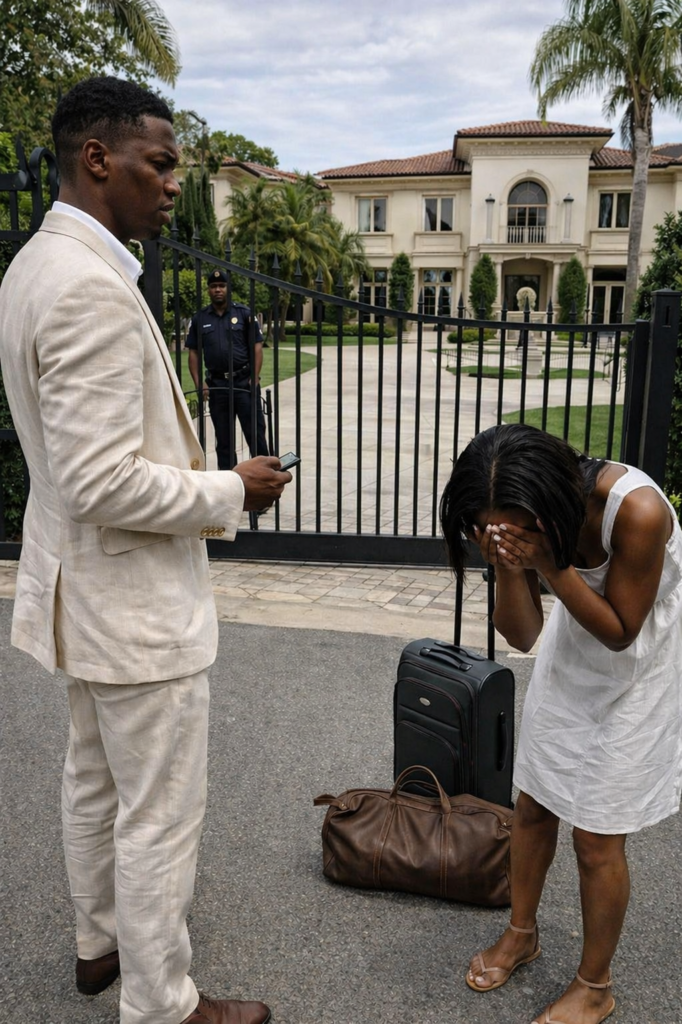
My husband used my money to marry another woman. But when he came back from his “honeymoon,” he discovered I had already sold the mansion where he planned to live with her.
They believed they could continue using my fortune forever… until they returned from their secret wedding and realized they no longer had a key, a card, or a single privilege left under their control.
It was almost eight at night, and I was still in my office in Polanco. I was exhausted after closing the biggest business deal of the year. I had worked nonstop to support the comfortable life my “family” enjoyed so much, while my husband, Mauricio Ríos, lived as if every luxury I provided belonged to him by birthright.
He was supposed to be away on a business trip in Singapore.
I picked up my phone and sent him a message.
“Take care. I miss you so much.”
There was no reply.
Trying to clear my mind, I opened Instagram.
In less than a second, my entire world changed.
The first post on my feed was from my mother-in-law, Lidia Ríos.
It was a wedding photo.
The man in the ivory suit, smiling with a happiness I had never seen from him before, was my husband. Standing beside him in white was Valeria Cruz, a junior employee from my own company.
Then I read the caption.
“My son is finally truly happy with Valeria. He finally chose the right woman.”
My body went cold.
I zoomed in on the picture and saw everyone.
His sisters. His cousins. His uncles. Every single one of them was smiling for the camera.
They all knew.
They had all helped hide it from me.
While I was paying the mortgage on our mansion in Bosques de las Lomas, covering Mauricio’s sports car, and sending monthly support to his mother, they were celebrating behind my back.
I called Lidia, hoping there was some explanation.
There wasn’t.
“Sofía, accept reality,” she said coldly. “You could not give my son children. Valeria is expecting a baby. She is the woman he needs. Do not stand in their way.”
Something inside me changed.
I did not fall apart.
I became completely clear.
They thought I was weak. They thought I would keep paying for their comfort because I was afraid to be alone. They thought they could use my money and still laugh at me in secret.
But they forgot one very important detail.
Everything was in my name.
The mansion.
The cars.
The investments.
The accounts.
That same night, I checked into a five-star hotel and called my lawyer.
“Sell the house in Bosques immediately,” I said. “I do not care what price gets it done. I want the money moved into my personal account by tomorrow.”
There was a long silence on the other end of the phone.
“Sofía,” my lawyer, Arturo, said carefully, “are you sure?”
I was standing beside the window of the hotel suite, looking down at the lights of Mexico City. For years, those lights had represented everything I had built. Success. Sacrifice. Survival.
Now they felt like witnesses.
“I have never been more sure,” I replied.
Arturo knew better than to ask too many questions. He had been my lawyer for eleven years. He knew that the house had been purchased before Mauricio and I married. He knew every account, every title, every investment, every document. He knew that I had always protected my assets not because I did not love my husband, but because my father had taught me one thing before he passed away.
“Love people with your heart,” he used to say. “But sign papers with your mind.”
At the time, I thought he was being cold.
That night, I finally understood him.
After calling Arturo, I sat at the hotel desk and opened my laptop. My hands were steady in a way that surprised me. I expected to cry. I expected to shake. I expected to collapse under the weight of betrayal.
But the tears did not come.
Only memories did.
I remembered the first time I met Mauricio at a charity gala twelve years earlier. He was charming, handsome, and gentle in public. He laughed at my jokes. He listened when I spoke. He made me feel seen at a time when everyone else only saw my company, my money, and my last name.
Back then, I believed he loved me.
Maybe he did for a while.
Or maybe he loved the doors I opened for him.
After we married, I paid off his debts quietly because I did not want him to feel ashamed. I bought him a car because he said arriving at business meetings in his old vehicle made him look unsuccessful. I helped his sister start a boutique. I covered his mother’s medical bills. I hired his cousin when no other company would give him a chance.
Every time I gave, they smiled.
Every time I helped, they called me family.
But now I had seen the truth in one photograph.
They had never seen me as family.
They had seen me as funding.
I gave three more instructions that night.
Freeze every shared account.
Cancel every card Mauricio carried.
Remove every access point he had to anything I owned.
Then I called my company’s HR director, Elena.
She answered on the second ring, even though it was late.
“Sofía? Is everything okay?”
“No,” I said calmly. “I need you to pull Valeria Cruz’s employment file. I also want a complete audit of her company email, access logs, expense claims, and any communication involving Mauricio Ríos.”
Elena paused.
“Is this disciplinary?”
“It may become legal.”
That was all I needed to say.
By midnight, Arturo had already contacted a private buyer who had once offered to purchase the mansion in Bosques de las Lomas. The buyer was a wealthy businessman who had wanted the property for his daughter and had told Arturo months earlier that if I ever decided to sell, he would close fast.
By morning, the paperwork was moving.
By afternoon, the house was no longer part of the life Mauricio thought he could return to.
And by the next day, the money was safely in my personal account, where he could not touch it.
I did not go back to the mansion.
I sent a trusted assistant to collect my personal belongings while Mauricio was still away. My jewelry. My documents. My father’s watch. My mother’s old rosary. A few photographs from before I knew what kind of people I had welcomed into my life.
Everything else could stay.
The furniture, the imported curtains, the wine cellar Mauricio loved to show off, the pool he bragged about to his friends—none of it mattered to me anymore.
Let the new owner decide what to do with it.
Three days later, Mauricio and Valeria returned to Mexico City.
No money.
No cards.
No plan.
They stepped out of a taxi in front of the mansion, expecting to find me waiting there, ready to forgive everything.
Mauricio walked to the gate and tried his key.
It did not work.
He frowned and tried again.
Still nothing.
Valeria stood beside him in oversized sunglasses, one hand on her suitcase, the other resting lightly on her stomach. She looked annoyed, not worried. That alone told me everything. She truly believed the mansion was waiting for her.
A security guard Mauricio had never seen before approached him and spoke calmly.
“Sir, this property was sold yesterday by its legal owner, Mrs. Sofía Aguilar. You no longer live here.”
Valeria dropped her suitcase.
Mauricio stood frozen in place.
And I watched everything from my phone through the security cameras, smiling for the first time in days.
Because that was not the end.
That was only the first part of the wedding gift I had prepared for them.
Mauricio called me twenty-seven times in fifteen minutes.
I did not answer.
Then came the messages.
“Sofía, what is going on?”
“Open the gate.”
“This is childish.”
“You cannot do this to me.”
Then, finally, the truth of his character appeared.
“You are embarrassing me.”
Not once did he apologize.
Not once did he say he was sorry for marrying another woman while still living from the life I had built.
Not once did he ask if I was okay.
He was not upset because he had hurt me.
He was upset because I had stopped paying.
I let the calls come.
I let the messages pile up.
Then I sent one sentence.
“Please direct all future communication to my lawyer.”
Less than a minute later, my phone rang again.
This time, it was Lidia.
I answered.
Her voice was not cold anymore. It was sharp, panicked, and full of anger.
“What have you done?”
“I protected what belongs to me,” I said.
“That house is Mauricio’s home.”
“No,” I replied. “It was my house. Mauricio lived there because I allowed him to.”
“You cannot throw your husband into the street.”
“My husband married another woman using the comfort I paid for.”
“She is carrying his child.”
“And I wish the child health and peace,” I said. “But that does not make me responsible for supporting the adults who lied to me.”
Lidia went silent for a moment.
Then she lowered her voice.
“You will regret humiliating this family.”
I almost laughed.
“Lidia, your family held a wedding and posted it online while I was still sending you money every month. You did not fear humiliation then.”
She had no answer.
So I gave her one final message.
“The monthly transfers are over. The apartment lease I paid for you ends in thirty days. After that, you and your son can support each other.”
Then I ended the call.
For the first time in years, the silence felt peaceful.
The next morning, Mauricio appeared at my office.
He did not make it past reception.
I watched through the glass wall of the conference room as he argued with security. He was wearing the same ivory suit from the wedding photo, now wrinkled, his face pale with disbelief. Valeria was not with him.
Good, I thought.
Reality had already started separating them.
My assistant came into the conference room quietly.
“Mrs. Aguilar, Mr. Ríos is demanding to see you.”
“Tell security to escort him out.”
“He says he is your husband.”
I closed the folder in front of me.
“Tell him my lawyer will be happy to discuss that.”
Security walked him toward the exit. Mauricio looked up and saw me through the glass. For one second, our eyes met.
I expected to feel sadness.
Instead, I felt nothing.
That was when I knew the marriage had ended long before the wedding photo. I had simply been the last person to find out.
By noon, Arturo called with more information.
“Sofía,” he said, “the audit found something.”
I leaned back in my chair.
“What?”
“Valeria used company time and company resources to plan the wedding. Flights, hotel bookings, vendor communication, even guest coordination. Some expenses may have been processed through internal accounts.”
I closed my eyes.
Of course.
They had not only used my personal money.
They had used my company.
My father’s company.
The company I had spent years rebuilding after his death.
The company where hundreds of honest employees worked every day.
That was the line they should never have crossed.
“Prepare everything,” I said.
“For termination?”
“For termination, reimbursement, and legal action if necessary.”
That afternoon, Valeria was called into HR.
She arrived dressed in expensive clothes I recognized because I had approved her salary increase six months earlier. She had cried in my office back then, telling me her mother was ill and she needed stability.
I had helped her.
I had trusted her.
Now she sat across from Elena and Arturo, her confidence fading as the evidence was placed in front of her.
Company email records.
Expense reports.
Travel coordination.
Messages between her and Mauricio discussing how to hide the wedding from me until after they returned.
One message from Valeria stood out.
“She will be angry, but she will forgive you. Women like Sofía are too lonely to let go.”
I stared at the printed page for a long time when Arturo showed it to me.
Too lonely to let go.
That was what they thought of me.
Not loyal.
Not generous.
Not loving.
Lonely.
Maybe I had been.
But loneliness was not the same as weakness.
Valeria was terminated before the end of the day.
Her company access was removed.
Her final payment was processed according to the law, minus pending review of unauthorized expenses.
When she left the building, Mauricio was waiting outside.
According to security, they argued right there on the sidewalk.
She accused him of lying about the house.
He accused her of pushing him to make the relationship public.
She cried.
He shouted.
The same people who had smiled proudly in a wedding photo were now blaming each other under the afternoon sun.
I did not enjoy their pain.
But I did not rescue them from it either.
That evening, Mauricio finally sent a voice message.
I almost deleted it.
Then I listened.
His voice was different. Smaller.
“Sofía… please. We need to talk. Things got out of control. I never meant for you to find out like that. My mother posted the photo without asking me. I was going to explain.”
I laughed softly.
Explain?
How does a man explain a secret wedding?
How does a family explain smiling beside another woman while his wife is paying for the champagne?
He continued.
“You and I have history. You cannot erase twelve years like this.”
That part almost reached me.
Almost.
Because we did have history.
Twelve years of dinners, holidays, birthdays, trips, shared rooms, shared plans. Twelve years of me believing that love meant patience. Twelve years of forgiving small humiliations because I thought marriage required sacrifice.
But then I remembered another kind of history.
The nights I worked late while he complained I was never home.
The mornings he spent my money without asking.
The way his mother slowly stopped thanking me and started expecting more.
The way his family praised me in private only when the checks cleared.
And the wedding photo.
That photo erased nothing.
It revealed everything.
I forwarded the voice message to Arturo and put the phone down.
The next week became a storm.
Mauricio tried to claim rights to the mansion. Failed.
He tried to access the accounts. Failed.
He tried to pressure mutual friends to convince me to “be reasonable.” Failed.
He even posted a vague message online about “people who use money to control others.”
That was his mistake.
Because people had already seen Lidia’s wedding post.
Screenshots had spread quietly among acquaintances, employees, and social circles. Mauricio had always cared deeply about his image. He wanted to be seen as respected, successful, and adored.
But now people were asking questions.
Why had he married someone else while still connected to Sofía?
Why was his new wife an employee from her company?
Why did his family attend?
Why did they post it publicly?
Why was he suddenly no longer living in the mansion?
The truth did not need me to shout.
It traveled by itself.
A few days later, Lidia showed up at the hotel where I was staying.
I do not know how she found me.
The receptionist called my room and said a woman named Lidia Ríos was downstairs, insisting it was urgent.
For a moment, I considered refusing.
Then I went down.
She was sitting in the lobby wearing pearls and a designer handbag I had bought her for Christmas two years earlier.
When she saw me, she stood.
Her face was tired now. The arrogance had cracked.
“Sofía,” she said. “This has gone far enough.”
I folded my hands in front of me.
“I agree.”
She looked relieved.
Then I continued.
“That is why I filed for divorce this morning.”
Her mouth opened slightly.
“You are making a mistake.”
“No, Lidia. I made my mistake years ago when I confused access with love.”
Her eyes hardened.
“My son gave you twelve years.”
“And I paid for twelve years of his comfort.”
“You never gave him a child.”
There it was again.
The same sentence she had used to reduce my entire worth to something my body had not given her son.
For years, that pain had been private.
Mauricio and I had tried. I had gone to doctors. I had endured tests, procedures, hope, disappointment, and quiet grief. He told me he accepted it. He told me we were enough.
But behind my back, he had allowed his mother to turn my heartbreak into a reason to replace me.
This time, I did not let the words wound me.
I let them reveal her.
“Lidia,” I said softly, “a woman’s value is not measured by whether she becomes a mother. And a man’s betrayal does not become honorable because another woman is expecting a child.”
She looked away.
For the first time, she had no sharp reply.
I removed an envelope from my bag and placed it on the table between us.
“What is this?” she asked.
“A record of every transfer I made to you over the last six years. Rent. Medical bills. Vacations. Credit card payments. Boutique expenses for your daughter. School fees for your nephew. Everything.”
Her face lost color.
“I am not asking for it back,” I said. “I am giving you a copy so you remember exactly who you called unworthy.”
She stared at the envelope as if it were burning.
Then she whispered, “You are cruel.”
“No,” I said. “Cruel is smiling at another woman’s humiliation while living from her kindness. I am simply finished.”
I walked away before she could answer.
Two weeks later, Mauricio’s life looked nothing like the image he had tried to create.
The sports car was repossessed because it was leased through one of my companies.
His club memberships were canceled.
The investment account he bragged about to friends had never been his.
The apartment he rented temporarily with Valeria was small, expensive, and paid for with money he did not have.
And Valeria, who had believed she was marrying into luxury, began to understand the truth.
Mauricio had never been rich.
He had been standing beside someone who was.
Without my name, without my money, without my protection, he was just a man with expensive habits and no plan.
Then came the final confrontation.
It happened outside Arturo’s office after the first formal divorce meeting.
Mauricio arrived with a new lawyer who looked uncomfortable from the beginning. They tried to argue that Mauricio had contributed emotionally to my success and deserved a large settlement.
Arturo calmly placed document after document on the table.
The house purchased before marriage.
The business inherited and expanded independently.
The separate accounts.
The prenuptial agreement Mauricio had signed without reading carefully because, at the time, he thought love meant he would never need it.
The unauthorized use of company resources.
The secret wedding.
The public post.
By the end of the meeting, his lawyer asked for a private conversation.
Mauricio refused.
He stood up and looked at me with red eyes.
“You are enjoying this.”
I looked at the man I had once loved.
“No, Mauricio. I am surviving it.”
He shook his head.
“You changed.”
“Yes,” I said. “I finally stopped confusing silence with loyalty.”
For the first time, he looked truly afraid.
Not because he had lost me.
Because he had lost control.
Outside the office, Valeria was waiting near the elevators. She looked different from the woman in the wedding photo. No perfect smile. No proud posture. No glowing confidence.
When she saw me, she stepped forward.
“Sofía,” she said quietly.
Mauricio snapped, “Do not talk to her.”
But Valeria ignored him.
“I just want to say…” She swallowed. “I did not think it would become like this.”
I looked at her carefully.
“You mean you did not think there would be consequences.”
Her eyes filled with tears.
“I believed what he told me.”
“And what did he tell you?”
She glanced at Mauricio.
“That your marriage was over. That you were only together legally. That you did not care. That the house was his too. That his family supported us because you were cold and controlling.”
I almost felt sorry for her.
Almost.
Then I remembered the message.
Women like Sofía are too lonely to let go.
“You believed him because the lie benefited you,” I said. “That is different from being innocent.”
She lowered her head.
I walked past them both.
Behind me, I heard Mauricio whisper her name, but she did not answer.
A month later, the divorce moved forward quietly.
Mauricio tried to delay it, then tried to negotiate, then tried to apologize. By then, his apologies sounded less like regret and more like strategy.
He sent flowers to my office.
I donated them.
He sent letters.
I gave them to Arturo.
He waited outside my building once.
Security handled it.
The woman I had been before might have listened. She might have softened. She might have remembered every good moment and used it as an excuse to ignore the painful truth.
But the woman I had become understood something important.
A person can love the memory of someone and still refuse to return to the harm they caused.
Meanwhile, my company recovered quickly. The audit became a turning point. We strengthened internal controls, changed access policies, and created a confidential reporting system for employees.
For the first time in years, I stopped carrying people who only knew how to take.
I moved into a smaller penthouse overlooking Chapultepec Park. It was not as grand as the mansion, but it was peaceful. Every piece of furniture inside was chosen by me. Every room felt honest.
No hidden lies.
No false family.
No footsteps in the hallway from someone living a double life.
One evening, months later, I opened Instagram again.
For a second, my hand froze.
That app had been the place where my life broke open.
But this time, the first post I saw was not a wedding photo.
It was a picture from one of my employees, celebrating a promotion.
The caption said:
“Grateful to work for a woman who teaches us that strength can be quiet.”
I stared at the words for a long time.
Then I cried.
Not because of Mauricio.
Not because of Valeria.
Not because of Lidia.
I cried because I finally felt the grief I had been too busy managing. I cried for the years I spent trying to earn love from people who were comfortable receiving everything and giving little back. I cried for the version of me who thought being generous meant letting others drain her until nothing was left.
And after I finished crying, I made tea, sat by the window, and watched the city lights come alive.
A week later, Arturo called.
“The divorce agreement is finalized,” he said.
I closed my eyes.
It was over.
Mauricio walked away with almost nothing compared to what he had expected. He kept some personal items, a modest amount required by agreement, and the consequences of his own choices.
Valeria disappeared from my company and from my life.
Lidia never called again.
I heard rumors, of course. People always talk.
Some said Mauricio and Valeria separated before the baby was born.
Some said they stayed together but struggled.
Some said Lidia moved in with her daughter after losing the apartment I had been paying for.
I did not investigate.
Their life was no longer my responsibility.
That was the greatest freedom of all.
One year after the wedding photo, I received a message from an unknown number.
It was Mauricio.
“I know I do not deserve an answer,” he wrote. “But I want you to know I regret everything. You were the best thing that ever happened to me, and I destroyed it.”
I read the message twice.
Then I deleted it.
Not out of anger.
Out of peace.
Some apologies arrive after the damage is done, not because the person finally understands your pain, but because they finally feel the cost of losing you.
I did not need to reply.
My silence was not weakness anymore.
It was closure.
People sometimes ask if I regret selling the mansion so quickly.
I do not.
That house was beautiful, but it had become a stage where other people performed love while quietly planning my humiliation.
Letting it go was not losing a home.
It was removing the walls that had kept me trapped inside a lie.
I built my fortune with discipline.
I built my peace with boundaries.
And I learned that betrayal does not always arrive with shouting or obvious signs. Sometimes it wears an ivory suit, smiles in a wedding photo, and assumes you will be too heartbroken to protect yourself.
But heartbreak did not destroy me.
It woke me up.
My husband married another woman using my money.
But when he came back from his honeymoon, he found out the mansion was gone, the accounts were frozen, the cards were canceled, and the woman he thought he could fool had already chosen herself.
And that was the real wedding gift.
Not revenge.
Freedom.