PART 2 — FULL CONTINUATION WITH COMPLETE ENDING:
For a few seconds, I could not move.
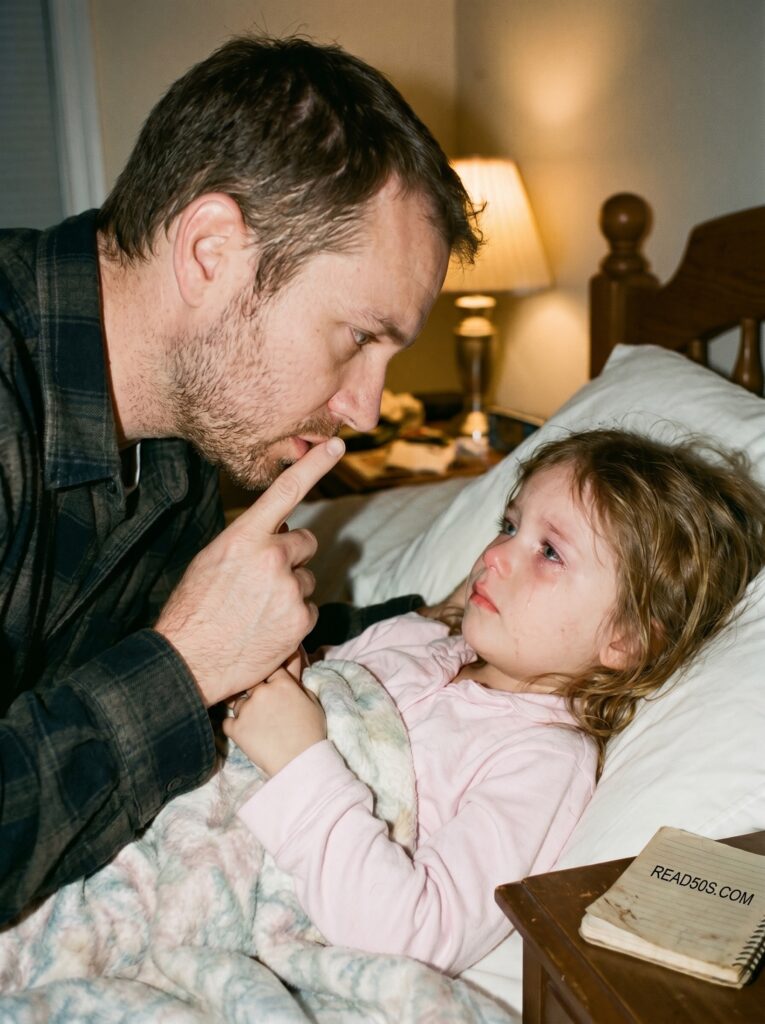
Sophie stood with her back to me, her pajama shirt lifted just high enough for me to see what she had been trying to hide. The hallway light fell across her small shoulders, and there, across the skin of her back, were dark marks spreading around the center like proof that pain had landed there and stayed.
My hands curled into fists.
Not at her.
Never at her.
At the room.
At the silence.
At every minute I had been away while my daughter learned to whisper pain like it was something she needed permission to feel.
“Can I put my shirt down?” Sophie asked.
Her voice was tiny.
It brought me back.
“Yes, baby,” I said quickly. “Of course.”
She lowered it and turned around slowly, watching my face like my reaction mattered more than her pain.
That nearly broke me more than the marks.
She was not looking for comfort first.
She was checking if I was angry.
I forced my hands open. Forced my breathing steady. Forced every terrible thought out of my voice.
“You are not in trouble,” I said. “Do you hear me?”
Her eyes filled with tears.
“Mom said you’d be mad.”
“I am not mad at you.”
“But you look mad.”
I swallowed hard.
“I’m upset because you’re hurt. Not because you told me. You did the right thing.”
Her chin trembled.
For the first time since I walked in, she took one small step toward me.
I did not grab her. I did not pull her into my arms, even though every part of me wanted to hold her so tightly nothing could ever reach her again.
I opened my arms a little and let her decide.
She came slowly.
When she leaned against me, I held her gently, careful not to touch her back.
Her body shook.
“I didn’t mean to spill the juice,” she whispered.
I closed my eyes.
“I know.”
“I was carrying it to the table. The cup slipped.”
“I believe you.”
“She said I was careless.”
“You are eight years old, Sophie. Cups spill.”
“She said I ruined everything.”
“No,” I said softly. “You did not ruin anything.”
A floorboard creaked down the hall.
Sophie stiffened instantly.
I looked up.
The bedroom door across the hallway was half-open. My wife, Claire, stood there in a robe, her hair loose around her face, her expression unreadable.
For one moment, nobody spoke.
Then she smiled.
Not warmly.
Carefully.
“You’re home early,” she said.
I stood slowly, placing myself slightly in front of Sophie.
“My flight changed.”
Claire’s eyes dropped to Sophie, then back to me.
“What’s going on?”
The question sounded normal.
That was what made it worse.
As if my daughter had not just whispered a secret that had split the night open. As if I had not just seen the evidence on her body.
“Sophie told me her back hurts,” I said.
Claire’s face tightened for half a second before she smoothed it away.
“She’s been dramatic all day.”
Sophie’s fingers dug into my shirt.
I felt it.
I felt the fear move through her.
Claire took one step closer.
“She fell yesterday. I told her to stop making it bigger than it was.”
“She said you pushed her.”
Claire’s eyes flashed.
Then she laughed once.
A short, sharp sound.
“Are you serious?”
I kept my voice low.
“Yes.”
“She spilled juice everywhere. I reached for her, she slipped backward, and now she’s turning it into some terrible story because she knows you baby her.”
Sophie made a small sound behind me.
I did not look away from Claire.
“Do not call her dramatic.”
Claire crossed her arms.
“Oh, so you’ve been home fifteen minutes and already decided I’m the villain?”
“I have decided Sophie needs medical attention.”
The words changed the room.
Claire’s face hardened.
“She does not need a hospital.”
“I’m taking her.”
“At this hour?”
“Yes.”
“It’s a bruise.”
“You haven’t looked at it properly.”
“She wouldn’t let me.”
Sophie whispered from behind me, “I did. You said stop crying.”
Claire’s mouth tightened.
I turned slightly toward Sophie.
“Go put on your shoes, sweetheart. Bring your blanket if you want.”
She looked between us.
“Can I bring Bunny?”
“Bring Bunny.”
She moved quickly toward her room, but she kept looking back, as if afraid the door would close before she could reach me again.
Claire waited until Sophie was out of sight before her voice dropped.
“You are making a mistake.”
I looked at her.
“No. I made a mistake when I left this house believing she was safe.”
Her expression changed then.
Not into guilt.
Into anger.
“You travel constantly. You leave me here with everything. School. Meals. Homework. Her tantrums. Her messes. Then you come home and act like some hero because she cries to you.”
I stared at the woman I had married.
I wanted to remember the Claire I knew before everything became tense between us. The woman who laughed during thunderstorms. The woman who cried when Sophie was born. The woman who once said she wanted our daughter to grow up fearless.
But the person in front of me was not thinking about Sophie’s pain.
She was thinking about being blamed.
That told me enough.
“I am not arguing in front of her,” I said.
Claire’s eyes narrowed.
“You walk out that door with her, and you’re accusing me.”
“I’m protecting her.”
Sophie returned with sneakers on the wrong feet, Bunny clutched to her chest.
I knelt and fixed her shoes carefully.
Claire stood in the hallway, silent and furious.
Sophie looked up at her mother.
“Am I bad?” she whispered.
I looked at Claire.
For one second, I hoped.
God help me, I hoped she would break.
I hoped she would kneel, cry, apologize, say she was overwhelmed, say she needed help, say anything that placed Sophie’s heart before her pride.
Instead, Claire looked away.
That was the answer.
“No,” I said firmly, turning Sophie’s face gently toward me. “You are not bad. You are hurt. And we are going to get you checked.”
I took my daughter to the emergency room.
During the drive, Sophie sat in the back seat wrapped in her blanket, staring out the window. Every time I looked at her in the rearview mirror, she tried to smile so I would not worry.
That was another thing that hurt.
My eight-year-old daughter was trying to comfort me.
At the hospital, I explained everything at the front desk. My voice shook once. The nurse noticed and spoke gently to Sophie instead of rushing.
A doctor examined her carefully, telling her each step before touching her. A child advocate came in. Then a social worker. Then an officer.
The process was slow, careful, and devastating.
Sophie answered questions in a quiet voice.
Yes, she spilled juice.
Yes, Mom got angry.
Yes, her back hit the door handle.
Yes, Mom told her not to tell Dad.
Yes, it still hurt when she moved.
No, this was not the first time Mom had grabbed her too hard.
That last answer changed everything.
I felt my heart drop through the floor.
The officer’s pen paused.
The social worker’s face stayed calm, but her eyes softened.
I did not interrupt.
I did not ask Sophie why she had never told me.
I already knew why.
Because someone had taught her that truth brought consequences.
Because I had been away too much.
Because fear makes children protect adults who should be protecting them.
The doctor later told me Sophie had bruising and soft tissue injuries that needed care and follow-up. He explained what to watch for, gave pain guidance, and recommended she not return to the home environment until a safety plan was in place.
A safety plan.
For my daughter.
From her mother.
I signed papers with hands that barely worked.
At 2:13 a.m., while Sophie slept in the hospital bed with Bunny tucked beneath her chin, I called my older sister, Natalie.
She answered groggily.
“Evan?”
“I need help.”
My voice cracked on the last word.
She was fully awake instantly.
“What happened?”
I told her enough.
Not all.
Enough.
By 3:00 a.m., she was at the hospital in sweatpants, hair tied messily, eyes red with fear. When she saw Sophie asleep, she covered her mouth.
Then she hugged me.
I almost collapsed.
“I didn’t know,” I whispered.
Natalie held me tighter.
“You know now.”
Those three words became the line I held onto.
You know now.
Not as comfort exactly.
As responsibility.
By morning, temporary protective steps were in motion. The officer explained the process. The social worker helped me understand what could happen next. I gave a statement. Sophie gave hers with someone trained to speak with children.
Claire called twenty-seven times.
Then texted.
You are destroying our family.
Then:
She is lying because she wants attention.
Then:
You better bring her home before this gets out of hand.
I showed the messages to the officer.
He read them, looked at me, and said, “Do not respond.”
So I did not.
For once, I did not try to calm Claire down.
I did not manage her emotions.
I did not explain Sophie’s pain in a way that made it easier for Claire to accept.
I chose silence.
Not the old silence.
Not the one that protected harm.
A new silence.
The kind that refused to feed it.
Sophie woke around seven and looked around in panic.
“Dad?”
“I’m here.”
She grabbed my hand.
“Are we going home?”
I looked at Natalie, then back at my daughter.
“Not to that house today.”
Her eyes filled.
“Is Mom mad?”
I sat beside her carefully.
“Mom has big feelings right now. But your job is not to fix them.”
“She said bad things happen when people tell.”
I swallowed hard.
“Sometimes hard things happen when people tell the truth. But that does not make telling wrong.”
She looked confused.
So I tried again.
“If there is a fire and you shout for help, people might run around, alarms might be loud, and everyone might feel scared. But shouting did not cause the fire. It helped people find it.”
Sophie stared at me.
“Was there a fire?”
“In a way,” I whispered. “And you were very brave to shout.”
She thought about that for a long moment.
Then she nodded once.
Natalie arranged for us to stay with her. The next few days were a blur of calls, appointments, legal forms, and careful conversations.
Claire denied everything.
Then she said it was an accident.
Then she said Sophie was sensitive.
Then she said I had turned our daughter against her.
Then she said she had been under stress because I traveled too much.
Some of that last part was true.
I had traveled too much.
I had missed signs.
I had let work become the place where I felt useful while home became a place I assumed would hold steady without me.
But stress did not excuse what happened.
My absence explained some cracks in our family.
It did not create the marks on Sophie’s back.
That distinction mattered.
I learned it in therapy.
Sophie started seeing a child therapist, too. At first, she spoke mostly through drawings. Houses with big doors. Small girls hiding under beds. Mothers with sharp eyebrows. Fathers as stick figures holding flashlights.
When her therapist told me that, I sat in my car afterward and cried until my shirt collar was damp.
A flashlight.
That was how my daughter drew me.
Not a hero.
Not a savior.
A light that came late, but came.
I changed jobs within a month.
Not easily. Not without financial fear. But I told my company I could no longer travel. At first, they resisted. Then I resigned. A smaller local firm hired me for less money and more predictable hours.
People told me I was sacrificing too much.
They were wrong.
I was paying attention too late and trying to make sure late did not become never.
The legal process was painful.
There were interviews.
Temporary custody hearings.
Parenting evaluations.
Documents.
Statements from Sophie’s school, including one teacher who admitted Sophie had seemed withdrawn for weeks but thought it was because I was traveling.
Claire attended one supervised visit and spent the first ten minutes crying about how much she missed Sophie.
Sophie sat stiffly in the chair and held Bunny so tightly one ear stretched.
The supervisor wrote notes.
The second visit ended early when Claire said, “You know you hurt Mommy by telling stories.”
After that, the visits stopped pending further review.
When I heard, I did not feel victory.
I felt grief.
Because somewhere beneath the anger was the terrible truth that Sophie wanted a mother who chose her over pride, and Claire kept choosing herself.
Months passed.
Sophie healed physically first.
The bruises faded.
She slept better.
She laughed more at Natalie’s house, especially when her cousins taught her card games and let her win badly.
But fear has echoes.
Sometimes she still asked if she was in trouble when a glass tipped over.
Sometimes she apologized if she needed help with homework.
Sometimes she whispered instead of speaking.
So I changed the rules around her.
If something spilled, we said, “Accidents happen,” and cleaned it together.
If she cried, I said, “Your feelings are allowed.”
If I was upset, I told her, “I am frustrated about the problem, not angry at you.”
At first, she watched me closely when I said these things.
Testing them.
Waiting for the hidden cost.
Slowly, she began to believe me.
One Saturday morning, she spilled orange juice at Natalie’s kitchen table.
The glass tipped, juice spreading across homework papers and dripping onto the floor.
Sophie froze.
Her face went white.
Everyone stopped.
My nephew reached for paper towels, but I held up a hand gently.
I knelt beside Sophie.
“Hey,” I said softly. “What do we say?”
Her lips trembled.
“Accidents happen?”
“That’s right.”
She burst into tears anyway.
I held her while Natalie cleaned the juice.
Not because Sophie was broken.
Because healing sometimes means crying over spilled juice that is not really about juice at all.
The divorce began after the custody orders stabilized.
Claire fought hard at first. Then less hard when documentation became impossible to explain away. Her attorney advised her to seek counseling. She did. Whether it helped, I do not know.
I hope it did.
That might surprise people.
But hope is not permission.
I could hope Claire became better and still keep Sophie safe from her until she proved it in ways that were real, consistent, and witnessed.
Those were the terms I learned to live by.
Not promises.
Patterns.
Not apologies.
Accountability.
A year after the night I came home, Sophie and I moved into a small townhouse near her school.
It had a tiny backyard, a blue front door, and a bedroom Sophie chose because “the morning sun comes in but not too bright.”
On our first night, we ate pizza on the floor because the table had not arrived yet.
Sophie looked around and said, “It’s quiet here.”
I tensed, worried quiet scared her.
Then she added, “Good quiet.”
I smiled.
“Yes. Good quiet.”
At bedtime, I sat beside her while she arranged Bunny, three stuffed cats, and a flashlight on her nightstand.
The flashlight made my chest tighten.
“Still keeping that?” I asked.
She nodded.
“In case the power goes out.”
“Good plan.”
She hesitated.
Then she said, “Dad?”
“Yes?”
“Do you ever get mad that I told?”
I felt the old heartbreak rise, but it no longer knocked me down.
I had learned that children sometimes need the same truth many times before it feels safe.
“No,” I said. “I am grateful you told me.”
“Even though everything changed?”
I looked around her new room.
The soft lamp.
The drawings taped to the wall.
The window with white curtains.
The door she knew she could close without fear.
“Yes,” I said. “Because some things needed to change.”
She thought about that.
Then she whispered, “I thought if I told, I’d lose my family.”
I reached for her hand and waited until she placed it in mine.
“You did not lose your family. We found the safe part of it.”
Her eyes filled.
“Is Aunt Natalie family?”
“Very much.”
“My cousins?”
“Absolutely.”
“Bunny?”
I smiled.
“Honorary family.”
She giggled.
That sound felt like sunrise.
Years do not erase a night like that.
They build around it.
Sophie grew taller. Stronger. Louder in the best way. She joined art club. She became fiercely protective of younger kids on the playground. She once told a teacher, “You shouldn’t say someone is dramatic when they’re trying to explain pain,” and I had to sit in my car afterward, laughing and crying at the same time.
Claire eventually earned supervised contact again after completing therapy and parenting programs. The first few visits were careful and limited. Sophie chose whether to continue. Sometimes she did. Sometimes she did not.
I never forced forgiveness.
I never spoke cruelly about her mother in front of her.
But I also never softened the truth into something false.
“What happened was not okay,” I told Sophie when she asked. “Adults are responsible for their actions. You were responsible for being a child.”
That became another sentence we repeated when needed.
You were responsible for being a child.
By the time Sophie turned twelve, the story no longer lived in every room with us.
It lived in a drawer.
Not forgotten.
Not denied.
Just no longer running the house.
On her twelfth birthday, she asked for pancakes, a sketchbook, and a sleepover with three friends who covered the living room in blankets and popcorn. At midnight, I passed by the hallway and heard them whispering ghost stories.
Sophie’s voice rose above the others.
Not scared.
Not fragile.
Confident.
“And then the dad came home,” she said dramatically, “and found the secret!”
The girls squealed.
I leaned against the wall, smiling through tears.
She had turned fear into a story she controlled.
That was healing too.
Later that night, after her friends fell asleep, Sophie found me in the kitchen.
“Dad?”
“Yes?”
“Do you think I’m brave?”
I looked at my daughter, taller now, hair messy from the sleepover, eyes still carrying pieces of the little girl who once stood behind a bedroom door.
“I know you are.”
She looked down.
“I didn’t feel brave when I told you. I felt scared.”
I pulled out a chair and sat across from her.
“Brave usually feels like scared while you’re doing the right thing.”
She thought about that.
Then she smiled.
“I like that.”
I reached across the table.
She took my hand.
For a moment, I saw both versions of her at once.
The eight-year-old whispering through pain.
The twelve-year-old asking if fear could still count as courage.
And I knew the answer with everything in me.
Yes.
Always yes.
That night, after she went back to her friends, I stood in the quiet kitchen of our safe little home and thought about the moment my life changed.
My suitcase by the door.
My daughter behind the bedroom door.
The words that stopped my world.
Dad… my back hurts so bad I can’t sleep. Mom told me not to tell you.
I used to replay that sentence with guilt so sharp I could hardly breathe.
Now, I hear something else inside it.
Not only pain.
Not only fear.
Trust.
A small, shaking thread of trust that my daughter handed me when she had every reason to believe adults would fail her.
I did not handle everything perfectly.
No parent does.
I was late to see what was happening. I had to live with that truth.
But when the moment came, I believed her.
And sometimes that is where rescue begins.
Not with shouting.
Not with revenge.
Not with a perfect plan.
But with a child finding the courage to tell…
and a parent finally becoming the safe place they should have been all along.