PART 2 — FULL CONTINUATION WITH COMPLETE ENDING:
I stood on the porch at 4:00 in the morning with Rusty sleeping in the back seat of my car and my husband looking at me like I had interrupted his night over nothing.
The porch light made everything too bright.
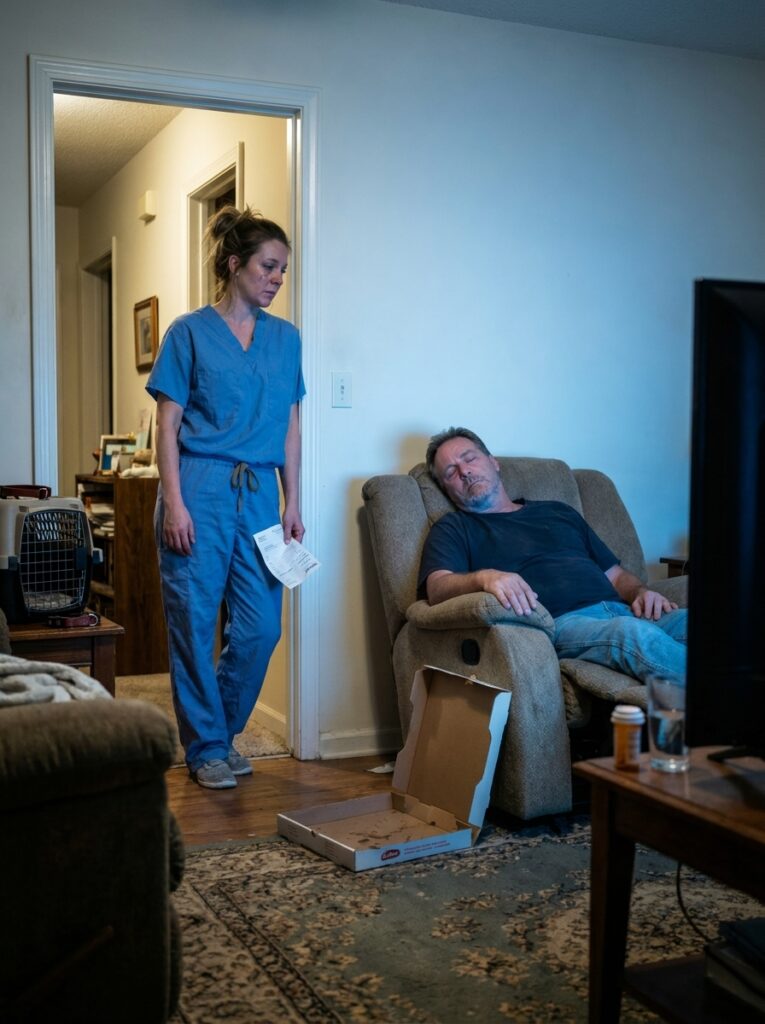
Mark’s hair was flattened on one side from sleeping in the recliner. His T-shirt had a pizza sauce stain near the collar. Behind him, through the front window, I could still see the television glowing blue in the living room.
He looked tired.
Confused.
A little annoyed.
“Sarah,” he said again, softer this time, as if I were the unreasonable one, “honestly, I think you’re overreacting. The game went into overtime, and I just got distracted. You should have called me again at 7:00 to make sure.”
For a moment, I heard nothing but the hum of the porch light.
You should have called me again.
That sentence did not land like a slap.
It landed like a key turning in a lock.
Suddenly, every door in my mind opened at once.
I remembered the time our youngest missed a field trip payment because I had pneumonia and Mark said, “You didn’t tell me where the form was.”
I remembered the year he forgot his own mother’s birthday and told her, “Sarah usually handles that stuff.”
I remembered him standing in the kitchen with the refrigerator door open, asking where the butter was while staring directly at the butter.
I remembered him telling friends, “I’d be lost without her,” and everyone laughing like it was romantic.
It was not romantic.
It was a warning.
Rusty made a weak sound from the back seat.
That small sound brought me back to myself.
I stepped around Mark and opened the rear door of the car.
“Help me carry him inside,” I said.
Mark blinked.
“Oh. Yeah. Sure.”
Even then, he waited for me to tell him exactly how.
Where to stand.
How to lift.
Which blanket to use.
Where to put Rusty.
I watched him waiting for instructions while our exhausted dog trembled in the back seat, and I felt something inside me become completely still.
Not angry.
Not yet.
Just clear.
I carried Rusty myself.
Mark followed me into the house, murmuring, “Careful, careful,” as though his concern after the crisis mattered more than his absence during it.
I made a bed for Rusty in the living room using clean towels. I measured water. I checked the discharge papers. I set the next medication alarm on my own phone.
Mark stood nearby with his hands on his hips.
“So… he’s going to be okay?”
“The vet thinks so.”
“That’s good.”
I waited.
He did not say anything else.
No apology.
No ownership.
No real understanding.
He rubbed the back of his neck and sighed.
“I mean, I feel bad. But I don’t know why you’re looking at me like that. I made a mistake.”
I looked up from Rusty’s blanket.
“You didn’t make a mistake, Mark.”
His face tightened.
“What does that mean?”
“A mistake is forgetting to buy milk. A mistake is missing an exit. You were given one urgent responsibility. I called. I texted. You acknowledged it. Then you ate pizza, watched the game, fell asleep, noticed Rusty acting strange, and still did nothing.”
His mouth opened.
Closed.
Then he said, “I didn’t know it was that serious.”
“Yes, you did.”
“No, Sarah, I really didn’t.”
I stood slowly.
“I told you exactly how serious it was. You just didn’t treat my words as important unless I was there to enforce them.”
That was when he got defensive.
Not loud.
Mark did not usually shout. That was one of the things people used to prove he was kind.
He stayed calm in the way men stay calm when they are used to being excused.
“Okay,” he said, holding up both hands. “I’m sorry. Is that what you want? I’m sorry. But you’re acting like I did it on purpose.”
I laughed once.
It sounded strange in my own mouth.
“No. That’s the problem.”
He stared at me.
“I don’t think you meant to hurt Rusty. I don’t think you meant to break my trust. I don’t think you meant to make me feel alone in my own marriage for twenty-five years.”
His face changed.
“Twenty-five years? Sarah, come on.”
“There it is.”
“What?”
“You think this started tonight.”
“Because tonight is what you’re yelling about.”
“I’m not yelling.”
He looked thrown by that.
I was right.
I was not yelling.
I was standing in the living room at dawn, still wearing scrubs from a shift that had nearly broken me, speaking more calmly than I had ever spoken in my marriage.
That frightened him more than tears would have.
I took off my shoes and sat on the edge of the couch beside Rusty. His breathing was still shallow but steadier than before.
“I am going to sleep in the guest room,” I said. “Do not wake me unless Rusty needs emergency care.”
Mark blinked.
“Sarah.”
“I mean it.”
“Are we seriously doing this?”
I looked at him.
“I have been doing this for twenty-five years.”
Then I went upstairs.
I did not sleep.
I lay in the guest room staring at the ceiling while morning light slowly turned the walls gray. I expected grief first. Or rage. Or fear.
Instead, I felt a terrible kind of relief.
Not because I wanted my marriage to end.
Because I had finally stopped arguing with myself about what it was.
By noon, Mark tried again.
He knocked lightly on the guest room door.
“Can we talk?”
I sat up.
“Yes.”
He came in holding two mugs of coffee, like coffee could turn the page back to ordinary. He handed one to me.
I did not take it.
He set it on the dresser.
“I’ve been thinking,” he said.
I waited.
“I get that you were scared. I do. Rusty means a lot to you.”
“To us,” I corrected.
He swallowed.
“Right. To us.”
But I heard the truth in the mistake.
Rusty was mine when care was required.
Ours when affection was easy.
Mark sat on the edge of the bed.
“I’m sorry I forgot the pill.”
I nodded.
“Thank you.”
He relaxed, thinking the worst had passed.
Then I said, “I’m still filing for divorce.”
His face went blank.
“What?”
“I’m filing for divorce.”
He stood.
“Over a dog pill?”
“No.”
He stared at me, stunned and offended.
“No, Sarah. You don’t get to just say that and pretend this makes sense.”
“It makes more sense than anything has in years.”
He ran both hands through his hair.
“We have a whole life together.”
“I know. I have managed most of it.”
“That’s not fair.”
“It is not fair that I know your prescription refill dates and you don’t know the name of Rusty’s medication. It is not fair that I manage your mother’s appointments, your birthday gifts, your family texts, our taxes, the insurance, the vet, the house repairs, the passwords, the kids’ schedules when they were young, the holiday meals, and every emergency plan. It is not fair that you call yourself helpful when I have to assign you tasks like a supervisor.”
He looked wounded.
“I thought we were a team.”
“A team does not have one captain and one person waiting on the bench for instructions.”
His eyes filled, and that almost got me.
For years, Mark’s sadness had been the place where my anger went to die. If he looked hurt, I would soften. I would explain more gently. I would comfort him for hurting me.
That morning, I did not.
He sat down again.
“I didn’t know you felt this way.”
I closed my eyes.
“I have told you for years.”
“No, you complained about being tired.”
“I said I needed you to notice things without being told.”
“I do notice things.”
“Rusty was in distress behind the dryer for hours.”
He flinched.
The room went quiet.
“I can change,” he said.
I believed he meant it.
That was the painful part.
Mark was not lying. In that moment, he truly wanted to become the man who would not lose his marriage over a pill.
But I had spent twenty-five years living in the gap between his intentions and his actions.
“I hope you do,” I said. “But I am no longer willing to be the alarm that makes you function.”
He left the room without another word.
The next few weeks were strange.
Mark tried.
Hard.
He made lists. He set reminders. He cleaned the garage without being asked. He scheduled Rusty’s follow-up appointment, though he asked me twice which vet it was. He bought groceries, including three things we did not need and none of the laundry detergent we did.
In another season of our marriage, I would have taken this as proof of hope.
Now I saw it more clearly.
He was cramming for a test he had ignored for decades.
And I was too tired to be the teacher.
Rusty recovered slowly. He limped for a few days. Slept more than usual. Followed me from room to room with cloudy old eyes as if he knew something had shifted.
I moved into the guest room permanently.
I contacted a lawyer.
I gathered financial records.
I told our adult children before Mark could frame the story as sudden madness.
Our daughter, Emily, cried.
Our son, Daniel, was silent for a long time.
Then he said, “Mom, I love Dad, but I get it.”
That sentence nearly broke me.
“You do?”
He sighed.
“Yeah. You were always the one who knew everything. Dad was… nice. But you were the one who kept us alive.”
It was not cruel.
It was true.
Emily admitted that when she had questions about insurance, recipes, doctor forms, school supplies, emotional problems, and family plans, she called me.
When she wanted someone to tell a joke or help move furniture, she called her father.
“I thought that was just how parents were,” she said.
“So did I,” I whispered.
My mother reacted exactly as expected.
“Sarah, don’t be ridiculous. Good men are hard to find.”
“I am not looking for another man.”
“That’s not what I mean.”
“I know what you mean.”
“He made one mistake.”
“No, Mom. Rusty almost paid for a pattern.”
She sighed.
“You are fifty-four years old. Starting over at your age is not easy.”
“Neither is staying.”
She had no answer for that.
The divorce process was not dramatic. Mark did not hide money. He did not threaten me. He did not become cruel. In some ways, that made it harder for other people to understand.
People wanted a villain.
A mistress.
A scandal.
A secret gambling habit.
Something obvious enough to justify leaving.
When I told the truth, some people looked disappointed.
“He forgot the dog’s pill?”
No.
He forgot he was responsible.
That was different.
In counseling, Mark said, “I feel like nothing I did was enough.”
I looked at him, this man I had loved for more than half my life, and my heart hurt.
“Because most of what you did began after I asked.”
He said, “I thought asking was communication.”
I said, “Asking is fine. Needing to be the only person who sees what has to be done is exhaustion.”
The counselor called it the mental load.
I already had a name for it.
My second full-time job.
The job with no paycheck.
No sick days.
No retirement.
No applause except occasional jokes about how helpless my husband would be without me.
Those jokes no longer felt funny.
Six months after Rusty’s emergency, I moved into a small townhouse twenty minutes away.
It had two bedrooms, a tiny patio, and enough space for Rusty’s bed beside mine. The first week there, I kept waking up at night thinking I had forgotten something.
Then I realized I was only responsible for my own home now.
My own bills.
My own schedule.
My own dog.
The quiet felt enormous.
At first, I cried in it.
Then I rested in it.
Mark and I remained civil. He took Rusty sometimes during the day when I worked long shifts, but only after he proved he could handle the medication schedule without reminders from me. He sent photos at 7:01 every time.
Rusty lying on his blanket.
Rusty beside the water bowl.
Rusty looking unimpressed.
The first time Mark sent a photo without being asked, I stared at it for a long time.
Part of me was proud of him.
Part of me was sad it had taken losing me for him to learn.
Both could be true.
One evening, about a year after the divorce was finalized, Mark asked if we could meet for coffee.
I almost said no.
Then I went.
He looked older. Softer. Less certain in a way that suited him better than the old easy confidence.
“I wanted to tell you something,” he said.
I wrapped my hands around my mug.
“Okay.”
“I understand now. Not all of it, probably. But more.”
I listened.
“I used to think you were better at that stuff. Schedules. Planning. Remembering. So I let you do it. Then I told myself I was being respectful because you liked things done your way.”
I almost smiled.
That old excuse.
“I know,” I said.
“But really, I was comfortable.”
That word mattered.
Comfortable.
Not helpless.
Not incapable.
Comfortable.
He looked at me with wet eyes.
“I am sorry I made you carry so much.”
My throat tightened.
“Thank you.”
“I wish I had understood before Rusty got hurt.”
“So do I.”
We sat quietly.
Then he said, “Do you ever regret leaving?”
I looked out the window.
A woman hurried past with grocery bags. A man held the door open for her. Across the café, a young couple sat with a baby between them, both parents reaching for wipes at the same time when the baby spit up.
Both.
I watched that small movement and smiled sadly.
“No,” I said. “I regret how long I waited to admit I was lonely.”
Mark nodded.
He looked hurt, but he did not argue.
That was growth.
Too late for our marriage.
But not too late for him.
Rusty lived another two years.
Good years.
Slow walks.
Soft blankets.
Medication at 7:00 sharp.
On his last night, he lay between me and Emily on the floor of my living room while Daniel drove over with takeout no one ate. Mark came too. I let him.
Rusty had loved us all in his simple, loyal way, even when we had failed him.
At 6:55, Mark’s phone alarm went off.
Then mine.
Then Emily’s.
Then Daniel’s.
All four of us looked at each other and laughed through tears.
Rusty lifted his head weakly, annoyed by the noise.
“Sorry, buddy,” Mark whispered.
He gave Rusty the pill gently.
No one reminded him how.
No one told him where it was.
He knew.
The next morning, Rusty passed peacefully at the vet, with my hand on his head and Mark’s hand resting near his paw.
Afterward, Mark walked me to my car.
“I’m sorry,” he said again.
“I know.”
“This time I mean about Rusty too.”
“I know.”
He nodded and stepped back.
There was no reconciliation.
No dramatic return.
No realization that divorce had been a mistake.
Only two people who had loved each other, failed each other in unequal ways, and were finally honest enough to stop pretending love alone could carry what responsibility refused to lift.
A few months later, I adopted an older terrier named Mabel.
She had one cloudy eye, a suspicious attitude, and a medication schedule taped to my refrigerator in bright blue marker.
7:00 PM.
Every night, when my phone alarm rings, I give Mabel her pill.
Then I sit on my porch with tea and listen to the evening settle around my small, peaceful home.
Sometimes people still ask why I left.
They expect a dramatic answer.
I tell them the truth.
“I left because I was tired of being the only adult who remembered what mattered.”
Some understand immediately.
Some do not.
That no longer bothers me.
I know what happened.
I know what it cost.
I know that a pill, a pizza box, and one sentence revealed the shape of my whole marriage.
“You should have called me again.”
No.
I should not have had to.
That was the ending.
And the beginning.
Because the day I stopped managing Mark’s life was the day I finally began living my own.