PART 2 — FULL CONTINUATION WITH COMPLETE ENDING:
When Brandon’s name lit up my phone, I let it ring twice.
Not because I wanted to be cruel.
Because after thirty years of answering every call from my son like it might be the one where he finally needed me in a way that mattered, I wanted to feel the weight of choosing not to rush.
On the third ring, I answered.
“Dad,” he snapped before I could speak, “what did you do?”
No apology.
No shame.
No trembling voice from a son who had woken up remembering what he had done to his father the night before.
Just anger.
That told me everything I needed to know.
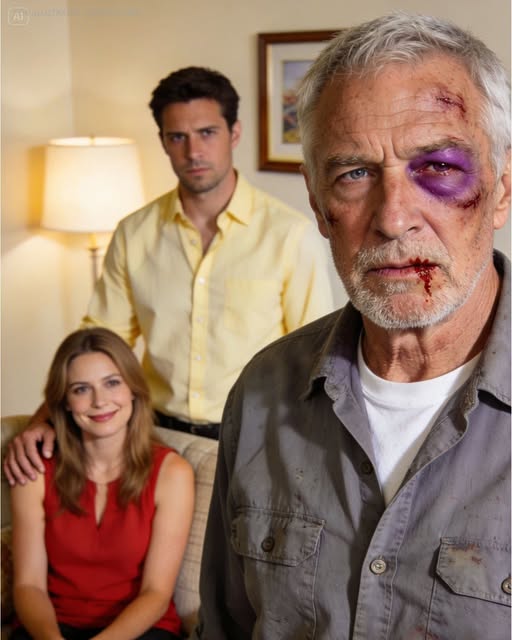
I sat in my lawyer’s conference room, a fresh bandage near my lip, my signature still drying on the final documents. Across from me, Harold Pruitt, my attorney of twenty-six years, lowered his glasses and watched me carefully.
I put the phone on speaker.
“What are you talking about, Brandon?” I asked.
“You know exactly what I’m talking about. There are people at my house saying it’s been sold.”
“Not your house,” I said.
Silence.
Then a short, disbelieving laugh.
“What?”
“The house belongs to Redwood Capital.”
“Don’t play games with me.”
“I’m not.”
I heard Amber’s voice in the background, sharp and panicked.
“Ask him if this is legal.”
Brandon repeated it like a man who still believed volume could change paperwork.
“Is this legal?”
Harold leaned toward the phone.
“Mr. Reeves, this is Harold Pruitt, counsel for Redwood Capital. The sale is legal, fully documented, and executed by the authorized owner of the property.”
Another silence.
Then Brandon’s voice dropped.
“You put my house in some company name?”
“I bought the house under an LLC,” I said. “Your name was never on the deed.”
“You told me it was mine.”
“I told you to treat it like home.”
“That’s the same thing.”
“No,” I said. “It isn’t.”
I could almost hear his breathing change through the phone.
He was beginning to understand.
Not regret.
Not yet.
Just danger.
The danger of consequences reaching him faster than his excuses.
“You can’t do this,” he said. “Amber and I live here.”
“You lived there.”
“This is insane. You’re doing this because of last night?”
“No, Brandon. I’m doing this because last night finally stopped me from lying to myself.”
His voice hardened.
“I lost my temper.”
“You raised your hand against your father thirty times.”
“Don’t exaggerate.”
“I counted.”
Amber said something again. Brandon covered the phone badly, but I still heard her.
“Tell him we’ll sue.”
Harold looked almost bored.
I said, “You may speak with your attorney if you wish.”
Brandon came back on the line.
“You’re going to ruin me over one argument?”
“One argument?” I repeated.
The conference room went very still.
I saw Harold glance at me, but I kept my eyes on the phone.
“Was it one argument when you laughed because I parked my old sedan down the street so your guests wouldn’t see it?”
Brandon said nothing.
“Was it one argument when Amber told your friends I was ‘old Texas money without the polish,’ even though every dollar that paid for the floor under her heels came from my work?”
“Dad—”
“Was it one argument when you stopped inviting me to holidays unless you needed something signed, paid, repaired, or explained?”
His breathing grew louder.
“You’re twisting things.”
“No,” I said quietly. “I’m finally naming them.”
For a long moment, there was no sound except the faint hum of the conference room air conditioner.
Then Brandon said the sentence that ended whatever softness I still had left.
“You’re old. You’re lonely. And now you’re punishing me because I have a life.”
I closed my eyes.
There he was.
My son.
My only child.
Not the boy who once fell asleep in my truck after job-site visits.
Not the teenager who asked me how to tie a tie before prom.
Not the young man who cried when his mother died and held onto me like I was the last solid thing in the world.
This was the adult standing in the house I had paid for, calling my loneliness a weapon while the bruise on my mouth still ached from his hands.
I opened my eyes.
“You have ninety days under the terms provided to vacate,” I said. “The buyer agreed to a leaseback transition only because I requested it. I suggest you use that time wisely.”
“You’re giving strangers our home?”
“I sold property that belonged to my company.”
“This is revenge.”
“No,” I said. “This is eviction from an illusion.”
He hung up.
The room was quiet after that.
Harold removed his glasses and set them on the table.
“You sure about this, Frank?”
I looked down at my hands.
They were old hands now. Thick knuckles. Scar across the left thumb. Sunspots that had not been there twenty years ago. Hands that had signed payroll checks, held blueprints, carried lumber when I was short on crew, and lifted my son onto my shoulders when he was small enough to believe I was the strongest man alive.
“No,” I said honestly. “But I’m certain I can’t keep funding my own humiliation.”
Harold nodded.
“That’s enough.”
The sale had moved quickly because the buyer had been waiting for that specific block for years. A private investor wanted the property for a long-term family residence, not a flip. Clean money. Fast close. No financing delays.
And yes, I had accepted less than I could have gotten if I waited.
But peace sometimes has a discount.
I went home that afternoon to my modest ranch house outside the city. The place was smaller than the River Oaks mansion, older too, with a porch that creaked in one corner and a kitchen window that stuck when it rained.
But every inch of it felt honest.
My late wife, Evelyn, had loved that house.
She used to sit on the porch at sunset with a glass of iced tea and say, “Franklin, don’t ever let money make you forget which rooms are warm.”
I had not forgotten.
But maybe I had tried to buy warmth from people who had none to give.
That evening, I placed Brandon’s unopened gift on the kitchen table.
The brown paper had torn slightly during the birthday dinner.
Inside was the antique watch.
My father had wanted one like it his whole life. Never bought it. Said there was always something more important: a school bill, a medical bill, a roof repair, a truck payment. When I saw the same model at an estate auction, I thought of him. Then I thought of Brandon turning thirty.
I had imagined saying something simple.
Your grandfather admired this watch. I restored it for you. Maybe one day you’ll give it to your son.
Instead, Brandon had barely looked at it.
I unwrapped it slowly and held it in my palm.
Then I put it back in the box.
Not every inheritance should be passed on.
Some have to be protected from the unworthy until someone better arrives.
The next two weeks were ugly.
Brandon hired an attorney who quickly discovered there was very little to fight. The deed was clear. The LLC records were clear. There had been no written transfer, no gift deed, no ownership agreement, no fraud.
There was, however, years of Brandon telling people the house belonged to him.
That became his embarrassment, not my legal problem.
Amber called me once.
I almost did not answer.
When I did, she skipped politeness entirely.
“Do you have any idea what you’re doing to us?”
“Yes.”
“You are destroying your son’s reputation.”
“Brandon damaged that himself.”
Her laugh was sharp.
“You’re being dramatic. Families fight.”
“Families do not sit and smile while a son raises his hand against his father.”
She went quiet for half a breath.
Then said, “You provoked him.”
There it was.
The sentence I had been waiting for without knowing it.
Amber had watched me bleed and decided I was still the problem.
I looked out my kitchen window at the mesquite tree Evelyn had planted the year Brandon was born.
“Thank you,” I said.
“For what?”
“For reminding me I made the right decision.”
I ended the call.
After that, I blocked her number.
Brandon kept texting.
At first, anger.
Then threats.
Then accusations.
Then something that almost looked like pleading.
Dad, we need to talk.
Dad, you can’t just cut me off like this.
Dad, I’m your son.
That last one sat on my screen for a long time.
I typed three responses and deleted them all.
Finally, I wrote:
You were my son before you were a man. I loved the child. I am holding the man accountable.
He did not reply for two days.
During that time, word spread.
Of course it did.
River Oaks lives on polished windows and whispered scandals.
People learned the house had been sold. People learned Brandon had not owned it. People learned the “self-made” young executive had been living under his father’s LLC while speaking about legacy as if he had built it with his own hands.
Some people called me cruel.
Some called me brilliant.
Most called me quietly, pretending they just wanted to check on me.
One old business friend, Leonard, came by with barbecue and no questions.
He sat with me on the porch and handed me a plate.
After ten minutes of silence, he said, “I heard he put hands on you.”
I looked at the sunset.
“Yes.”
Leonard’s jaw shifted.
“You report it?”
“No.”
“Why?”
I thought about it.
“Because I didn’t want the story to become about punishment. I wanted it to become about consequence.”
Leonard nodded slowly.
“Sometimes that’s heavier.”
He was right.
The sale did not put Brandon in jail. It did not bruise him. It did not shout back.
It simply removed the thing he had mistaken for proof of his superiority.
And men like Brandon fear losing status more than they fear losing love.
A month later, something unexpected happened.
My granddaughter called.
Brandon and Amber had a daughter, Lily, seven years old. She was the only reason I had not pulled away sooner. Sweet child. Serious eyes. Loved drawing horses and asking questions adults did not want to answer.
I had not heard from her since the birthday dinner.
Her call came from Brandon’s phone, which I had not blocked because I am a fool in the specific way fathers and grandfathers often are.
I answered carefully.
“Hello?”
“Grandpa?”
My chest tightened.
“Lily?”
“Daddy said you’re mad at us.”
I closed my eyes.
“I’m not mad at you, sweetheart.”
“Are we losing our house?”
The question landed hard.
Children should not have to carry adult consequences before breakfast.
I sat down.
“You are moving,” I said gently. “But you will have another place to live.”
“Daddy said you took it.”
I breathed slowly.
“Your daddy and I have grown-up things to talk about. But none of this is because of you.”
She was quiet.
Then she whispered, “At the party, Daddy was mean.”
My heart hurt.
“Yes,” I said. “He was.”
“Mommy said don’t talk about it.”
“I’m sorry she said that.”
“Did you get hurt?”
I looked at the watch box still sitting on my shelf.
“A little.”
Her voice became smaller.
“I cried after.”
I covered my eyes with one hand.
Oh, Brandon.
What did you do to your own child while trying to prove you were a man?
“I’m sorry, Lily,” I said. “You should not have seen that.”
“Are you still my grandpa after we move?”
The question broke something open in me.
“Yes,” I said immediately. “Always. Houses do not decide family.”
“Daddy said you don’t love us.”
“I love you very much.”
“Do you love Daddy?”
I stared across the room.
There are questions children ask that adults spend whole lives trying to answer.
“Yes,” I said finally. “But love does not mean pretending wrong things are okay.”
She thought about that.
“That sounds like school rules.”
I laughed softly despite everything.
“Maybe it is.”
Before hanging up, she said, “I miss you.”
“I miss you too.”
After the call, I sat still for a long time.
Then I called Harold.
“I need something added to the trust.”
He sighed. “Frank, every time you say that, my week gets worse.”
“This one matters.”
I created an education trust for Lily.
Not through Brandon.
Not through Amber.
Directly protected, managed independently, untouchable by her parents. College, medical needs, emergency support if she ever needed a place to land when she was older.
I had learned something the hard way.
Giving too much to the wrong adult can become poison.
But protecting a child’s future is different.
By the end of the ninety days, Brandon and Amber had moved into a luxury rental that was smaller than the house but still nicer than most people could dream of. Naturally, they acted as if they had been exiled.
The new owners took possession quietly.
I drove by once after the transition, not to spy, but to say goodbye to the illusion.
The River Oaks house looked the same.
Big windows.
Trimmed hedges.
Iron gate.
For years, I had looked at it and thought: My son is secure.
Now I saw the truth.
Security without character becomes entitlement.
I kept driving.
Six months passed before Brandon asked to meet.
Not at his office.
Not at some expensive restaurant where he could perform success.
He asked to meet at a diner halfway between my house and the city.
I arrived early.
Old habit.
He came in wearing a polo shirt instead of a suit. He looked thinner. Tired. Less polished. For the first time in years, he looked like the boy I remembered and the man he had become were fighting behind his eyes.
He sat across from me.
Neither of us spoke at first.
The waitress poured coffee.
Finally, Brandon said, “I’m sorry.”
I looked at him.
Two words.
Easy to say.
Hard to trust.
“For what?” I asked.
His face tightened.
“For hitting you.”
I waited.
“For humiliating you.”
I waited.
“For letting Amber talk about you the way she did.”
I waited.
He swallowed.
“For thinking everything you gave me was something I earned.”
That was the first real sentence.
I picked up my coffee.
“What changed?”
His eyes flicked away.
“Lily asked me if houses decide family.”
I said nothing.
“She said you told her they don’t.”
“I did.”
“She asked me why I acted like the house mattered more than you.”
His jaw worked like he was trying not to cry.
“I didn’t know what to say.”
“Good.”
He looked up.
“Good?”
“Sometimes not having an answer is where honesty begins.”
Brandon rubbed both hands over his face.
“I was angry at you for selling it. Then embarrassed. Then angry again. But after we moved, I realized something.”
“What?”
“I don’t know how to live without proving I’m important.”
That surprised me.
Not because it was untrue.
Because it was the first time I had heard him say something about himself that did not sound polished.
He continued.
“When people came over to that house, I felt like I had won. Like I had become someone. I told myself I deserved it because I worked hard. But deep down, I knew I couldn’t have touched that life without you.”
His eyes reddened.
“So I made you smaller.”
I looked out the diner window.
Traffic moved along the frontage road. Ordinary people heading to ordinary places, carrying problems no one else could see.
“You did,” I said.
He flinched.
I did not soften it.
He had come for truth, or he had come for nothing.
“I don’t expect you to forgive me,” he said.
“Good.”
That hurt him too.
But I was done giving fast forgiveness to people who wanted relief more than change.
“I can’t undo it,” he said.
“No.”
“But I want to try to become someone Lily doesn’t have to be ashamed of.”
That sentence reached me.
Not because it fixed anything.
Because it was pointed in the right direction.
I set down my cup.
“Then start there. Not with me. With her. With how you speak. How you treat people who cannot give you status. How you act when no one important is watching.”
He nodded.
“And Amber?” I asked.
His face closed slightly.
“She thinks I should fight you.”
“Still?”
“She says you manipulated everything.”
“And what do you say?”
He looked at me.
“I say I put my hands on my father and lost the right to call myself the victim.”
For the first time that morning, I felt something in my chest loosen.
Not forgiveness.
Not yet.
But a door cracking open.
A small one.
“Keep saying true things,” I told him. “Eventually they might become a life.”
We did not hug when we left.
That would have been too easy.
But he stood when I stood.
And when I reached for the check, he stopped me.
“I’ve got it,” he said.
I almost smiled.
“You sure? I wouldn’t want to ruin your finances.”
He winced.
Then, to his credit, laughed once.
“I deserved that.”
“Yes,” I said. “You did.”
Over the next year, Brandon changed unevenly.
That is how real change usually happens.
Not like a speech.
Like construction.
Tear out rot.
Find more rot underneath.
Rebuild one beam at a time.
He began therapy, which Amber mocked until he stopped telling her details. He spent more time with Lily. He apologized to her—not with the vague “sorry you saw that,” but with the truth.
“I hurt your grandfather. That was wrong. You were not responsible for my anger.”
She repeated that to me over the phone, proud and serious.
“Daddy used accountable words,” she said.
I nearly laughed and cried at the same time.
Amber did not change much.
Eventually, their marriage cracked under the pressure of Brandon no longer performing the role she preferred. They separated quietly. Lily spent more weekends with me after that, filling my ranch house with crayons, cereal crumbs, and questions about bridges.
“Can a bridge fall if the foundation is bad?” she asked one Saturday.
“Yes,” I told her.
“Can you fix it?”
“Sometimes.”
“How?”
“You stop pretending it’s safe. Then you rebuild the parts that matter.”
She considered that.
“Like Daddy?”
I looked at her.
“Maybe.”
Years passed.
Brandon and I never returned to what we had been when he was a boy. You do not go backward after a thing like that.
But we built something different.
More careful.
More honest.
He never asked me for another house.
I never offered one.
When he bought his own modest place three years later, he invited me over. It was nothing like River Oaks. Smaller yard. Older roof. Kitchen cabinets that needed work.
But his name was on the loan.
His money made the payments.
His effort fixed the fence.
He walked me through it quietly, almost shy.
“It’s not much,” he said.
I looked around.
Lily’s drawings were on the fridge. Work boots sat by the back door. A crooked bookshelf leaned in the living room.
“It’s yours,” I said.
His eyes filled.
“Yeah.”
That day, I brought the antique watch.
He stared at the box for a long moment.
“I don’t deserve that.”
“No,” I said. “You don’t deserve it because you turned thirty. You don’t deserve it because you’re my son. You receive it when you understand what it means.”
He opened the box carefully.
His hands trembled when he lifted the watch.
“This was Granddad’s?”
“No. But it was the kind he admired. He never bought it because he always chose responsibility first.”
Brandon swallowed.
“I’m trying.”
“I know.”
He looked at me then.
Really looked.
Not at my age.
Not at my old sedan parked outside.
Not at what I could give.
At me.
“I’m sorry, Dad,” he said. “For all of it.”
This time, I heard no performance in it.
Only grief.
Only accountability.
Only a man finally standing where the boy had failed.
I nodded.
“I forgive you,” I said.
He broke down then.
Not dramatically.
Not loudly.
Just a grown man holding a watch in an old kitchen, crying because forgiveness had arrived after consequences, not instead of them.
That distinction matters.
Forgiveness without consequence can teach the wrong person that love is permission.
But consequence without bitterness can teach them where the road back begins.
I am older now.
Seventy-two.
My hands shake a little when the weather changes. My business runs mostly without me. Lily is nearly twelve and says she wants to be an engineer because “bridges are honest if you know how to read them.”
I told her bridges can lie too if people ignore the cracks.
She told me that sounded like something I would say.
She is right.
Sometimes people ask if I regret selling the River Oaks house.
I do not.
That house was beautiful, but it had become a stage for arrogance. Selling it did not destroy my family. It exposed what was already broken.
And once something is exposed, you have a choice.
Cover it again.
Or rebuild.
I chose to stop covering.
Brandon chose, eventually, to rebuild.
Not everyone does.
Amber never apologized. That is her burden, not mine.
As for me, I kept the ranch house. The porch still creaks. The kitchen window still sticks when it rains. Evelyn’s mesquite tree is taller now, wide enough to shade the steps in the afternoon.
Some evenings, Brandon and Lily come by for dinner.
He brings groceries without being asked.
He helps fix things without making a speech.
He listens when I talk.
Sometimes, when he thinks I do not notice, he looks at my mouth where the scar faded and his face still tightens with shame.
I do not rescue him from that feeling.
Some memories should remain heavy enough to guide a man’s hands.
One night, after Lily fell asleep on the couch, Brandon and I sat on the porch watching heat lightning flicker over the horizon.
He said, “Selling that house was the worst thing that ever happened to me.”
I looked at him.
Then he added, “And probably the best.”
I nodded.
“Foundations,” I said.
He gave a tired smile.
“Yeah. Foundations.”
We sat in silence after that.
Not the cold silence of estrangement.
The quiet of two people who knew the past could not be erased, but also knew the future did not have to kneel before it.
I thought of the night of his birthday.
The counting.
The blood.
The gift in brown paper.
The phone call the next morning.
And I thought of the lesson I learned too late but not too late to matter:
Sometimes loving your child means giving.
Sometimes it means forgiving.
And sometimes, when the child has become an adult who mistakes your love for weakness, it means taking back the house…
so he can finally learn how to build one of his own.