PART 2 — FULL CONTINUATION WITH COMPLETE ENDING:
After Trent left, I did not cry right away.
I thought I would.
I thought I would collapse onto the kitchen floor, clutching the red and green dish towel, sobbing beside the apple pie I had baked for a Christmas morning that no longer existed.
But grief did not come like that.
It came quietly.
It came in the hum of the refrigerator.
In the glow of the Christmas tree reflecting against the dark window.
In the ridiculous neatness of the wrapped gifts beneath it.
One for Trent.
One for me.
One for the life I thought we still had.
I stood in the kitchen for almost an hour after he walked out. The house felt too warm, too decorated, too full of things pretending nothing had changed.
Finally, I could not breathe inside it anymore.
So I put on my thickest coat, wrapped a scarf around my neck, and pulled on my only good winter boots.
They were old but sturdy, black leather with fleece lining, the kind of boots I had bought after slipping on hospital steps three winters earlier. They had carried me through icy parking lots, double shifts, and late-night walks home when the bus was delayed.
I did not know where I was going.
I just needed to move.
Snow fell in soft, steady sheets over the neighborhood. Christmas lights blurred through the storm, red and gold and blue against the white. Through windows, I saw families at tables. Children running through living rooms. Someone carrying a tray of cookies. A man helping a woman hang one last ornament.
Every glimpse felt like pressing a bruise.
I walked until my neighborhood ended and the streets grew quieter.
Then I reached Bellweather Park.
In summer, it was full of joggers and picnic blankets. That night, it was nearly empty, the benches crusted with snow, the trees standing black and thin beneath the frozen sky.
I sat on a bench under a streetlamp and stared at nothing.
At fifty-five years old, I suddenly felt both too old and too young.
Too old to start over.
Too young to believe my life was finished.
Trent’s words circled in my head.
Predictable.
Safe.
Old.
I had spent thirty years as a nurse. I had held the hands of dying strangers. I had cleaned wounds, comforted families, worked through holidays, and learned how fragile the body could be. I had thought safe was a beautiful thing.
Safe meant steady.
Safe meant home.
Safe meant someone who stayed.
Apparently, to Trent, safe meant dull.
I laughed once, bitterly.
The sound disappeared into the snow.
That was when I saw him.
At first, he was only a shadow near the walking path.
A man moving slowly, almost stumbling. His coat was far too thin for the weather. His head was bowed. One arm held his side as if every step hurt.
Then he moved into the pool of streetlamp light.
He was barefoot.
I stood before I realized I had moved.
Nurse instincts do not ask permission. They rise.
“Sir?” I called.
The man stopped.
He lifted his head.
He looked maybe in his sixties, though suffering makes age hard to read. His hair was silver at the temples, his face pale, his lips almost blue from cold. His bare feet were red and raw against the snow.
“My God,” I whispered. “Where are your shoes?”
He looked at me for a long moment.
His eyes were sharp despite the cold.
“I lost them,” he said.
His voice was rough but controlled.
That was strange.
A freezing man should sound panicked. Confused. Broken.
He sounded like someone forcing himself to remain dignified.
“You need help,” I said.
“I’ll manage.”
“No, you won’t.”
His mouth twitched faintly, as if my bluntness surprised him.
“I don’t want trouble.”
“You already have trouble. Your feet are in snow.”
I moved closer, taking off my gloves as I looked him over. No obvious bleeding. No severe confusion. But his skin color worried me.
“How long have you been outside?”
“Long enough.”
“That is not a medical answer.”
This time, he almost smiled.
“You a doctor?”
“Nurse. Thirty years. Sit down before you fall down.”
He stared at me.
Most men, I had learned, did not enjoy being ordered around by middle-aged women. But this man lowered himself onto the bench without arguing.
His shoulders shook once.
That decided me.
I looked down at my boots.
Then at his feet.
“No,” he said immediately.
“I haven’t said anything.”
“You’re going to give me your boots.”
“I am.”
“No.”
“Yes.”
“It’s Christmas Eve. You’re alone in a park. Keep your boots.”
“Sir, I still have socks. You have nothing.”
“You’ll freeze.”
“I live closer than you can safely walk barefoot.”
That was not entirely true.
But it sounded convincing.
I sat beside him and began unlacing the boots.
“Take them.”
“I can’t.”
“You can, and you will.”
He looked at me carefully.
“You don’t know me.”
“I know your feet need boots.”
“That’s enough?”
“For tonight, yes.”
He was silent.
I pulled off the first boot, then the second. The cold bit through my socks immediately, sharp enough to make me suck in a breath. I ignored it and pushed the boots toward him.
He did not move.
I sighed.
“I am not in the mood for male pride tonight. Put them on.”
That did it.
A startled laugh escaped him.
Then, slowly, he put on the boots.
They were too small. I could see it. But they were better than snow.
I wrapped my scarf around his shoulders before he could object.
“What’s your name?” I asked.
He hesitated.
“Roman.”
“I’m Claudia.”
His gaze lifted.
“Claudia.”
The way he said my name made me feel oddly seen.
Not admired.
Not judged.
Seen.
“Do you have somewhere to go, Roman?”
“Yes.”
“Can you call someone?”
“I already did.”
I frowned.
“Then why are you walking barefoot in a snowstorm?”
His eyes moved to the empty path.
“Long story.”
“It always is.”
He looked back at me.
“And you? Why are you sitting alone in a park on Christmas Eve?”
I almost told him a polite lie.
Then I was too tired.
“My husband left me tonight.”
Roman’s expression did not fill with pity.
I appreciated that.
“For another woman,” I added. “A young one.”
His jaw tightened slightly.
“A foolish man.”
I laughed softly.
“You don’t even know him.”
“I know enough.”
The cold was seeping up through my socks, but I stayed where I was.
For a few minutes, neither of us spoke.
Snow gathered on my sleeves. Roman sat beside me wearing my boots and scarf, looking less like a man saved and more like a king temporarily misplaced.
“You should go home,” he said.
“I’m not ready.”
“Because he’s gone?”
“Because everything he left behind is still there.”
Roman nodded like he understood that more than he wanted to.
“Then sit a few more minutes,” he said. “But not long.”
“You’re giving medical advice now?”
“I’m giving survival advice.”
We sat until headlights appeared at the far end of the park.
At first, I thought it was one car.
Then another.
Then more.
Black SUVs rolled along the service road, one after another, dark and silent against the snow. Their headlights cut through the storm like blades.
My body went still.
Roman exhaled.
“Ah.”
I turned to him.
“Ah?”
He stood, still wearing my boots.
Seventeen black SUVs formed a wide semicircle near the path. Doors opened. Men in dark coats stepped out, scanning the park with practiced movements.
I backed up instinctively.
“Roman, who are these people?”
He looked suddenly tired.
“My people.”
That was not comforting.
A tall man rushed forward.
“Mr. DeLuca.”
Mr. DeLuca.
The name struck something in my memory.
DeLuca Hotels.
DeLuca Medical Centers.
DeLuca Foundation.
DeLuca Shipping.
Even I, who paid little attention to the wealthy unless they donated to the hospital, knew that name.
I stared at the barefoot stranger wearing my boots.
“Roman DeLuca?”
He looked at me almost apologetically.
“Yes.”
Before I could respond, two men brought him a long wool coat and polished black shoes. Another held a medical kit. A woman in a tailored suit spoke into an earpiece while looking at me with obvious curiosity.
Roman removed my boots carefully.
One of his men tried to take them.
Roman stopped him.
“No. Give them back to Mrs.—”
“Claudia,” I said automatically.
His eyes returned to mine.
“Claudia.”
The man handed me the boots. I slipped them on quickly, grateful for the warmth.
Roman disappeared into one of the SUVs for several minutes.
When he returned, he was wearing a perfectly tailored black suit beneath a heavy coat. His silver hair had been combed back. His color had improved. He looked like an entirely different man.
Powerful.
Controlled.
Untouchable.
The man from the bench had been a shadow.
This man made the snow feel like it was falling by permission.
He walked toward me while his people stayed several steps behind.
Then he said the sentence I had not expected.
“I’m glad you passed the test.”
I stared at him.
“The what?”
His expression remained calm, but something in his eyes shifted.
Regret, perhaps.
“The test.”
My body went cold in a different way.
I looked around at the SUVs. The bodyguards. The woman in the suit. The man I had just helped, now dressed like a billionaire.
“You were testing people?”
“Yes.”
I took a step back.
“Were you ever in danger?”
His answer came too slowly.
“Not as much as you believed.”
The humiliation hit fast.
Hot.
Sharp.
I had just been betrayed by my husband, had given away my boots in the snow, had sat beside a stranger with my heart cracked open, and now he was telling me it had been staged.
I pulled off his scarf and shoved it into his hands.
“Then you can pass this back to yourself.”
The woman in the suit looked horrified.
Roman’s mouth parted slightly.
“Claudia—”
“No.”
My voice shook, but I did not care.
“You don’t get to make suffering into a game because you have too much money to trust people.”
His face changed.
One of his guards stepped forward.
Roman lifted a hand without looking.
The man stopped.
I kept going.
“You sat there letting me think you were freezing. I took off my only boots. I told you my husband left me. And now you stand here in a suit with seventeen cars telling me I passed?”
Snow fell between us.
No one spoke.
Roman looked at me for a long moment.
Then, quietly, he said, “You’re right.”
That stopped me.
I expected defense.
Explanation.
Powerful men love explanations. They wrap selfishness in strategy and call it wisdom.
But Roman DeLuca lowered his head slightly.
“You’re right,” he repeated. “It was cruel.”
My anger faltered, but did not disappear.
“Then why?”
His eyes moved toward the dark park path.
“Because three weeks ago, my brother died alone in this city while people walked around him.”
The words landed heavily.
“He had dementia,” Roman said. “Early onset. He disappeared from his care facility during a staff change. For six hours, he wandered in the cold. People saw him. Cameras showed them looking. Avoiding him. Crossing the street.”
His jaw tightened.
“When help finally came, it was too late.”
My anger softened, unwillingly.
“I’m sorry.”
“So am I,” he said. “But grief made me ugly. I wanted to know if anyone in this city still stopped. If anyone helped when there was no reward.”
I looked at the SUVs.
“And you chose Christmas Eve?”
“My brother loved Christmas.”
The answer was heartbreaking.
It was also not enough.
“That explains your pain,” I said. “It doesn’t excuse using mine.”
Roman looked at me fully.
“No. It doesn’t.”
For the first time, he looked less like an untouchable billionaire and more like the freezing man from the bench.
Tired.
Haunted.
Human.
“I apologize,” he said. “Not as a performance. Not as a transaction. I was wrong.”
The apology was plain.
That made it harder to reject.
Still, I lifted my chin.
“Goodnight, Mr. DeLuca.”
I turned and began walking away.
The snow was deeper now. My boots were wet inside. My feet ached. My heart felt emptied out.
Behind me, Roman said, “Let me take you home.”
I did not turn.
“I have already been taken for enough tonight.”
I walked until one of his female staff members caught up, keeping a respectful distance.
“Mrs. Claudia?” she said.
“Just Claudia.”
“Claudia. My name is Elena. Mr. DeLuca asked me to offer you a ride. Not with him. With me. No conversation required. It is dangerous to walk in this storm.”
I stopped.
My pride wanted to refuse.
My nursing brain knew she was right.
I looked at her.
“No test?”
She smiled faintly.
“No test. Just heat.”
So I accepted.
Elena drove me home in silence. When we reached my house, I saw Trent’s tire tracks still faintly visible beneath the new snow. The windows glowed from the Christmas tree inside.
The sight hurt less than I expected.
Maybe because the night had become too strange for any single pain to own me.
Elena walked me to the porch.
“Mr. DeLuca asked if he may contact you tomorrow to apologize again.”
I almost laughed.
“Does he ask permission for everything after using fake homelessness as a social experiment?”
Elena’s mouth twitched.
“Not everything. But perhaps he is learning.”
I sighed.
“He can send a letter.”
“Understood.”
Then she left.
I went inside.
The pie was still on the counter.
The tree was still lit.
Trent’s gift still sat wrapped beneath it.
I took his present, carried it to the closet, and placed it on the top shelf.
Then I cut myself a slice of apple pie and ate it standing at the kitchen counter.
It tasted like cinnamon, butter, and the first minute of my life after Trent.
The next morning, Christmas Day, a handwritten letter arrived by courier.
No gift.
No flowers.
No check.
Just paper.
Claudia,
Last night, you gave warmth to a man you believed had none. I turned that kindness into evidence for my grief. I am ashamed of that.
My brother’s name was Samuel. He used to say people reveal themselves in doorways: when someone needs to enter, when someone needs to leave, and when someone needs shelter.
You revealed yourself with mercy. I revealed myself with suspicion.
I am sorry.
If you allow it, I would like to make something useful from the harm I caused. Not for you unless you ask. For people like Samuel, and for people like the man you thought I was.
Respectfully,
Roman DeLuca
I read it twice.
Then I placed it beside my tea.
I did not answer that day.
Or the next.
I had my own life to sort through.
Trent called on December 26.
I let it go to voicemail.
His message was uncomfortable and rambling. Jessica had apparently gone to see her family and “needed space.” He hoped I was okay. He wanted to come by for some remaining things.
I listened once.
Then deleted it.
Not out of revenge.
Because his confusion no longer required my care.
By New Year’s, I had met with a divorce attorney.
The house, despite Trent’s grand exit, was very much half mine. The retirement accounts. The savings. The debts. The furniture. The life he wanted to leave without fighting over “things” still needed adult handling.
I had spent twenty-eight years being practical.
Now practicality served me.
Roman sent nothing else.
No pressure.
No dramatic invitation.
Just one more letter two weeks later.
This one contained a proposal, not for me, but for the hospital system where I worked.
The DeLuca Foundation wanted to fund a winter outreach program for vulnerable adults: emergency warming rides, medical checks, temporary footwear and coats, direct coordination with shelters and hospitals, and specialized training for dementia-related wandering cases.
At the bottom, in handwriting, Roman wrote:
If this feels like another test, throw it away. If it feels useful, tell me what people actually need. I will listen.
That sentence mattered.
I had known many donors. They liked ceremonies. Plaques. Photographs of themselves holding oversized checks.
Tell me what people actually need.
That was rarer.
I called him.
He answered himself.
“Claudia.”
“Mr. DeLuca.”
“I deserve that.”
“Yes.”
A pause.
Then, “Is the proposal offensive?”
“No,” I said. “It’s incomplete.”
For the first time since the park, I heard him breathe out in something almost like relief.
“Tell me.”
So I did.
For forty minutes, I told a billionaire what people freezing in cities actually needed.
Not only coats.
Socks.
Foot checks.
Medication storage.
Transportation that did not require forms longer than a prayer.
Staff who knew how to approach someone confused without frightening them.
Warm places that allowed pets.
A hotline families could call when an elderly relative disappeared.
He interrupted only to ask useful questions.
At the end, he said, “Will you consult?”
“No.”
“Fair.”
“I have a full-time job and a divorce.”
“Understood.”
“But I’ll review the plan once more if you send revisions.”
“I will.”
He did.
The program launched in February.
No gala.
No stage.
No Roman DeLuca speech.
Just vans, nurses, social workers, drivers, shelter coordinators, and boxes of boots.
The first night it operated, a man with dementia was found near a bus depot and returned safely to his daughter within an hour.
Roman sent me one text.
Samuel would have liked this.
I sat in my car after a twelve-hour shift and cried.
Not because I forgave the test entirely.
Because sometimes wrong beginnings can still be turned toward right work.
Spring came slowly.
My divorce moved forward.
Trent’s new life with Jessica became less glamorous once it involved bills, laundry, and a man nearly sixty trying to prove he was young. I knew this because he told me far too much in emails I mostly forwarded to my attorney.
One day, he wrote:
I think I made a mistake.
I answered:
That is something to discuss with your therapist, not your ex-wife.
It felt good.
Not cruel.
Clean.
Roman and I became something like friends, though neither of us knew what to call it at first.
He asked before calling.
I answered when I wanted.
He never mentioned romance.
I appreciated that more than flowers.
He told me about Samuel. About guilt. About growing up poor before wealth hardened the family. About how suspicion had become his habit because money attracted people who performed kindness for access.
I told him about Trent. About nursing. About aging inside a marriage where my steadiness was mistaken for dullness. About how painful it was to be called old by someone whose entire adult life had been cushioned by my loyalty.
Roman listened.
Really listened.
One evening in April, after an outreach meeting at the hospital, Roman walked me to my car.
The air smelled like rain instead of snow.
He stopped near the driver’s door.
“I have wanted to ask you something for weeks,” he said.
I raised an eyebrow.
“If this is another test, I’ll take your shoes.”
He smiled.
A real smile this time.
“No test.”
“Then ask.”
“May I take you to dinner?”
I looked at him.
The powerful man from the SUVs.
The barefoot stranger from the snow.
The grieving brother.
The man who had apologized without trying to buy forgiveness.
“I’m still divorcing.”
“I know.”
“I’m not looking for someone to rescue me.”
“I know.”
“I’m fifty-five.”
“I am sixty-three.”
“I’m not predictable.”
His smile deepened.
“I was hoping not.”
I laughed despite myself.
Then I said, “Dinner. One dinner.”
“One dinner,” he agreed.
It was not a fairy tale after that.
I do not trust stories that turn heartbreak into instant romance.
Healing took time.
My divorce finalized in August. I kept the house for a while, then sold it because every room had too many ghosts. I bought a smaller place with a sunroom, a better kitchen, and no memories of Trent placing keys on the counter like a goodbye gift.
Roman continued the outreach program and expanded it across three cities. He put Samuel’s name on it, not his own. I liked that.
We dated slowly.
Carefully.
Sometimes I got scared because wealth creates its own weather. Roman’s world included security, assistants, board meetings, private planes, and people who spoke in polished half-truths.
My world included night shifts, leftover soup, comfortable shoes, and knowing which hospital vending machine still sold decent coffee.
But Roman never treated my life like something to replace.
He stepped into it respectfully.
He sat with me at diners.
He learned the names of nurses.
He carried boxes at outreach events without cameras.
And one snowy evening, nearly a year after the night in the park, he brought me to Bellweather Park.
No SUVs.
No entourage.
Just him, me, and a bench beneath the same streetlamp.
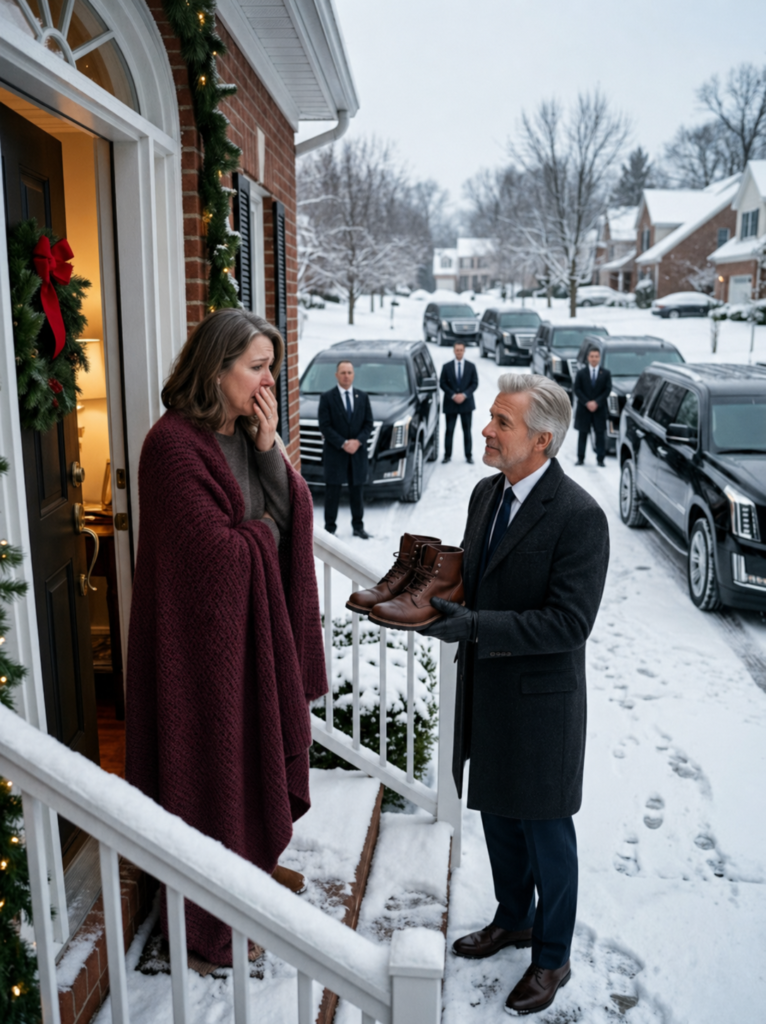
He held a pair of boots in his hands.
Black leather.
Fleece-lined.
My size.
“I should have replaced them the next day,” he said.
“You should have not needed them in the first place.”
“Yes.”
I took the boots.
“They’re nice.”
“They are also not a test.”
“Good.”
We sat on the bench.
Snow fell softly, just like it had the night my marriage ended.
Only this time, I was warm.
Roman looked at the path where I had first seen him.
“I keep thinking about what you said,” he told me. “That I made suffering into a game.”
“You did.”
“I know.”
“And then you made it into something useful.”
He nodded slowly.
“Because you refused to let me feel noble about being wrong.”
I smiled.
“That’s one of my gifts.”
“It is.”
For a while, we watched snow gather on the trees.
Then he said, “Trent was a fool.”
I laughed.
“You’re just realizing that?”
“No. I’m saying it because I no longer feel guilty for benefiting from his foolishness.”
I looked at him.
Roman’s expression was gentle.
Not possessive.
Not triumphant.
Just honest.
“I am sorry he hurt you,” he said. “But I am grateful your life continued past him.”
My throat tightened.
“So am I.”
Years later, people still ask about the 17 black SUVs.
They love that part.
It sounds dramatic. Cinematic. Impossible.
But that is not the part I remember most.
I remember sitting alone in my kitchen after Trent left, eating apple pie because I refused to let my own work go untouched.
I remember cold snow under my socks.
I remember Roman’s raw feet.
I remember my anger when I learned the truth.
I remember the first van from Samuel’s Winter Reach bringing a confused old man safely home.
I remember the day my divorce papers were final and I slept through the night for the first time in months.
I remember buying my little house and realizing every item in it belonged to the life I chose.
The black SUVs make a good story.
But the real story is smaller.
A woman was told she was old.
Predictable.
Safe.
Then, on the worst night of her life, she still chose to be kind.
That kindness was not weakness.
It was not naivety.
It was not proof she could be used.
It was proof that Trent had not taken the best parts of her when he left.
I am older now than I was that Christmas Eve.
Happier too.
Not because a wealthy man stepped out of the snow and changed my life.
But because heartbreak did not turn me bitter.
Because I learned that safe is not dull when someone values shelter.
Because I discovered that the life after betrayal can be quieter than the life before it, and still be more alive.
Sometimes Roman and I still visit the park on Christmas Eve.
We bring boots.
Real ones.
Dozens of pairs.
No tests.
No cameras.
No speeches.
Just warmth for whoever needs it.
And every year, when I see someone pull on a pair and sigh with relief, I think about the woman I was on that bench.
Cold.
Abandoned.
Certain her best years had been discarded.
I wish I could sit beside her now and tell her the truth.
Your husband did not leave with your future.
He only left with the version of you that believed love had to stay to be real.
The rest of you is still here.
Still warm.
Still walking.
Still capable of opening a door no one expected.
And sometimes, that is how a life begins again.