PART 2 — FULL CONTINUATION WITH COMPLETE ENDING:
At 3:19 in the morning, Ethan Caldwell opened his eyes.
At first, he did not understand where he was.
The ceiling above him was too white. The air smelled too sharp, too clean. A machine beeped beside him with steady patience, as if measuring whether he had earned another second.
His chest burned.
His throat felt raw.
When he tried to move, pain tightened across his body and pulled a low sound from him before he could stop it.
A nurse appeared beside him almost instantly.
“Mr. Caldwell,” she said gently, leaning close. “You’re awake.”
He blinked slowly.
Hospital.
He was in a hospital.
Memory returned in broken flashes.
The park.
The morning air.
The children laughing somewhere in the distance.
The pressure in his chest.
The world tilting.
Then the ground rising too fast.
He tried to speak, but his voice came out rough.
“What happened?”
The doctor came in minutes later, calm but serious, with dark circles under his eyes that told Ethan the man had been working too long.
“You suffered a major cardiac emergency,” the doctor said. “You were brought in quickly, and that is the reason you are alive. If help had arrived even a few minutes later, this conversation might not be happening.”
Ethan stared at him.
Alive.
The word felt strange.
He had spent years thinking survival was something he could buy. Private security. Private doctors. Private planes. The best specialists. The best equipment. The kind of money that made doors open before he knocked.
But in the park, none of that had mattered.
He had been just a man on the ground.
Helpless.
Ignored.
“The girls,” he whispered.
The doctor paused.
“What girls?”
Ethan closed his eyes, trying to hold the memory before it slipped away.
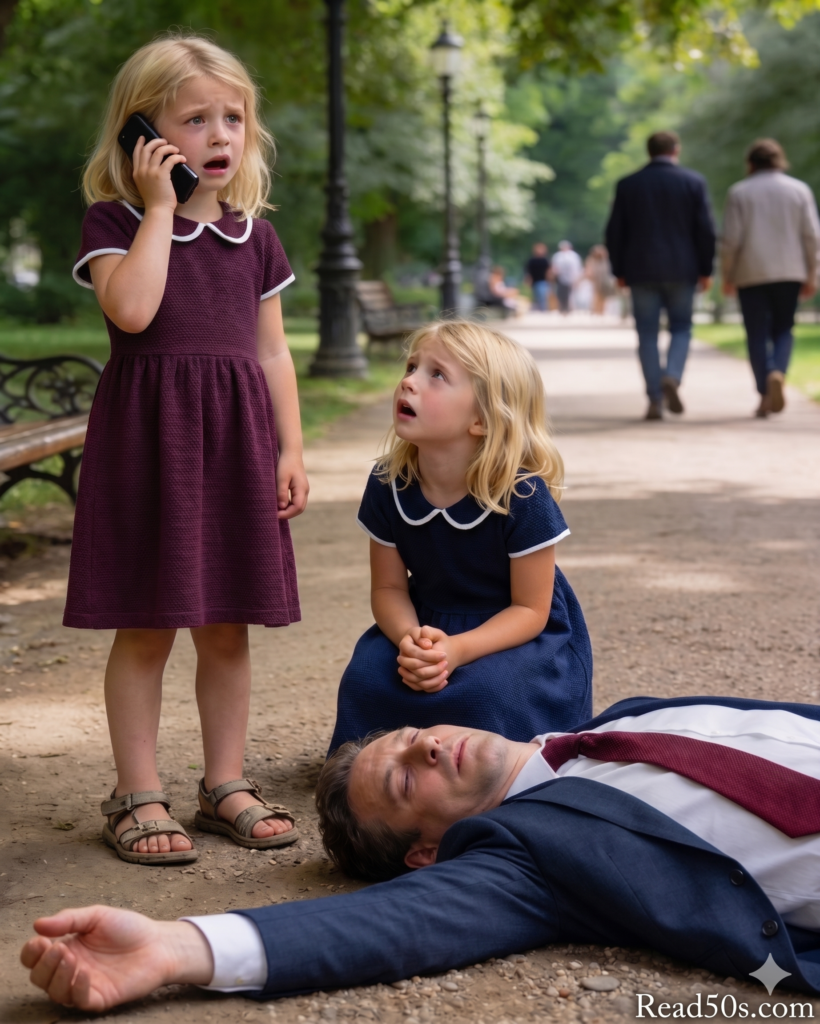
“Two little girls. Twins, I think. They were there. One called for help. One held my hand.”
The doctor’s expression changed.
“You remember them?”
“They saved me?”
The doctor did not soften the truth.
“Yes. They did. The emergency call came from a child. One of the paramedics said the girls stayed with you until help arrived.”
Ethan turned his face toward the window.
Outside, morning had not yet arrived. The glass reflected his own face back at him: pale, older than he expected, oxygen tube beneath his nose, hospital gown replacing the expensive suit he had worn when he decided he did not need his driver.
He remembered feeling trapped by his own life.
Armored cars.
Meetings.
Money.
People watching him but rarely seeing him.
He had thought walking alone would make him feel free.
Instead, he had fallen in front of strangers and discovered how invisible a powerful man could become when he looked powerless.
“Find them,” he said.
The doctor hesitated.
“Mr. Caldwell, you need rest.”
“I need their names.”
“I can ask the paramedics.”
“Do that.”
His voice was weak, but something in it returned—a trace of the man who had built an empire by refusing to be ignored.
Then he stopped himself.
No.
Not that man.
Not now.
He lowered his voice.
“Please,” he added.
The doctor seemed surprised.
Then he nodded.
“I’ll see what I can learn.”
A few corridors away, in a quieter part of the hospital, Lily and Emma sat on either side of their mother’s bed.
Maria Torres was thirty-two years old.
She had kind hands, even lying still.
That was what Lily always thought when she looked at her. Her mother’s hands looked like they were supposed to be braiding hair, packing lunches, tying shoes, fixing blankets, wiping tears.
But for seventeen days, they had not moved.
Maria lay beneath a thin hospital blanket, her face pale, her dark hair brushed carefully back from her forehead. Tubes ran from her arm. A monitor beeped beside her bed. Every sound in the room had become part of the girls’ lives now.
Beep.
Pause.
Beep.
Pause.
It was the sound of waiting.
Lily held a small plastic comb and gently pulled it through the ends of her mother’s hair.
“Mom, you look pretty today,” she whispered.
Emma stood on a chair beside the bed, carefully adjusting the blanket over Maria’s shoulder.
“Don’t be cold,” she said. “It’s morning now.”
Their mother did not answer.
She had not answered since the accident.
It had been raining the day Maria collapsed at work. She cleaned offices at night and cared for elderly patients during the day, doing whatever she could to keep food on the table. The doctors used many words Lily did not fully understand. Brain swelling. Trauma. Complications. Observation. Uncertain recovery.
But Lily understood the most important part.
Mom was asleep, and nobody knew when she would wake up.
At six o’clock that morning, a nurse entered the room with a man in a gray suit.
The nurse was kind. Her name was Carla. She brought the girls crackers sometimes and pretended not to notice when they slept curled together in the chair.
The man in the suit did not look unkind exactly.
He looked tired.
Tired people who had bad news often looked at children the same way.
“We need to speak with a responsible adult,” he said.
Lily looked up.
“There aren’t any.”
The man blinked.
“Is there a relative we can call?”
Emma shook her head.
“Our auntie is far away. She doesn’t answer.”
Lily added, “Mom said we don’t bother people who already decided not to help.”
Nurse Carla’s face tightened with sadness.
The man cleared his throat.
“Girls, this is difficult. Your mother has been receiving extended care. There are financial matters that must be addressed.”
Lily did not understand all of that.
But she understood money.
She understood counting coins with her mother at the kitchen table.
She understood when Maria said, “Not this week, baby,” in the grocery store.
She understood the way adults looked when they were about to take something away.
“What does that mean?” Lily asked.
The administrator looked at Nurse Carla, then back at the girls.
“If the bill is not handled by noon, your mother may need to be transferred to another facility.”
Emma climbed down from the chair.
“But she is still sick.”
“I know,” Nurse Carla said softly.
“Then why would you move her?”
The administrator pressed his lips together.
“There are rules.”
Lily hated that word.
Rules were what people said when they did not want to explain why something unfair was still going to happen.
“Will she get better there?” Lily asked.
No one answered quickly enough.
Emma’s eyes filled.
“What if she wakes up and we are not there?”
Nurse Carla stepped closer.
“We will try to help.”
“But can you stop them?” Lily asked.
Nurse Carla’s eyes shone.
“I don’t know.”
That was honest.
And somehow worse than a lie.
At 7:05, Ethan Caldwell was sitting upright in bed, against medical advice and two pillows, when his assistant arrived.
Julian Pierce looked as if he had aged ten years overnight. His tie was crooked. His hair, usually perfect, was slightly disordered. He carried two phones, a tablet, and the expression of a man ready to reorganize the universe to prevent another scare.
“Sir,” Julian said. “Thank God.”
Ethan looked at him.
“Did you find the girls?”
Julian paused.
“I’m working on it. Security is pulling park footage, and the paramedic team is being contacted. But you need to focus on recovery.”
“I am focused.”
“On your heart?”
“On why it is still beating.”
Julian closed his mouth.
That was rare.
Ethan had known Julian for twelve years. He was efficient, loyal, and almost impossible to surprise. But that morning, something about Ethan’s tone made him soften.
“I’ll find them,” Julian said.
“No cameras. No press. No reward announcement.”
“Understood.”
“I want their names before the board calls.”
“The board has already called.”
“Then they can wait.”
Julian almost smiled.
“That, at least, sounds like you.”
“No,” Ethan said quietly. “I’m not sure it does.”
By 7:20, Nurse Carla entered Ethan’s room.
She looked nervous.
“Mr. Caldwell?”
“Yes?”
“I heard you were asking about two little girls from the park.”
Ethan’s whole body sharpened with attention.
“You know them?”
“I believe so. Lily and Emma Torres. Five-year-old twins. They come through that park every morning.”
“Where are they?”
Nurse Carla hesitated.
“They’re here.”
Ethan stared at her.
“In this hospital?”
“Yes. Their mother is a patient here.”
Something in Ethan’s chest tightened, and not from the heart attack.
“What happened to her?”
“She’s been unconscious for seventeen days after a medical emergency following an accident. It’s complicated.”
“Are the girls alone?”
The nurse looked down.
“Mostly.”
That one word told Ethan more than any file could.
Mostly.
A word used when a situation was wrong, but nobody had the authority or courage to say it loudly.
“I want to see them,” he said.
“Mr. Caldwell, you are in no condition to—”
“I want to see them,” he repeated, softer this time. “Please.”
Fifteen minutes later, Ethan was in a wheelchair.
His doctor was not pleased. Julian looked like he might physically block the door if Ethan tried to stand. But the nurse guiding the wheelchair seemed to understand that some debts could not wait for full medical clearance.
The hallway felt longer than it should have.
Ethan passed private rooms, nurses’ stations, sleeping families, vending machines, and windows glowing faintly with early morning light.
Then they stopped outside a small room with the door slightly open.
Inside, Lily and Emma sat beside their mother.
They were smaller than he remembered.
That was the first thing that hit him.
In the park, they had seemed brave, almost unreal, like tiny angels in worn shoes. But here, in the hospital light, they were just children.
Two little girls with tangled hair, tired eyes, and a backpack on the floor that probably held everything they thought they needed.
One was combing Maria’s hair with careful fingers.
The other was tucking the blanket around her mother’s feet.
“Mom,” Emma whispered, “today we helped a man.”
Lily leaned close to Maria’s ear.
“They said he is going to be okay,” she whispered. “Just like you, right?”
Only the machine answered.
Ethan looked away for a second because something inside him had broken open too quickly.
He had sat across from presidents of companies, senators, billionaires, and men who thought themselves untouchable.
None of them had ever made him feel as humbled as these children did.
He knocked gently.
The girls turned.
Emma’s eyes widened.
“The man from the park.”
Lily stood quickly.
“You’re awake.”
Ethan gave a small, tired smile.
“Yes,” he said. “I’m awake.”
The nurse rolled him closer.
For a moment, no one spoke.
Then Ethan looked at both girls and said, “You saved my life.”
Emma looked down at her shoes.
“I just called the number.”
“No,” Ethan said. “You stopped. That is not small.”
Lily glanced at her mother.
“People should stop when someone falls.”
“Yes,” Ethan said quietly. “They should.”
But the park had already shown him how many did not.
Emma twisted her fingers together.
“Are you sick too?”
“A little. But I am better because of you.”
“That’s good,” she said.
Lily studied him with serious eyes.
Children have a way of looking at adults that removes all decoration. They do not care about net worth, reputation, holdings, or titles. They only want to know if you are safe.
“Are you rich?” she asked suddenly.
Nurse Carla gasped softly.
“Lily.”
Ethan almost laughed. It hurt, so he stopped.
“Yes,” he said. “I am.”
Emma looked at her sister.
Then Lily asked the question that would stay with Ethan for the rest of his life.
“Can you save my mom?”
The room went silent.
Not awkward silent.
Sacred silent.
The kind that forms around a child’s last hope.
Ethan looked at Maria Torres.
Her face was still. Her body quiet. The machines keeping record of all the things her daughters could not understand but could not stop watching.
He looked at the girls.
There was no manipulation in their faces.
No greed.
No idea what they were really asking.
To them, rich meant enough.
Enough medicine.
Enough help.
Enough power to make adults stop saying rules.
Ethan felt shame rise again.
He had used money for control.
For status.
For distance.
For insulation from discomfort.
But no money had reached for him in the park.
No investment account had called 911.
No building had held his hand.
These two little girls had.
“Yes,” he said.
Lily froze.
Emma covered her mouth with both hands.
Ethan leaned forward slightly.
“Yes. I will help your mother.”
Nurse Carla’s eyes filled.
Julian, standing behind the wheelchair, immediately pulled out his phone.
Ethan did not look back at him.
“Start with the bill,” he said. “All of it. Then get her file reviewed by the best specialists. Quietly. No publicity. No headlines. No foundation photos. Understand?”
Julian nodded.
“Understood.”
The administrator who had spoken to the girls earlier appeared near the doorway, pale and uncertain.
Ethan turned his head toward him.
“And no one moves Maria Torres without medical necessity and my direct review.”
The man swallowed.
“Yes, Mr. Caldwell.”
Lily looked confused.
“You can do that?”
Ethan looked back at her.
“I can do that.”
Emma began to cry.
Not loudly.
She simply folded into her sister, and Lily wrapped both arms around her, trying to be brave and failing beautifully.
Ethan reached out one hand, then stopped.
He did not touch them without permission.
“May I?” he asked.
Lily looked at his hand.
Then she took it.
Her fingers were small and warm.
The same hand that had held his in the park.
And for the first time in years, Ethan Caldwell cried.
Only one tear.
But enough.
The next days moved quickly.
Maria’s outstanding bills were paid before noon.
A new team of specialists reviewed her case by evening.
Tests were repeated.
Medications adjusted.
Therapies changed.
A patient advocate was assigned.
A social worker located a distant aunt who admitted she had been overwhelmed and ashamed, not unwilling to care. With support, she agreed to come.
But Ethan insisted on something more permanent and structured.
Not because he wanted ownership over the girls’ lives.
Because he understood now that help without protection can collapse the moment the helper leaves.
He created a trust for Maria’s medical care and the girls’ education, managed independently with oversight from a legal nonprofit. He arranged housing support so they would not lose their apartment. He hired no private publicity team. He gave no interview.
When a hospital board member suggested issuing a statement about “Mr. Caldwell’s generous act,” Ethan looked at him and said, “If their pain becomes my public relations, I will remove my name from every donor wall in this building.”
No statement was released.
Lily and Emma remained by their mother’s side as much as the hospital allowed.
Sometimes Ethan visited in his wheelchair, then later with a cane, then eventually walking slowly. He always knocked. He always asked.
The girls began to trust him in pieces.
Emma drew him a picture of the park, except in her version, everyone stopped to help.
Lily asked him why rich people wore sad colors.
Ethan looked down at his dark suit and said, “Poor imagination.”
The girls laughed.
That laughter changed the room more than any machine.
On the ninth day after Ethan woke, Maria moved her fingers.
It was small.
So small that the nurse nearly missed it.
But Emma saw.
“Mom moved,” she whispered.
Nurse Carla came running.
Lily stood frozen beside the bed.
“Mom?” she said.
Maria’s eyelids fluttered.
Not open.
Not yet.
But enough to change the air.
Over the next forty-eight hours, Maria began to emerge slowly from the long dark place where her body had been hiding.
First, her fingers.
Then her eyes.
Then small responses.
Pain.
Confusion.
Tears.
The first time she fully recognized her daughters, Lily climbed onto the bed despite everyone telling her to be gentle, and Emma pressed her face into Maria’s shoulder.
“Mom,” Lily sobbed. “We helped a man and he helped you.”
Maria looked over their heads, confused, frightened, overwhelmed.
Ethan stood near the door, not entering.
Maria saw him.
“Who…?”
“My name is Ethan Caldwell,” he said softly. “Your daughters saved my life.”
Maria blinked slowly.
Then tears slipped down her temples.
“They are good girls,” she whispered.
“Yes,” Ethan said. “They are.”
Recovery was not instant.
Stories like this often want miracles to happen all at once.
Real healing does not work that way.
Maria had weakness on one side. Speech that came slowly. Memory gaps. Medical debt that had vanished but left behind fear. Two little girls who had learned too early how to watch machines and read adult faces.
But she was alive.
And with proper care, she improved.
The aunt, Rosa, arrived from New Mexico, crying before she even entered the room.
“I didn’t know it was this bad,” she told Maria.
Maria, still weak, whispered, “Neither did I.”
Rosa helped with the girls. Social workers helped with services. The trust covered what programs could not. Ethan’s foundation, quietly redirected by his personal order, began building emergency support for families like Maria’s—families caught between illness, bills, and silence.
But Ethan was careful.
He did not turn Lily and Emma into symbols.
He did not adopt their story for speeches.
He did not act like money made him their savior.
One afternoon, weeks later, Lily asked him directly, “Are you our fairy godfather?”
Ethan considered that seriously.
“No.”
“Why not?”
“Because fairy godparents disappear after midnight. I prefer legal documents.”
Lily frowned.
“That is not magical.”
“No,” he agreed. “But it lasts longer.”
She seemed to accept that.
Months passed.
Ethan’s heart healed, though his doctor insisted he change nearly everything about his life.
Less stress.
Less isolation.
More walking, but not alone.
Better food.
Fewer midnight meetings.
“Find reasons to live that are not quarterly numbers,” the doctor told him.
Ethan thought of two little girls in worn shoes.
“I’m working on it,” he said.
Maria left the hospital after nearly three months.
Not walking perfectly.
Not fully recovered.
But walking with assistance, holding Lily’s hand on one side and Emma’s on the other.
Ethan stood near the exit, leaning on his cane.
Maria stopped in front of him.
“I don’t know how to thank you,” she said.
Ethan shook his head.
“You already did.”
“How?”
“You raised daughters who stopped.”
Maria’s eyes filled.
She looked down at Lily and Emma.
“They are the best thing I ever did.”
“Yes,” Ethan said. “I believe that.”
One year later, Bellweather Park looked different to Ethan.
The city had installed emergency call stations along the main paths after his foundation offered funding. Benches had small plaques now, not with Ethan’s name, but with simple words:
If someone falls, stop.
Lily and Emma visited the park with Maria on the anniversary of that morning.
Maria walked slowly with a cane.
The girls ran ahead, taller now, their shoes newer but their hands still linked when crossing the path.
Ethan waited near the bench where he had fallen.
No cameras.
No reporters.
Just Ethan, Julian, Nurse Carla, Maria, Rosa, and the girls.
Emma ran to him first.
“Mr. Ethan! Mom made sandwiches.”
“She did?”
Maria smiled from behind them.
“Peanut butter and strawberry jam. The girls insisted you like it.”
“I’ve never had it.”
Lily gasped.
“You’re rich and you never had peanut butter and strawberry jam?”
“A tragic oversight,” Ethan said.
They spread a blanket on the grass.
For a while, the day was ordinary in the best possible way.
Children eating sandwiches.
Adults laughing.
Sunlight filtering through trees.
Life moving freely around them.
At one point, Ethan watched Lily help Emma open a juice box, and something in his chest ached—not with illness this time, but with tenderness.
Maria sat beside him.
“You look emotional,” she said.
“I was thinking.”
“That sounds dangerous for billionaires.”
He smiled.
“It has been.”
She looked toward the path.
“I used to hate needing help.”
“So did I.”
“You still do?”
“Yes,” Ethan admitted. “But I’m learning the difference between weakness and being human.”
Maria nodded.
“Children know that difference better than we do.”
They watched the twins chase each other across the grass.
Later, Lily came back and sat beside Ethan.
“Do you remember when I held your hand?” she asked.
“Yes.”
“Were you scared?”
He looked at her.
A year ago, he might have lied.
“No,” he said. “I was too far away to be scared. But I think I would have been if I knew.”
She nodded thoughtfully.
“I was scared.”
“I know.”
“But Mom says brave means you do the right thing even if your knees feel funny.”
“Your mother is wise.”
“She is.”
Lily leaned her head against his arm for one brief second, then ran back to Emma.
Ethan sat very still.
That small trust felt heavier than any award he had ever received.
Years later, people still told the story of the two little girls who saved a billionaire in the park.
Some versions made Ethan sound more heroic than he was.
He corrected them when he could.
“I was the man on the ground,” he would say. “They were the heroes.”
Maria recovered enough to return to work part-time, but not to the crushing schedule that had nearly broken her. She trained for a role helping families navigate hospital systems, using her own experience to sit beside frightened people and say, “Here is what they mean. Here is what you can ask. Here is where help begins.”
Lily and Emma grew up knowing Ethan as Mr. Ethan, the serious man who attended school plays awkwardly, gave practical birthday presents, and once received a handmade crown that said “Best Almost-Grandpa” in glitter letters.
He kept it in his office.
On the shelf behind his desk.
Beside awards that suddenly looked much less important.
One evening, when the girls were twelve, Emma asked him, “Do you ever think about what would’ve happened if we didn’t stop?”
Ethan looked at her.
“Yes.”
Lily asked, “Does it scare you?”
“Yes.”
Emma looked down.
“It scares me too.”
Ethan leaned forward.
“Then let us remember the better part.”
“What better part?” Lily asked.
“That you did stop.”
The girls were quiet.
Then Lily smiled.
“Mom says sometimes the smallest thing changes everything.”
Ethan looked at the handmade crown on his shelf.
“She is right.”
That night, after they left, Ethan stood by his office window overlooking the city.
For most of his life, he had believed power meant being unreachable.
Armored cars.
Private elevators.
Names on buildings.
Phones answered at any hour.
But the morning he fell in the park, power had meant nothing.
He had been saved by two children with a cracked phone, worn shoes, and hearts untrained by fear.
They did not know his name.
They did not know his bank accounts.
They did not know whether he was important.
They only knew someone had fallen.
So they stopped.
That was the lesson Ethan carried for the rest of his life.
Not that wealth could fix everything.
It could not.
It could pay bills, open doors, hire specialists, and build systems. Those things mattered. They mattered deeply.
But wealth could not create the first act of mercy.
That had to come from a human heart.
And on one ordinary morning in a quiet city park, two little girls had more of that than all the people who walked by.
Sometimes the people with the least are the ones who remind the world what matters most.
And sometimes the smallest hands can hold an entire life together long enough for help to arrive.