It was a gray Thursday morning in early October, the kind that made western Pennsylvania feel washed clean and cold.
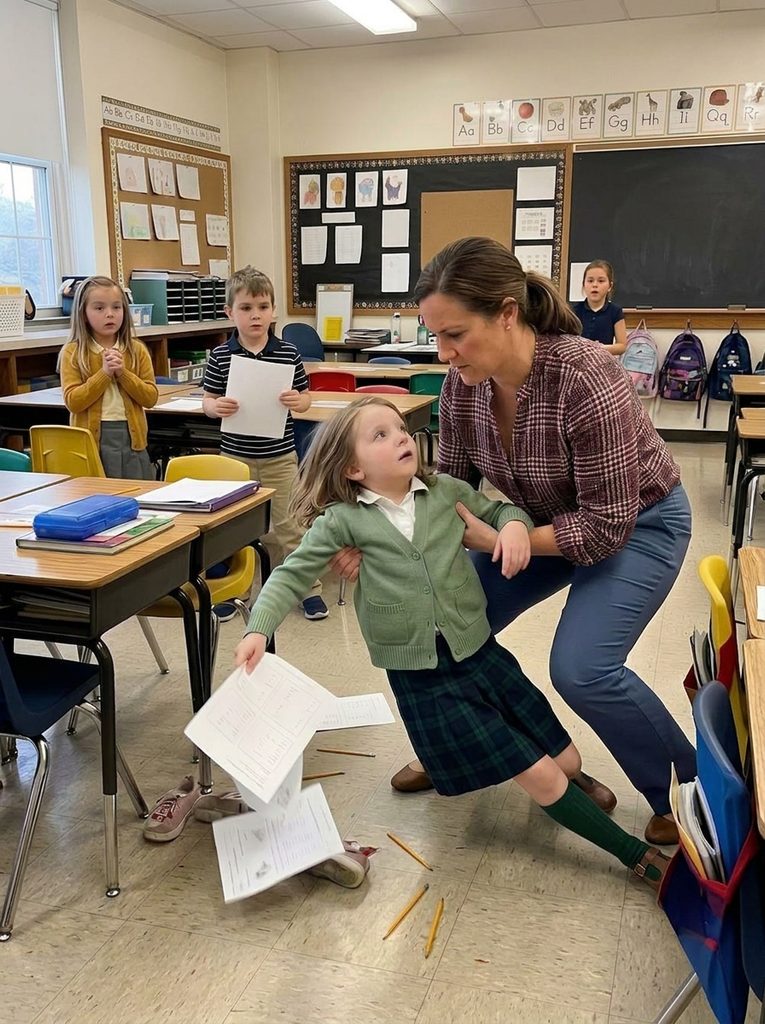
Inside Room 204, fluorescent lights hummed while second graders scraped chairs across the floor, clicked pencils, and settled in for math.
Ms. Valerie Kincaid was holding the day’s worksheets when she noticed seven-year-old Lila Mercer.
Not because Lila was making noise.
Because she was working so hard not to.
Lila sat in the third row beside the windows, her pale blue cardigan buttoned neatly and her hands folded whenever they were supposed to be folded.
She was the kind of child adults described as well-behaved.
She never interrupted.
Never grabbed.
Never demanded attention.
But Valerie had been teaching long enough to recognize the difference between quiet and careful.
Lila was careful.
She shifted in her chair once.
Then again.
Her shoulders tightened.
Her knees stayed pressed together beneath the desk.
Each time she moved, pain crossed her face for half a second before she forced it away.
At 8:42, the class bent over math worksheets.
By 8:56, children were lining up to turn them in.
Lila waited until everyone else had gone first.
When she finally stood, she pressed one hand against the edge of her desk and stayed there before taking a step.
One foot.
Pause.
Then the other.
“Lila,” Valerie asked casually, “are you feeling okay this morning?”
For a second, fear crossed the little girl’s face.
Then came a practiced smile.
“I’m fine, Ms. Kincaid. I just need to sit up straight.”
The sentence sounded wrong.
Too polished.
Too prepared.
Valerie started to ask another question.
Then the color drained from Lila’s face.
The worksheets slipped from her hands.
Her knees gave way.
Valerie caught her before her head struck the tile.
By 9:03, Lila was lying on the narrow cot in the nurse’s office.
Her blood pressure was low.
The nurse initially mentioned dehydration.
Valerie wanted desperately for that to be the explanation.
Then she noticed Lila’s hands gripping the blanket.
Her cardigan had been buttoned incorrectly near the bottom.
One button had missed its hole.
Another pulled awkwardly across her middle, as though something beneath the fabric was pressing against her.
Valerie moved a chair beside the cot.
“Lila, sweetheart, can you tell me what hurts?”
The child stared at the ceiling.
Then slowly turned her head.
“My dad said it wouldn’t hurt…”
Her voice trembled.
“But it does.”
The nurse’s pen stopped.
Valerie kept her voice soft.
“What hurts, sweetheart?”
Lila looked toward the closed door.
Then the nurse.
Then back at Valerie.
No answer.
So Valerie said the one thing that changed Lila’s expression completely.
“You are not in trouble.”
Tears filled the little girl’s eyes.
Valerie did not ask another leading question.
She did not touch Lila’s clothes.
She did not demand an explanation.
She simply said:
“Thank you for telling me.”
For nearly a minute, no one spoke.
Then Lila whispered:
“Can you promise Dad won’t come in here?”
Valerie’s stomach tightened.
“I can make sure you stay with safe adults while we get you help.”
Lila swallowed.
“He gets mad when people interfere.”
The nurse quietly moved toward the office phone.
“What happened this morning?” Valerie asked.
Lila looked down at herself.
“He put the belt on again.”
Valerie did not react outwardly.
“What belt?”
“The straight belt.”
That was what Lila called it.
Not because that was its real name.
Because that was what her father had told her it was for.
“He says I slouch.”
She sniffed.
“He says people think children with bad posture are lazy.”
“When did he put it on?”
“Before breakfast.”
“Is it still on you?”
Lila nodded.
That explained the strange pull beneath the cardigan.
The nurse immediately stopped treating the situation like routine dehydration.
She contacted the appropriate school administrator and emergency medical services according to protocol.
Lila began crying harder.
“Please don’t tell Dad I told.”
“You did the right thing,” Valerie said.
“He said if I tell people things from our house, they’ll take me away.”
Valerie felt something cold settle inside her.
“Lila, none of this is your fault.”
The child whispered:
“He says that too.”
Valerie frowned.
“What?”
“Before he does it.”
Then Lila repeated the phrase she had apparently heard many times.
“This isn’t punishment. This is helping you.”
The paramedics arrived shortly afterward.
At the hospital, medical staff found a rigid compression device wrapped too tightly around Lila’s lower torso beneath her clothes.
It was not a prescribed medical brace.
It had not come from her pediatrician.
Her father had assembled it himself from a commercial posture-support garment, additional straps, and stiff inserts.
He had tightened it far beyond its intended use.
The pressure had caused extensive bruising, restricted movement, and contributed to Lila’s dizziness and difficulty breathing comfortably.
There was no permanent internal damage.
But the physician was clear.
It had never been appropriate for a seven-year-old child to be forced to wear it that way.
Especially not repeatedly.
And the examination suggested this had not been the first time.
Valerie stood outside the room when a child-protection investigator arrived.
Her name was Dana Pierce.
She spoke briefly with the doctor.
Then with the nurse.
Then she approached Valerie.
“You’re the teacher?”
“Yes.”
“What exactly did Lila disclose to you?”
Valerie repeated the words exactly.
Not what she thought they meant.
Not what she feared.
Exactly what Lila had said.
Dana nodded.
“That matters.”
Then she entered Lila’s room.
By noon, the school contacted Lila’s father.
His name was Aaron Mercer.
He arrived furious.
Not frightened.
Not confused.
Furious.
“I want my daughter.”
The administrator told him Lila was at the hospital and that he would need to speak with investigators.
Aaron immediately demanded to know who had “put ideas in her head.”
That response was documented too.
At the hospital, he tried another approach.
He told police the brace was therapeutic.
Lila had terrible posture.
She complained about everything.
Children exaggerated discomfort.
He had only been trying to help.
Then the physician asked one simple question.
“Who prescribed it?”
Aaron had no answer.
“Which doctor evaluated her?”
Silence.
“Who instructed you to tighten it this way?”
Aaron’s face hardened.
“I’m her father.”
The doctor replied:
“That wasn’t my question.”
For the first time that day, Aaron stopped talking.