For more than twenty years, I let my family believe I was nothing special.
That was not exactly the same as lying.
At least, that was what I told myself whenever someone made another joke about my “little government job.”
My mother introduced me as the daughter who “did paperwork for the Army.”
My uncle once asked:
“Sarah, you’ve been doing that office thing forever. Don’t they ever promote people over there?”
I smiled.
I always smiled.
Explaining my real career was rarely possible.
My work came with classified briefings, nondisclosure requirements, need-to-know rules, and the habit of saying less than I knew.
Over time, silence became part of me.
My family interpreted it differently.
They thought silence meant I had nothing impressive to say.
They thought I had spent decades as some forgotten administrative employee.
They believed I worked under fluorescent lights stamping forms while other people made important decisions.
They believed that because I let them.
And perhaps because that version of me suited them.
At home, I was not Major General Sarah Whitmore of Army Intelligence.
I was simply Sarah.
Sarah in faded jeans.
Sarah driving an old blue sedan.
Sarah who missed holidays for reasons she could never adequately explain.
Sarah who smiled when cousins joked about “classified staplers.”
Being underestimated could be painful.
It could also be useful.
That Fourth of July began like every other family cookout.
My sister Melissa hosted at her house outside Fredericksburg.
By noon, the backyard smelled like charcoal, cut grass, hot plastic, and barbecue sauce burning around the edges of the grill.
Children ran through the sprinkler.
Teenagers sat in lawn chairs pretending not to record them.
Small American flags decorated the porch.
I arrived at 3:52 p.m.
I know the exact time because my dash camera recorded it.
That wasn’t paranoia.
It was habit.
I had spent too many years learning that timestamps are often more reliable than memories.
I parked at the far edge of the driveway.
Plenty of room remained for other vehicles.
Nothing about the spot was unusual.
I took the fruit salad inside.
Mom saw me.
“There’s Sarah. Finally.”
“I’m not late.”
“You’re always later than you think.”
Everything in our family sounded harmless until it wasn’t.
I kissed her cheek.
Helped Melissa move food into the shade.
Listened to Uncle Ray complain about property taxes.
Then Aunt Denise asked:
“Army finally upgrade your cubicle?”
“Something like that.”
My cousin Brad overheard and laughed.
Brad had been a deputy sheriff for eight years.
He had found a way to make those eight years sound longer than most wars.
Even off duty, he wore his uniform to family gatherings.
Pressed shirt.
Duty belt.
Handcuffs.
Badge.
Radio.
Sidearm.
Brad loved authority most when people were watching him use it.
He corrected waitresses.
Lectured children.
Turned casual conversations into speeches about compliance.
Most relatives laughed because laughing was easier than challenging him.
That afternoon, he began watching me almost immediately.
Eventually, he looked toward my car.
“Nice parking job, Sarah.”
“My car is fine.”
“It’s crowding the truck.”
“It isn’t.”
A few people laughed.
Brad stepped closer.
“Don’t give me attitude.”
“I’m not.”
“You government pencil-pushers think the rules don’t apply to you.”
“Brad, this isn’t the place.”
His eyes flashed.
He moved into my space.
Then put his hand on my arm.
I looked down.
“I strongly suggest you remove your hand.”
He should have stopped.
Had he done so, the afternoon might have become another unpleasant family memory.
Instead, his fingers tightened.
“You need to learn to respect authority.”
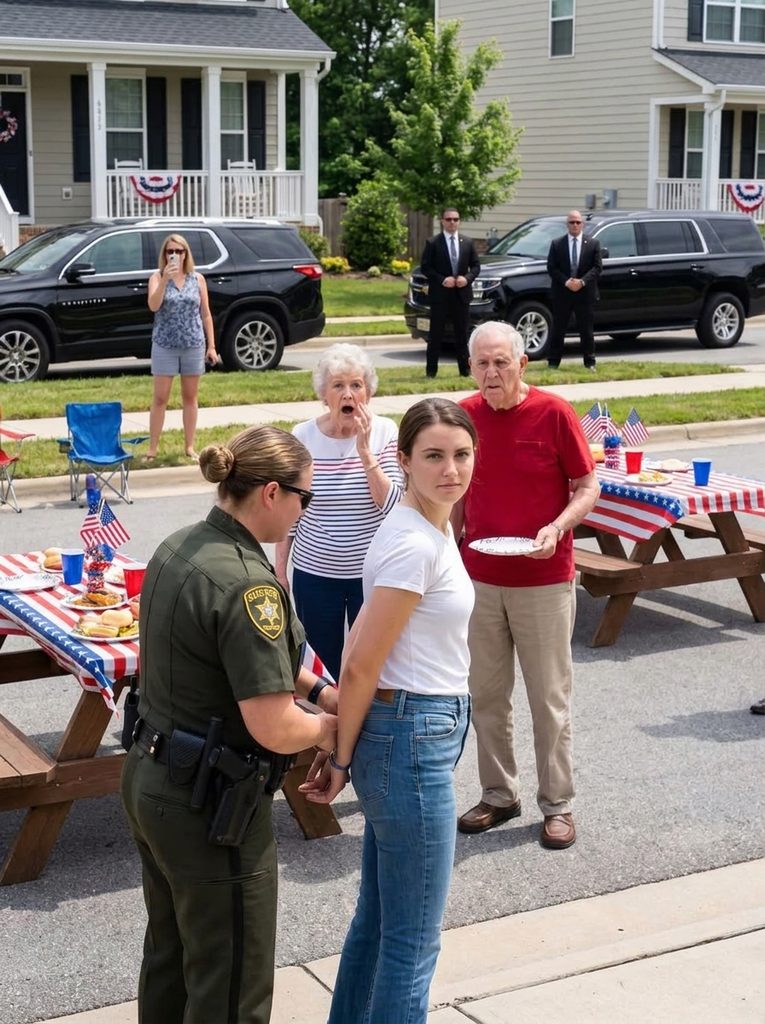
Then he jerked me toward the picnic table.
My hip struck the edge.
A plate fell into the grass.
My shoulder twisted.
My cheek scraped the rough wood.
“Stop resisting!”
I had not resisted.
He needed the words anyway.
Words can turn aggression into procedure if nobody challenges them.
His knee pressed into my back.
Then the handcuffs came out.
Cold steel around one wrist.
Then the other.
He tightened them until they bit into my skin.
The backyard froze.
My aunt held lemonade halfway to her mouth.
Uncle Ray stared at the ground.
Melissa stood near the dessert table.
My mother’s face went blank.
Children stopped playing.
No one moved.
Brad hauled me upright.
“Who’s the boss now, Sarah?”
I could feel everything.
The pressure against my wrists.
The bad angle in my shoulder.
His balance.
The position of his radio.
The sidearm on his belt.
My body knew several ways to end the situation.
One shift.
One turn.
One movement.
Brad would have been on the grass.
I did nothing.
Because if I fought back, Brad would have paperwork.
He could say I attacked him.
Say I was aggressive.
Say he used force because I forced his hand.
I had seen people survive far worse behavior because they controlled the first written version.
So I breathed.
And looked for Chloe.
My nineteen-year-old niece stood near the porch.
When she was sixteen, I had given her a matte-black card.
One telephone number.
No logo.
No name.
“Never use it,” I told her.
“Unless something happens and you truly need help.”
“Why me?”
“Because you listen before you react.”
That afternoon, I saw the card tucked behind her phone case.
I caught her eyes.
One nod.
That was all.
She stepped out of Brad’s line of sight.
At exactly 4:17 p.m., she made the call.
Brad was too busy enjoying his audience to notice.
“You think because you work in some federal office you can talk however you want?”
He jerked the cuffs.
“Maybe today you finally learn something.”
I looked at him.
“No.”
“What?”
“You’re a countdown.”
He frowned.
“I’d enjoy that feeling of control while it lasts.”
His grip tightened.
“It expires in about five minutes.”
Brad laughed.
Nobody else did.
Then came the sound.
Low at first.
Tires.
Brakes.
Vehicle doors.
Three black SUVs stopped outside in a coordinated line.
Men and women in dark clothing stepped out.
They did not rush.
They did not shout.
They moved like people who already knew exactly what they had come to do.
One man crossed the yard.
His eyes went to my cuffs.
Brad’s badge.
His weapon.
Then his face.
“Deputy,” he said, “take your hands off Major General Sarah Whitmore.”
The yard went silent.
Brad blinked.
“What did you say?”
The man opened a credential case.
“Now.”
Brad released the chain.
Someone whispered:
“Major general?”
My sister said my name like she had never heard it before.
“Sarah?”
I ignored the family.
First, I dealt with procedure.
“Remove these, please.”
A woman from the security team came behind me.
Carefully.
She photographed the placement before unlocking the cuffs.
The skin around both wrists was red and broken.
“Do you need medical attention, ma’am?”
“Documentation first.”
The team immediately began recording the scene.
My wrists.
My cheek.
The picnic table.
My vehicle.
The driveway.
Brad’s position.
Witness names.
Chloe’s call.
Then Brad finally said:
“She was resisting.”
I looked toward him.
“No.”
My voice remained calm.
“You put your hands on me because you wanted an audience.”
His face changed.
“You parked illegally.”
“No.”
I glanced toward my sedan.
“I parked somewhere that gave you an excuse to invent a problem.”
The family remained silent.
My mother whispered:
“We didn’t know.”
I looked at her.
Not yet.
There would be time for that sentence later.
Instead, I looked toward Chloe.
Her hands were shaking.
“You did exactly right.”
“I didn’t know if they would answer.”
“They did.”
“I thought I was making it worse.”
“You made it stop.”
That was when she began crying.
I walked toward her.
And hugged her.