Her head was shaved.
Her body was frighteningly thin.
A broken plate lay in the mud around her hands.
A bucket of dirty water sat near her feet.
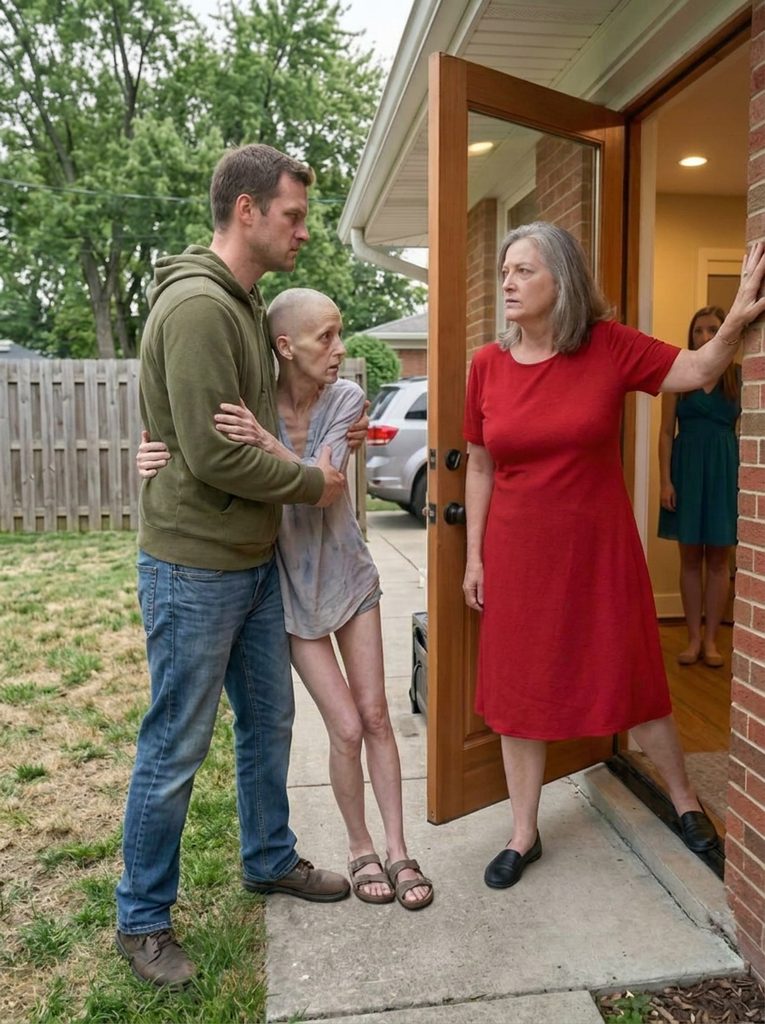
From inside the house, my sister Brianna shouted:
“That bald woman shouldn’t let herself be seen when we have company!”
Then my mother, Theresa, told Lucy that if anyone cut themselves on the broken plate, she would take the cost “out of her food.”
I stood behind the fence with my suitcase in my hand.
Nobody knew I had come home.
For four years, I had worked long shifts in metal fabrication in Canada.
Every month, I sent thousands of dollars home.
Nearly one hundred thousand dollars in total.
The money was meant for the house.
Our future.
And Lucy.
I trusted Theresa to manage it because distance made everything difficult.
I trusted Brianna because she was my sister.
And whenever Lucy told me she was fine, I believed her.
Then she stopped using video during our calls.
Bad connection.
Old phone.
Too tired.
Those were her excuses.
Now I understood.
Lucy tried to stand.
Her legs gave way.
Brianna walked into the yard wearing expensive clothes and carrying wine.
Lucy whispered that she had not eaten since the day before.
Brianna laughed.
“With everything you stole, you should be able to buy yourself a feast.”
I wanted to confront them immediately.
But instead, I listened.
Lucy begged Theresa to let her call me.
She said her doctor wanted her to continue treatment.
Theresa told her not to “burden” me.
Then I saw the gold hummingbird pendant around my mother’s neck.
The necklace I had given Lucy on our anniversary.
Lucy had tried to sell it for medical care.
Theresa took it.
Then I heard the sentence that ended whatever trust remained between my mother and me.
“My son sends the money to my account. That means I decide how it gets used.”
Lucy pointed toward the evidence surrounding us.
The remodeled house.
The SUV.
Brianna’s salon.
Luxury furniture.
New electronics.
Then she admitted she had been sleeping in the storage shed.
I finally stepped through the door.
Brianna dropped her glass.
Theresa immediately began explaining.
Lucy was difficult.
Unstable.
Wasteful.
She had supposedly stolen things.
I looked at the hummingbird necklace.
“Like that?”
Theresa covered it.
Then I asked Lucy:
“What illness do you have?”
“Cancer.”
Eleven months.
My wife had been sick for eleven months while I sent money home.
Theresa claimed treatment was too expensive.
I asked how many visits they had paid for.
“A few.”
Lucy whispered:
“Two.”
I picked Lucy up.
She barely weighed anything.
“We’re going to the hospital.”
Theresa tried to stop me.
She said I had abandoned the family.
I rolled up my sleeve and showed her the burns and scars from years of work.
“I spent two Christmases alone so nobody here had to struggle.”
Theresa answered:
“And we didn’t.”
I looked at my wife.
“She did.”
I could have exploded.
Instead, I pulled out my phone.
Then I lied.
I told them an industrial accident in Canada had led to a settlement worth approximately $1.25 million Canadian dollars.
The story was bait.
The reaction told me everything.
Theresa’s anger disappeared.
Suddenly, I was her “poor brave boy.”
Brianna immediately started discussing investments and business expansion.
The same women who had treated Lucy as a burden were suddenly offering private nurses and specialists because they believed another fortune was arriving.
But Lucy went to the hospital first.
Her condition was critical.
She was severely dehydrated, dangerously weak, fighting an infection, and had received only a fraction of the cancer care her records suggested she should have been receiving.
Then Dr. Vance showed me something that changed the investigation.
Significant amounts of specialized cancer medication had been billed and collected under Lucy’s name.
But the treatment was not in her system.
Instead, doctors found evidence that she had repeatedly been given powerful sedating medication that left her weak, confused, and unable to properly eat or advocate for herself.
The pharmacy’s pickup records identified the authorized collector.
Brianna Miller.
Theresa instantly tried to blame the pharmacy.
Brianna claimed she simply collected whatever bags were handed to her.
I did not argue.
I asked the doctor to give Lucy every medically appropriate treatment available and told him I would handle billing directly.
Then I turned back to my mother and sister.
I reminded them about the supposed Canadian settlement.
I told them the money could not be processed until our family assets and the funds I had previously sent were fully documented.
Theresa’s eyes lit up.
Brianna’s did too.
They followed me home willingly.
For the next two hours, they produced records.
The house.
Brianna’s salon.
The SUV.
Cash accounts.
Renovations.
They eagerly identified which assets had been acquired using money I had sent from Canada.
They believed their signatures would help release my fictional settlement.
In reality, the signed asset schedules gave my attorney and investigators a clear, documented picture of how my money had been used.
I left them celebrating.
Theresa asked me to return at 8:30 the next morning so we could “go to the bank together.”
I promised I would.
Then I went back to Lucy.
And that night, the real investigation finally showed me how deep the betrayal went.