The first person to laugh was my mother-in-law.
It was not a loud laugh, just a delicate breath behind her manicured hand—the kind of sound Vivian Hale used whenever she wanted to humiliate someone without appearing impolite.
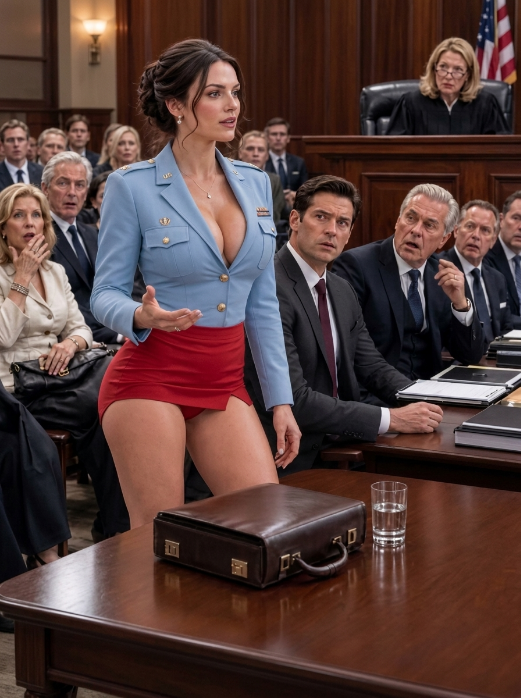
Her diamond bracelet flashed beneath the white courtroom lights as she leaned toward her husband and whispered something that made him smile.
Across the aisle, my husband, Preston, did not look at me.
He sat behind a polished oak table with three attorneys surrounding him, each wearing the relaxed expression of men already paid to attend a victory celebration.
Their table was covered with binders and color-coded folders.
Mine held one leather briefcase and a glass of water.
“Mrs. Hale,” Judge Rebecca Morrison said, peering over her glasses, “you understand that you have the right to retain counsel, and you are choosing to represent yourself?”
“I am, Your Honor.”
A quiet snicker drifted from the gallery.
Vivian had spent seven years teaching me how little she thought of me, but she had always preferred private dining rooms, charity luncheons, and holiday gatherings.
Hearing that same contempt inside a courtroom felt different.
The sound did not wound me.
It sharpened me.
Preston’s lead attorney, Martin Voss, rose slowly.
He was silver-haired, broad-shouldered, and famous in our city for making wealthy men look reasonable while their wives left court carrying cardboard boxes.
“Your Honor,” he said, “we are prepared to proceed, although we are concerned that Mrs. Hale’s lack of representation may unnecessarily complicate a straightforward dissolution.”
Straightforward.
That was the word Preston’s family had chosen for destroying me.
Three weeks earlier, I had been sitting in the breakfast room of our estate, watching rain slide down the tall windows while the coffee maker hissed behind me.
Preston entered wearing the charcoal suit I had steamed for him the night before.
He did not kiss my forehead.
He did not ask whether I had slept well.
He placed a white envelope beside my plate.
“What is this?”
“You know what it is.”
I opened it and saw the petition for dissolution of marriage.
The brass clock Vivian had given us on our fifth anniversary ticked while Preston checked his phone and I read the first page twice.
Seven years of marriage had been reduced to numbered paragraphs.
Irreconcilable differences.
Separate property.
No meaningful contribution by the respondent.
No claim to business assets.
“You’re saying I contributed nothing?”
“You ran the house, Amelia.”
“I ran your life.”
His jaw tightened.
“And you were compensated for it. You lived well.”
“Compensated?”
I stared at the man whose panic attacks I had talked him through and whose speeches I had rewritten.
“I left Washington because you said you couldn’t manage the company and a marriage from different cities. I handled your mother’s galas, your father’s donors, your travel, your contracts—”
“You scheduled dinners,” he cut in. “Don’t turn that into a profession.”
I looked at him.
“What do you think my profession is?”
His eyes flickered.
Preston knew I was an Army Reserve attorney but had never cared enough to ask what law I practiced, what rank I held, or why generals occasionally called after midnight.
To his parents, I remained “a part-time government clerk.”
Eventually, I stopped correcting them.
Now I folded the petition and returned it to the envelope.
“Who drafted this?”
“Voss.”
“Of course.”
Preston looked at me.
“Don’t make this ugly.”
“You said I contributed nothing, attached an agreement I have never seen, and asked the court to remove me from my home.”
“The agreement is valid.”
“Then you won’t mind proving it.”
He smiled condescendingly.
“You don’t have money for a fight, Amelia.”
“No,” I said quietly.
“But I do have training.”
He mistook my calm for surrender.
That was his first mistake.
His second was allowing Martin Voss to file the exhibits.
Back in court, Voss reached for his first binder.
Before he could open it, Preston’s father leaned back in the gallery.
Graham Hale had built Hale Meridian Systems into one of the largest privately held defense suppliers in the country.
“Too broke to hire a lawyer,” he murmured loudly enough for both tables to hear. “This will be quick.”
Vivian smiled.
Judge Morrison’s expression hardened.
“Mr. Hale, another comment and I will have you removed.”
“My apologies, Your Honor.”
Voss stood.
“As I was saying—”
I rose.
My knees did not tremble.
My voice did not rise.
“Your Honor, Lieutenant Colonel Amelia Reed Hale, Judge Advocate General’s Corps, appearing pro se for the respondent. Before petitioner presents evidence, I move to disqualify Mr. Voss and his firm, strike Exhibit Four as a fraud upon this court, and preserve the petitioner’s electronic devices under an emergency anti-spoliation order.”
The entire courtroom went silent.
Not quiet.
Silent.
Voss’s hand remained suspended over his binder.
One associate stopped typing.
Graham’s smile vanished.
Preston turned so sharply his chair scraped the floor.
Judge Morrison removed her glasses.
“Lieutenant Colonel?”
“Yes, Your Honor. Army Reserve. I have served seventeen years. For the last nine, I have practiced military justice and federal procurement law. My state bar number and certificate of good standing are behind the motion.”
The judge examined the slim folder I had delivered that morning.
“You are also admitted to the Court of Appeals for the Armed Forces and federal district court.”
“I am.”
Voss found his voice.
“Your Honor, whatever the respondent does for the military is irrelevant to the validity of her marriage agreement.”
“It is relevant to whether I need you to explain basic procedure to her,” Judge Morrison replied.
She turned to me.
“Grounds for disqualification?”
I placed one hand on my briefcase.
“Mr. Voss claims he represents only Preston. Exhibit Four, the alleged postnuptial agreement, states on page fourteen that Voss Legal Group acted as independent counsel for both parties during its negotiation.”
I looked directly at Voss.
“If that is true, he is my former attorney and possesses privileged information material to this dispute.”
I paused.
“If it is false, the exhibit contains a fabricated representation.”
Judge Morrison turned toward him.
“Mr. Voss?”
“Boilerplate language.”
“In a notarized contract?” I asked.
He glared.
“Counsel—”
“She is not counsel,” Preston muttered.
I turned toward him.
“Actually, Preston, that is the one fact in this room no longer open to dispute.”
A startled breath came from the gallery.
Judge Morrison tapped her pen.
“Mrs. Hale, the fraud allegation?”
I withdrew one sheet.
“The agreement is dated October 18 of last year. It contains what purports to be my electronic signature, witnessed by a notary named Elena Torres.”
I let the silence settle.
“Ms. Torres died on August 2—eleven weeks before she supposedly watched me sign it.”
This time, even Voss looked toward Preston.
“The document also lists the internet protocol address used to authenticate my signature. That address belongs to Hale Meridian’s executive conference room.”
I placed another document down.
“On October 18, I was nine hundred miles away serving on active-duty orders at Fort Bragg. My access logs, flight records, and sworn declaration from my commanding officer are attached.”
Voss objected that they had not been given time to verify the claims.
“You filed the exhibit,” I replied. “Verification should have happened before you asked the court to enforce it.”
After a thirty-minute recess, Judge Morrison disqualified Voss Legal Group from the agreement dispute, ordered all relevant records preserved, denied Preston’s temporary request to remove me from the marital residence, and imposed equal financial restraints on both parties.
The gavel fell.
Graham approached afterward.
“A uniform and a title don’t change what you are,” he said. “An ungrateful woman who wandered into a life she could never have built.”
I closed my briefcase.
“You’re welcome to try proving that.”
Then I noticed Vivian.
She stood behind Graham, pale and completely still.
Her right hand rested on her diamond bracelet.
She touched the largest stone twice.
Then once.
Two short flashes.
One long.
A distress pattern she had once watched me demonstrate at a veterans’ fundraiser.
I gave no sign that I understood.
But for the first time, I wondered whether Vivian’s diamonds were hiding something more than wealth.