My Son Laughed When He Brought My Bruises Into Court to Prove I Was Too Confused to Control My Own Money—Then the Judge Recognized My Name
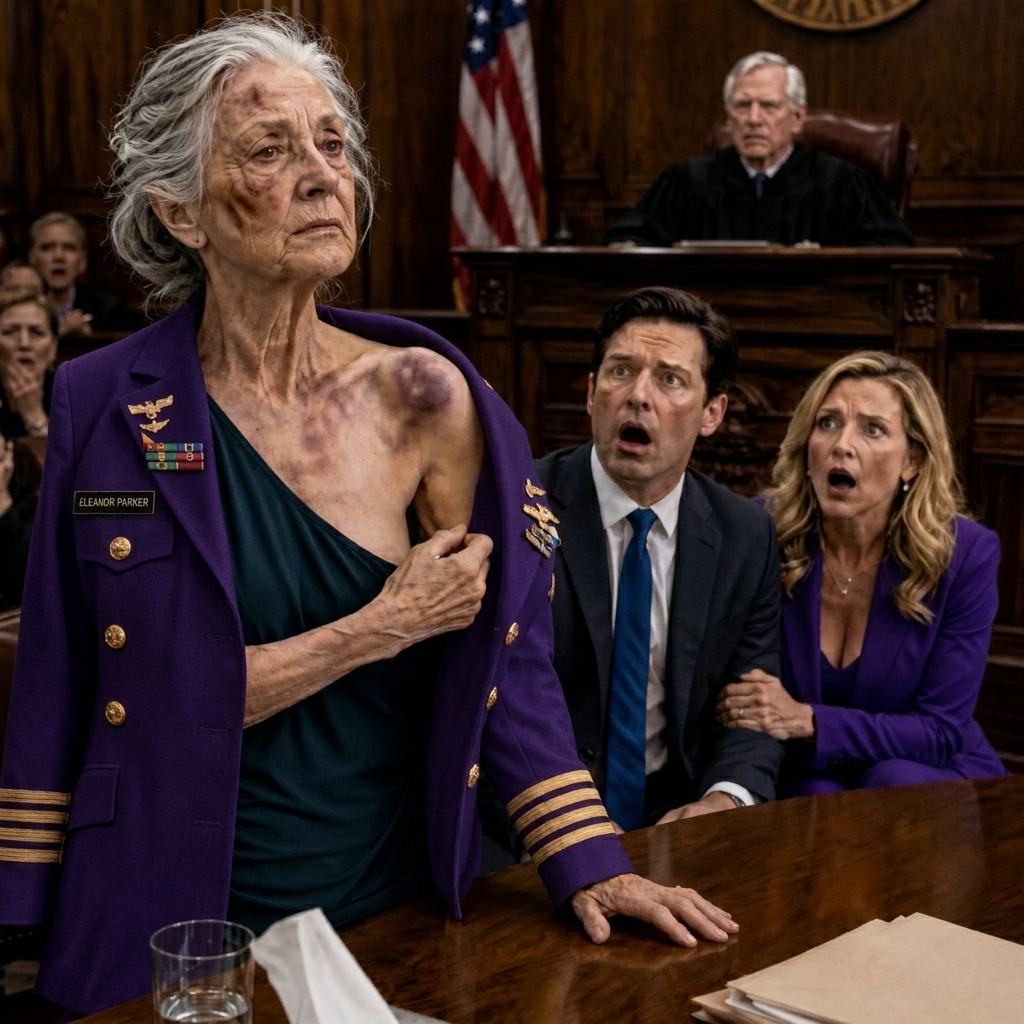
My son laughed when I walked into the courtroom.
Not loudly.
Daniel had always been careful about witnesses.
He leaned toward his wife and whispered:
“Ha-ha, now we’re going to leave her with nothing.”
Vanessa covered her mouth as though she were embarrassed.
She wasn’t.
I could see victory in her eyes.
I walked past them in a plain navy coat, carrying no handbag and accompanied by no lawyer.
At seventy-one, with silver hair, a cane, and bruises fading beneath the sleeves of my blouse, I looked exactly like the woman they had spent six months teaching everyone else to see.
Frail.
Forgetful.
Unstable.
Dangerous to herself.
Their petition for emergency guardianship described me as an elderly widow in rapid cognitive decline.
According to Daniel, I had begun falling repeatedly after my husband died.
I wandered around the house at night.
I misplaced medication.
I forgot conversations.
I injured myself and then accused other people of causing those injuries.
Their attorney had photographs.
A purple bruise around my wrist.
A green-yellow mark near my shoulder.
A cut above my eyebrow.
A swollen left hand.
They had dates.
Notes.
Statements.
Even a handwritten log Vanessa claimed she kept because she was “deeply worried about Mom.”
That was their story.
I remembered every injury.
The bruise around my wrist came from Vanessa grabbing me when I refused to sign paperwork giving Daniel access to my savings.
The mark near my shoulder came from Daniel shoving me against the hallway wall after I asked why $42,000 had disappeared from an account he was supposedly helping me consolidate.
The cut above my eyebrow came when I tried to stop them from carrying boxes of documents out of my late husband’s study.
Daniel slammed a desk drawer while my hand was still inside.
I stumbled backward and struck the corner of a bookcase.
Blood ran down the side of my face.
He stared at me for three seconds.
Then said:
“Jesus, Mom. You need to be more careful.”
Vanessa photographed the injury before she cleaned it.
I understood why only later.
Each time they hurt me, they created documentation suggesting I hurt myself.
“You really need help, Mom,” Daniel would say afterward.
Vanessa would touch my arm and speak slowly.
“Do you remember what happened?”
Of course I remembered.
I also remembered the first time they realized other people would believe them before they believed me.
It happened at my physician’s office.
Vanessa accompanied me without being invited.
When Dr. Levin asked how I bruised my arm, I said:
“My daughter-in-law grabbed me.”
Vanessa laughed nervously.
“She means I caught her when she almost fell.”
“That is not what happened.”
Vanessa looked devastated.
Not angry.
Devastated.
She was talented.
“Eleanor,” she whispered, “you scared me half to death.”
Dr. Levin looked between us.
Then typed something into my chart.
That tiny movement told me everything.
A record had been created.
After that, Daniel became more careful.
I had become forgetful since Henry died.
I was depressed.
I resisted help.
I became suspicious.
I accused family members.
I hoarded documents.
I forgot that Daniel had permission to manage bills.
Some statements contained fragments of truth.
That made them effective.
I had forgotten appointments after Henry’s funeral.
I had cried in grocery stores.
Once, I left my reading glasses inside the refrigerator.
Grief does strange things.
But grief is not dementia.
Sadness is not incompetence.
Daniel did not need to prove I was incapable forever.
He only needed enough doubt to convince a judge that temporary control should be handed to him.
Then he could control my accounts and major legal decisions while a more complete evaluation took place.
And eventually, he could ask for authority over the house Henry and I had built forty years earlier.
Appraised value:
Just over $1.4 million.
Three weeks before the hearing, Daniel changed my locks.
I came home from church.
My key did not fit.
Daniel opened the door but would not let me enter.
“What did you do?”
“We need to keep you safe.”
“This is my house.”
“You keep wandering outside.”
“I went to church.”
“You’re upset.”
“I want my key.”
“You’re proving my point.”
That frightened me more than the locked door.
Everything could become evidence.
Anger meant instability.
Silence meant confusion.
Resistance meant paranoia.
Compliance meant incapacity.
It was a perfect trap.
I spent the night in a motel.
Daniel sat in my living room drinking his father’s seventeen-year-old bourbon.
I knew because Henry had installed a motion-activated camera near the home bar after a burglary eight years earlier.
Daniel forgot it existed.
At 12:06 a.m., he texted:
Stop making this difficult.
He had mistaken silence for helplessness.
That was his first mistake.
The second was believing his mother had spent forty-three years as nothing more than a bookkeeper.
Their attorney, Curtis Hale, stood when I entered courtroom 4B.
Gray suit.
Perfect tie.
Sympathetic expression.
“Mrs. Vance’s repeated injuries demonstrate why immediate intervention is necessary,” he said. “Her son and daughter-in-law have attempted to provide support, but she has become increasingly suspicious and combative.”
Daniel lowered his head.
I saw him smile.
Then Judge Adrian Mercer entered.
Everyone stood.
Mercer was in his late sixties, with a narrow face and a reputation for disliking courtroom theater.
He opened the file.
Adjusted his glasses.
Then looked toward me.
His expression changed.
“Eleanor Vance?”
“Yes, Your Honor.”
“The Eleanor Vance who uncovered the Bellweather pension fraud?”
Daniel’s smile disappeared.
Vanessa went pale.
Twenty-six years earlier, Bellweather Industrial collapsed after executives diverted employee pension assets through shell companies.
Hundreds of retirees nearly lost everything.
I had been the forensic accountant who traced the money.
My testimony contributed to convictions involving several executives and a state treasurer implicated in the scheme.
Later, I founded Vance Forensic Advisory.
We specialized in stolen inheritances, fraudulent guardianships, fiduciary abuse, hidden assets, and financial exploitation of older adults.
Daniel apparently told Vanessa I had been some kind of bookkeeper.
Technically, he wasn’t entirely wrong.
Bookkeeping was where I started.
Judge Mercer looked at the photographs attached to the guardianship petition.
Then Daniel.
Then me.
“Mrs. Vance, are you telling this court those injuries were not caused by falls?”
I reached inside my coat.
“No, Your Honor.”
For the first time, Vanessa looked frightened.
I removed a small flash drive.
Curtis Hale stood.
“Your Honor, if Mrs. Vance intends to introduce evidence—”
Mercer raised one hand.
“She is appearing without counsel in a petition seeking to remove control over almost every aspect of her life. I am going to let her finish.”
I placed the drive on the table.
“These are copies. The originals are secured with my former firm and have also been provided to the appropriate elder-financial-abuse authorities.”
Daniel’s face emptied.
“What originals?” Mercer asked.
“Audio recordings. Video. Bank records. Metadata. Copies of documents removed from my husband’s office. And a chronology of transfers from my accounts into entities associated with my son.”
Curtis Hale objected again.
Mercer looked at him.
“Your own petition alleges Mrs. Vance cannot understand and manage her finances. If she independently assembled a coherent forensic record concerning those finances, that would appear highly relevant.”
Hale sat.
The judge leaned forward.
“Mrs. Vance, why did you come without an attorney?”
“Because I wanted the court to see something.”
“What?”
“What my son sees when he believes I am alone.”
Daniel finally snapped:
“Mom, this is insane.”
Judge Mercer looked sharply toward him.
I continued calmly.
“That sentence is part of the pattern too. Any disagreement becomes evidence that I’m mentally unstable.”
Mercer called a recess.
He appointed temporary independent counsel to advise me.
Her name was Marissa Grant.
When we entered the consultation room, she carried a tablet and an expression suggesting she was annoyed with everyone except me.
“Mrs. Vance?”
“Yes.”
“I’m court-appointed for today. You can reject me.”
“I probably will.”
She smiled.
“At least you’re consistent with your reputation.”
“You know me?”
“I interned at Vance Forensic Advisory during law school.”
“Which year?”
“2011.”
“Under Caroline Wu?”
Her eyebrows rose.
“Yes.”
“You spent most of that summer misclassifying restricted stock.”
She stared.
Then laughed.
“That was me.”
“I remember.”
“You reviewed my spreadsheet.”
“I corrected your spreadsheet.”
“You destroyed my spreadsheet.”
“It needed destroying.”
She sat down.
“That may be the fastest competency evaluation I’ve ever performed.”
“Do not confuse memory with capacity.”
“I’m not.”
“Good.”
Then I gave her the chronology.
Henry died fourteen months earlier.
Daniel began helping with household finances about eight weeks after the funeral.
I allowed him limited access to one operating account.
Four months later, I found three transfers totaling $42,000 to an LLC called DSV Residential Holdings.
Daniel claimed they reimbursed him for repairs to my home.
No repairs worth $42,000 had occurred.
When I revoked his access, the injuries began.
First my wrist.
Then my shoulder.
Then my eyebrow.
After that, Vanessa began calling physicians.
Neighbors.
My church.
My pharmacist.
Every lie was planted somewhere another person could later repeat it honestly.
Marissa listened.
Then asked:
“Did you contact police?”
“Once.”
“What happened?”
“Daniel convinced them I had fallen and become disoriented.”
“Was there a report?”
“Yes.”
“Did you tell them he pushed you?”
“Yes.”
“And?”
“The report described an accidental fall with conflicting statements.”
Marissa exhaled.
“Why didn’t you hire counsel earlier?”
“I did.”
She looked up.
“My attorney is downstairs.”
She stared at me.
“You came in without him?”
“Yes.”
“Why?”
“Daniel’s petition partly depends on the theory that I cannot organize my own defense.”
“Who is your lawyer?”
“Jonathan Reed.”
Her smile disappeared.
“Oh.”
That was an appropriate response.
Jonathan had spent twenty years representing people in guardianship and fiduciary-abuse cases.
“Why is he downstairs?”
“Waiting.”
“For what?”
“For me to decide whether today was merely a guardianship hearing—or the first evidence-preservation hearing in a financial-abuse case.”
Then I showed Marissa something else.
The petition claimed I had been personally served at my residence at 7:40 p.m. on March 11.
I had not.
At exactly 7:40 that evening, I was at St. Anne’s Hospital undergoing an MRI.
The hospital had timestamped check-in records.
Billing records.
Security footage.
And the process server worked for a company partly owned by Curtis Hale’s brother.
Marissa stared at the affidavit.
“That’s bad.”
“It gets worse.”
And it did.