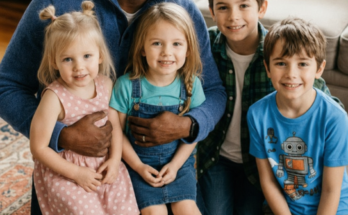
My ex stood in court and claimed our children were going hungry. But before the judge could make a decision that might take them away from me, my nine-year-old daughter walked forward in sparkly shoes, carrying a glitter-covered shoebox that exposed his lies.
Part 3 of 3
There were other changes too.
Ms. Delaney, no longer stretched thin by emergency motions and hearings, had time to talk like a person instead of a rushing voice in a hallway.
She admitted that when Garrett first filed, he looked like the kind of father courts often found persuasive.
“Well-dressed. Calm. Financially established. The kind who knows how to speak in concern-shaped sentences.”
“And me?” I asked one afternoon.
She smiled sadly.
“You looked like a tired mother telling the truth. Which should be enough. But not always.”
I appreciated that she did not sugarcoat it.
She also said something I have never forgotten.
“People like him count on fatigue,” she told me. “They know exhaustion makes good people doubt their own memory.”
That sentence moved into my bones and stayed there.
Because so much of my marriage had been exactly that.
Not dramatic scenes.
Not broken plates or slammed fists.
Something quieter.
He would tell the story of an argument differently enough times that I would begin to wonder whether I had imagined my own side of it.
He would call me too sensitive, then too defensive, then impossible to talk to.
He would provoke, then step back and point at my reaction as proof that I was unstable.
Over years, it makes you smaller.
Not visibly.
Internally.
You begin editing your own reality before it even leaves your mouth.
The courtroom did more than protect my custody.
It gave me back my sense of scale.
The children noticed changes in me too.
I stopped apologizing for taking up space in my own apartment.
I sent texts to Garrett only through the parenting app the court required.
I did not soften simple facts to make him comfortable anymore.
Pick-up is at four.
Rosie has a school project due Monday.
Colton’s inhaler is in the front pocket.
Nothing extra.
Nothing to soothe his feelings about information.
The first supervised visit was the hardest day since court.
Not because I doubted the order.
Because the children were torn in ways children should never have to be.
They still loved their father.
That is one of the cruelest truths in family fracture.
Children do not stop loving the parent who frightens or confuses them.
They just learn to love carefully.
Rosie chose her words all morning like she was packing glass.
Colton asked whether he should still wear the dinosaur tie “so Dad doesn’t think I’m mad.”
When they came home, both were quiet.
I made grilled cheese and let silence sit at the table with us.
Finally, Rosie said, “He cried.”
That startled me enough to pause halfway through cutting Colton’s sandwich.
“How did that feel?”
She thought about it.
“Real in the moment,” she said. “But also like maybe he wanted us to fix it.”
I looked at her then with a strange mix of pride and grief.
Because that kind of emotional accuracy should not belong to a nine-year-old.
But there it was.
Colton chewed for a while, then added, “He kept saying he made mistakes because he loved us too much.”
I waited.
Colton frowned at his plate.
“I don’t think love should feel like homework.”
There are sentences children say that split you open because they are so plain and so exact there is nowhere to hide from them.
That was one.
I reached across the table and squeezed his hand.
“No,” I said. “It shouldn’t.”
Summer arrived slowly.
Open windows.
Popsicles in the freezer.
Rosie taping solar system facts above her bed.
Colton building an entire cardboard courthouse city in the hallway, where every office had a title like Truth Room and Judge Dino Chamber.
Our apartment did not become bigger.
It became lighter.
Like years of held breath were finally leaving one room at a time.
There were still hard moments.
Once, I found Rosie in front of the hall closet, staring at the shoebox.
“What is it?”
She looked up.
“I keep thinking maybe I should have told Grandma Vera sooner. Maybe then…”
I crossed the room and took both her hands.
“No.”
She frowned.
“But what if—”
“No.”
I waited until she met my eyes.
“You do not get to carry grown-up outcomes on a child’s timeline. Do you understand me?”
Tears filled her eyes instantly.
“I miss her.”
“I know.”
“She would’ve known what to do.”
The truth in that nearly knocked the breath out of me.
Vera probably would have known what to do.
Or at least she would have known where to stand so no child had to stand there first.
I pulled Rosie into my arms.
“Then we honor her,” I whispered. “By telling the truth the way she taught us.”
At science camp orientation later that month, Rosie wore the same sparkly shoes.
By then, they were more silver-gray than silver.
The glitter had thinned.
The toes were permanently scuffed.
I had bought her new sneakers twice since court, but she still went back to those.
I finally asked why.
She shrugged like the answer was obvious.
“Because those are my brave shoes.”
So I stopped trying to replace them.
Some things are not about practicality.
Some things are evidence.
Colton changed too, just in quieter ways.
He slept deeper.
He started drawing bigger maps.
Not escape maps anymore.
Adventure maps.
Museum routes.
Mountain roads.
A dinosaur park with a legal office in the center because, as he explained, “Even dinosaurs need fair rules.”
One afternoon, while he colored at the table, he asked me, “Mom, why do people who know better still lie?”
I set down the dish towel.
“Sometimes because they want something badly enough to believe their own story. Sometimes because telling the truth would require them to see themselves clearly.”
He considered that.
“Do you think Dad sees himself clearly?”
I was honest.
“I don’t know.”
He nodded.
Then he said, “I hope one day he does. But not near us until he can.”
Seven years old.
And already understanding boundaries better than many adults.
The first time I slept eight straight hours, it happened by accident.
I woke up disoriented, sunlight filling the room, my heart pounding because I was sure I had missed something.
Then I looked at the clock.
Looked again.
And realized my body had, for one whole night, believed enough in safety to let go.
I sat there on the edge of the bed and cried.
Again.
There was a lot of crying that summer.
Not dramatic crying.
Uncoiling crying.
The kind that comes when your nervous system finally believes the emergency may actually be over.
In August, Claire brought over a small frame.
Inside it was a photograph of Walter and Vera sitting on a porch swing, their heads bent toward each other, both smiling at something outside the camera.
On the back, Vera had written in her tidy hand:
Truth tells on people eventually.
I stared at that sentence for a long time.
Then I put the photo on the mantle beside the shoebox.
Rosie saw it first.
“She knew,” she whispered.
“Yes,” I said. “I think she did.”
We stood there together in the quiet.
Then Colton came rushing in with a dinosaur book and stopped short.
“Can we put the box in the middle?”
“Why the middle?” I asked.
“Because it’s kind of the hero.”
Rosie rolled her eyes.
“It’s not the hero. People are the hero.”
Colton thought about that.
“Then maybe it’s the witness.”
We all considered it.
In the end, the shoebox stayed in the middle.
Not because cardboard and glitter saved us.
Because it reminded us that ordinary things can hold extraordinary proof when love refuses to look away.
Months later, people still sometimes ask how I knew Garrett was lying.
The truth is, I did know.
Just not in ways a courtroom respects.
I knew in my body.
In the endless sense of rearranging myself around him.
In the way every hard thing somehow bent until it pointed back at me.
In the way the children came home carrying moods that did not belong to them.
But intuition is often treated like a luxury women invent when they cannot produce paperwork.
So for a long time, I discounted what I knew because I could not staple it to a filing.
Rosie’s shoebox changed that.
It took all those quiet, invisible truths and gave them edges.
Dates.
Receipts.
Photos.
Recorded words.
A child’s careful observation of what adults hoped she would not understand.
That is what stays with me most.
Not Garrett’s face when the lies cracked.
Not the judge’s ruling.
Not even the relief.
It is the image of my daughter standing in a courtroom full of adults and deciding, with her whole small body shaking, that truth was worth the risk.
And my son stepping up beside her because courage, in our house, became a thing siblings carried together.
There are days I still get angry.
Angry that they had to do it.
Angry that systems are so often impressed by polished fathers and suspicious of exhausted mothers.
Angry that money can buy presentation, and presentation can look so much like stability from a distance.
But the anger no longer owns the whole story.
Because there is something bigger now.
Not triumph.
Not exactly.
Something steadier.
A reclaimed life.
A home where the children no longer lower their voices when talking about what they feel.
A kitchen where budget talk is no longer overheard like doom.
A mother who no longer edits herself before speaking.
The other night, I tucked Rosie in after she spent twenty minutes explaining a camp experiment involving pH strips and cabbage water with the kind of joy only children and real teachers possess.
As I pulled the blanket up, she said, “Mom?”
“Yeah, baby?”
“Were you scared that day in court?”
I laughed softly.
“Yes.”
“More scared than me?”
I thought about it.
“No,” I said. “Just scared in a different direction.”
She nodded like that made perfect sense.
Then she said, “I was scared too. But I kept thinking about what you say when I have to do something hard.”
“What do I say?”
“You say, ‘Truth doesn’t need fancy shoes. It just needs a steady voice.’”
I blinked.
I had forgotten saying that.
Apparently, she had not.
“Well,” I said, smoothing her hair back, “looks like you remembered better than I did.”
She smiled.
Her front tooth was still a little crooked where the new one had come in.
There were glitter specks on her pillowcase from the shoes she still insisted on wearing too long into the evening.
She looked entirely like a child again.
And because of that, entirely like a miracle.
Across the hall, Colton was already half asleep, one arm flung over a dinosaur book and his blanket twisted around his feet.
On his nightstand sat a little cardboard courthouse with a paper sign taped to the front.
In block letters, it read:
THE ROOM WHERE PEOPLE HAVE TO TELL THE REAL THING.
I stood there in the doorway and smiled until my eyes stung.
Then I turned off the light.
The apartment hummed around me.
Dishwasher running.
Radiator quiet for once.
The low city sounds outside the window.
Ordinary life.
Precious life.
The life I thought I might lose because a man cared more about appearances and access than truth.
But we did not lose it.
We held on.
Together.
And maybe that is the real center of the story.
Not that justice arrived clean and perfect.
Not that a judge fixed everything.
Not that lies always collapse on schedule.
They do not.
Sometimes they stretch on and on, dressing themselves up in paperwork and polite concern.
Sometimes truth has to wait in a shoebox on a hallway table while a tired mother folds laundry and thinks she is fighting alone.
Sometimes it gathers itself quietly in little hands.
Sometimes it wears sparkly shoes.
Sometimes it sounds like a seven-year-old saying, very simply, that love should not feel like homework.
And when it finally steps into the light, it does not roar.
It does not perform.
It just stands there, clear and undeniable, until everyone in the room has to rearrange themselves around it.
That is what saved us.
Not perfection.
Not money.
Not power.
A steady voice.
A glitter-covered box.
Two children who knew what home really looked like.
And a truth too well loved to stay hidden forever.
- My Husband Left Me for a 28-Year-Old on Christmas Eve…
- [Full Story] Young Triplets Disappeared in 1981 — 30 Years Later, Their Mother Makes a Shocking Discovery…
- My ex stood in court and claimed our children were going hungry…..
- [PART 2] My ex stood in court and claimed our children were going hungry…..
- [PART 3] My ex stood in court and claimed our children were going hungry…..