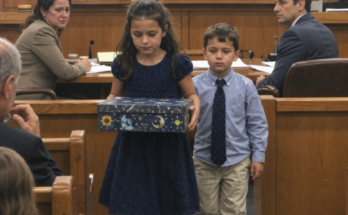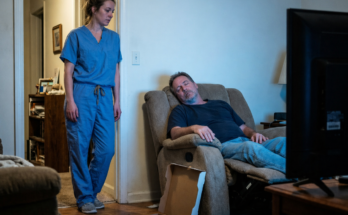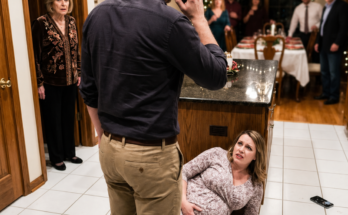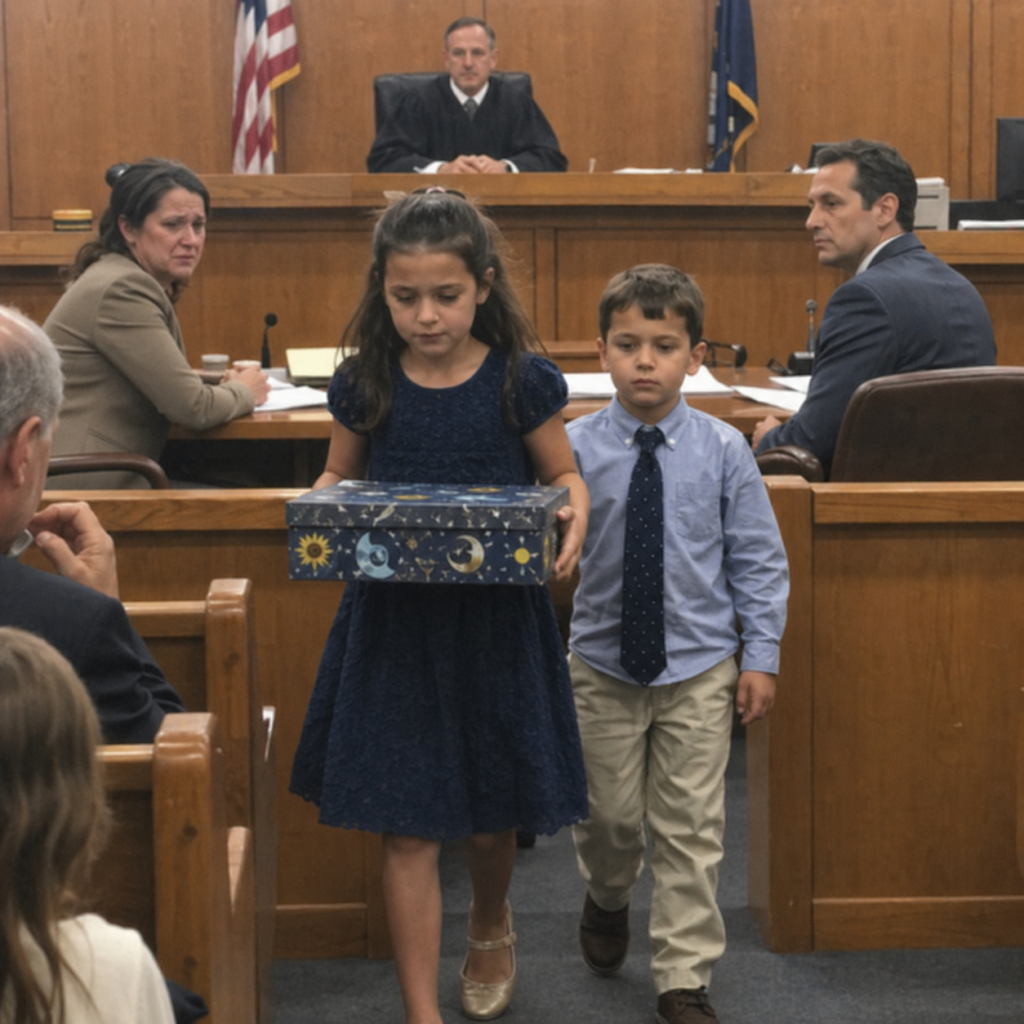
My ex stood in court and claimed our children were going hungry. But before the judge could make a decision that might take them away from me, my nine-year-old daughter walked forward in sparkly shoes, carrying a glitter-covered shoebox that exposed his lies.
Part 1 of 3
“Your Honor, this woman cannot provide a stable home.”
Garrett’s attorney said it calmly, smoothly, and with complete confidence, as if he were simply reading numbers from a clean white page.
“Her children go to bed hungry. They arrive at school in worn-out clothes. She works so many hours that she barely sees them. My client is deeply concerned for their well-being.”
The courtroom felt too warm and too bright.
I sat there in my only navy suit, the same one I had bought years ago for job interviews and altered by hand twice since then. My palms were damp. My mouth had gone dry. I could hear papers shifting, chairs moving, and someone coughing two rows behind me.
But mostly, I could hear Garrett breathing across from me.
Slow.
Steady.
Confident.
He did not look nervous at all. He sat in an expensive gray suit with one hand resting near his lawyer’s elbow, as if everything had already been decided and the rest of us were only catching up.
His expression was the same one he used to wear in our kitchen when he made me apologize for things that were never my fault.
That small, satisfied look.
The one that said, See? I told you no one would believe you.
Beside me, my legal aid attorney, Ms. Delaney, was flipping through papers so quickly they blurred. She was smart. She cared. But she was handling more cases than any one person should ever have to carry, and I could feel how thin our side looked next to Garrett’s glossy exhibits and neat binders.
The judge leaned forward.
“Mrs. Cole,” he said, looking at me over his glasses, “these are serious allegations. I need to understand the conditions in your home.”
I gripped the edge of the table.
“Your Honor, I work two jobs so my children have what they need.”
Garrett’s lawyer raised one eyebrow.
“Sixty-one hours last week, correct?”
“Yes.”
“And during those sixty-one hours, who was caring for your children?”
“They were in school during the day. My neighbor watched them in the evenings when I worked late.”
“Your elderly neighbor,” he said, glancing at his notes, “who is seventy-three.”
“She is strong, kind, and fully capable.”
He gave the kind of smile that was not really a smile at all.
Then he held up a photo.
It was my refrigerator.
Or rather, it was my refrigerator at the emptiest possible moment, the shelves half bare because I had cleaned them out before putting new groceries away.
“Would you like to explain why it appears there was almost no food in the home on Monday morning?”
My stomach dropped.
That photo.
Of course.
Garrett had shown up early for pickup that day. Nearly three hours early. He had texted that he was “in the area” and wanted a few extra minutes with the kids. I had been rushing out the door for a double shift, with grocery bags still sitting in delivery totes on the kitchen floor because I had not had time to unpack them.
He had stood in my kitchen while I grabbed my keys.
He had looked around too carefully.
I understood it now.
But in that moment, all I felt was the sick, helpless realization that a trap had closed around me after the fact.
“That photo was taken before the groceries were put away,” I said. “There was food in the apartment.”
“Do you have proof of that?”
I opened my mouth.
Then closed it.
My receipts were somewhere in a drawer. Maybe under the school forms. Maybe in my purse. Maybe tucked inside the cookbook where I shoved things when life became too loud.
But I did not have them with me.
Garrett’s lawyer held up another photo.
Rosie in her favorite silver sneakers, the toes scuffed white.
Colton in the green jacket his grandmother had sewn dinosaur patches onto before she passed.
“These children appear to be dressed in damaged and undersized clothing,” he said.
“They have newer things,” I said quickly. “Rosie loves those shoes. Colton loves that jacket. They choose them.”
“And your bank records show repeated overdraft fees over the past three months. How does that align with your claim that you are managing your household responsibly?”
Because Garrett had stopped making support payments on time twice.
Because automatic bills do not care that someone decided to play games with your life.
Because one broken appliance, one school fee, or one missed overtime shift can turn a careful budget into a stack of late charges.
Because surviving and looking polished are not the same thing.
But every answer I had sounded weak the second it entered the room.
Across from me, Garrett finally spoke.
“Our kids need stability,” he said, shaking his head with a practiced sorrow that made my skin go cold. “They need structure. They need consistency. Beth, you always mean well, but meaning well isn’t enough.”
Beth.
He had not called me that in months.
Not since he left.
Not since he told me I was “too exhausting to love.”
He only used that soft voice now when there was an audience.
Something sharp rose in my chest.
Before I could speak, the judge turned another page.
“There is also concern,” he said slowly, “about household safety and irregular meal patterns.”
My vision blurred.
I had been tired before.
I had been overworked before.
I had stood in rooms where people cried, begged, and received the hardest news of their lives, and I had stayed calm. I had walked families through pain. I had gone twelve hours without sitting down. I had driven home at dawn with my scrub top smelling like antiseptic and stale coffee.
But nothing had ever made me feel as powerless as sitting there while a man who had forgotten Colton’s school concert and Rosie’s parent science night painted himself as the safer parent.
Because he had money.
Because he had a nicer house now.
Because his new wife had time to bake muffins for social media photos and stand in the back row looking polished, patient, and ready to love children she barely knew.
Because he understood the oldest trick in the world.
Make the tired mother look like the failing mother.
I swallowed hard.
Then a small voice cut through the room.
“Your Honor, may I say something?”
Every head turned.
There, in the third row of the gallery, stood my daughter.
Rosie.
Nine years old.
Her dark hair was half pulled back the way I did it for school concerts. She was wearing the purple dress we had found on clearance last spring and her sparkly shoes that flashed silver every time they caught the light. In her hands was a shoebox covered with glitter, construction paper stars, and magazine cutouts of moons, microscopes, and sunflowers.
Colton stood beside her in a little button-down shirt and the dinosaur tie he loved because he said it made him “look like a courthouse person.”
My heart nearly stopped.
They were not supposed to be there.
They were supposed to be with Mrs. Alvarez from downstairs.
“Sweetheart,” I whispered before I realized I had spoken.
The bailiff took one step toward them.
“Children can’t interrupt proceedings,” he said gently.
But Rosie did not sit down.
She clutched the shoebox tighter.
“My name is Rosalie Cole,” she said, her voice shaking only a little. “That’s my mom. And I brought the receipts my dad told me to hide.”
The room went still.
Not quiet.
Still.
It felt as if the air itself had paused.
Garrett rose so fast his chair scraped loudly against the floor.
“This is inappropriate,” he snapped. “She doesn’t know what she’s saying.”
The judge lifted one hand without looking at him.
“Sit down, Mr. Cole.”
Garrett remained standing for half a second too long.
Then he sat.
Rosie took a deep breath that lifted her shoulders all the way to her ears.
The judge looked at her carefully.
“What receipts, Rosalie?”
She stepped into the aisle.
“The grocery receipts,” she said. “And the pharmacy ones. And the school things. And the shoe receipt. And the notebook where I wrote down when Dad came over and moved things around while Mom was at work.”
I could not move.
I could not even think.
I was watching my child become something fierce right in front of me, and part of me wanted to run to her, hold her, and take all of this away from her. The other part of me knew that if I spoke, I might break whatever courage had lifted her to her feet.
Garrett’s attorney tried to recover.
“Your Honor, a child’s statement under these circumstances—”
The judge cut him off.
“I will decide what is relevant.”
Then, softer, he said to Rosie, “Bring the box forward, please.”
Her shoes squeaked on the courtroom floor as she walked.
Colton followed at her shoulder like a tiny bodyguard.
When they reached the front, Rosie set the shoebox on the rail and opened it.
Inside were folded receipts, a small spiral notebook with a unicorn sticker on the cover, a few printed photos, and a little silver voice recorder I recognized immediately.
My breath caught.
Vera’s recorder.
Garrett’s mother had given it to Rosie for her eighth birthday because Rosie loved “collecting important sounds.” Birdsong. Birthday candles. Colton trying to whistle.
Vera had laughed and called her “our little scientist of truth.”
That memory hit me so hard I almost had to look down.
The judge picked up the first receipt.
Rosie pointed to it with a trembling finger.
“That one is groceries from last Monday,” she said. “Mom bought chicken, cereal, apples, yogurt, frozen vegetables, milk, and pancake mix because Colton likes breakfast for dinner on Tuesdays. Dad took the picture of the fridge before she put all the bags away.”
Garrett leaned forward.
“This is absurd.”
Rosie turned and looked right at him.
For one terrible second, I saw the child in her face.
The child who still asked me to leave the hallway light on. The child who tucked notes into my lunch bag on hard shifts. The child who cried when a bird hit our window last fall.
Then I saw something else settle over her.
Not hardness.
Not anger.
Clarity.
“No, Dad,” she said. “What’s absurd is making people lie.”
A sound moved through the room. Not quite a gasp. Not quite a murmur.
Just the sound people make when truth lands harder than they were prepared for.
The judge set down the receipt.
“Rosalie, why did you keep these?”
She pressed her lips together.
At first I thought she might cry.
Then she said, “Because I knew one day we’d need them.”
My chest caved in.
I had no idea.
Not even a little.
Not how much she had seen.
Not how long she had been carrying it.
Ms. Delaney stood slowly, like someone waking up inside her own body.
“Your Honor,” she said, “my client had no prior knowledge of this. But we ask that the court allow us to review and submit whatever the children have brought.”
The judge nodded once.
“Proceed.”
Rosie reached into the box again.
She took out a photograph.
It was blurry and crooked, clearly taken by a child’s hand. But there was Garrett, unmistakable in his sport coat and loafers, standing by the dumpster behind our building with a grocery bag in one hand and a cereal box half visible through the plastic.
My pulse roared in my ears.
“I took that,” Rosie said. “Dad said he was helping clean. But then he threw away food from our pantry and freezer. I knew that was strange, so I followed him to the back steps and took pictures.”
Garrett’s face changed.
Not pale exactly.
Flat.
As if someone had wiped every expression from him at once.
His attorney picked up the photo and frowned.
“This proves nothing. It could be old food. Spoiled food. Discarded items.”
Rosie was already pulling out another photo.
Then another.
Garrett by the dumpster again.
A gallon of milk.
A bag of frozen vegetables.
A pack of chicken.
A family-size cereal box.
The time stamps were visible.
One after another.
Monday morning.
Monday morning.
Monday morning.
The same morning as the empty-fridge photo.
The judge looked up.
“Mr. Cole, did you remove food from the children’s residence?”
Garrett gave a short, bitter laugh.
“I cleaned out expired groceries. That’s all.”
Colton spoke then, his voice small but clear.
“It wasn’t expired. I checked the milk because I wanted cereal later.”
Every adult in the room looked at him.
He held his tie with one fist like it was keeping him brave.
“And the cereal box was my cinnamon one,” he added. “It had the astronaut puzzle on the back. I was saving it.”
I covered my mouth.
Suddenly, I knew exactly why Colton had asked me two nights later if astronauts ever felt tricked in space.
At the time, I thought he was just being seven.
The judge leaned back.
“Continue.”
Rosie’s composure wobbled.
She took out the notebook with the unicorn sticker.
“I wrote dates,” she said. “Because Grandma Vera told me that when grown-ups start acting strange, dates matter.”
The moment Garrett heard his mother’s name, something flickered in his face.
“Rosalie,” he said, trying to sound warm, fatherly, and in control, “honey, you’re confused.”
She did not look at him.
She opened the notebook.
“January eighteenth,” she read. “Dad came when Mom was working late and said we were playing a secret game. He took pictures of the cabinets. February third. He moved things under the sink and said if anyone asked, we should say Mom forgot them. February twelfth. He told me to wear my old shoes to school because it would help prove a point.”
A soft sound escaped me.
Not a sob.
Something smaller.
Something wounded.
Rosie glanced at me, and for one second she was my little girl again, checking if I was okay.
I nodded.
It was all I had.
She continued.
“February twenty-first. Dad said not to tell Mom he had copies of our apartment key from before the divorce because sometimes adults need backup plans.”
Garrett shot to his feet.
“That is enough.”
The judge’s voice hardened.
“Sit down, Mr. Cole.”
“I will not sit here while a child is manipulated into making me look like some kind of villain.”
Rosie flinched.
Colton took one small step closer to her.
The judge let the silence settle over him for three full seconds.
Then he said very quietly, “Sit. Down.”
Garrett sat.
The room had changed.
Everyone could feel it.
He knew it.
His lawyer knew it.
The judge knew it.
The performance had cracked.
And underneath it was something ugly, frantic, and desperate that no polished suit could hide.
Rosie reached for the little silver recorder.
Her hand shook so much I thought she might drop it.
The judge saw it too.
“Take your time,” he said.
She pressed the button.
At first there was static.
Then Garrett’s voice came through.
Clear as church bells.
“Okay, sweetheart, let’s practice one more time.”
My knees went weak.
On the recording, Rosie’s smaller voice answered, “Do I have to?”
Garrett laughed.
“Just until the hearing. Then this whole mess is over.”
“What do I say?”
“You say there’s not enough food at Mommy’s place. You say you feel worried there. You say she’s always gone.”
A pause.
Then Rosie, tiny and uncertain, said, “But Mom makes breakfast even when she worked all night.”
Garrett’s voice dropped into that patient tone he used when he wanted to sound reasonable while twisting the room around him.
“Grown-ups sometimes have to tell a story a certain way so the right thing can happen.”
“But that’s lying.”
“No,” he said. “It’s helping.”
Another pause.
Then he spoke again.
“If you help Daddy, I’ll get you that big microscope you wanted. The one with the light and the slides. And maybe we can finally do that trip to Orlando.”
My eyes burned.
That microscope.
She had circled it in a catalog, then quietly put the catalog away when she heard me on the phone asking for an extra shift.
On the recording, Rosie whispered, “What about Mom?”
There was a longer silence.
Then Garrett said, “Mom will be fine. She just doesn’t know what’s best right now.”
Something inside me turned over and settled into a strange, painful calm.
Because hearing it out loud did not hurt in the way I expected.
It clarified things.
It cleaned the fog off years of confusion.
This was who he had always been when no one else was listening.
The judge held out his hand. Rosie passed him the recorder.
Garrett’s attorney rose again, but he sounded thinner now.
“Your Honor, with respect, this recording has not been authenticated.”
“Neither have your exhibits,” the judge said without looking up. “Yet you were content to argue from them.”
Rosie bent down and pulled one more thing from the shoebox.
A folded letter.
The edges were soft from being handled too many times.
She looked at it for a second before giving it to the judge.
“That’s from Grandma Vera,” she said. “I wrote to her when things started feeling weird. She wrote back before…” Rosie’s voice caught. “Before she was gone.”
The judge unfolded the note slowly.
His expression changed as he read.
He did not read it aloud, but I knew Vera’s handwriting. Small, slanted, neat as thread.
I could almost hear her voice anyway.
Sweet girl, truth does not stop being true just because somebody louder talks over it.
Vera.
My throat tightened.
Garrett stared at the floor now.
For the first time all morning, he looked like a man who understood that control was leaving the room without him.
The judge turned to Colton.
“Would you like to say anything?”
Colton looked at Rosie first.
Then at me.
Then he nodded.
He dug into the pocket of his little shirt and pulled out a folded page covered in careful block letters.
“I made a list too,” he said.
He opened it with both hands.
“Dad told me to tell my teacher I was hungry in the mornings. But I’m not. Mom makes us breakfast, or she leaves toaster waffles ready, or cereal in bowls with spoons on napkins so all we have to do is pour milk.”
A few people smiled despite the tension.
Colton kept going.
“He told me to say my jacket is too small because Mom doesn’t buy me clothes. But I like this jacket because Grandma made the dinosaur patches, and I feel fast in it.”
He swallowed.
Then added, “He also told me if I said the wrong thing at court, maybe Rosie and I wouldn’t get to live together anymore.”
That did it.
I broke.
Not loudly.
I did not scream or collapse.
I just put one hand over my eyes and finally let the tears come, because there are some kinds of pain too honest to fight once they are named.
Ms. Delaney laid a hand on my shoulder.
Light.
Steady.
For the first time since the nightmare started, I felt like someone was standing beside me instead of simply representing me.
The judge called a recess.
Fifteen minutes.
No one moved much at first.
The room seemed unsure how to start breathing again.
When the judge left, people began whispering. Low. Fast. Stunned.
Garrett reached for his attorney.
I watched them speak in tight, urgent motions.
Then Garrett looked over at me.
I thought I would see anger.
Maybe even shame.
Instead, I saw calculation.
He still believed there was a version of this he could survive if he found the right angle quickly enough.
That realization should have terrified me.
Instead, it made me tired.
Deeply, permanently tired.
Because I finally understood there had never been a limit to what he would twist if it benefited him.
The shoebox sat open on the rail.
A glittery, ordinary thing.
Construction paper.
Glue.
Silver stars.
A child’s craft project.
And inside it, the whole truth of our life.
Six months earlier, I would not have believed something so small could hold enough weight to save us.
Six months earlier, I was still trying to explain Garrett to myself in ways that made him seem less dangerous than he was.
Back then, my world was narrow, loud, and running on fumes.
I worked days at the regional medical center in cardiac recovery and picked up evening shifts at a neighborhood urgent clinic when I could. It was not glamorous. It was not balanced. But it kept the rent paid, the lunch accounts funded, and the lights on.
Every morning in our apartment began the same way.
Rosie would shuffle into the kitchen with a bird’s nest of dark curls and ask if the laws of weekdays had somehow changed overnight and Wednesday could now be pancake day.
Colton would sit cross-legged in his chair, lining up toy dinosaurs along the placemat as if every breakfast required a prehistoric audience.
Our apartment was on the second floor of a brick building that had once been charming and was now simply tired.
The windows rattled when trucks passed.
The hallway smelled faintly of old paint and someone’s cooking.
The radiator knocked in winter like it had complaints of its own.
But inside those rooms, we had made a life that belonged to us.
Rosie’s science fair ribbons were taped along the edge of the hall mirror.
Colton’s paper maps of imaginary cities covered the side of his dresser.
Our couch had a sag in the middle. The kitchen floor curled at one corner. One cabinet door only closed if you lifted and pushed at the same time.
Still, when I came home after a long shift and saw their shoes by the door, or heard Rosie explaining something far too complex to Colton in the living room, it felt like home in the truest way I knew.
Messy.
Warm.
Earned.
The divorce had been final for just over three months when everything changed.
March fifteenth.
I remembered the date because I wrote it on the calendar in black marker and stared at it for a long time before I could take a full breath.
Not because I was happy.
Because I had survived.
Garrett had left in January.
No dramatic scene.
No emotional confession.
Just one winter evening with his suitcase already by the door and his voice so even it sounded almost bored.
“This isn’t working anymore.”
That was all.
Later, I learned there had been someone else for months.
Lila.
Twenty-six.
A wellness coach who posted pastel quotes about peace, alignment, and starting fresh.
She had the kind of online life where every blanket was textured and every cup of tea looked carefully staged.
I tried not to resent her.
Mostly because I did not have the energy.
By then, I was too busy learning what single motherhood felt like after years of living with a man who somehow made everything heavier instead of lighter.
The first strange thing after the divorce was how peaceful our apartment became.
There was still stress, of course.
Bills.
Schedules.
Exhaustion.
But there were no more invisible tripwires.
No more guessing whether an innocent question about milk would somehow become a lecture about how I was disrespectful, controlling, dramatic, ungrateful, or impossible.
No more long silences that felt like punishments.
No more apologizing just to end the day.
I slept badly, but I slept cleaner.
The children noticed too.
Rosie laughed louder.
Colton stopped chewing on the necks of his shirts.
Even our little routines felt easier.
Then Garrett’s parents died.
Walter and Vera Cole had driven home from an anniversary dinner two towns over and never made it back.
The phone call came before dawn.
I sat on the side of my bed listening to Garrett’s sister, Claire, cry so hard I could barely understand her.
I cried too.
Not for Garrett.
For Vera.
For Walter.
For the grandparents who had remembered every school event, every favorite color, every allergy, every tiny detail that said, I see you.
They had loved my children with an attention so steady it felt sacred.
Vera taught Rosie how to label her science jars in neat handwriting.
Walter let Colton “help” him build birdhouses and praised every crooked nail like it was genius.
Even after Garrett left, they kept showing up.
Quietly.
Faithfully.
A casserole on a Wednesday.
A birthday card in the mail.
A note tucked beside grocery store gift cards that said, For something fun too, not just practical.
Their deaths hit the children hard.
Rosie folded into herself.
Colton slept with his sneakers on for three nights because Walter had once said a good explorer should always be ready.
I was barely holding them together when the trust letter arrived.
I opened it at the kitchen table after a night shift, thinking it was routine paperwork.
It was not.
Walter and Vera had set up their estate years earlier through a family trust. There were rental homes, investments, savings, and land outside town. Enough money that I had never known the full shape of it, and I had never cared to.
Tucked into the dry legal language was a clause that changed everything.
A major portion of Garrett’s inheritance would be released only if he maintained primary residency with any minor children of the family line.
If not, those assets would remain restricted and eventually be directed into charitable giving and educational trusts.
I read it twice.
Then a third time.
I did not fully understand the mechanics of it.
I only understood what it meant.
If Garrett did not have the children under his roof most of the time, the easiest path to that money stayed closed.
The first time he came by after that letter, he brought designer backpacks, a giant science kit for Rosie, and a remote-control dinosaur for Colton.
He stayed almost two hours.
He asked unusually detailed questions.
What time did they eat breakfast?
Who watched them after school?
Did they have their own rooms?
Did I ever feel overwhelmed?
Didn’t it seem unfair that I had to work so much?
At first, I thought he was trying to repair something.
Some guilty, late-blooming version of fatherhood.
I know better now.
He was measuring walls.
Looking for leverage.
CONTINUE PART 2