The first thing Mara noticed was the silence.
Not the ordinary kind of silence that settled over a hospital room after midnight, when nurses lowered their voices and footsteps softened in the hallway. Not the peaceful silence that came after exhaustion, when a mother finally closed her eyes and rested after bringing a child into the world.
This silence felt different.
It felt heavy.
It pressed against the walls, gathered in the corners, and sat between the bed and the empty newborn bassinet like something that could not be moved.
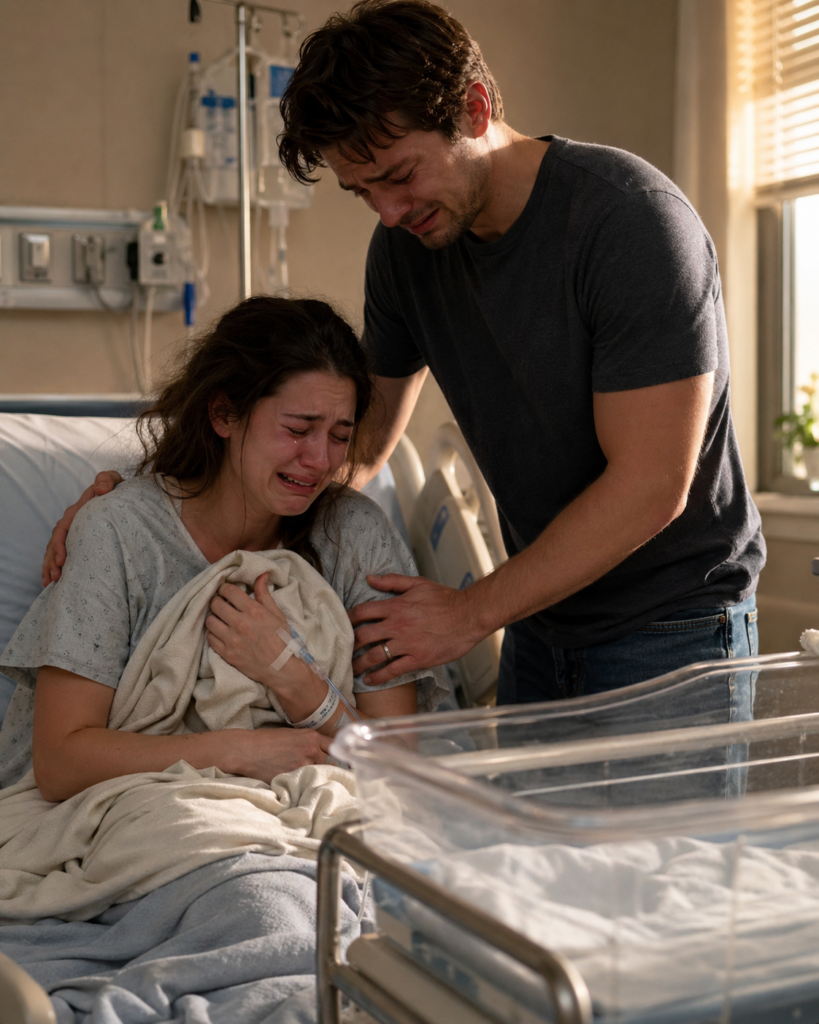
Mara sat propped against white pillows with her hair loose around her face and both hands resting on the blanket across her lap. Her fingers were curled tightly into the fabric, but she did not seem to notice. Her eyes were red from crying, her lips pale, her body still carrying the exhaustion of labor.
Beside the bed stood Adrian, her husband.
He had one hand on the metal rail and the other pressed against his mouth. He had been standing there for so long that his legs felt numb, but he could not make himself sit down. Sitting down felt too normal. Breathing felt too normal. Everything felt like a betrayal because the world outside the room was still moving.
Somewhere down the hallway, a baby cried.
Mara flinched.
Adrian closed his eyes.
Neither of them said anything.
The bassinet stood near the window, clean and waiting, with a small folded blanket inside. It was the soft yellow one Mara’s mother had bought three months earlier, after Mara had said she did not want everything pink or blue.
“Yellow feels like morning,” Mara had told Adrian then, smiling as she held it against her cheek in the baby aisle. “Like sunshine.”
Now the blanket looked too bright for the room.
Too hopeful.
Too untouched.
Mara turned her head slowly toward it, and her face broke again.
Adrian saw it happen before she made a sound. Her mouth trembled. Her shoulders shook. Then she covered her face with both hands and bent forward as much as her tired body allowed.
“I can’t,” she whispered. “Adrian, I can’t look at it.”
He moved to her at once, sitting carefully on the edge of the bed. He wrapped one arm around her shoulders, but she felt fragile in a way he had never known before. Not weak. Never weak. Mara had been brave through every appointment, every worry, every sleepless night, every difficult hour in that room.
But grief had made her seem far away from him, as if she had drifted to a place he could not reach.
“I’m here,” he said, though the words sounded useless even to him.
She clutched the front of his shirt.
“She was supposed to be here,” Mara said. “She was supposed to be right there.”
Adrian looked at the bassinet and felt something inside him give way.
“I know,” he whispered.
They had named her Elena.
They had chosen the name on a rainy Sunday afternoon while sitting on the floor of the nursery, surrounded by tiny clothes, cardboard boxes, instruction sheets, and half-assembled furniture. Adrian had been trying to put together the crib, pretending he understood the instructions, while Mara sat cross-legged on the rug with one hand on her stomach and a notebook full of baby names balanced on her knee.
“Elena,” she had said suddenly.
Adrian looked up from a wooden rail and a handful of screws. “Elena?”
Mara nodded. “It means light. Or bright one. Something like that.”
He had smiled. “Our little light.”
Mara had put both hands on her belly. “Elena Grace Rivera.”
Adrian had repeated it softly, testing the sound. “Elena Grace Rivera.”
That was the first time the baby felt fully real to him. Not just a heartbeat on a monitor. Not just movement under Mara’s skin. Not just ultrasound photos taped to the refrigerator.
A name made her a person.
A name made her someone they were waiting for.
After that, everything in their lives began to arrange itself around Elena.
The empty second bedroom became a nursery. A small white dresser arrived. Adrian painted the walls a gentle cream color after Mara decided the first shade looked too cold. Friends sent packages. Mara’s mother knitted a blanket with uneven edges and cried when Mara loved it anyway. Adrian’s younger sister bought tiny socks with clouds on them. Their neighbor left a bag of baby books outside their door with a note that said, “You will need these sooner than you think.”
Mara read every parenting article she could find.
Adrian practiced folding the stroller.
They argued over diaper brands and laughed about it afterward.
At night, they lay in bed with Adrian’s hand resting on Mara’s stomach, waiting for Elena’s kicks. Sometimes the baby moved as soon as he started talking.
“She knows your voice,” Mara would say.
Adrian liked to believe it.
He told Elena about the old oak tree outside their apartment building. He told her about the park where he would push her stroller. He told her about Sunday pancakes, bedtime stories, and how her mother cried during commercials but pretended she had allergies.
Mara would slap his hand lightly and say, “Don’t tell her all my secrets.”
“She should know what kind of family she’s joining,” he would answer.
Those nights became their favorite memories before they even understood they would need memories to survive.
The pregnancy had not been perfect, but it had been filled with hope.
There had been moments of fear, small warnings, extra appointments, and days when Mara’s blood pressure worried the doctor. But each time, someone reassured them. Each time, they were told to monitor, rest, return if something felt wrong, and keep hoping.
So they hoped.
They hoped through every checkup.
They hoped through every late-night worry.
They hoped when Mara could no longer sleep comfortably and Adrian built a mountain of pillows around her.
They hoped when the hospital bag sat packed near the door for two weeks.
And when Mara woke before dawn with sharp waves of pain and grabbed Adrian’s arm, they had both believed the hard part was beginning, but joy was waiting on the other side.
Adrian remembered the drive to the hospital with cruel clarity.
The streets had been almost empty. The sky was gray, not yet morning. Mara sat in the passenger seat breathing carefully while one hand gripped the door handle and the other held his.
“Don’t speed,” she told him through clenched teeth.
“I’m not speeding.”
“You are definitely speeding.”
“I’m emotionally speeding.”
She had laughed then.
A small, breathless laugh.
He would remember that sound for the rest of his life.
At the hospital entrance, a nurse brought a wheelchair. Adrian parked badly, apologized to no one in particular, and hurried after them with the overnight bag swinging from his shoulder. Mara kept breathing the way they had practiced, but her face had gone serious.
The room they were given had pale walls, a narrow bed, a window looking over the parking lot, and a newborn bassinet already waiting near the corner.
Mara looked at it and smiled.
“There it is,” she said softly.
Adrian put the bag down and touched the clear plastic side of the bassinet.
“Soon,” he said.
He took a picture of it.
He did not know why. Maybe because everything felt important. Maybe because he imagined sending it to their parents later with a photo of Elena wrapped inside.
The first hours passed in a blur of nurses, monitors, contractions, water cups, whispered encouragement, and Adrian’s hand nearly crushed in Mara’s grip.
Mara was stronger than he had ever seen her.
She cried once, from pain and fear, and apologized for it.
Adrian leaned close to her forehead and said, “Don’t you dare apologize.”
She nodded, breathing hard.
The doctors came and went. Sometimes they spoke in calm voices. Sometimes they studied the monitors longer than Adrian liked. Once, a nurse adjusted something and told Mara, “We’re keeping a close eye. You’re doing well.”
Mara looked at Adrian after the nurse left.
“Is she okay?” she asked.
Adrian wanted to say yes without hesitation.
But he had seen the nurse’s face.
“She said they’re watching,” he answered.
Mara understood the part he did not say.
The next hour changed everything.
The room grew busier.
Another nurse came in. Then a doctor. Then two more people Adrian did not recognize. Their voices stayed professional, but the air shifted. Mara sensed it at once.
“What’s wrong?” she asked.
The doctor moved beside her and explained that the baby was showing signs of distress. They needed to act quickly. They were going to help. They were going to do everything they could.
Everything after that became broken pieces in Adrian’s memory.
Mara’s frightened eyes.
The bed moving.
His own voice asking if he could come.
Someone telling him where to stand.
Bright lights.
A mask near Mara’s face.
Her hand searching for his.
Adrian held it and whispered her name again and again.
“I’m right here. I’m right here.”
Mara turned her head toward him, tears sliding into her hair.
“Don’t let go,” she said.
“I won’t.”
But then someone asked him to move. Someone else guided him back. He did not remember how far. He remembered the sound of machines, the doctor’s voice, a nurse calling out numbers, and the terrible feeling of watching people fight against time.
He prayed then.
Adrian had not prayed properly in years. Not because he did not believe in anything, but because life had made him careless. He prayed in traffic, during storms, before job interviews, in the small selfish ways people often do when they are afraid.
But in that room, he prayed with everything he had.
Take anything else, he thought. Take the car. Take my job. Take every plan we made. Just let her live. Let them both live.
Minutes stretched.
The world narrowed.
Then Elena was born into a room that did not celebrate.
There was movement. Urgency. Soft commands. A tiny body carried quickly to a warmer. Nurses surrounding her. A doctor still focused on Mara.
Mara tried to lift her head.
“Why isn’t she crying?” she asked.
No one answered quickly enough.
“Adrian,” Mara said, panic sharpening her voice. “Why isn’t she crying?”
He could not answer because he did not know how to exist inside that question.
A nurse came to him, speaking gently but firmly, telling him they were helping the baby breathe. The team was working. They needed him to stay with Mara.
Mara heard enough to understand.
“No,” she whispered. “No, no, no.”
Adrian leaned over her. “They’re helping her.”
“I want to see her.”
“I know.”
“I want my baby.”
“I know, Mara. I know.”
The baby team worked for what felt like forever and no time at all.
Adrian watched faces.
That was how he knew before anyone spoke.
Doctors and nurses are trained to keep their expressions steady, but there are moments when the truth passes through a room before words can catch up. He saw it in a nurse’s eyes when she looked toward the doctor. He saw it in the way someone’s shoulders lowered slightly. He saw it in the pause.
The doctor came to them.
Adrian had always thought life-changing news would arrive like thunder. Loud. Violent. Impossible to miss.
But it came softly.
The doctor stood close, her eyes kind and tired, and said words Adrian would hear for the rest of his life.
They had done everything they could.
Elena had not survived.
Mara made a sound that did not seem human.
It was not a scream exactly. It was deeper than that. Smaller and larger at the same time. It came from somewhere beyond speech, beyond thought, beyond anything Adrian could fix.
He held her while her body shook.
“No,” she sobbed. “Please. Please, no. I just want her. I just want my baby.”
Adrian kept saying her name, but his own voice broke.
“Mara. Mara, I’m here.”
But being there was not enough.
Love was not enough.
Hope had not been enough.
Later, they brought Elena to them.
The room had been cleaned. The urgency was gone. Everything looked almost normal, which made it worse. The machines hummed quietly. The window showed a pale morning sky. Someone had dimmed the lights.
A nurse entered carrying a small bundle wrapped in the yellow blanket.
Mara stopped breathing for a moment.
The nurse’s eyes were wet, but her voice stayed gentle.
“Would you like to hold her?”
Mara reached out with trembling arms.
Adrian stood beside the bed as the nurse placed Elena against Mara’s chest.
She was tiny.
So much smaller than all their dreams.
Mara looked down at her daughter’s face and began to cry silently. No loud sobs now. Just tears falling one after another onto the blanket.
“Hi, Elena,” she whispered. “Hi, my love.”
Adrian sat beside them and touched one tiny hand with the tip of his finger.
He had imagined that hand curling around his.
It did not.
Mara bent her head and kissed Elena’s forehead.
“She has your nose,” she said.
Adrian could barely see through his tears.
“She has your mouth,” he whispered.
For a while, they simply held her.
They counted her fingers. They touched the soft dark hair on her head. They studied her face with the desperate attention of parents trying to memorize a lifetime in minutes. The nurse asked if they wanted photos, handprints, a memory box.
Mara looked at Adrian as if asking permission for something no parent should have to decide.
“Yes,” he said, because he knew one day they would need proof that Elena had been real outside their hearts.
The nurse moved quietly around them. She treated Elena with tenderness. She spoke her name. She called Mara and Adrian “Mom” and “Dad,” and each time, Mara cried harder.
Hours passed strangely.
Family members arrived.
Mara’s mother, Celia, came first, still wearing the cardigan she had thrown on in a hurry. She entered the room hopeful and frightened, asking, “What happened? Where is she?”
Then she saw Mara’s face.
Celia stopped in the doorway.
“No,” she whispered.
Adrian’s father came later with red eyes and shaking hands. His younger sister stood in the hall for ten minutes before she found the courage to enter. No one knew what to say. Everyone tried. Every sentence fell apart.
“She was beautiful,” Celia said.
“She is beautiful,” Mara corrected through tears.
Celia covered her mouth and nodded. “She is beautiful.”
That mattered to Mara.
Even in the worst moment of her life, she needed the world to know Elena was not just a tragedy. She was not just loss. She was their daughter. She had a name. She had a face. She had been held. She had been loved from the moment she existed.
By afternoon, the hospital room was filled with flowers that made Mara angry.
She did not want flowers.
Flowers were for celebrations and apologies and tables. Flowers would die in vases while she was still trying to understand how to leave the hospital without her baby.
Adrian noticed her staring at them.
“Do you want me to move them?” he asked.
She nodded.
He carried them into the hallway one arrangement at a time. When he returned, she was looking at the bassinet again.
It was still empty.
A nurse had offered to take it away earlier, but Mara had said no.
She did not know why.
Maybe because removing it felt like admitting Elena would never lie there. Maybe because keeping it hurt, but losing it would hurt too. Grief made every choice impossible.
As evening settled, the room grew quiet again.
Family went home because the nurses said Mara needed rest. Celia refused at first, but Mara asked her to go gently.
“I need a minute with Adrian,” she said.
Celia kissed her forehead. Then she hugged Adrian so hard he almost lost his balance.
“Take care of her,” she whispered.
“I will,” he said.
But after she left, he stood in the room and wondered how.
How did a husband take care of a wife after something like this?
How did a father take care of a child he could not bring home?
How did a person continue after the future had been folded into a small memory box?
Mara watched him from the bed.
“You can cry,” she said.
Adrian looked at her.
He had been crying all day, but quietly. Carefully. As if his grief had to make room for hers. As if one of them had to remain steady or the whole room would collapse.
“I don’t want to make it worse for you,” he said.
Her face twisted.
“You lost her too.”
Those four words broke him.
He sat beside her and leaned forward, elbows on his knees, both hands over his face. The sob came suddenly, rough and deep, and Mara reached for him. She put her hand on his back the way he had put his hand on hers so many times during labor.
They stayed like that for a long time.
Two parents in a hospital room.
One bed.
One empty bassinet.
One name that filled every corner.
In the days that followed, time lost its shape.
The hospital kept Mara for monitoring. Nurses came in with medicine, paperwork, soft voices, careful eyes. Some knew what had happened before they entered. Others looked toward the bassinet and then quickly away.
Mara noticed everything.
She noticed when people avoided saying Elena’s name.
She noticed when they said “the baby” instead.
She noticed when a nurse came in with discharge instructions and accidentally mentioned newborn feeding before stopping mid-sentence, horrified.
The nurse apologized until she cried.
Mara surprised herself by reaching for her hand.
“It’s okay,” Mara said, though nothing was okay.
The nurse left the room in tears.
Adrian sat by the window, filling out forms he could barely read.
There were choices to make. Arrangements. Signatures. Calls. Questions no parent expects to answer.
Did they want a service?
Did they want burial or cremation?
Did they want to donate anything?
Did they want the hospital chaplain?
Each question felt like someone placing a stone on Mara’s chest.
Adrian handled what he could, but he asked her before every decision.
“I don’t know,” she said again and again.
Finally, near midnight on the second day, she said, “I want a small service. Just family. And I want the yellow blanket with her.”
Adrian nodded.
“Okay.”
“And I want her name said.”
His throat tightened.
“Yes.”
“Not avoided. Not whispered like it’s something wrong.”
“I promise.”
They went home on a Thursday.
A nurse wheeled Mara to the hospital entrance because hospital policy required it. Adrian carried the overnight bag, the memory box, and a folder of papers.
No baby carrier.
No car seat.
No tiny hat.
As they passed the maternity waiting area, a man walked by holding balloons that said Welcome Baby. He smiled automatically at them, then saw their faces and looked away.
Mara stared straight ahead.
Outside, the air was cold.
Adrian helped her into the car and placed the memory box on her lap. She held it with both hands.
They drove in silence.
At a red light, Mara looked out the window at a woman pushing a stroller along the sidewalk. The woman leaned down to adjust the blanket, smiling at the child inside.
Mara turned her face away.
Adrian reached for her hand, but she did not take it.
Not because she did not want him.
Because she was holding the box.
When they reached their apartment, neither of them moved.
The building looked the same. Their mailbox was the same. The oak tree Adrian had promised to show Elena stood in the courtyard, its branches bare against the gray sky.
Their home waited upstairs with a nursery they could not enter.
“I can’t go in,” Mara said.
Adrian turned off the engine.
“We can sit here.”
“For how long?”
“As long as you need.”
They sat in the parking lot for forty-three minutes.
Finally, Mara opened the door.
Inside the apartment, everything was exactly as they had left it.
That was the cruelty of home.
The mugs in the sink. The blanket on the couch. The hospital bag checklist still stuck to the refrigerator. A pack of diapers on the hallway table because Adrian had planned to carry them into the nursery when they returned.
Mara stood in the doorway and looked around.
Then she dropped to the floor.
Adrian set the bag down and knelt beside her.
“I don’t want this life,” she said.
He held her as she cried into his chest.
“I know.”
“I want the one we had yesterday.”
“I know.”
“I want her.”
“I know.”
The nursery door was closed.
Neither of them opened it that day.
Or the next.
For the first week, people brought food.
Soup. Pasta. Rice dishes. Bread. Things that could be reheated. Things that sat untouched in the refrigerator because Mara could not eat and Adrian forgot until his hands shook.
Visitors came and spoke softly. Some were helpful. Some were not.
A neighbor told Mara, “You’re young. You can try again.”
Mara stared at her until the woman stopped talking.
Adrian walked the neighbor to the door and did not invite her back.
An aunt said, “Everything happens for a reason.”
Celia snapped, “Not this. Do not say that in this house.”
Mara loved her mother fiercely in that moment.
The most helpful people did not try to explain.
They washed dishes.
They took out trash.
They sat quietly.
Adrian’s sister, Sofia, came every morning before work and left coffee on the counter. She did not ask Mara how she was. She simply kissed the top of her head and said, “I love you. I’m here.”
One afternoon, she found Adrian standing outside the nursery door.
He had one hand on the knob.
“You don’t have to,” Sofia said.
He looked at her. “I don’t know if leaving it closed is helping or hurting.”
“Maybe both.”
His eyes filled.
“I was supposed to build her bookshelves this weekend.”
Sofia leaned against the wall beside him.
“Show me what you picked.”
He shook his head. “I can’t.”
“Okay.”
She did not push.
That was love too.
Mara changed after Elena.
Not all at once, and not in simple ways.
Some mornings she woke and seemed almost normal for ten minutes. She brushed her teeth, tied back her hair, made tea. Then something small would undo her. A commercial. A sound from the hallway. The sight of the yellow baby towel folded on the laundry shelf.
Other mornings, she could not get out of bed.
Adrian learned to stop asking, “Are you okay?”
The question had no answer.
Instead, he asked, “Do you want the curtains open or closed?”
“Tea or water?”
“Do you want me beside you or in the living room?”
Small questions. Questions she could survive.
His own grief came differently.
He stayed busy at first. He called the funeral home. He organized bills. He emailed his manager. He responded to messages with the same sentence until he hated it.
Thank you for thinking of us. We need privacy right now.
At night, when Mara finally slept, Adrian went into the bathroom, turned on the shower, sat on the closed toilet seat, and cried with a towel pressed to his mouth so she would not wake.
He thought no one knew.
Mara knew.
One night she stood outside the bathroom door and listened, her hand pressed against the wood. She wanted to go in. She wanted to hold him. But she was so tired of being held together by someone else’s strength. She was afraid if she saw him break, she would shatter beyond repair.
So she returned to bed and cried silently into her pillow.
Grief made them lonely in the same room.
The small service was held eleven days after Elena’s birth.
The sky was bright and painfully clear. The kind of day people call beautiful when nothing terrible has happened.
Mara wore a black dress she had bought years ago for a wedding rehearsal dinner. It did not fit the same. Nothing fit the same. Her body had prepared to care for a child who was not there, and every ache reminded her.
Adrian wore the suit he had planned to wear for Elena’s first church visit with his parents.
They stood together in a small chapel with flowers Mara had not chosen and family members crying into tissues. At the front was a tiny white casket.
Mara stared at it and felt the room tilt.
Adrian put his arm around her waist.
“I can’t,” she whispered.
“You don’t have to speak.”
“I promised her name would be said.”
“I can say it.”
She turned to him.
His face was pale, but steady.
When the time came, Adrian walked to the front with a folded paper in his hand. His fingers trembled so badly the paper shook.
He looked at the small gathering.
“Our daughter’s name is Elena Grace Rivera,” he said.
Mara closed her eyes.
“She was with us for a short time,” Adrian continued, his voice breaking, “but she was loved before she was born. She was loved in every room of our home. She was loved in every plan we made. She was loved in every song Mara played for her, every story we imagined, every night I talked to her like she could already understand me.”
A soft sob moved through the chapel.
Adrian looked down at the paper, then folded it closed.
“I don’t know how to make sense of losing her,” he said. “I don’t think we ever will. But I know this. Elena was real. She is our daughter. And love does not become smaller because a life was brief.”
Mara covered her mouth with both hands.
Adrian looked at her.
“Mara,” he said softly, in front of everyone, “you gave our daughter a home inside your heart before the rest of us ever met her. She knew love because of you.”
Mara broke then, but she did not fall.
Celia held one side of her. Sofia held the other.
Adrian returned to her, and together they stood while the chaplain spoke.
After the service, people hugged them carefully. Some cried. Some whispered Elena’s name. Mara thanked each one who did.
That night, when they returned home, Mara walked straight to the nursery door.
Adrian stopped behind her.
“Mara?”
She put her hand on the knob.
“I need to see it.”
He stood close, not touching her yet.
“Okay.”
She opened the door.
The room smelled faintly of fresh paint, baby detergent, and the lavender sachets Celia had placed in the dresser drawers. The crib stood against the wall, made and waiting. A mobile with small felt clouds hung above it. Books were stacked in a basket. Tiny clothes filled the open closet.
Mara stepped inside as if entering a sacred place.
Adrian followed.
For several minutes, neither spoke.
Then Mara walked to the crib and touched the sheet.
“I imagined her here,” she said.
“I did too.”
“I imagined being tired. I imagined complaining because she wouldn’t sleep. I imagined you making terrible coffee at three in the morning.”
Adrian laughed once, and it turned into a sob.
“I would have made terrible coffee.”
She smiled through tears.
Then she picked up a small stuffed rabbit from the rocking chair. It still had the tag attached. Adrian had bought it secretly and placed it there the night before they went to the hospital.
“I saw this,” she said.
“You weren’t supposed to until we came home.”
“I loved it.”
He nodded, unable to speak.
Mara sat in the rocking chair and held the rabbit against her chest. Adrian sat on the floor beside her, his back against the crib.
For the first time since the hospital, the nursery door stayed open.
Healing did not come quickly.
It did not arrive like sunrise, bright and complete.
It came in fragments.
A morning when Mara ate half a piece of toast.
An afternoon when Adrian walked to the store without feeling like the world was watching him.
A night when they said Elena’s name and smiled before crying.
A day when Mara opened the memory box and looked at the photos.
The first time was unbearable.
She sat at the kitchen table with Adrian beside her and lifted each item slowly. The hospital bracelet. The tiny ink prints. A lock of soft dark hair in a small envelope. The photographs.
Elena wrapped in yellow.
Elena in Mara’s arms.
Elena’s hand near Adrian’s finger.
Mara touched the image with shaking fingers.
“She was beautiful,” she whispered.
“She is beautiful,” Adrian said, remembering.
Mara looked at him and nodded.
After that, the memory box stayed on a shelf in their bedroom, not hidden, not displayed for everyone, but present.
Like Elena.
A month passed.
Then two.
The world expected them to return.
Bills came. Work called. People stopped checking in as often, not because they stopped caring, but because life pulls people forward. Mara understood and resented it anyway.
Adrian went back to work first.
His first day back, someone had decorated his desk with a small card that said Thinking of You. He appreciated it until a coworker he barely knew asked, “How’s your wife handling everything?”
Adrian stood frozen with his coffee in his hand.
Everything.
As if there was a word big enough.
“She’s grieving,” he said.
The coworker nodded awkwardly and walked away.
At lunch, Adrian sat in his car and called Mara.
She answered on the fourth ring.
“Are you okay?” he asked, then hated himself for asking.
“No,” she said.
“Me neither.”
They stayed on the phone without speaking for twelve minutes.
That helped more than anything else.
Mara did not go back to her job at the library until the third month.
Her manager, Mrs. Bell, met her before opening and hugged her tightly. “You don’t have to do a full day.”
“I want to try,” Mara said.
She lasted until noon.
A woman came in with a newborn strapped to her chest and asked where the parenting books were. Mara showed her the section, returned to the staff room, and could not stop crying.
Mrs. Bell drove her home.
“I’m sorry,” Mara said in the car.
“Do not apologize for loving your child,” Mrs. Bell replied.
That sentence stayed with Mara.
Do not apologize for loving your child.
She began writing it in a notebook.
At first, the notebook was only grief.
I miss you.
I don’t know what to do with my arms.
Your father dreamed about you last night.
Today I heard a baby cry and had to sit down.
I am scared people will forget you.
Then the entries changed.
Your grandmother planted yellow flowers for you.
Your aunt Sofia says your name every time she visits.
Your father fixed the rocking chair because it squeaked.
I opened the window in your room today.
I think the light looked beautiful.
Mara did not call it healing.
The word felt too clean.
But writing gave her grief a place to go.
Adrian found his own way through action.
One Saturday, he bought wood and built the bookshelves he had once planned for the nursery. Mara watched from the doorway as he measured, cut, sanded, and stained each board on the small balcony. He worked slowly, carefully, with tears on his face.
When he installed them, he placed three books on the first shelf.
Goodnight Moon.
The Snowy Day.
A children’s book about stars.
Mara stood beside him.
“What are we doing?” she asked quietly.
“I don’t know,” he said. “But I couldn’t leave it unfinished.”
She leaned her head on his shoulder.
“Thank you.”
On what would have been Elena’s due date, they went to the park.
Mara had dreaded the day for weeks. She had imagined staying in bed with the curtains closed. Instead, she woke before sunrise and shook Adrian gently.
“I want to go somewhere,” she said.
He sat up at once. “Where?”
“The park. The one you told her about.”
So they went.
The morning was cool and misty. The grass was damp. The old oak trees spread their branches over the walking path. Parents pushed strollers. Toddlers ran clumsily. Dogs barked.
Mara almost turned back.
Adrian held her hand.
“We can leave.”
She shook her head. “No. I want to show her.”
They walked to a bench near the pond. Mara took the small stuffed rabbit from her bag and held it in her lap.
“I know she isn’t here,” she said.
Adrian looked at the water.
“I don’t know what I believe about where she is,” he admitted. “But I think love has to go somewhere.”
Mara nodded.
They sat for an hour.
Before leaving, Mara tied a yellow ribbon around a low branch of an oak tree. Not tightly. Just enough to stay.
“For Elena,” she whispered.
After that, they returned every month.
Sometimes they talked. Sometimes they sat in silence. Sometimes they cried. Sometimes they brought coffee and watched ducks move across the pond.
The yellow ribbon faded in the sun.
Adrian replaced it.
Six months after Elena’s birth, Mara received a message from a woman named Claire.
They had met briefly in an online support group for parents who had experienced newborn loss. Mara rarely posted, but one night she had written a short message:
My daughter’s name was Elena. I am afraid the world will move on and leave her behind.
Claire replied privately the next day.
The world may move on, but we can carry them together.
Mara did not answer for three days.
Then she wrote back.
Claire had lost a son named Noah two years earlier. She did not offer easy comfort. She did not say time would fix it. She simply understood the strange language of grief.
They began messaging once a week.
Then talking on the phone.
Then meeting for coffee.
The first time they met, Claire brought a small blue notebook.
“I write Noah’s name every year on his birthday,” she said. “Sometimes I write the names of other babies too. May I write Elena’s?”
Mara cried in the café.
“Yes,” she said. “Please.”
Friendship grew from that simple kindness.
Through Claire, Mara met other parents. Fathers who went silent when people asked how many children they had. Mothers who kept hospital bracelets in jewelry boxes. Couples who had survived and couples who had separated under the weight of grief. People who laughed and cried in the same conversation because grief had taught them that both could exist together.
Adrian resisted at first.
“I don’t want to sit in a circle and talk about feelings,” he said.
Mara looked at him over her tea. “You sit in the shower and cry into towels.”
He blinked.
“You know about that?”
“I’m your wife.”
He looked away.
She reached across the table and took his hand.
“I’m not asking you to perform grief,” she said. “I’m asking you not to carry it alone.”
So he went once.
Then again.
At the third meeting, another father named Luis said, “I went back to work after two weeks because I thought being busy would save me. It didn’t. It just made me tired and angry.”
Adrian stared at the floor.
After the meeting, he stood outside with Luis under a streetlamp and talked for forty minutes.
On the drive home, Mara did not ask what they talked about.
Adrian told her anyway.
“He said he forgot how to be a husband for a while,” Adrian said.
Mara looked out the windshield. “Do you feel that way?”
“Sometimes. I’m scared I’ll say the wrong thing. Or not say enough. Or make you feel like I’m moving on.”
She turned to him.
“Are you?”
“No.”
“Neither am I.”
The car rolled through the quiet streets.
Mara added, “But maybe moving forward isn’t the same as moving on.”
Adrian nodded slowly.
“Maybe.”
That became something they held onto.
Forward, not on.
They began finding ways to bring Elena with them.
On Christmas, they hung a small ornament with her name on the tree. Mara cried when Adrian placed it near the top.
On Mother’s Day, Adrian gave Mara a necklace with a tiny yellow stone. She held it in her palm for a long time before putting it on.
“I didn’t know if I should,” he said. “I didn’t want to make the day harder.”
“You remembered I’m her mother,” Mara whispered. “That makes it easier.”
On Father’s Day, Mara gave Adrian a framed photo of his hand near Elena’s. He sat on the edge of the bed and wept openly.
“Thank you,” he said.
Their marriage changed.
It had to.
They were not the same people who had driven to the hospital before dawn. Those people belonged to another life. A life with a packed bag by the door and jokes about emotional speeding.
Sometimes Mara missed those people almost as much as she missed Elena.
She missed who she had been when hope came easily.
She missed Adrian’s careless laugh.
She missed the way pregnancy had made strangers smile at her in grocery stores.
She missed believing that love and preparation could protect them.
But slowly, she began to see that something remained.
Adrian still made terrible coffee.
Mara still cried at commercials.
They still argued about laundry and apologized afterward.
They still sat on the couch with their feet touching.
They still loved each other, though that love had become quieter, deeper, marked by loss but not destroyed by it.
One evening, nearly a year after Elena’s birth, Mara found Adrian in the nursery.
He had been in there more often lately. Sometimes reading. Sometimes dusting shelves. Sometimes sitting in the rocking chair with his eyes closed.
This time, he was holding the yellow blanket.
Mara stood in the doorway.
“I thought maybe we could donate some things,” he said carefully. “Not everything. Only what feels right.”
Mara’s chest tightened.
The nursery had remained mostly unchanged for months. Open, cared for, but untouched. A room for a baby who had not come home.
“What things?” she asked.
“Diapers. Some clothes with tags. Bottles. Things another family might need.”
She looked at the dresser.
“I’m not ready to empty it.”
“We don’t have to.”
“I don’t want people thinking we’re replacing her.”
“No one who matters will think that.”
Mara walked to the crib and touched the rail.
“What if I forget the way she felt in my arms?”
Adrian’s eyes filled.
“You won’t.”
“What if one day I wake up and can’t remember her face without looking at photos?”
“Then we’ll look at photos.”
“What if the world forgets her?”
He stepped closer.
“Then we will remind it.”
Mara looked at him.
“How?”
Adrian swallowed. “Maybe we do something in her name.”
That idea stayed with them.
At first, they did not know what it meant. A scholarship? A donation? A memorial bench? Nothing felt right until Mara remembered the hospital room. The long hours. The empty bassinet. The questions. The way she had needed Elena’s name spoken.
“What about memory boxes?” she said one night.
Adrian looked up from the dishes.
“For families?”
She nodded. “The hospital gave us one. It hurt to receive it, but later… it mattered. What if we helped provide them? Not just boxes. Beautiful ones. With blankets, journals, maybe a card that says their baby’s name matters.”
Adrian turned off the sink.
“That sounds like her.”
So they began small.
Mara contacted the hospital. A social worker called her back. They spoke for almost an hour. The hospital already had some bereavement support, but donations were always needed.
Mara and Adrian created Elena Grace Boxes.
Each box included a soft blanket, a small journal, a keepsake pouch, a candle, and a handwritten card.
Your baby’s life matters. Your love matters. Their name is safe here.
The first time they delivered ten boxes to the hospital, Mara nearly could not enter the building.
Adrian stood beside her in the parking lot.
“We can turn around,” he said.
She looked at the entrance where their old life had ended.
“No,” she said. “I want to bring her back here in a different way.”
They walked in together.
The same lobby. The same elevators. The same clean hospital smell.
Mara’s knees weakened, but Adrian held her hand.
A nurse met them upstairs. Not the same nurse who had cared for Elena, but kind. She accepted the boxes with tears in her eyes.
“These will mean more than you know,” the nurse said.
Mara looked down at the top box.
“I know a little,” she said.
On the way out, they passed a maternity room with the door partly open. Inside, a father laughed softly while someone said, “She’s perfect.”
Mara stopped.
Adrian prepared himself for her to crumble.
Instead, she closed her eyes, breathed in, and whispered, “I hope they get to take her home.”
Adrian squeezed her hand.
“So do I.”
That did not mean the pain was gone.
It meant love had widened.
The first anniversary of Elena’s birth arrived on a rainy morning.
Mara woke before dawn, just as she had on the day everything began. For a moment, she did not know where she was. Then memory returned, not as a sharp blade this time, but as a deep ache.
Adrian was already awake beside her.
They looked at each other in the dim room.
“One year,” he said.
Mara nodded.
They had planned the day carefully. Not too much. Not too little.
In the morning, they visited the park and tied a new yellow ribbon to the oak tree. Rain dotted Mara’s coat and Adrian’s hair. The pond was gray. The bench was wet, but they sat anyway.
Mara took out the notebook she had filled with letters to Elena.
Her voice shook as she read.
“My sweet Elena, today you would be one. I wonder what your laugh would sound like. I wonder if you would have your father’s serious eyebrows when you were thinking. I wonder if you would love music, or bananas, or being carried near the window. I wonder about everything.
“For a long time, I thought wondering would destroy me. Sometimes it still hurts more than I can explain. But I want you to know something. Your father and I are still here. We are different, but we are here. We say your name. We carry you. We love you. We always will.”
Adrian wiped his face with his sleeve.
Then he took out a folded paper of his own.
Mara looked surprised.
“I wrote something too,” he said.
He cleared his throat.
“Elena Grace Rivera, my little light. I only held you for a short time, but being your father changed me forever. I used to think a father’s job was to teach, protect, guide, and bring his child home. I could not do those things the way I wanted. But I can love your mother. I can speak your name. I can help other parents feel less alone. I can make sure your light keeps reaching places I will never see.”
Mara leaned into him, and they cried together in the rain.
Later that afternoon, family came to their apartment.
Not for a party.
For remembrance.
Celia brought yellow flowers. Sofia brought a cake with no candles because Mara had asked for that. Adrian’s father brought a small wooden box he had made himself, carved with Elena’s initials.
They ate quietly. They told stories from the pregnancy. Mara laughed when Sofia confessed she had bought three ridiculous baby outfits Adrian had refused to approve.
“One had a pineapple hat,” Sofia said.
Adrian shook his head. “No daughter of mine was going to wear a pineapple hat.”
Mara laughed so hard she cried.
For the first time, the crying did not erase the laughter.
That evening, after everyone left, Mara and Adrian stood in the nursery.
The room had changed slowly over the year. The crib was still there, but the dresser now held supplies for Elena Grace Boxes. The bookshelves Adrian built held children’s books and journals. The rocking chair sat near the window with the stuffed rabbit on it.
It was still Elena’s room.
But it was also a room where love had learned to move.
Mara picked up the yellow blanket from the memory shelf. Not the one buried with Elena, but a matching one Celia had bought later because Mara wanted something to hold.
“I used to think this room was proof of what we lost,” Mara said.
Adrian stood beside her.
“What is it now?”
She looked around.
“Proof that she was loved.”
He nodded.
Mara took his hand.
“And proof that we survived loving her.”
Outside, the rain had stopped. The city lights reflected on the wet street. Somewhere in the building, a baby cried.
Mara heard it.
Her eyes filled, but she did not flinch this time.
Adrian heard it too.
They stood together in the soft light of the nursery, holding hands, listening to the sound of another life beginning somewhere nearby.
The ache remained.
It always would.
There would always be an empty place at their table, in their family photos, in the quiet dreams they carried. There would always be dates that hurt, rooms that remembered, songs that opened old wounds without warning.
But there would also be Elena’s name.
There would be yellow ribbons.
There would be memory boxes delivered to hospital rooms where other parents sat in stunned silence, needing proof that their babies mattered.
There would be Mara’s notebook.
There would be Adrian’s terrible coffee.
There would be mornings when they woke and chose to keep going, not because grief had ended, but because love had not.
Years later, when people asked Mara if she had children, she no longer froze.
She would touch the yellow stone at her neck and say, “Yes. I have a daughter. Her name is Elena.”
Sometimes people understood.
Sometimes they did not.
But Mara said it anyway.
Because Elena Grace Rivera had existed.
She had been hoped for, named, held, mourned, remembered, and loved.
And in a quiet hospital room where an empty bassinet once stood beside a brokenhearted mother, a love had begun that even loss could not take away.
- While Dressing My Late Husband for His Funeral, I Found Coordinates Hidden Under His Hairline….
- [FULL STORY] Lost Baby During Newborn – Hospital Tragedy Mood
- [FULL STORY] Lost Baby During Newborn – Hospital Tragedy Mood
- My Husband Left Me for a 28-Year-Old on Christmas Eve…
- [Full Story] Young Triplets Disappeared in 1981 — 30 Years Later, Their Mother Makes a Shocking Discovery…