Part 1/3
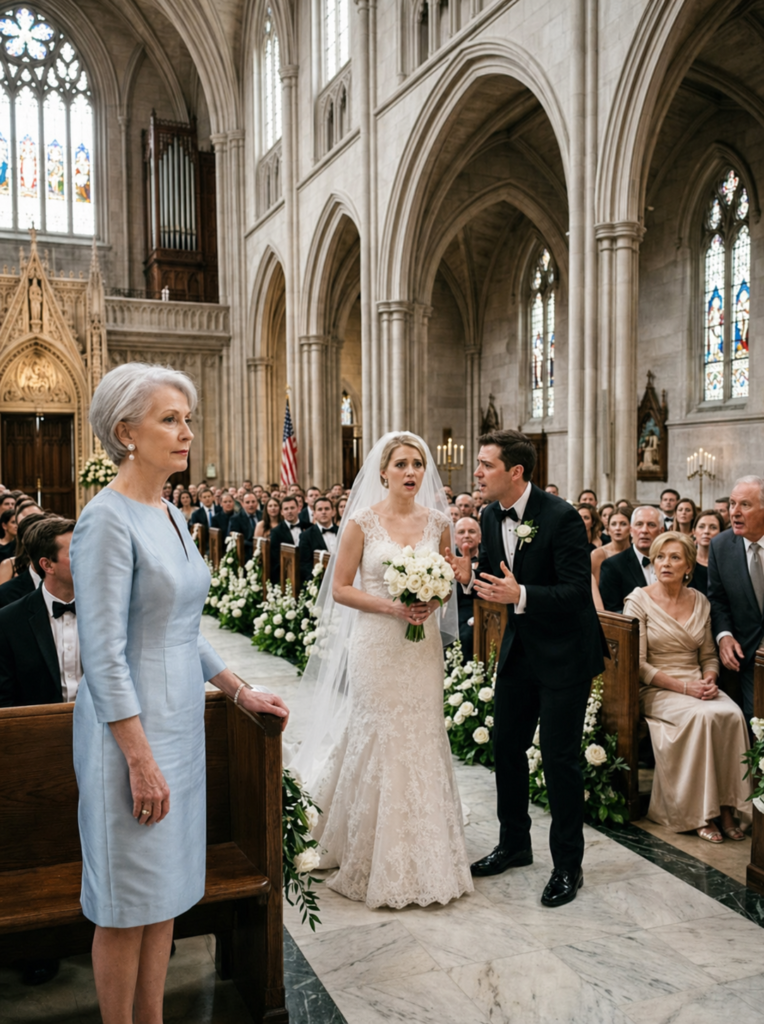
At my son’s wedding, I sat quietly in my little blue department-store dress while his bride’s family treated me like a harmless small-town widow they had generously agreed to tolerate.
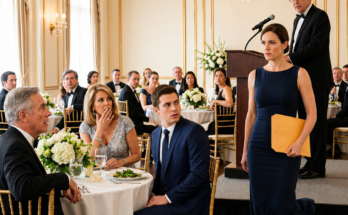
That lasted until the moment his future mother-in-law glanced at me, smirked toward her sister, and said just loudly enough for the front row to hear, “That’s not a mother. That’s a mistake in a dress.”
Then the bride laughed.
Not a nervous laugh. Not the kind of laugh people use to cover an awkward moment. Jessica threw her head back and clapped twice, sharp and delighted, as if it was the funniest thing she had ever heard.
And then my son heard them.
You could actually see the moment it happened. Tyler had been standing near the front of the terrace, one hand near his boutonniere, his face pale with the ordinary nerves of a groom about to change his life. Then something inside him went very still.
His shoulders straightened. His mouth hardened. The softness that love had kept in his eyes for the past eight months vanished so quickly it felt like watching a candle go out in a crowded room.
That was the exact moment the wedding ended.
The strange thing is, six months earlier, I had been worrying about flower bulbs.
Not important things. Not the kind of things people worry about before their lives crack open and reveal the truth underneath. I was in my kitchen in Cedar Falls, Iowa, with a seed catalog spread beside my coffee cup, trying to decide whether I had planted the tulips too close to the daffodils before the first freeze.
It was one of those gray late-autumn mornings when the world looks folded inward and the trees stand bare, as if waiting for judgment.
At sixty-two, I had become very good at being quiet.
Quiet clothes. Quiet car. Quiet house. Quiet money.
Especially quiet money.
To the people of Cedar Falls, I was Margaret Henderson, a respectable widow, mother of one, casserole contributor, the woman who drove a sensible Honda Civic and wore the same camel coat every winter because there was nothing wrong with it.
My husband, Jim, had been gone for twelve years by then. Most people assumed I lived on his pension, a little Social Security, and old habits of thrift.
Most people were wrong.
But I had learned long before that being underestimated is one of the hidden luxuries of middle age. Men brag in front of you. Women condescend to you. Strangers explain the world in small, careful words, as if the truth might injure you.
All the while, you are free to see them clearly, because they never think to watch themselves around you.
That winter morning, I had been content. Maybe not wildly happy, but content in the durable, disciplined way a person becomes after grief has passed through life and rearranged the furniture.
My days had rhythm. Coffee at six. Market reports at seven. A walk if the sidewalks were not icy. Church office volunteer hours on Tuesdays. Dinner alone, but peaceful.
A life modest enough that no one looked at it twice.
Then Tyler called.
“Mom,” he said, and I could hear the smile in his voice before he said another word, “I want you to meet someone.”
If you have ever had a child, you know there are entire novels hidden inside that sentence.
Tyler was thirty-two that year. Smart, kind, and a little too eager to please. He was the sort of man who held doors open even when his hands were full. He had inherited Jim’s patience and my habit of thinking three steps ahead, though in matters of the heart, he was his own kind of foolish—decent, hopeful, and painfully sincere.
“Her name is Jessica,” he said. “We’ve been seeing each other for a couple of months.”
The pause that followed told me more than the sentence had.
He was serious. Serious enough to be nervous about my reaction.
“Bring her to dinner,” I said.
The first time I met Jessica Walsh, she spent twelve full minutes photographing her appetizer.
We were at a little Italian restaurant downtown, the kind with checked tablecloths and candle stubs in Chianti bottles. Tyler looked so proud of her that I tried very hard to be generous in my first impressions.
She was beautiful in the way beauty can be measured by symmetry, hair appointments, and confidence. Tall, blonde, polished in the way wealthy young women often are, as though they had been professionally lit since adolescence.
She wore a cream sweater that probably cost more than my monthly electric bill and spoke with an airy confidence that suggested she had never once doubted she would be liked.
She kissed Tyler’s cheek before sitting down. She called me “Mrs. Henderson” with exactly the right brightness. She ordered a salad, then rotated the plate three times to find its best angle beneath the restaurant lights.
While Tyler talked happily about work, Jessica asked me questions with a smile so sweet I nearly missed the blade hidden inside it.
“Do you still live in the family home?” she asked.
“Yes.”
“All by yourself?”
“Yes.”
“That must be hard.”
“It has its moments.”
“And have you thought about what you’ll do eventually?” she asked, sprinkling grated parmesan over her lettuce as if the future needed seasoning. “You know, long-term. Housing, support, medical things. My mother is obsessed with making sure everyone has a plan.”
I remember looking at Tyler, wondering if he heard it.
He didn’t. Or rather, he heard the words, but not the structure beneath them.
Young men in love almost never do.
“I do have a plan,” I said.
“That’s smart,” Jessica replied, nodding approvingly, as if I were a fourth grader who had successfully tied my own shoes. “So many women of your generation leave all that to chance.”
Women of your generation.
I smiled. “I’ve never been much for chance.”
Tyler laughed because he thought I was making a light joke. Jessica smiled back at him, satisfied with herself.
If the evening had ended there, I might have written her off as merely tactless.
But then the bill came.
Tyler reached for it.
Jessica did not stop him. She did not even perform the little dance some well-brought-up girls do, that theatrical flutter of, “Oh no, let me,” before allowing themselves to be treated.
She simply leaned back, watched him pay, and said, “You’re so traditional. Daddy will love that.”
Daddy.
There are women who say father. Women who say dad. Women who say my father as if they are quoting minutes from a board meeting.
A woman who says Daddy at thirty-two in a cashmere sweater has usually been taught two things very young: money is a language, and she is expected to speak it fluently.
After dinner, Tyler hugged me in the parking lot.
“Well?” he asked.
“She’s very polished,” I said.
He laughed. “That’s one word for it.”
I could have said more. I could have said she watches rooms the way appraisers study furniture. I could have said her interest in me felt less maternal than forensic.
But he was happy, and happiness in a widowed mother can become its own kind of superstition.
You do not swat at your child’s joy unless you are certain it is fire.
So I let it pass.
The second time I met Jessica, she brought her mother.
That alone should have told me everything.
Tyler called three days beforehand, sounding oddly tentative.
“Jessica and her mom want to stop by on Sunday,” he said. “Kind of an informal get-to-know-you thing.”
“Her mother?”
“Yeah. Patricia. She’s… involved.”
That, as it turned out, was the understatement of the year.
Sunday afternoon came cold and bright. I made coffee, set out the good shortbread tin, and tidied the living room even though there was not much to tidy.
My house was not grand, but it was warm. Jim had painted the walls himself before the year he died. The oak floors had scratches from Tyler’s childhood and a faint water ring on the end table where Jim had once forgotten a glass during football season.
Every room held evidence of actual living.
I had always preferred that to display.
When Patricia Walsh arrived, she looked around my house with the expression of a woman touring a well-kept museum of lower expectations.
She was slim, elegantly preserved, and dressed in shades of winter white that would have been impossible in any practical household. Her pearls sat at her throat like punctuation.
Behind her, Jessica smiled brightly and drifted toward my kitchen before I had fully invited them in, opening cabinets with the false casualness people use when they are quietly inventorying someone else’s life.
“Margaret,” Patricia said, taking both my hands as if we were old friends meeting after an unfortunate war, “what a treat. Jessica has told me so much.”
I doubted that very much.
She settled into Jim’s recliner without asking. It had once been my favorite place in the room to look at. Seeing her in it felt so wrong that I nearly tasted metal.
“This is charming,” she said, scanning the room. “So cozy.”
Cozy is what wealthy women call houses too modest to impress them but too clean to criticize openly.
“Thank you,” I said.
Jessica wandered back from the kitchen carrying a coffee mug before I had offered her one.
“I love how authentic everything feels here,” she said. “It’s almost… nostalgic.”
Almost.
Nostalgic.
Authentic.
I should have served something stronger with the sugar.
Patricia crossed one leg over the other and gave me a smile practiced over decades of charity luncheons.
“We’re just thrilled Tyler has found someone who understands how important family support systems are. Young couples need a network around them, don’t you think? Emotional support, practical help, all of it.”
“I do,” I said.
“Of course,” she continued, glancing around my living room as though support systems could be judged by square footage, “every family contributes differently.”
There it was. The first clean edge of it.
“Differently how?” I asked.
“Oh, you know.” She waved a manicured hand. “Some families contribute financially. Some socially. Some simply offer encouragement and warmth.”
Some simply offer encouragement and warmth.
I do not know if she intended the insult to land that plainly, or whether she was so used to hierarchy that she could no longer hear it when she spoke.
Jessica heard it.
She lowered her eyes to hide a smile.
Tyler missed it entirely.
He was in love.
It embarrasses people when I say that now, as if love were a kind of contagious incompetence, but the truth is that it often is. Not because love makes us stupid, but because it makes us interpret things that should alarm us as something manageable.
You tell yourself she is blunt, not cruel. Her mother is protective, not controlling. Their money makes them formal, not arrogant.
You keep softening the truth because the alternative is admitting you have invited danger inside while calling it hope.
After they left, Tyler lingered on my porch while Jessica and Patricia sat in their car.
“Mom,” he said carefully, “I know they can come on a little strong.”
“A little?”
He sighed. “Jessica grew up differently than I did.”
I folded my arms against the cold. “Differently is one word for it.”
He looked miserable, which made me immediately regret the sharpness in my voice.
“She makes me happy,” he said.
There it was again.
Happiness.
That same pleading note.
I touched his cheek the way I had when he was small and feverish.
“Then I’m glad,” I said.
And I was.
Or at least I wanted to be.
What Tyler did not know—what almost nobody knew—was that I had spent the last twelve years building a second life underneath the first one.
When Jim died, people came to my house in waves. Neighbors with hams. Church ladies with lemon bars. Men in dark coats who used words like burden and transition and making do.
I was fifty then, too young to feel old and too old to begin again in any straightforward way.
Tyler was twenty. Just old enough to think he should be protecting me, and just young enough not to understand that a widow is never more vulnerable than in the first year after people begin calling her brave.
They mean it kindly. Most of them do.
But brave is what people call a woman when they have quietly begun to remove her from the category of power.
Jim had left me three things of real importance: a paid-off house, a life insurance policy just over two hundred thousand dollars, and a conviction repeated so often during our marriage that it lived in me like scripture.
Money is a tool, not a costume.
He had also left me Robert Chen.
Robert had been his financial adviser for years, though adviser makes him sound grander than he was. At the time, he was a cautious, clever man in his forties with rimless glasses and a habit of speaking only after he had already worked out three versions of an answer in his head.
After the funeral, he came by with a folder and sat at my kitchen table.
“There are safe options,” he told me gently. “Certificates. Bonds. Something conservative. Enough to supplement the pension.”
“Safe for whom?” I asked.
He blinked.
“For me,” I clarified. “Or for the people who would prefer I never take a risk?”
A slow smile appeared at the corner of his mouth. It was the first time anyone had looked at me since Jim’s death as though I were not in danger of shattering under ordinary language.
Over the next year, Robert taught me to read what he read.
Not because he thought I could not manage on my own, but because I insisted that if my money was going to work, I wanted to know where it was putting its hands.
We started carefully. Index funds. Municipal bonds. A handful of dividend stocks. Then commercial REITs. Then small private placements that never made the local gossip circuit because they were too dull for people who think fortunes only happen in movies and bankruptcy court.
I learned quickly.
Not because I was gifted, though I was not bad, but because I paid attention and had no interest in being dazzled.
I knew what panic cost. I had buried a husband. Nothing in the market could frighten me the way that did.
Numbers, once you strip them of ego, are just weather with paperwork.
By year five, I was making choices Robert merely refined.
By year eight, I had started buying small commercial parcels through quiet partnerships.
By year twelve, my modest life had become a disguise so complete that even women at church recommended coupon apps to me with pitying enthusiasm.
I let them.
There is an almost holy freedom in not having to perform wealth for anyone.
So when Tyler called in November to tell me he and Jessica were engaged, I congratulated him warmly, then sat down in my kitchen and stared at the refrigerator until its hum seemed louder than the room.
He sounded giddy.
“She said yes before I even finished asking,” he told me. “Jessica’s parents are thrilled.”
That word again.
Thrilled.
There are very few things wealthy families are actually thrilled about when their daughter marries a man whose mother shops at department stores and drives a Honda.
But I kept my voice soft and asked about the ring.
“Her mother already has ideas for the wedding,” Tyler said, laughing in that brittle way people laugh when they are trying to pretend they are not already being managed. “They want to host it at the family estate in June.”
June.
Seven months away.
“That’s quick.”
“I know, but Jessica says summer weddings photograph best on the grounds.”
Of course she did.
Two days later, she called me herself.
“Mrs. Henderson,” she sang into the phone, “I wanted you to hear it from me. We’re so excited. Mother has already spoken to the florist and the planner, and Daddy’s making arrangements for the guest list. The estate can handle three hundred people comfortably.”
Comfortably.
“Isn’t that lovely,” I said.
“We know your side may be more modest in scale,” she added, with the same tone one uses when promising not to overburden a pensioner at Christmas. “So please don’t worry about expectations. We’ll take care of the major things.”
Major things.
The implication sat between us, polished and obvious.
They would fund the spectacle.
My family would bring sentiment and folding chairs.
“Very generous,” I said.
She mistook my calm for gratitude and chatted on about peonies, calligraphy, and imported linen. When she finally hung up, I set the phone down and laughed once, sharply, into my empty kitchen.
It was not a happy sound.
Three weeks later, I was in Robert Chen’s office reviewing my year-end statements when the idea first came to me with enough shape to become dangerous.
Robert’s office overlooked a parking lot and a strip of winter sky. He had upgraded his furniture since the year Jim died, but not his caution. He tapped a line on the printed summary and adjusted his glasses.
“Margaret,” he said, “you’ve had an exceptionally strong year. Even accounting for the downturn in spring, your diversification has paid off. Current net worth, as of today, is just over three point eight million.”
He said it in the same tone doctors use to report excellent cholesterol.
I looked at the number.
I had seen numbers like it before, watched them rise and dip and rise again. But that day, it landed differently because somewhere across town, a family named Walsh was busy deciding how much dignity they could afford to extend to the widow from Cedar Falls.
“Robert,” I said, “how quickly could I move half a million without attracting unnecessary attention?”
He went still.
“There’s a difference between can and should,” he said.
“I’m aware.”
“What are you planning?”
“A wedding gift.”
Robert’s brows rose. “That is a substantial gift.”
“My son is getting married.”
He studied me for a long moment. Robert had learned years ago that when I sounded calmest, I was usually furthest from triviality.
“This isn’t just a gift,” he said quietly.
“No.”
“What is it, then?”
I folded the statement closed.
“Insurance.”
He leaned back in his chair. “Against what?”
“Humiliation,” I said. “Control. Regret. Choose one.”
He did not smile. “Should I be worried?”
“No,” I said.
Then, after a beat, I added, “But Gordon Walsh probably should.”
That was the first day of what I later thought of—privately, and with more satisfaction than was entirely Christian—as the Walsh Education Initiative.
I began with research.
People with real power rarely advertise the cracks in their foundations, but paperwork does not care about dignity. County records, business journals, property tax assessments, trade filings—small towns are full of information disguised as boredom.
You just need patience and the willingness to read what everyone else ignores.
Within a week, I knew more about Gordon Walsh’s finances than some members of his own family likely did.
His three car dealerships looked solid from the road: bright signs, polished showrooms, expensive inventory parked in neat rows. But under the shine, two were heavily leveraged. Sales had dipped. Interest rates had eaten through more of his margin than he wanted to admit.
His restaurants were vanity projects with uneven books. One did well during the holiday season but quietly bled money in February.
The shopping center stake he bragged about at dinner parties was his most promising asset—small on paper, potentially transformative when paired with the medical expansion being discussed in whispers across county development boards.
The Walsh estate itself, that sprawling colonial monument to inherited certainty, was mortgaged far deeper than any house with that much marble should have been.
House rich.
Cash hungry.
Patricia’s side of the family was not much better. Old money, yes, but old money after too many poor decisions becomes mostly old stories with expensive upholstery.
Her father had gambled. Her brother had launched three doomed ventures in succession. Much of what Patricia wore, displayed, and defended with such aristocratic force was not wealth in the sturdy sense.
It was theater maintained by refinancing.
When you understand that, a certain type of rich woman suddenly becomes very easy to read.
Every sneer is fear in better tailoring.
The next truly useful piece of information came from Tyler.
He called one evening sounding excited in a way that made my stomach tighten.
“Gordon offered me a position after the wedding,” he said. “At one of the dealerships.”
I closed my eyes.
“What kind of position?”
“Sales manager to start. Mostly commission at first, but he says if I prove myself, there could be profit-sharing. Maybe even partial ownership later. Mom, it’s huge.”
Commission at first.
Profit-sharing later.
Ownership maybe.
It was the kind of offer a powerful man makes when he wants gratitude before dependence, and dependence before obedience.
“What about your current job?” I asked.
Tyler worked operations for a regional supply company. It was not glamorous, but it was stable. Benefits. Reasonable hours. A life that let him sleep like a human being.
“I’d leave after the honeymoon,” he said. “Jessica thinks it’s the perfect chance to become part of the family business.”
Jessica thinks.
“Where would you live?”
“They found an apartment closer to town. Higher rent, but if my commissions are good—”
If.
I looked out the window at my dark yard and remembered how love can turn if into a bridge sturdy enough to walk off a cliff.
“That’s fast,” I said carefully.
“I know, but Gordon says opportunity doesn’t wait.”
No, I thought.
Men like Gordon Walsh certainly do not.
After I hung up, I called Sarah Mitchell.
Sarah was the lawyer I used when quiet things needed to become official. She was in her fifties, sharp as cut glass, and had once told me over lunch that her favorite clients were women who had been underestimated long enough to become dangerous.
I had been loyal to her ever since.
When I told her what I wanted, she listened without interrupting.
“You want a holding company,” she said when I finished. “Structured so your son can step in as managing partner whenever you decide.”
“Yes.”
“And you want assets positioned in such a way that he cannot be folded neatly under Walsh control after the wedding.”
“Yes.”
“And the wedding gift?”
“A visible layer,” I said. “Something simple enough not to start a war before I’m ready.”
Sarah’s mouth twitched. “You are assuming the marriage survives long enough for the gift to matter.”
“I’m planning for both outcomes.”
She looked impressed despite herself. “You really have thought this through.”
“I’ve had practice,” I said. “Widowhood is basically a postgraduate degree in contingency planning.”
Over the next six weeks, the pieces moved.
Robert liquidated selected positions without disrupting the broader portfolio. Sarah built Henderson Investment Properties as a legal vessel sturdy enough to hold more than sentiment.
Through partnerships I already had and new ones arranged quickly, we began acquiring interests in three developments Gordon either underestimated or needed more than he knew.
The most important was Riverside, the shopping center parcel adjacent to the planned medical expansion. Gordon owned only a slice of it, but he was counting on that slice to eventually deliver a large payout.
What he did not know was that the medical consortium wanted speed more than anything. Unified control would let them move months earlier, and months are worth fortunes to people building hospitals.
Money does not always roar.
Sometimes it simply arrives early.
By February, Henderson Investment Properties held enough influence in Riverside to matter.
By March, we held enough to steer.
By April, I knew with total certainty that if Gordon kept assuming he was the only adult in the room, he was going to lose more than his dignity.
And still, I kept making casseroles for church.
That was the part people never understood later, when the story became town legend and women began retelling it over coffee with little gasps of admiration.
They made it sound as if I had transformed overnight from widow into avenging financier.
But that is not how real transformation happens.
I did not become someone else.
I simply stopped allowing other people’s assumptions to define which parts of me were visible.
I still bought tomatoes at Hy-Vee.
I still deadheaded the roses myself.
I still wore my old coat because it was warm.
Power does not become less real because it is not draped in cashmere.
In May, Tyler invited me to the Walsh estate for what he called a proper family dinner.
“Jessica’s parents really want to get to know you,” he said.
I almost laughed.
Men who own dealerships often believe a dinner can establish hierarchy if they control the silverware.
The Walsh estate stood on the western edge of town behind a stone wall and a line of old maples. It was the sort of house people describe with phrases like gracious and legacy-rich when what they really mean is enormous and expensive to heat.
The drive curved up to white columns, black shutters, and windows so tall they seemed to exist mainly to reflect the family’s opinion of itself.
I parked my Honda behind Tyler’s Toyota, which together looked like two practical mistakes in a driveway built for German declarations of status.
Jessica opened the door before I reached it. She wore a dress the color of champagne and smiled as if she had practiced the exact width of it.
“Mrs. Henderson,” she said, kissing the air near my cheek. “Welcome.”
Patricia descended the staircase in pearls. Gordon appeared from somewhere wood-paneled.
Everything about the evening had been staged to communicate the same thing: Here is what success looks like. Be impressed, but not too comfortable.
Dinner was served in a room large enough to intimidate poultry.
Six of us sat at one end of a table that could have seated twenty. Candles glowed in silver. The steak was excellent. The wine cost more than many people’s car insurance.
For the first twenty minutes, the Walshes performed themselves.
Patricia told a story about a villa in Tuscany as if logistics were a personality. Gordon discussed market conditions in the tone of a man convinced he had personally invented capital. Jessica laughed at her parents in exactly the right places.
Tyler tried so hard to seem at ease that the effort showed in his jaw.
Then Gordon turned to me.
“So, Margaret,” he said, swirling his wine, “Tyler tells us you’ve managed things admirably since Jim passed. That takes discipline.”
“It does.”
“A lot of people never recover from a financial shock like that. They spend emotionally. Or they get timid. It takes a certain head for numbers to preserve capital.”
Preserve capital.
Not grow it.
Not wield it.
Preserve it, as one preserves canned peaches or antique linens.
I took a sip of wine and let him continue.
“The secret, really,” he said, warming to himself, “is understanding that money should work harder than you do. Most people spend their whole lives earning a salary and never learn how to make their capital produce.”
Jessica nodded like a student before a beloved professor.
I set my glass down carefully.
“That is certainly one approach.”
He smiled, pleased I had validated him.
Patricia dabbed her lips with her napkin and said, “And of course, we would never dream of putting pressure on Tyler’s side of the family where the wedding is concerned.”
I waited.
“We know these things can become awkward when one family has different… capacities.”
Capacities.
Tyler looked up sharply. Jessica touched his arm as if to soothe him before there was yet anything obvious to soothe.
“We’re handling the larger expenses,” Patricia continued. “Venue, flowers, music, catering. Please don’t feel any obligation to match us. Emotional support matters just as much.”
I cannot adequately explain the power of silence when used by a woman who knows exactly how much she is worth.
I let that silence sit.
Gordon misread it as embarrassment and smiled kindly.
“No shame in limits, Margaret. Everybody contributes in their lane.”
In their lane.
I smiled back, polite as cream.
“How considerate.”
Jessica leaned forward.
“We were actually thinking that after the wedding, you might enjoy joining us on one of our trips sometime. We do family travel. Aspen at Christmas, maybe Europe in the spring. It would be nice for you to see more of the world.”
There was something almost touching about the sincerity with which she believed she was offering charity wrapped as inclusion.
“That’s very kind,” I said.
Then, because I wanted to see how far they would go, I added, “I would like to contribute something meaningful to the wedding, if you’ll let me. The rehearsal dinner, perhaps?”
It was a beautiful moment.
The three Walshes exchanged a glance so quick and coordinated they might as well have been a school of fish.
Patricia recovered first.
“Oh, Margaret, that’s sweet. Truly. But we’ve already handled it.”
“Then flowers?”
Jessica laughed lightly. “Mother has someone she always uses.”
“Photography?”
Gordon cleared his throat. “Our vendors are fairly specialized.”
Specialized.
Expensive.
Beyond your experience, little widow.
“I see,” I said.
“Perhaps,” Patricia offered, “a sentimental gift for the couple would be lovely.”
A sentimental gift.
Something framed and harmless. Something that could sit on a side table while adults handled assets.
“That sounds appropriate,” I said.
And that was the exact second I decided to stop being merciful.
Not because I cared what Patricia Walsh thought of me. Women like that have always existed and always will.
But because I saw what their assumptions were doing to Tyler.
He sat there smiling too hard, grateful for crumbs offered as if they were jewels, already bending himself to fit a family that intended to make him earn his place forever.
During dessert, Gordon began explaining a shopping center development in the voice men reserve for discussing land they believe others are too provincial to understand.
“Riverside is where the smart money is,” he said. “Medical expansion, population shift, long-term leasing opportunities. If you control the adjacent commercial parcels, you practically write your own future.”
“Do you control them?” I asked.
He smiled with all his capped confidence.
“Enough of them.”
I nearly laughed into my coffee.
After dinner, Patricia insisted on giving me a tour of the house. That is how rich women display dominance: by walking you past their things and waiting for awe.
Portraits. Imported rugs. A library full of leather spines with the decorative stiffness of unread ambition. An upstairs sitting room larger than my living room.
“The house has been in Gordon’s family for generations,” Patricia said, trailing her fingers over a marble mantel. “We do feel a responsibility to preserve standards.”
Standards.
“Of course,” I murmured.
Jessica joined us in the upstairs hall and said, “That’s part of why Daddy wants Tyler at the dealership. Family should build together. Mother says once men marry well, they stop drifting.”
Marry well.
I smiled so warmly it nearly qualified as sainthood.
“What a blessing for him.”
On the drive home, I rolled the windows down despite the cold because I needed air.
Some people inspire outrage.
The Walshes inspired clarity.
At home, I took off my coat, set down my purse, and stood in the kitchen where Jim used to kiss my forehead while reading the evening news.
I could almost hear him.
Money is a tool, Maggie. Not a costume.
He had been right.
The Walshes had mistaken their costume for power.
That is always fatal eventually.
By the time I went to bed that night, Henderson Investment Properties had become more than a contingency.
It had become a strategy.