My stepmother called at 11:47 p.m. on the first night I spent in the beach house I had bought with my own money. She told me that she and my father were moving in the next day, that they were taking the master suite, that her daughter would get the best ocean-view room, and that if I had a problem with any of it, I could leave.
PART 3/3
The next morning, by ten, the first calls came.
Not to me directly. To Adrien. To Miriam. To the foundation. To my father’s longtime financial advisor. To a criminal attorney Vanessa had apparently once recommended to another donor wife during a “tax misunderstanding.”
The machinery that wakes after a public financial scandal is not loud at first.
It hums.
Quietly, expensively, and with terrifying efficiency.
Vanessa and Khloe returned to the house at noon under escort from a private attorney and a moving service.
No screaming.
No scene.
In wealthy families, removal happens with inventory sheets and legal phrases.
Adrien was present. So was a uniformed officer, by his recommendation, not because anyone expected violence, but because disputed possession and emotional delusion can produce theatrical instincts in people unused to being denied.
Vanessa entered the foyer in yesterday’s makeup, carefully repaired. Even then, even with ruin in motion around her, she had touched up her concealer.
That would have been almost admirable if it had not been so grotesquely on brand.
She looked at me once, from the doorway to the living room where I stood in cream slacks and bare feet with a coffee cup in my hand.
“This is cruelty,” she said.
“No,” I replied. “This is checkout.”
Her chin lifted. “You think you’ve won.”
I looked past her at the moving crew carrying down garment bags and mirrored cosmetic cases from the master suite.
“I think you misunderstood the house.”
She frowned.
“It was never something you were taking from me,” I said. “It was the place where you finally showed me exactly who you were.”
For the first time in all the years I had known her, Vanessa had no line ready.
Khloe did, though.
“You’ve always hated us,” she snapped, mascara beginning to gather at the edges no matter how carefully she blinked. “You were jealous from the beginning.”
I turned to her.
There are moments when truth is almost too simple to say because so much damage has been built to avoid it.
“No,” I said. “I was neglected from the beginning. That isn’t the same thing.”
She actually stepped back.
Vanessa recovered enough to do what she had always done best: translate herself into the victim of someone else’s inability to appreciate her.
“You have destroyed your father,” she said to me softly, as if sharing concern.
I held her gaze.
“No. You just counted on me being easier to destroy.”
She left twenty-two minutes later with six suitcases, twelve garment bags, the skincare fridge, the tiny dog, two framed photographs, and the final expression of a woman who still believed reality had behaved unfairly by refusing to remain decorative.
The house changed the moment the last car cleared the gate.
You could feel it.
Not symbolically. Physically.
The upstairs air no longer smelled like her perfume. The kitchen lost that faint charge of performance. The silence stopped bracing for commentary.
I walked through room after room, reclaiming things that had been mine all along.
My clothes returned to the master suite. My books went back to the nightstand. My mother’s photograph returned to the dresser where Vanessa had placed orchids instead. Khloe’s ring light disappeared. The embroidered guest towels Vanessa had ordered without asking went into storage. The west bedroom doors opened to ocean air again without beauty products lined up like troops across every surface.
At sunset, I stood on the terrace in my own bedroom with the windows wide and listened to the Pacific.
It sounded the same as it had on the first night.
The difference was me.
People talk about revenge as though it is heat. Rage. A burst. A spectacle.
They are wrong.
The most devastating form of revenge is not dramatic destruction. It is patient exposure. It is letting someone believe their habits are still working while you quietly gather the architecture of their collapse. It is refusing the sloppy satisfaction of early confrontation because you understand that truth, if timed correctly, can do more than wound.
It can end things.
Vanessa had not just tried to take my beach house. She had walked into it under the assumption that I was still the girl she could edit out of family photographs, still the daughter who would absorb insult because objecting required energy better spent surviving.
She had believed the old hierarchy still held: her elegance, my silence, my father’s avoidance, Khloe’s entitlement, the room arranged exactly as she liked it.
What she did not understand was that silence changes character once it belongs to a woman who no longer needs the family to tell her who she is.
The legal process moved on from there, because of course it did.
Investigations. Freezes. Negotiations. Restitution. Public withdrawal of the award. A carefully worded foundation statement about “serious concerns regarding source-of-funds representations.” Quiet board resignations from two women who had championed Vanessa too aggressively. Gossip-column euphemisms. A legal filing so dryly written it almost made me laugh, given how much pain lived inside it.
Khloe tried, for a while, to rescue the narrative online. Posts about betrayal. Mental health. Family trauma. The dangers of believing one version of a story.
None of them landed.
Influencer-adjacent sympathy evaporates quickly when court records begin circulating in private group chats among people who fund museums.
My father filed civil claims. Criminal review followed. Vanessa’s attorney negotiated fiercely and then, when faced with the quality of the paper trail, less fiercely. Certain assets were frozen. Others surrendered. The Del Mar property transfer was challenged successfully. The line of credit was unwound. The retirement-account losses were partially recoverable, though not without embarrassment and cost.
My father aged ten years in six months.
I wish I could say we rebuilt everything quickly.
We did not.
That is not how relationships recover when betrayal has layered over neglect. There were conversations. Long ones. Angry ones. Quiet ones.
He told me things I had not known: that after my mother died, he had been terrified of the silence in the house; that Vanessa seemed like structure at a time when structure felt indistinguishable from rescue; that he had convinced himself my distance meant resilience because the alternative was admitting he had failed to look closely at the one child who needed him to.
I told him things he had not wanted to know: that there is a special kind of loneliness in being praised for your independence by people who are really just relieved they do not have to care for you; that every time Vanessa used my self-sufficiency as an excuse to divert resources to Khloe, it taught me something corrosive about love and convenience; and that he had let it happen not because he was evil, but because noticing would have forced him to choose conflict over comfort much sooner than he was willing.
He cried once.
It startled us both.
I did not.
Not because I felt nothing. Because my grief for my father had already lived in me for years, and by the time he finally arrived at the ruins, I had long since learned the map.
We do not have a perfect relationship now. Perfect is for people who were not remade by omissions.
But we have something I did not think possible when I was twenty-three and watching Vanessa place Khloe at the center of every holiday photograph.
We have honesty.
He visits the beach house sometimes.
Not often. Not casually. He asks first. He stays in a guest room. He brings newspaper sections he thinks I’ll find interesting, still clipped too neatly because he thinks physical paper makes the gesture more sincere.
Once, standing on the terrace at dusk, he told me my mother would have loved the way the light hits the water in late June.
“I know,” I said.
And for that one moment, the sentence held both of us without punishing either.
As for Vanessa, I hear things.
Not directly. Through legal updates. Through Adrien. Through the social ecosystem that once lifted her up and now treats her name like a cautionary tale told over espresso after committee meetings.
She rented for a while. Lost several boards. Lost more friends. Not because they suddenly discovered morality, but because proximity to exposed fraud is terrible for donor confidence.
She still dresses beautifully, I’m told. Still speaks softly. Still tells versions of the story in which she was misunderstood, under-supported, targeted by a jealous stepdaughter with a flair for public cruelty.
People like Vanessa rarely confess. Confession would require an identity not built entirely on curation.
Khloe pivoted, naturally. She always was good at landing in the next available aesthetic. For a while, she posted desert retreats and vague captions about beginning again. Then a wellness podcast. Then a rebrand around female resilience. I almost admired the efficiency of it.
Trauma, too, had become content.
Sometimes people ask if it was worth it.
They do not ask directly, usually. They ask around the edges.
Wasn’t it hard to do it in public?
Didn’t part of you feel sorry for her?
Why not just handle it quietly?
Those questions always reveal more about the asker than the answer. They imagine private handling exists in some clean moral space untouched by power.
It usually does not.
Private handling is where women like Vanessa thrive. Behind closed doors, she would have smiled, lied, denied, reframed, cried if necessary, and later told the world I had become unstable and bitter.
The only reason the truth held was because it entered a room she cared about more than she cared about me, and because that room contained people whose self-interest aligned, however briefly, with justice.
So yes.
It was worth it.
Not because I enjoyed watching her collapse. I didn’t, not exactly. What I felt was not pleasure. It was release. The release that comes when the burden of proving what you have endured finally shifts from your body onto paper other people are forced to read.
And there was another reason.
That night in the ballroom, when Judge Carter said my name and two hundred twenty people turned to look at me, I understood something my mother had tried to teach me before she died.
You do not become visible by begging to be included in the frame.
You become visible by stepping into the truth so completely that the frame has to widen or break.
Vanessa had spent years treating me like background. Like the competent, quiet daughter whose resources could be appropriated, whose feelings could be translated, whose life could be rearranged if it served prettier people with softer voices and more decorative needs.
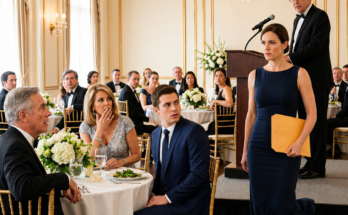
But when I walked onto that stage with the manila envelope in my hands, I was no one’s background.
I was the witness.
I was the file.
I was the line that finally held.
Some nights, I still think about that first call.
11:47 p.m. The ocean outside. Her certainty. The way she said if I had a problem with any of it, I could leave.
I replay it sometimes not because I regret anything, but because the sentence has become almost holy to me in its arrogance. She handed me the moment that made the rest possible. She believed she was assigning terms.
She was actually exposing method.
If she had asked more carefully, lied more subtly, waited a month, covered the paper trail better, maybe it would have taken longer. Maybe some part of her world would have remained intact.
But entitlement makes people sloppy, especially when they have been right for too long about who will stay quiet.
The beach house is truly mine now.
Not legally—it always was—but spiritually, which is a harder and more meaningful possession.
I wake to the sound of water and do not feel watched. I host dinners with people I choose. I work at the long table facing the sea. My mother’s photograph sits in the master suite where the late light touches the frame every evening. I keep white peonies in the kitchen when they are in season because she loved them. Sometimes I walk barefoot from room to room at night just because I can.
When storms roll in, the waves hit the bluff hard enough to shake the glass.
I love that.
It reminds me that force is not always violence. Sometimes it is simply nature refusing to be arranged by someone else’s idea of decor.
I am still unmarried. Still in finance. Still excellent with spreadsheets, though Vanessa would hate to know how much damage those skills can do when paired with patience and legal counsel.
I am no longer the daughter easiest to forget the minute a prettier story enters the room.
Not because they finally learned to see me.
Because I stopped waiting for them to.
And on the rare evenings when the sky goes lavender over the Pacific and the house is all salt and light and open glass, I stand on the terrace with a drink in my hand and think of the ballroom, the envelope, Judge Carter’s calm voice, and Vanessa’s face when recognition finally found her.
Then I listen to the water.
It sounds like ownership.
It sounds like witness.
It sounds like the end of a lie.
THE END
- My stepmother called at 11:47 p.m. on the first night I spent in the beach house I had bought with my own money…
- My stepmother called at 11:47 p.m. on the first night I spent in the beach house I had bought with my own money…
- My stepmother called at 11:47 p.m. on the first night I spent in the beach house I had bought with my own money…
- At my son’s wedding, I sat quietly in my little blue department-store dress while his bride’s family treated me like a harmless small-town widow they had generously agreed to tolerate.
- At my son’s wedding, I sat quietly in my little blue department-store dress while his bride’s family treated me like a harmless small-town widow they had generously agreed to tolerate.