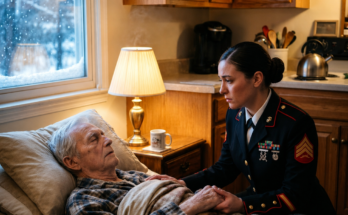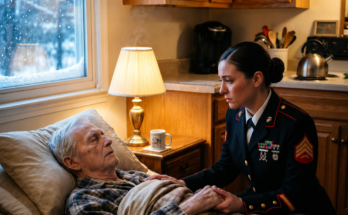
The old man sat in the living room with one hand pressed gently against his face, trying not to let his son see how badly his heart was shaking.
His name was Samuel Bennett, and for seventy-two years, he had believed one thing with all his soul: family was where a person should be safest.
But that evening, under the warm yellow light of the home he had helped pay for, Samuel sat alone in the front chair while his son Daniel and daughter-in-law Claire stood behind him with folded arms and cold eyes.
Daniel did not ask if his father was okay.
Claire did not bring him water.
Neither of them said sorry.
Samuel’s shirt was stained from the chaos earlier that night, his lip trembled when he breathed, and one side of his face carried the painful proof of a confrontation that had gone too far. But what hurt him most was not the injury.
It was the way his only son looked at him like he was a burden.
“I told you not to interfere,” Daniel said quietly.
Samuel slowly lifted his eyes.
“I wasn’t interfering,” he whispered. “I was protecting what your mother left behind.”
At that sentence, Claire’s expression changed.
Daniel’s jaw tightened.
And for the first time that night, Samuel realized the truth was much bigger than a family argument.
Something had been hidden in that house.
And they were afraid he had found it.
Samuel had not planned to confront anyone that evening.
He had come to the house with a small brown envelope tucked inside his coat pocket, the same envelope he had found two days earlier inside an old recipe box that belonged to his late wife, Margaret.
For months, Daniel had been telling him that the house needed to be sold. He said the repairs were too expensive. He said the neighborhood was changing. He said keeping the place was “emotional thinking,” not practical thinking.
Samuel had almost believed him.
He was tired. Grief had made him softer than he used to be. Since Margaret passed, mornings felt too quiet, dinners felt too large for one person, and the family photographs on the hallway wall seemed to watch him with questions he could not answer.
So when Daniel and Claire insisted that moving him into a smaller apartment would be “better for everyone,” Samuel tried to listen.
But then he found the envelope.
Inside were copies of documents, a handwritten letter from Margaret, and one line that made Samuel’s hands shake.
“Sam, if Daniel ever pressures you about the house, do not sign anything until you speak to Attorney Howard.”
At first, he thought it was old worry. Margaret had always been careful. She labeled every jar, saved every receipt, and remembered every birthday before anyone else did.
But when Samuel called Attorney Howard, the truth began to unfold.
Margaret had placed part of the home in a protected family trust years earlier. Daniel knew about it. Claire knew about it. They had been trying to get Samuel to sign papers that would give them control before he understood what he was signing.
Samuel had not shouted when he learned this.
He simply sat at his kitchen table until the sunlight moved across the floor, remembering every time Daniel had rushed him, every time Claire had placed papers in front of him with a sweet voice and impatient eyes.
That night, Samuel came to Daniel’s house to ask one question.
“Why?”
But the question did not open a conversation.
It opened something colder.
Claire accused him of being confused. Daniel told him he was “making things difficult.” When Samuel said he had spoken to the attorney, the room changed. Claire’s calm smile disappeared. Daniel stepped closer, not like a son, but like a man who had been caught.
Then came the moment Samuel would replay again and again.
Daniel reached for the envelope.
Samuel held it tighter.
The chair scraped. The lamp shook. A framed family photo fell from the side table and cracked against the floor.
And when the room finally went still, Samuel was sitting in the chair, breathing unevenly, staring at the son he had raised with both hands and every sacrifice he had ever made.
Daniel stood over him, pale and silent.
Claire looked toward the closed front door.
Then someone knocked.
Three slow knocks.
Not police.
Not a neighbor.
Someone Daniel clearly did not expect.
And when Claire whispered, “Don’t open it,” Samuel finally understood that the envelope was not the only secret in the room.
For a moment, nobody moved.
The living room seemed to hold its breath. The lamp beside the sofa flickered softly, throwing long shadows across the cream-colored wall where family portraits still hung in neat rows. In one photograph, Daniel was five years old, sitting on Samuel’s shoulders at the county fair, one hand full of cotton candy, the other gripping his father’s hair.
Samuel could still remember the weight of that little boy.
He could remember Daniel laughing so hard that Margaret had begged both of them to stand still for the picture.
Now that same boy stood a few feet away as a grown man, jaw clenched, eyes dark with panic.
Another knock came.
Daniel turned his head toward Claire.
“Who is that?” he asked under his breath.
Claire’s face had lost color.
“I don’t know,” she said, but Samuel heard the lie in her voice.
The old man lowered his hand from his face. His fingers trembled, but his voice came out steadier than he expected.
“Open the door, Daniel.”
Daniel looked at him sharply. “You don’t get to give orders in my house.”
Samuel glanced around the room slowly.
“Your house,” he repeated.
Those two words landed heavily.
Claire stepped forward. “Samuel, this has been a very emotional night. You’re upset. Daniel is upset. We all need to calm down.”
Samuel looked at her.
For years, Claire had spoken to him in that voice. Soft, controlled, polite enough that anyone outside the family would have called her kind. But Samuel had learned that her kindness always came with a hook. Every gentle sentence pushed him somewhere. Every smile hid a calculation.
“Claire,” Samuel said quietly, “I am calmer than I have been in months.”
The third knock sounded.
Then a woman’s voice called through the door.
“Mr. Bennett? It’s Anna Howard. Your attorney sent me. Are you alright?”
Daniel’s expression changed completely.
Not anger this time.
Fear.
Samuel felt the room shift around him. He had spoken to Attorney Howard that afternoon, yes. The man had been worried. He had told Samuel not to confront Daniel alone. Samuel had promised to be careful, but he had not wanted strangers involved in family pain.
He had not known Howard would send someone.
Claire whispered, “Daniel, don’t.”
But Daniel was already walking toward the door, not to open it, but to turn the lock more firmly.
Samuel saw the movement and pushed himself up from the chair.
His knees complained. His back ached. The room tilted for a second, and he grabbed the armrest until it steadied.
“Daniel,” he said, louder this time. “Open the door.”
Daniel froze with his hand on the lock.
“You want to embarrass us?” he said. “You want to make this public?”
Samuel looked at the broken photo frame on the floor.
Behind the cracked glass, Margaret’s smile was split by a thin line.
“No,” Samuel said. “I wanted my son.”
Daniel did not answer.
The words seemed to cut deeper than any accusation could have.
Outside, Anna Howard called again.
“Mr. Bennett, please answer me.”
Samuel took one slow step forward.
Claire moved to block him, but something in Samuel’s face made her stop.
He walked past her. Daniel stared at him, breathing hard, but did not move. When Samuel reached the door, his hand shook so badly that it took him two tries to unlock it.
The door opened.
Anna Howard stood on the porch with a phone in one hand and a worried expression that turned serious the moment she saw Samuel.
She was younger than Samuel expected, perhaps in her mid-thirties, with dark hair pulled back and a navy coat buttoned to her throat. Behind her stood Mr. Howard himself, an older man with silver hair and a briefcase held tightly at his side.
“Samuel,” Howard said, his voice heavy with concern.
Samuel tried to smile. “I’m alright.”
“No,” Anna said gently. “You are not.”
Daniel stepped forward quickly. “This is a family matter.”
Howard looked past Samuel and into the living room. His eyes moved from Daniel to Claire, then to the broken frame on the floor.
“A family matter can still require witnesses,” he said.
Claire lifted her chin. “You have no right to come here.”
Howard opened his briefcase slowly. “Actually, Mrs. Bennett, I came because Samuel called me today after discovering documents that should never have been hidden from him. And because I received an email from your address at 6:14 p.m. asking me to disregard any future communication from Samuel due to his supposed confusion.”
Samuel turned to Claire.
Claire’s lips parted.
Daniel said nothing.
Samuel felt something cold settle in his chest.
“My confusion?” he asked.
Claire swallowed. “Samuel, I was only trying to protect—”
“Don’t,” Howard interrupted calmly. “The email was not sent by Samuel. It also included an attachment: a signed authorization form. The signature appears to have been copied.”
The room went silent.
Samuel looked at Daniel.
His son’s eyes darted away.
That was answer enough.
For weeks, Samuel had noticed small things but explained them away. Missing mail. Calls from the bank that Daniel said were mistakes. Papers placed in front of him at dinner, always with Daniel tapping the table and saying, “Just sign here, Dad. It’s routine.”
Routine.
That word now felt like a door closing.
Anna stepped inside carefully. “Mr. Bennett, would you like medical help?”
Samuel almost said no. Pride rose automatically, old and stubborn. But then he looked at his son again and saw no concern there. Only fear of consequences.
“Yes,” Samuel said.
The single word seemed to shake Daniel more than shouting would have.
Claire’s face tightened. “Samuel, please think about what you’re doing. Once you bring outsiders into this, you can’t undo it.”
Samuel turned toward her.
“I have spent the last year trying to keep this family together,” he said. “I ignored the way you spoke to me. I ignored the way Daniel stopped visiting unless he needed a signature. I ignored how every conversation about my future somehow ended with your hands on my wife’s house.”
Claire’s eyes flashed. “Your wife’s house? Margaret wanted Daniel taken care of.”
Samuel’s voice softened. “Margaret wanted all of us taken care of. That is why she protected it.”
Howard stepped forward and placed a folder on the coffee table.
“This is the trust document,” he said. “Margaret Bennett established it eight years before her passing. Samuel has lifetime rights to reside in the home. No sale can occur without his informed consent and independent legal review. Daniel was notified because he was named as a future beneficiary, not a current controller.”
Daniel finally spoke.
“She never trusted me,” he said bitterly.
Samuel flinched.
Howard closed the folder. “She trusted you enough to leave you a future share. She did not trust anyone to pressure Samuel after her death. There is a difference.”
Daniel laughed once, but it was empty.
“You don’t know what it was like,” he said. “All my life, everything was about Dad. Dad’s hours. Dad’s sacrifices. Dad’s rules. Mom acted like he was a saint.”
Samuel stared at him.
A thousand memories moved through him at once.
Working double shifts after the factory cut wages. Selling his fishing boat to pay Daniel’s college tuition. Sitting up all night when Daniel had pneumonia at nine years old. Margaret sewing Daniel’s first interview shirt because they could not afford a new one.
“What did you lack?” Samuel asked quietly.
Daniel’s face twisted. “You never gave me control.”
Samuel blinked.
Control.
Not love. Not respect. Not attention.
Control.
Claire placed a hand on Daniel’s arm, but he pulled away, too far gone now to hide.
“You think I don’t know what people say?” Daniel continued. “That I got everything because of you? That I live in a house my father helped buy? That my mother left things tied up like I’m some child who can’t be trusted?”
Samuel’s heart ached with a tiredness he had no words for.
“I helped you because you were my son,” he said. “Not because you were weak.”
Daniel looked away.
For one brief second, Samuel saw the boy from the photograph again. Hurt. Proud. Desperate to prove something. But the boy disappeared behind the man’s hard eyes.
Anna spoke gently. “Mr. Bennett, we should step outside.”
Before Samuel could answer, another sound came from the hallway.
A small voice.
“Grandpa?”
Everyone turned.
At the bottom of the stairs stood Emily, Daniel and Claire’s twelve-year-old daughter. She wore pink pajamas, one hand gripping the railing, her eyes wide with fear.
Samuel’s face changed immediately.
“Emily,” Claire said quickly. “Go back upstairs.”
But the girl did not move. She looked at Samuel’s face, then at her father, then at the broken picture on the floor.
“Dad,” she whispered, “what happened?”
Daniel’s mouth opened, but no words came.
Samuel felt shame rush over him, not because he had done wrong, but because a child had seen the family stripped of its mask.
He opened his arms slightly.
Emily ran to him.
Claire reached out as if to stop her, but Howard’s quiet stare made her lower her hand.
Emily hugged Samuel around the waist. Samuel winced but held her gently.
“I’m okay, sweetheart,” he whispered.
“No, you’re not,” she said, crying now. “I heard yelling.”
Daniel closed his eyes.
The room could survive lawyers. It could survive documents. It could survive accusations.
But it could not survive Emily’s tears.
Samuel stroked her hair.
That was when he made his decision.
He had come for answers. He had received them. But he would not let this child stand in the middle of adult greed and bitterness.
“Mr. Howard,” Samuel said, “I want everything handled properly. Legally. Quietly, if possible. But I will not sign anything. Not tonight. Not ever under pressure.”
Howard nodded. “That is wise.”
Samuel looked at Daniel.
“And I will go home.”
Daniel’s eyes flickered. “Dad—”
Samuel raised a hand.
Not angrily.
Enough.
“You lost the right to call me only when you need something,” he said. “When you remember how to speak to me as your father, not as an obstacle, you know where I live.”
Emily clung tighter to him.
“Can I come see you tomorrow?” she asked.
Samuel looked down at her, and his eyes filled.
“Always.”
Claire crossed her arms again, but this time the coldness looked fragile.
“Emily has school,” she said.
Samuel met her eyes.
“Then after school.”
Howard helped Samuel out to the porch. Anna called for medical assistance, and while they waited, Samuel sat on the front steps with Emily beside him, wrapped in a blanket Anna found in her car.
The night air was cool.
For the first time in months, Samuel felt like he could breathe.
Not because the pain was gone.
Because the pretending was over.
The days that followed were not easy.
Family pain rarely ends in one night. It spreads through phone calls, paperwork, whispers, and long silences. Daniel did not call the next morning. Claire sent one message through Howard claiming the whole situation had been “misunderstood.” Samuel did not answer.
He went home to the house Margaret loved.
It was a modest two-story place with blue shutters, a small garden in front, and a kitchen window that caught the morning sun. To other people, it might have looked ordinary. To Samuel, every corner held a life.
Margaret’s reading chair still sat near the window.
Her flowered apron still hung on the pantry hook.
The recipe box was back on the kitchen shelf, no longer just a box of old cards, but the place where she had reached through time and protected him one last time.
Samuel spent the first morning moving slowly from room to room.
He noticed things he had ignored while grief swallowed him. Dust on the piano. A loose hinge on the cabinet. A stack of unopened mail Daniel had told him was “nothing important.”
He opened every envelope.
By afternoon, he had found three notices from financial institutions, two letters from the county office, and one statement showing that Daniel had tried to list himself as a contact on Samuel’s homeowner account.
Samuel sat at the table for a long time.
He did not feel rage.
That surprised him.
What he felt was grief with edges.
The kind that comes when someone you love does not simply hurt you once, but reveals they had been choosing to hurt you slowly.
Howard visited that evening.
He brought copies of everything and explained each step in simple words. Samuel appreciated that. Not because he could not understand, but because Howard treated him like a person, not a problem.
“We can send formal notices,” Howard said. “We can also document the attempted pressure. Given what happened, I recommend you do not meet Daniel or Claire alone.”
Samuel nodded.
Howard hesitated. “There is another matter.”
Samuel looked up.
“Margaret left a personal letter with my office,” Howard said. “It was to be given to you only if a dispute over the house happened.”
Samuel’s throat tightened.
Howard placed a sealed envelope on the table.
Samuel recognized the handwriting before he touched it.
Sam.
Just that.
No one else wrote his name like Margaret did.
Howard stood. “Take your time.”
After he left, Samuel sat alone with the letter until the kitchen darkened around him. He was afraid to open it. Not because Margaret had ever frightened him, but because grief had a way of making paper heavier than stone.
Finally, he slid a butter knife under the seal.
The letter was three pages long.
My dearest Sam,
If you are reading this, then my fear has come true, and I am sorry.
I know you will want to blame yourself. Do not. You raised our son with love. You gave him chances. You gave him patience. But love does not mean handing someone the power to erase you.
Daniel has always struggled with pride. I saw it more clearly than you did because you were busy loving him through it. I do not write this to condemn him. I write it to protect you.
The house is yours for as long as you live. Not because walls matter more than people, but because a person should not lose their shelter in old age because someone else is impatient.
If Daniel becomes the man we prayed he would become, then one day he will understand. If he does not, then please remember this:
You are not a burden.
You are my husband.
You are Emily’s grandfather.
You are a good man.
Do not let anyone make you small in the home where we built our life.
Samuel covered his mouth with one hand.
For the first time since the night at Daniel’s house, he cried fully.
Not quietly.
Not politely.
He cried for Margaret. For the son he thought he had raised. For the years he had spent making excuses. For the humiliation of needing protection from his own child.
And when the crying ended, he folded the letter carefully and placed it in the recipe box.
The next afternoon, Emily came.
She arrived in a school uniform with her backpack hanging from one shoulder. Daniel drove her but did not get out of the car. Samuel saw him through the window, hands gripping the steering wheel, eyes fixed straight ahead.
Emily knocked even though she had never knocked before.
Samuel opened the door.
“Hi, Grandpa,” she said softly.
He smiled. “Hi, sweetheart.”
She stepped inside and looked around like the house might have changed.
It had not.
The smell of cinnamon tea filled the kitchen. A plate of biscuits sat on the table. Margaret’s old radio played quietly near the sink.
Emily sat where she always sat, at the chair with the cushion Margaret had sewn. For a while, neither of them spoke.
Then Emily said, “Mom told me not to ask questions.”
Samuel poured tea into his cup.
“What do you want to ask?”
She looked at him carefully. “Are you mad at Dad?”
Samuel breathed in slowly.
“Yes,” he said. “But I still love him.”
Emily seemed confused by that.
Samuel understood. Many adults were confused by it too.
“Love doesn’t mean pretending something is okay,” he explained. “Sometimes love means telling the truth and stepping back until people choose to do better.”
Emily traced a circle on the table with her finger.
“Did Dad hurt your feelings?”
Samuel’s eyes softened.
“Very much.”
She nodded, holding back tears.
“I’m sorry.”
“Oh, Emily.” Samuel reached across the table and covered her hand. “You do not carry grown people’s mistakes.”
She cried then, quietly.
Samuel let her.
Children, he thought, should never have to stand between adults and truth.
That visit became the first of many.
Claire tried to stop some of them. Howard made it clear that Samuel’s relationship with Emily was not part of any property dispute. Daniel, perhaps ashamed or perhaps simply tired, did not block them.
Every Wednesday, Emily came after school.
At first, she was careful. She spoke softly, avoided mentioning her parents, and watched Samuel’s movements with worried eyes. But slowly, the house began to feel normal again.
She baked Margaret’s cinnamon biscuits with him. She helped weed the garden. She sat on the porch steps while Samuel told stories about her grandmother.
Through Emily, Samuel began to heal.
Not completely.
Not quickly.
But enough to remember that Daniel’s betrayal was not the whole story of his life.
Then, three weeks after the confrontation, Daniel came to the house alone.
Samuel saw him from the kitchen window walking up the path with his hands in his pockets. He looked smaller somehow. Tired. His expensive coat was wrinkled, and he had not shaved.
Samuel did not open the door immediately.
He stood behind it, one hand on the knob, listening to Daniel breathe on the other side.
Then Daniel knocked.
“Dad,” he said. “It’s me.”
Samuel opened the door.
Daniel looked at his father’s face, now mostly healed but still marked by the memory of that night. Shame moved across his expression.
“Can we talk?”
Samuel stepped aside.
Daniel entered the house where he had grown up. His eyes went first to the staircase, then the living room, then the framed picture of Margaret on the mantel.
He swallowed.
“Smells the same,” he said.
Samuel said nothing.
Daniel stood awkwardly, like a guest instead of a son.
“Sit,” Samuel said.
They sat at the kitchen table.
For a long moment, Daniel stared at his hands.
Then he said, “Claire and I are separating.”
Samuel did not react.
Daniel let out a bitter laugh. “I thought you’d be happy.”
“I am not happy when my family breaks,” Samuel said.
Daniel’s eyes reddened.
“She was pushing hard,” he said. “About the house. About money. About everything. But I let her. I wanted it too.”
Samuel appreciated the honesty, even though it hurt.
Daniel rubbed both hands over his face.
“I told myself I deserved it. That you and Mom made decisions without me. That I was always treated like a boy. Claire kept saying the trust proved Mom never respected me.”
Samuel listened.
Daniel’s voice cracked.
“But that night, when Emily looked at me…” He stopped. “I saw myself through her eyes. And I hated it.”
Samuel looked toward the window.
Outside, Margaret’s roses moved gently in the wind.
“I have spent weeks trying to figure out when you stopped seeing me as your father,” Samuel said.
Daniel covered his mouth.
“I don’t know,” he whispered. “Maybe when I started measuring everything by what I didn’t have.”
Samuel turned back to him.
“You had a home.”
“I know.”
“You had parents who loved you.”
“I know.”
“You had help when you needed it.”
Daniel nodded, tears sliding down his face.
“I know.”
Samuel’s voice stayed calm, but every word carried weight.
“Then why was I sitting in your living room feeling like an unwanted stranger?”
Daniel broke then.
Not loudly. Not dramatically. He simply bent forward and cried into his hands like a man who had run out of excuses.
Samuel did not rush to comfort him.
That was the hardest part.
Every instinct in him wanted to reach across the table, touch Daniel’s shoulder, and tell him it was alright.
But it was not alright.
Forgiveness given too quickly can become permission for the wound to happen again.
So Samuel waited.
When Daniel finally looked up, his face was wet.
“I’m sorry, Dad,” he said. “Not because Howard got involved. Not because Claire left. Not because Emily saw it. I’m sorry because I became someone Mom would have been afraid to leave you alone with.”
Samuel closed his eyes.
That sentence entered the room and stayed there.
Daniel continued.
“I don’t expect you to trust me. I don’t deserve that. But I want to make it right if I can.”
Samuel studied him.
Making it right.
People loved those words because they sounded clean. But real repair was not clean. It was slow, humiliating, repetitive. It required changed behavior when nobody was watching.
“You can start,” Samuel said, “by telling Howard everything.”
Daniel nodded immediately. “I will.”
“All of it.”
“Yes.”
“And you will not ask me for the house again.”
Daniel shook his head. “Never.”
Samuel leaned back.
“And you will apologize to Emily. Not with excuses. Not blaming your mother. Not blaming Claire. You will tell her you were wrong.”
Daniel’s face tightened with pain.
“I already tried,” he said. “She barely speaks to me.”
“Then keep being someone worth speaking to.”
Daniel nodded.
The conversation lasted two hours.
Daniel admitted to signing Samuel’s name on one form. He admitted Claire had drafted the email to Howard, but he had approved it. He admitted they had contacted a real estate agent before Samuel had agreed to sell. He admitted that he had ignored Margaret’s wishes because he felt insulted by them.
Samuel listened to every word.
By the time Daniel left, nothing was fixed.
But something had begun.
Over the next months, Daniel cooperated legally. Howard documented everything. The false authorization was withdrawn. The real estate agent was notified that the property was not for sale. Daniel signed a formal statement acknowledging Samuel’s rights under the trust.
Claire moved out of Daniel’s house six weeks later.
She did not apologize to Samuel. Samuel did not wait for her to.
Some people only regret losing control, not causing pain.
Daniel started therapy at Emily’s request. At first, Samuel thought that detail came from Claire, but Emily told him herself.
“I told Dad I didn’t want to be scared of his voice,” she said one Wednesday afternoon while rolling biscuit dough.
Samuel had to turn away for a moment.
Children should not have to teach adults gentleness.
But sometimes they do.
The first real sign of change came in spring.
Samuel was in the garden trying to repair a loose section of fence when Daniel arrived without calling. Samuel stiffened at first, but Daniel stayed near the gate.
“I brought tools,” he said.
Samuel looked at the toolbox in his hand.
“I didn’t ask.”
“I know,” Daniel said. “I’m asking if I can help.”
Samuel almost said no.
Then he remembered Margaret’s letter. If Daniel becomes the man we prayed he would become, then one day he will understand.
Understanding was not the same as being forgiven.
But it was a start.
Samuel handed him a hammer.
They worked in silence for forty minutes.
Daniel did not mention money.
He did not mention the house.
He did not complain about the heat or ask for praise.
He simply held boards in place while Samuel measured, then drove nails where Samuel pointed.
When they finished, Daniel wiped sweat from his forehead.
“Mom always hated this fence,” he said softly.
Samuel smiled despite himself. “She said it leaned like a tired man.”
Daniel gave a small laugh.
The sound was familiar.
For one second, Samuel heard the boy again.
Not fully returned.
But not gone.
That summer, Emily turned thirteen.
She asked to have her birthday dinner at Samuel’s house.
Daniel came early to help set the table. He brought no Claire, no excuses, no tension. Just flowers for Margaret’s grave and a birthday cake from the bakery Emily liked.
When Emily arrived, she ran first to Samuel, then hesitated before hugging her father.
Daniel closed his eyes when she did.
Samuel saw that.
He also saw Daniel’s hands stay gentle.
Dinner was simple. Roast chicken, potatoes, green beans, biscuits, and chocolate cake. They laughed more than Samuel expected. Emily told stories from school. Daniel washed dishes without being asked. Samuel dried them.
At the sink, Daniel said quietly, “I know this doesn’t erase anything.”
Samuel placed a plate in the cabinet.
“No,” he said. “It doesn’t.”
Daniel nodded.
Samuel looked at him.
“But it adds something new.”
Daniel’s eyes filled, but he smiled.
Later that night, after Emily blew out her candles, she asked for a picture.
The three of them stood in the living room near the mantel. Samuel in the center, Emily beside him, Daniel on the other side. Margaret’s portrait was visible behind them.
The camera timer blinked.
Samuel felt Daniel’s arm hover uncertainly behind his back, not touching, asking without words.
Samuel looked straight at the camera.
Then he shifted slightly closer.
Daniel’s hand rested gently on his father’s shoulder.
The picture captured no miracle.
No perfect ending.
No sudden repair of everything broken.
But it captured a beginning.
And sometimes, after betrayal, a beginning is the bravest thing a family can hold.
Months later, Samuel placed that photograph beside the cracked one from Daniel’s house. He had repaired the frame, though the glass still carried a thin line across Margaret’s smile.
He kept it that way on purpose.
Not every crack needs to be hidden.
Some remind people what carelessness can break.
Some remind people what truth can save.
One evening, Daniel came by with Emily after school. They found Samuel on the porch, drinking tea under the golden light of sunset.
Emily sat on the step and opened her homework.
Daniel leaned against the railing.
For a while, nobody spoke.
Then Daniel said, “Dad?”
Samuel looked up.
“I’m glad you opened the door that night.”
Samuel watched the sun touch the tops of Margaret’s roses.
“So am I,” he said.
And he meant both doors.
The door to the house.
And the door to the truth.
Because the night Samuel sat injured in his son’s living room was not the night his life ended.
It was the night he stopped being silent.
It was the night his wife’s final act of love protected him.
It was the night his granddaughter saw the truth and still chose love.
And it was the night Daniel began the painful work of becoming a son again.
Samuel never sold the house.
He never signed away his safety.
He never again allowed anyone to speak to him like a burden.
On quiet mornings, he still missed Margaret so deeply that the ache felt physical. But now, when sunlight entered the kitchen and warmed the recipe box on the shelf, Samuel felt something beside grief.
Gratitude.
For the warning she left.
For the truth that came out.
For the courage he found late in life.
And for the simple, powerful lesson he wished every parent and every child could learn before pride damaged what love had built:
A home is not just walls.
A family is not just blood.
And an elder’s silence should never be mistaken for weakness.
- We Went on a Cruise. You Take Care of Grandpa.” Then Grandma’s Letter Fell From Her Bible, and the Whole Kitchen Went SilentPart 1 “We went on a cruise. You take care of Grandpa.” My mother had written it like it was nothing. The note sat on the kitchen counter in her …
- [PART 2] We Went on a Cruise. You Take Care of Grandpa….We Went on a Cruise. You Take Care of Grandpa.” Then Grandma’s Letter Fell From Her Bible, and the Whole Kitchen Went Silent Part 2 That afternoon, as snow melted …
- [FULL STORY] The old man sat in the living room with one hand pressed gently against his face, trying not to let his son see how badly his heart was shaking.The old man sat in the living room with one hand pressed gently against his face, trying not to let his son see how badly his heart was shaking. His …
- [FULL STORY] The morning their children left, Harold and Mae stood in the backyard holding hands, pretending to smile for a family photo that no one wanted to take.The morning their children left, Harold and Mae stood in the backyard holding hands, pretending to smile for a family photo that no one wanted to take. Their son had …
- [FULL STORY] The nurses were running so fast that the wheels of the newborn crib rattled against the hospital floor.My baby was only minutes old. Wrapped in a white blanket, wearing a tiny blue cap, he looked too small for the panic around him. Two nurses pushed the clear …