PART 1
I ruined Christmas dinner for fifteen people because my 90-pound rescue dog refused to walk past a stranger in a hospital hallway who seemed to be spending his final Christmas alone.
And somehow, it became the best mistake of my life.
My phone kept vibrating against my thigh.
6:45 PM.
“Turkey is on the table. Where are you? Dad is asking questions.”
I was standing under the bright fluorescent lights of Oak Creek Care Center. I wasn’t a nurse. I wasn’t a doctor. I was only a volunteer dropping off knitted blankets for residents who didn’t have family visiting during the holidays.
My task was finished. I was supposed to be on my way home by then, singing Christmas songs and drinking eggnog with my family.
“Come on, Barnaby. Let’s go, buddy,” I whispered, gently tugging on the leather leash.
Barnaby is not exactly a graceful dog. He is a Golden Retriever mixed with something that looks like a bear, and he sheds like a winter storm. He is clumsy, he drools whenever he sees cheese, and he is usually nervous around shiny hospital floors.
But when I pulled the leash, Barnaby didn’t slip, stumble, or try to hurry away.
He planted his paws firmly on the floor like four little cement blocks.
He wasn’t looking at the exit.
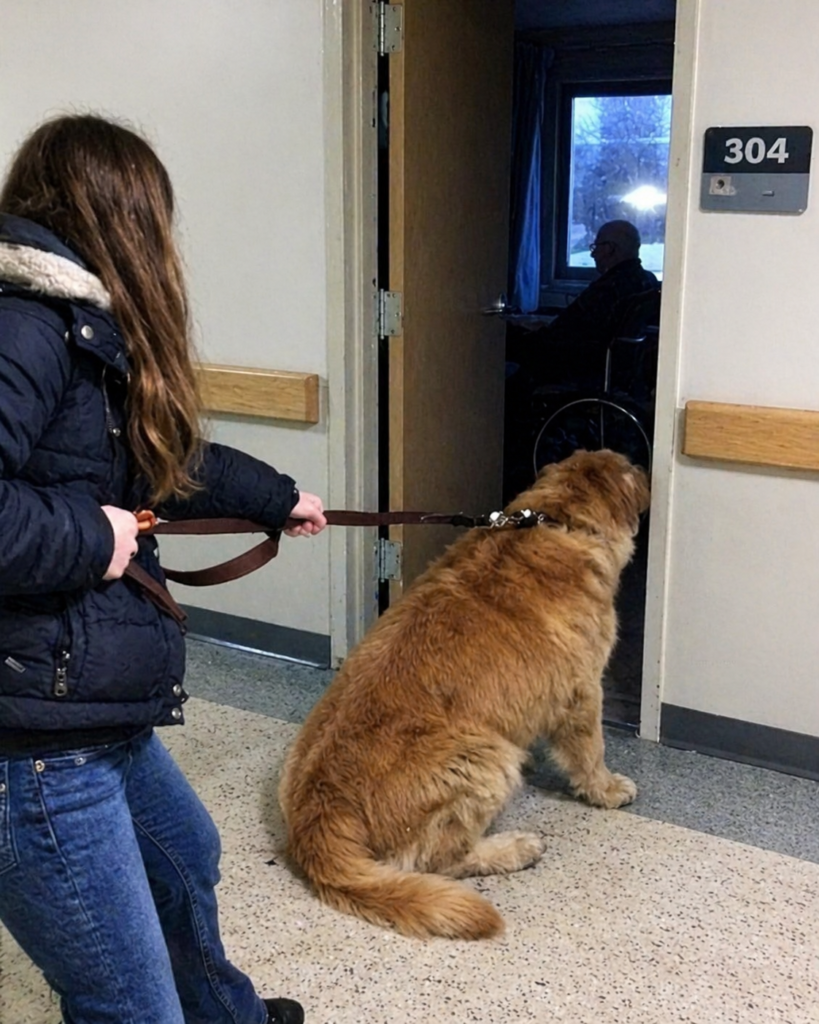
He was staring into Room 304.
The door was slightly open. Inside, sitting in a wheelchair by the window, was Mr. Miller.
The staff had already warned me about him.
“He can be difficult,” the head nurse had said gently. “He doesn’t like visitors. Last week, he tossed a cup of Jell-O toward the chaplain.”
Mr. Miller was staring out at the parking lot, watching the taillights of families leaving to go home to their warm houses.
His room was dark.
No decorations.
No cards.
No little signs that anyone was coming.
Just the steady hum of an oxygen machine filling the silence.
“Barnaby, please,” I whispered, checking my watch. “We are going to be in so much trouble.”
Barnaby ignored me.
Then he made a low, deep whine—a sound I had never heard from him before.
A moment later, he did something he was absolutely not supposed to do.
He pushed the door open with his wide, blocky head and walked straight into the room, right up to the wheelchair.
I panicked.
I rushed in after him, ready to grab his collar, apologize for the interruption, and pull my big, shedding dog away from the elderly man everyone said wanted to be left alone.
But then I froze.
Barnaby didn’t jump.
He didn’t bark.
He didn’t beg for attention.
He simply sat beside the wheelchair, rested his heavy chin gently on Mr. Miller’s knee, and let out a long, quiet sigh.
Mr. Miller didn’t shout.
He didn’t complain.
His hand, thin and trembling, slowly lifted from the armrest. Then he buried his fingers into the thick fur behind Barnaby’s ears.
“Hey, Colonel,” the old man whispered, his voice rough and tired. “You found me.”
He wasn’t talking to me.
He wasn’t even seeing Barnaby.
He was seeing someone from another time.
I looked at my phone.
7:00 PM.
“Seriously? Everyone is eating. Call me.”
Then I looked back at Mr. Miller.
He was crying.
Silent tears moved down the deep lines of his face as he scratched Barnaby’s neck with a kind of desperate tenderness, like he had just been reunited with the only friend who had ever understood him.
“I told you I’d wait for you, Colonel,” Mr. Miller whispered, closing his eyes. “I knew you wouldn’t let me be alone.”
The nurse appeared in the doorway, looking worried.
“I’m so sorry,” she said quickly. “I can take the dog—”
“No,” I said, surprising even myself. “Please leave them.”
I pulled up a plastic chair and sat beside the wheelchair.
Then I texted my husband:
“I can’t come. Start without me. I’m sorry.”
After that, I turned my phone off.
For the next two hours, the world outside that room seemed to disappear.
There was no turkey waiting on the table.
No gifts.
No family conversations.
No arguments about anything.
There was only the soft sound of Mr. Miller’s uneven breathing and the gentle thump of Barnaby’s tail against the wheelchair wheel.
Mr. Miller didn’t speak to me.
But he spoke to Barnaby.
He talked about a porch in Georgia.
He talked about a woman named Eleanor who made the best peach pie.
He talked about a time in his life that had left him with hearing loss in one ear, and about the dog who welcomed him home when the people around him didn’t know what to say.
Barnaby, my goofy, clumsy, chaotic dog who normally couldn’t sit still for thirty seconds, didn’t move a muscle.
He stayed right there.
Quiet.
Steady.
Gentle.
It was as if he understood exactly what Mr. Miller needed.
He became an anchor for a tired heart that seemed ready to let go.
Around 9:15 PM, Mr. Miller’s breathing changed.
The pauses between each breath grew longer.
His fingers gave Barnaby’s ear one final, weak squeeze.
“Good boy,” he whispered. “Let’s go home now.”
Then the room became quiet.
The nurse came in and gently checked him. A moment later, she nodded with a solemn expression.
Mr. Miller was gone.
But he didn’t spend his final moments staring at an empty wall.
He left this world with his hand resting in warm fur, believing his best friend had come back to stay with him until the end.
When Barnaby and I walked out into the freezing night air, everything inside me finally gave way.
I was exhausted.
I was three hours late.
I thought I had ruined the holiday.
I buckled Barnaby into the backseat, and he immediately fell asleep, snoring loudly as if his work was done.
I drove home dreading the confrontation.
I rehearsed my apology again and again.
I lost track of time.
It was an emergency.
I didn’t know how to explain that to people who had been waiting around a dinner table.
When I walked into my house, the guests had already left.
The kitchen was a mess of dirty plates, half-empty glasses, and cold leftovers.
My husband, Evan, was sitting at the island, scrolling through his tablet. He looked up when I came in.
I opened my mouth to beg for forgiveness, but he raised one hand gently.
“Come look at this,” he said softly.
He turned the screen toward me.
It was a photo on the community page of Oak Creek Care Center.
The nurse must have taken it from the doorway.
It was a grainy, low-light photo of Mr. Miller sitting peacefully in his chair, his hand resting on Barnaby’s head, while I sat in the shadows holding the man’s other hand.
The caption read:
“Mr. Miller passed away tonight. He had no living relatives listed in his file. But thanks to a volunteer and her amazing dog, Barnaby, he didn’t leave this world alone. Rest in peace, sir.”
I looked at my husband.
His eyes were red.
“You didn’t ruin Christmas,” he said, standing up to hug me. “You and that dog just reminded us what Christmas is actually about.”
My daughter, Mia, twelve years old and usually glued to her video games, walked into the kitchen.
She didn’t say a word.
She just walked past me, sat on the floor next to Barnaby, and wrapped her arms around his neck, burying her face in his fur.
We spend our lives trying to teach our dogs to sit, stay, and heel.
We think we are the masters.
But that night, Barnaby taught me the only command that really matters.
When someone is hurting, you don’t run away.
You don’t check the time.
You stay.
You sit.
And you love them until the very end.
Mr. Miller thought Barnaby was his old dog, Colonel, come back to guide him.
Maybe he was right.
Maybe dogs carry something with them that we don’t fully understand.
Maybe love finds its way back in whatever form it can.
Good boy, Barnaby.
Good boy.