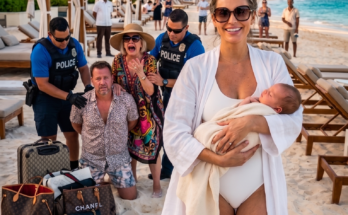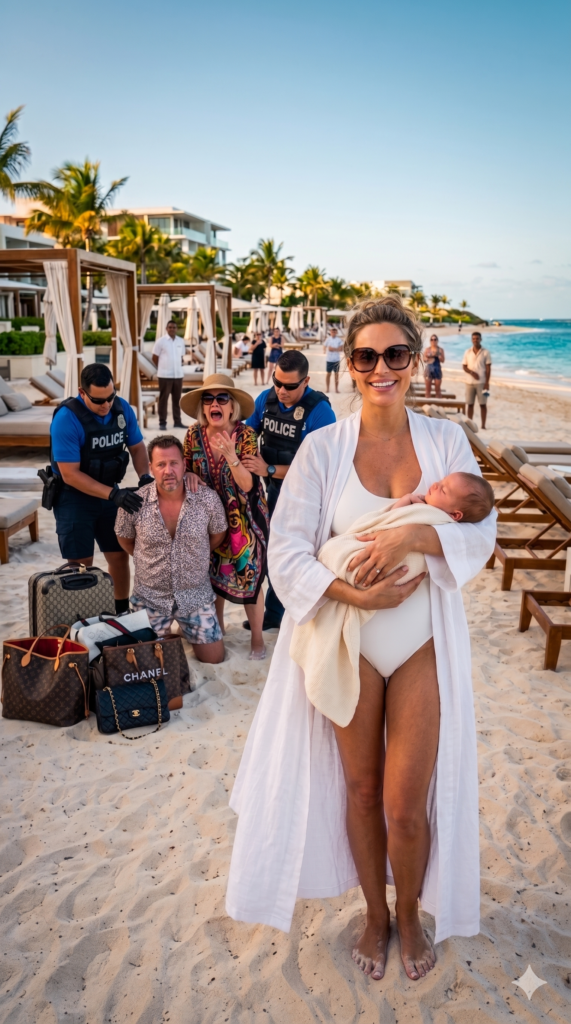
My mother-in-law looked at my 38-week pregnant belly, turned to my husband, and said, “Lock both deadbolts. Let her give birth alone.”
Then she left for a luxury Miami trip paid for with my money.
Seven days later, they came home tan, smiling, and dragging suitcases full of shopping bags… but one look at the front door told them they had crossed a line they could never uncross.
The morning my life split into a before and an after, my Houston home smelled like expensive leather, strong espresso, and departure.
In the grand foyer, designer luggage sat stacked neatly by the door. My husband, Marcos, stood near the kitchen island, nervously checking the rideshare app on his phone. His sister, Beatriz, paced the hallway, admiring her new ivory vacation handbag in the mirror.
And near the front door, holding court like she owned the house, stood Pilar—my mother-in-law.
She was complaining about airport traffic, brunch reservations, and how nothing ever happened on time.
I was thirty-eight weeks pregnant. My ankles were swollen, my back ached constantly, and since dawn, something inside me had felt wrong. Not “uncomfortable” wrong. Not “pregnancy is hard” wrong.
This was the kind of dread that sits heavy in your chest before your life changes forever.
Then the first real contraction hit.
It wasn’t the dull ache I had been feeling for days. It was sudden and powerful, a sharp wave that tore through my body and folded me in half. I dropped to my knees near the sofa, gripping the upholstery with shaking fingers.
“It’s starting,” I gasped. My voice barely sounded like my own. “Marcos. Don’t go. Please call someone.”
Marcos froze.
For one second, his eyes met mine. They were wide, frightened, and empty.
Then they moved straight to his mother.
That was the moment I understood something I had spent years trying not to see.
My husband did not look to me when I needed him.
He looked to Pilar for permission.
Pilar didn’t even put down her iced coffee.
She only sighed, as if my pain was another inconvenience added to her travel schedule.
“Do not start this today, Elena,” she said coldly. “You have been having false alarms for two weeks.”
I tried to speak, but another wave of pain stole the words from my throat.
Pilar adjusted the collar of her silk resort blouse and lifted her carry-on bag.
“We are not canceling a seven-thousand-dollar vacation because you suddenly need attention.”
Seven thousand dollars.
That number burned into my mind.
Not because the money mattered more than the birth of my child, but because Pilar had just said the quiet part out loud.
That was my value to them.
I was carrying their grandchild, on the floor, struggling to breathe through real labor, and Pilar’s mind was still on ocean-view suites, poolside drinks, and luxury shopping.
The worst part?
My salary had paid for every cent of that trip.
Then my water broke.
Warmth rushed down my legs and spread across the white marble floor.
For the first time that morning, Beatriz’s smug expression cracked. She looked scared.
I looked at Marcos, the man I had married, the man who had once promised to protect me.
“Call 911,” I begged.
He didn’t move.
He just stood there, trapped between the woman who needed him and the mother who controlled him.
It would almost have been easier if he had yelled at me. If he had shown anger, cruelty, anything clear and honest.
But the look on his face was worse.
It was the look of a weak man realizing he was making an unforgivable choice.
The heavy front door swung open.
Suitcase wheels rolled over the threshold.
Another contraction hit so hard my forehead dropped toward the cold marble.
From the porch, I heard Beatriz whisper, “Is she serious right now?”
Then Pilar’s voice cut through the air, sharp and emotionless.
“Lock both deadbolts, Marcos. Let her have the baby quietly. Do not give her the chance to follow us to the airport.”
The door shut.
Then came the first sound.
Click.
The upper deadbolt slid into place.
Then the second.
Click.
The lower lock sealed shut.
There are sounds your mind never forgets.
For me, it was the sound of brass sliding into a doorframe while I lay in active labor on the floor of my own home.
They were locking me inside.
My husband. His mother. His sister.
They were leaving me there because they didn’t want to miss a flight.
I lay on the cold marble, listening as the suitcase wheels faded down the driveway.
For a few seconds, I couldn’t move.
Pain rolled through me in waves. My breath came in broken pieces. The room spun. Above the fireplace, our wedding photo stared back at me from its frame—Marcos smiling, me glowing, both of us standing beneath flowers like we had built something sacred.
Now that photo felt like a cruel joke.
I forced myself to crawl.
The marble was slick beneath my hands. My body screamed with every inch. My oversized T-shirt was damp, my hair stuck to my face, and my fingers trembled so badly I nearly collapsed before reaching the coffee table.
My phone was there.
I grabbed it.
I dialed 911.
The dispatcher’s voice was calm at first. Routine. Professional.
Then she asked, “Can the paramedics come through the front door?”
I choked on a sob.
“No,” I whispered. “They locked both deadbolts from the outside. They took the keys.”
Everything in her voice changed.
“Stay on the line with me, honey,” she said, suddenly sharp and focused. “Fire and rescue are three minutes away. They have permission to force entry.”
I remember the sound of the back patio door breaking.
I remember boots rushing across the floor, radios crackling, voices calling out instructions.
A female paramedic knelt beside me. Her eyes were tired but kind. She pressed an oxygen mask gently over my face while her partner prepared a stretcher.
“Did the people who locked you in do anything else?” she asked softly.
At first, I almost didn’t answer.
Because how do you explain betrayal while your body is trying to bring a child into the world?
How do you explain that the people who left you on the floor were also spending your money?
“They used my credit card for their trip,” I whispered.
It sounded small compared to everything else.
But trauma remembers details in strange ways.
And that detail mattered.
My son, Leo, was born five hours later.
He came into the world beneath bright hospital lights, crying with a fierce, perfect strength that made the whole universe shrink down to his tiny chest.
When they placed him against me, warm and breathing and alive, something inside me shifted.
For one hour, there was no Pilar. No Marcos. No locked doors.
There was only my child.
Then dawn broke over the hospital skyline.
My phone chimed on the plastic tray beside the bed.
A bank alert.
$2,850 charged at a luxury boutique in Palm Beach.
I stared at the screen.
I didn’t cry.
I didn’t scream.
Something colder than anger moved through me.
Because once your husband and his family lock you inside a house during labor, fly away, and then use your money to buy luxury resort clothes before you’ve even recovered, confusion is no longer innocence.
Confusion becomes self-betrayal.
I didn’t call Marcos.
I didn’t call Pilar.
I called Sofía.
She arrived at the hospital less than forty minutes later, wearing mismatched sneakers and an old college hoodie, her dark eyes already burning with protective fury.
Sofía had known me before Marcos. Before Pilar. Before I learned to soften my voice just to survive in a family that treated cruelty as tradition.
She looked at the bruises on my arms from dragging myself across the marble. Then she looked at Leo sleeping in the bassinet.
She leaned down and kissed my forehead.
“Tell me what we’re taking apart,” she whispered.
For the first time in twenty-four hours, my voice came out steady.
“I need the vault.”
Long before I met Marcos, before the ring, before the wedding, before I tried to turn his family into mine, I had bought that house in my own name.
It was mine.
Free and clear.
No mortgage. No co-owner. No hidden claim.
Years earlier, when Pilar started calling it “our family estate” with a smug little smile, a quiet instinct pushed me to protect myself. I signed a limited durable power of attorney naming Sofía as my only agent if I was ever hospitalized.
I never told Marcos.
Now, lying in a hospital bed with my newborn son beside me, I finally understood why my instincts had been screaming for years.
I scrolled past Marcos’s messages.
Not one asked if I was safe.
Not one asked if the baby had been born.
They were complaints about the Florida heat, the hotel check-in, and his mother being “upset.”
I called Allison Reed, a real estate and family law attorney.
Her voice was calm in a way that made me feel less afraid.
I told her everything.
The contractions. The deadbolts. The 911 call. The fire department breaking in. The credit card charges.
She was silent for three seconds.
Then she asked, “Is Marcos on the deed?”
“No.”
“Is there proof of what happened?”
“Yes,” I said. “911 recordings. Fire department reports. Front porch cameras.”
Her answer was quiet and sharp.
“Good. Do not answer his calls. We are going to handle this correctly.”
Just as she hung up, my phone buzzed again.
This time, it wasn’t the bank.
It was a motion alert from my front porch camera.
Someone was standing at my broken front door.
Holding a crowbar.