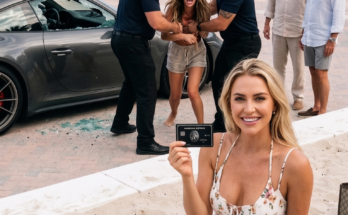
48 hours later, Mia was living inside the fantasy she had always wanted.
From a burner phone, I watched her public social media accounts fill with videos and photos.
Mia behind the wheel of the matte-black Range Rover.
Mia posing beside the car with sunglasses on.
Mia taking our parents to expensive dinners.
Mia writing captions about “manifesting success” and “finally stepping into luxury.”
She truly believed she had found a bottomless source of money.
She believed I had been hiding wealth from her.
She believed the card was hers now because she wanted it badly enough.
What she did not know was that every swipe, every signature, every camera angle, every social media post, and every public brag had become part of a growing file.
And that file was no longer in my hands alone.
It was inside Sterling Enterprises.
Fifty floors above downtown Los Angeles, I stood inside the glass-walled executive boardroom of Victor Sterling’s private tower.
I was not wearing my oversized basement cardigan anymore.
Victor’s personal concierge had delivered a tailored charcoal suit, polished shoes, and a new phone linked directly to the company’s secure network.
For the first time in days, I looked like the woman I had always been when my family was not looking.
Capable.
Focused.
Untouchable.
Victor Sterling stood beside me, silent and still, staring at a wall-sized digital map.
A red dot blinked on Rodeo Drive.
Mia.
“She has been very active today,” Victor said.
“She believes the card has no limit,” I replied.
“Because it does not,” Victor said. “But access and ownership are very different things.”
His head of cybersecurity brought the dealership paperwork onto the screen.
The documents were clean, official, and damning.
Mia had not simply used the card for a small purchase.
She had paid for the vehicle in full.
Because the card was tied to a high-level Sterling corporate account, the dealership had processed it without the usual delays. But to complete the purchase and release the vehicle, Mia had signed a digital contract.
On the signature line was my name.
Or at least, Mia’s sloppy attempt at it.
Chloe Sterling.
I stared at the screen.
She had not even known enough to forge the right name.
She had assumed the card belonged to me because I had it. She had assumed she could take it, use it, sign for it, and walk away.
Victor’s expression did not change.
“She signed a commercial document tied to a protected corporate banking network,” he said. “That makes this larger than a family argument.”
I nodded.
“If I had called local police immediately, they might have treated it like a household dispute. She would have cried. My parents would have defended her. Everyone would have said it was a misunderstanding.”
“And now?” Victor asked.
“Now there are documents. Purchases. Video records. Digital signatures. Banking records. Public posts. She made the truth impossible to deny.”
For a moment, Victor simply looked at me.
“You gave them a chance to choose correctly,” he said.
“I did,” I answered. “They told me to leave.”
The red dot stopped moving.
“She is inside Maison de Luxe,” the cybersecurity chief reported. “High-end boutique. Your mother is with her.”
Victor turned toward me.
“Then we will let the system finish what she started.”
Across town, Mia was at the boutique counter, enjoying what she thought was the finest moment of her life.
She had placed several designer handbags, silk scarves, and a pair of expensive sunglasses on the glass counter.
My mother stood beside her, sipping complimentary champagne, glowing with pride.
“I’ll take everything,” Mia announced loudly, clearly hoping nearby shoppers would hear.
She pulled out the heavy black card and placed it on the counter with a confident smile.
The sales associate picked it up.
The first attempt did not go through.
The second attempt made the terminal flash red.
Mia frowned.
“Your machine is broken,” she snapped. “That card has no limit.”
The cashier looked at the screen.
Her face changed.
The message did not say declined.
It said the card was a flagged corporate asset and should not be returned to the customer.
The cashier stepped back.
“I’m sorry, ma’am,” she said carefully. “I need to call my manager.”
Mia reached for the card.
“Give it back.”
The cashier moved farther away.
“I can’t do that.”
Mia’s face twisted with humiliation.
“Do you know who I am? That is my card.”
My mother touched her arm.
“Mia, maybe we should leave.”
But Mia was too deep in her own pride to hear reason.
“No. I’m not letting some store clerk embarrass me.”
People began to stare.
Not with admiration this time.
With concern.
The manager arrived. Security followed.
Mia’s voice grew louder.
My mother’s smile disappeared.
Finally, furious and embarrassed, Mia grabbed her bag.
“Forget this place,” she said. “I’ll call the bank from the car and have this fixed.”
She stormed out of the boutique, with my mother hurrying behind her.
The Range Rover was parked at the curb near the valet stand.
Mia got inside and slammed the door.
My mother slid into the passenger seat, pale and trembling.
Mia pressed the start button.
The engine came to life.
Then the center screen went black.
A silver wolf logo appeared.
Sterling Enterprises.
The door locks clicked at the same time.
Mia pulled the handle.
Nothing.
She pressed the unlock button.
Nothing happened.
“What is wrong with this car?” she muttered.
Then three black SUVs pulled into position around the vehicle, blocking it from the front, the back, and the side.
Men and women in dark windbreakers stepped out with official badges from the Financial Crimes Division.
My mother whispered, “Mia… what did you do?”
Mia’s face drained of color.
Back inside Sterling Tower, Victor adjusted the cuffs of his suit.
“The vehicle is secured,” he said. “Shall we retrieve my property?”
I looked at the red dot on the map.
Then I nodded.
“Yes.”
We took Victor’s private elevator down to the secured garage and stepped into the back of an armored Mercedes Maybach.
The drive to Beverly Hills was quiet.
I did not feel happy.
I did not feel nervous.
I felt the strange calm of a person who had spent years being blamed for problems she did not create, finally watching the truth arrive without needing to shout.
When we reached Rodeo Drive, the street had been partly blocked off.
A small crowd had gathered.
Phones were raised.
People whispered.
The matte-black Range Rover sat trapped at the curb.
Inside, Mia was crying and pounding on the window.
My mother sat frozen in the passenger seat, clutching her purse like it could protect her.
My father had arrived too, probably after a panicked call from my mother.
He was on the sidewalk shouting at the agents.
“Let my daughter out! This is a mistake! We’ll sue all of you!”
Then Victor’s door opened.
His head of security stepped out first, clearing the path.
Victor followed.
The street seemed to quiet around him.
He did not need to raise his voice. He did not need to prove anything. Power has a way of speaking before words are even said.
Then I stepped out of the car.
My father turned.
His mouth opened, but no sound came out.
Through the window of the Range Rover, my mother saw me and froze.
Mia stopped crying for one second.
The look on her face was not anger anymore.
It was confusion.
Then fear.
“Chloe?” my mother called through the small opening agents had allowed in the window. “Thank God. Tell them this is a misunderstanding. Tell them to let your sister go.”
I walked forward slowly.
My heels clicked against the pavement.
I stopped a few feet away from my father.
He stared at my suit. At the security around me. At Victor standing beside me.
For the first time in my life, my father looked at me as if he was wondering who I really was.
Victor turned to him.
“Your daughter did not simply buy a car,” Victor said. “She used a corporate asset belonging to Sterling Enterprises. The card she used belongs to my company.”
My father’s face went pale.
“No,” he whispered. “Chloe said…”
“I told you she took it,” I said quietly. “I told you there would be consequences. You called me a liar.”
My mother reached one hand through the window opening.
“Chloe, please. She didn’t understand. She’s your sister. We’re family.”
That word landed strangely.
Family.
For years, they had used that word when they wanted something from me.
Never when I needed protection.
Never when I needed fairness.
Never when I needed love.
Victor looked at my mother.
“The dealership contract includes a forged signature,” he said. “The transaction moved through corporate banking systems. There are digital records, surveillance records, and purchase documents. This is not a simple misunderstanding.”
Mia began crying again.
“I didn’t know! I thought it was Chloe’s! I thought she was hiding money!”
I looked at her.
“You thought stealing was acceptable as long as you believed the person you stole from was me.”
My father’s knees seemed to weaken.
“Chloe,” he said, his voice breaking. “Please. You can stop this. Tell him to let it go. We’ll pay it back. We’ll sell the house. Please. She’s your blood.”
I looked at the man who had thrown me out of his house.
I looked at the woman who had called me a leech.
I looked at the sister who had stolen from me, mocked me, and tried to build her dream life on something she had no right to touch.
Then I leaned slightly toward my father.
“You told me to stand on my own two feet,” I said. “So I did. And the first thing I did was stop protecting people who never protected me.”
I stepped back.
The lead agent moved forward.
The doors were opened under official supervision, and Mia was carefully removed from the vehicle.
Her designer sunglasses fell onto the pavement.
No one picked them up.
The agents placed her in custody while she cried for our parents to help her.
But for once, my parents could do nothing.
My mother covered her face and sobbed.
My father stood frozen, staring at me like he had finally realized the daughter he discarded had been the only person in that house who understood consequences.
I turned away.
I did not look back as I returned to the Maybach.
The door closed behind me, sealing out the noise.
Six months later, Mia stood in a federal courtroom.
She no longer looked like the polished influencer from her photos.
Her designer clothes were gone.
Her confidence was gone.
Her carefully crafted image had collapsed under the weight of evidence she had created herself.
The Sterling legal team presented everything.
The dealership contract.
The forged signature.
The boutique footage.
The card records.
The social media posts where she bragged about the car and the lifestyle she had funded with stolen access.
Mia cried through most of the hearing.
My parents sat behind her, silent and hollow.
They had drained their retirement savings trying to defend her. They had hired expensive attorneys. They had begged, argued, and blamed everyone but Mia.
None of it changed the facts.
The judge sentenced Mia to five years in a federal correctional facility.
When the sentence was read, my mother made a sound like the world had disappeared beneath her.
My father covered his face.
Mia wept as she was led away.
I watched without smiling.
This was not victory in the way people imagine it.
It was not sweet.
It was not thrilling.
It was simply the ending they had written for themselves.
The damage did not stop there.
Victor Sterling’s civil attorneys filed claims related to the compromised corporate asset, the forged documents, and the harm caused by my family’s actions.
My parents were forced to sell what little they had left.
The house I had grown up in—the house they had thrown me out of—was lost.
The basement where they had called me useless became someone else’s storage room.
The dining table where they had mocked me was sold.
The driveway where they had celebrated Mia’s stolen car sat empty.
And I moved forward.
Victor promoted me to Vice President of Global Operations for Sterling Enterprises.
He did not do it out of pity.
Victor did not believe in pity.
He did it because I had handled a crisis with discipline, restraint, and precision.
He did it because I had proven what I had always known about myself.
I was never useless.
I had simply been surrounded by people who benefited from making me feel small.
My signing bonus was a two-story penthouse overlooking the Pacific Ocean.
The first morning I woke there, sunlight spilled across the marble floors. The air smelled like salt and clean linen. The windows stretched from floor to ceiling, and beyond them, the ocean moved endlessly under a bright sky.
For a long time, I stood on the balcony and breathed.
No shouting from upstairs.
No insults at dinner.
No footsteps outside my door.
No one demanding money while calling me a burden.
Just silence.
Peace.
Freedom.
A few weeks after the sentencing, my assistant Elena brought me a stack of forwarded letters from my old P.O. box.
They were from my mother.
Her handwriting was shaky and frantic.
PLEASE.
WE NEED YOU.
FORGIVE US.
YOUR FATHER IS SICK WITH REGRET.
WE LOST EVERYTHING.
I stared at the envelopes for a long moment.
I waited for anger.
I waited for guilt.
I waited for the old ache that used to make me want their approval.
But nothing came.
The emotional cord had been cut the day they celebrated while I walked away with one bag.
I thanked Elena and carried the letters into the living room.
A sleek gas fireplace was built into the marble wall.
I turned it on.
Blue flames rose behind the glass.
Without opening a single envelope, I placed the stack inside and watched the paper curl and darken.
I was not destroying evidence.
I was not punishing them.
I was releasing the last pieces of a life that had only ever asked me to shrink.
As the letters turned to ash, my encrypted phone rang.
Victor.
He was calling about a new international acquisition in London.
I looked once at the fireplace.
Then I answered.
Two years later, on a rainy afternoon in late November, I was driving through the city in my own car—a slate-grey Aston Martin DBS I had purchased with my own money.
The engine hummed beneath me as the windshield wipers moved steadily across the glass.
I was on my way to Sterling Tower for an emergency board meeting.
Victor had decided to step back into an advisory role.
That day, I was expected to be named managing partner.
The traffic light ahead turned red, and I eased the car to a smooth stop.
Rain made the street shine.
Neon signs reflected in the wet pavement.
I glanced toward the bus stop on the corner.
Two people stood under a broken black umbrella.
Their raincoats were worn.
Plastic grocery bags hung from their hands.
Their shoulders were bent under more than just the weather.
It was my parents.
They looked older than they should have.
Smaller.
Defeated.
Mia was still serving her sentence, and the daughter they had once worshipped could no longer rescue them from the life they had chosen.
They had lost the house.
They had lost their savings.
They had lost their certainty that cruelty came without cost.
For one brief second, my mother looked up.
Her eyes landed on the Aston Martin.
She stared at it with the same awe she once had for Mia’s stolen Range Rover.
But she could not see me.
The tinted glass kept my face hidden.
To her, I was only a stranger in a beautiful car.
A symbol of the life she had once believed Mia deserved.
A life she never imagined belonged to the daughter she had thrown away.
I watched them quietly.
I felt no rage.
No pity.
No longing.
They were no longer the center of my pain.
They were simply two people standing in the rain, living inside the results of their own choices.
The light turned green.
I pressed the accelerator.
The Aston Martin moved forward, smooth and powerful, leaving the bus stop behind.
For the first time, I smiled without bitterness.
“I finally learned how to stand on my own two feet,” I whispered.
And as the city opened in front of me, bright and limitless, I left the shadows of my past in the rearview mirror.
The view from the top was not beautiful because I had more money.
It was beautiful because I was free.
And I had built that freedom with my own two hands.