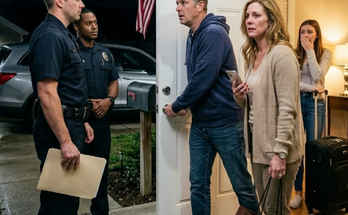
Brandon was charged with child endangerment.
At first, he called it a misunderstanding.
Then he claimed a neighbor was checking on Liam.
The neighbor denied it.
He said Liam begged to stay behind.
Liam denied it.
He said I knew.
His messages proved otherwise.
He insisted there was plenty of food.
Police photographs showed what was actually there.
Then phone records revealed something especially cruel.
Brandon had not called Liam once during those six days.
Liam had contacted him.
On the first night:
Can you tell Mom goodnight for me?
Brandon:
She doesn’t need extra problems right now.
The next evening:
Can I call Mom?
No.
The third:
I’m scared because somebody knocked.
Stay quiet.
The fourth:
I think the milk is bad.
Drink water.
The fifth:
When are you coming home?
Soon.
Then Brandon added:
Please don’t tell Mom. If she finds out you couldn’t handle a few days alone, she’ll think you’re still a baby.
I could barely finish reading.
The divorce petition was filed Monday.
Within days, Brandon was telling everyone I was destroying a marriage over “one bad parenting decision.”
His sister called.
“You’re divorcing him over one mistake?”
I hung up.
A friend wrote:
Families forgive mistakes.
Blocked.
Then Brandon messaged:
You’re turning my children against me.
I replied once.
You did that yourself.
For Liam, the hardest question was not whether Brandon had done something wrong.
It was why.
Children search themselves for explanations when adults treat them badly.
Maybe I talk too much.
Maybe I’m annoying.
Maybe I’m not fun.
Maybe I ruin vacations.
One evening, I found Liam sitting beside the refrigerator.
“Did Lucas really want me there?”
“Yes.”
“How do you know?”
“He told me.”
“Alyssa too?”
“Yes.”
Then:
“Why did Brandon hate me?”
My heart broke.
“I don’t know if he hated you.”
“He didn’t take me.”
“That means he failed you.”
“Same thing.”
“No.”
I turned his face toward me.
“A bad person can treat a good person badly. That doesn’t make the good person the reason.”
But I began asking the same question.
Why Liam?
Why the elaborate lies?
If Brandon simply wanted a trip with his biological children, he could have told me.
He could have arranged a sitter.
Neighbor.
Relative.
Anyone.
Instead, he intentionally isolated an eight-year-old and warned him not to seek help.
That was not laziness.
It was intention.
And intention usually has a reason.
The first clue came from Brandon’s ex-wife.
Claire Dawson walked into Erin’s office carrying a thick folder.
According to Brandon, Claire had moved to Arizona and barely cared about Lucas or Alyssa.
“I live in Cincinnati,” she told me.
Ninety minutes away.
“I’ve lived there for seven years.”
She opened her folder.
Birthday cards.
Certified letters.
Court motions.
Visitation requests.
Emails.
Photographs.
Years of attempts to see her children.
“I sent something every birthday and Christmas.”
“Brandon said you abandoned them.”
Claire closed her eyes.
“Of course he did.”
“What did he tell the children?”
“That I chose a boyfriend over them.”
“Did you?”
“There was never a boyfriend.”
Then Claire said something that explained San Diego perfectly.
“Rachel, Brandon creates different realities for different people and keeps them separated so nobody can compare notes.”
To me:
Liam is with Brandon.
To Lucas and Alyssa:
Liam is with Rachel.
To Liam:
Lucas and Alyssa don’t want you.
Three realities.
One liar.
Claire had been fighting for access to her children for years.
Two weeks before the San Diego trip, she filed another custody motion.
Brandon learned about it on May 23.
The day before my mother died.
Two days after her death, he canceled Liam’s ticket.
Then took Lucas and Alyssa across the country.
But San Diego contained another secret.
Brandon had changed the hotel shortly before departure.
He also made several cash withdrawals.
When Erin examined the source, my stomach turned.
The money had come from Liam’s custodial investment account.
After Daniel died, part of his life-insurance settlement had been placed there for Liam.
College.
Medical expenses.
His future.
There should have been approximately $640,000.
The balance was barely over $511,000.
More than $100,000 was missing.
Transfers.
Withdrawals.
Payments.
All supposedly authorized by:
Rachel Mercer.
My signature appeared on the paperwork.
It looked close.
But it wasn’t mine.
“My husband forged this.”
Erin stopped me.
“We let a forensic examiner establish that.”
Investigators later found copies of my identification on Brandon’s laptop.
Daniel’s death certificate.
Liam’s birth certificate.
Trust paperwork.
And a draft titled:
PETITION FOR SUCCESSOR CUSTODIAN.
It claimed I had become emotionally unstable after my mother’s death.
It described Brandon as Liam’s primary day-to-day caregiver.
The man who left him alone for six days intended to create a record claiming he had been caring for him.
That was why he could not risk anyone discovering the truth.
Privately, he abandoned Liam.
Legally, he intended to use those same days as evidence that I was absent and he was acting as the responsible parent.
Liam had not been forgotten.
He had been turned into evidence Brandon believed he could manufacture.
But there was another question.
How had Brandon become so interested in Daniel’s life-insurance money?
I had barely discussed it before our marriage.
Then my late mother answered from beyond the grave.
Her attorney found an envelope in a locked drawer.
On it:
FOR RACHEL ONLY.
IF I AM WRONG, BURN THIS AND FORGIVE ME.
IF I AM RIGHT, DO NOT CONFRONT HIM ALONE.
Inside was a letter.
Mom had become suspicious months earlier because Brandon knew information about Daniel’s life-insurance settlement she did not remember me sharing.
So she hired a retired investigator.
Behind the letter was an old photograph of Brandon.
Standing outside:
HARTWELL LIFE & CASUALTY.
The company that issued Daniel’s life-insurance policy.
Brandon had once worked there.
Not merely in “commercial insurance,” as he told me.
He had worked in claims review.
After Daniel died, Brandon accessed Daniel’s policy file multiple times without being assigned to the claim.
That file contained my name.
Address.
Dependent information.
Settlement amount.
And Liam’s beneficiary records.
Then came the employment record.
Brandon had been fired from Hartwell for unauthorized access to private client files.
Three files.
Daniel’s was one.
Another belonged to an elderly widower.
The third belonged to a recently divorced woman.
Two of those three households were later personally approached by Brandon.
One was mine.
The other—
was Claire’s.
Her brother had died in a construction accident.
Hartwell insured him.
He left Claire money.
Six months later, she met Brandon at a grief-related fundraiser.
Exactly the same kind of “coincidence” through which I later met him.
Claire began crying.
“He found me too.”
We both understood.
Brandon had not accidentally married two women connected to significant insurance proceeds.
He had selected us.
People were not relationships to Brandon.
They were files.
Balances.
Opportunities.
My mother’s final warning said:
Brandon did not marry you because fate brought him to you.
He came looking.