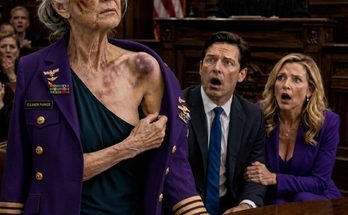
When the paramedics entered, Daniel immediately began talking.
He told them I had been exhausted.
That I had been stressed.
That perhaps I had confused one of my medications.
He suggested Noah might simply have reacted badly to the meal after seeing me collapse.
Every sentence sounded reasonable when heard alone.
That was what made his explanation dangerous.
I interrupted once.
“Same dinner.”
Everyone looked toward me.
“Same time.”
Then I said:
“Test both of us.”
At the hospital, Noah remained beside me.
I watched him constantly.
Every few minutes, I checked his face.
His hands.
His breathing.
Daniel continued behaving like a frightened husband.
A concerned father.
Someone who had nearly lost his family and had no idea why.
Then the first screening results returned.
Both Noah and I had a sedating substance in our systems.
Neither of us had been prescribed it.
Daniel’s version of the evening suddenly had a serious problem.
A police officer stood near the doorway.
A nurse asked what we had eaten.
Daniel’s eyes moved toward me.
That was when I reached beneath my shirt.
I pulled out the sealed freezer bag.
“This.”
The nurse took it with gloved hands.
Daniel stopped talking.
The food he thought had disappeared from the kitchen was still there.
The investigators did not need another explanation.
They had something that could be examined.
Something preserved before Daniel returned.
Something he did not know existed.
The kitchen became central to the investigation.
Detectives documented where everything had been.
The table.
The freezer drawer.
The old telephone.
The route Daniel had taken after returning.
And the blue plate he had removed.
That plate was no longer simply part of dinner.
It became part of a timeline.
Daniel had returned to the house.
Ignored two supposedly unconscious family members.
Removed the plate.
Placed it into a trash bag.
Then told someone he had “cleaned everything up.”
Those actions mattered.
So did the food I had preserved.
Investigators also examined the difference between what Daniel had done and what he later claimed.
He insisted he had returned because he was worried about us.
But he had not checked us first.
He had gone to the table.
He said he believed I might have mixed up medication.
But both Noah and I had the same unexpected substance in our systems.
He said the dinner itself was ordinary.
But then why remove the plate?
Every answer created another question.
Noah and I spent several days away from home afterward.
The silence felt strange.
He kept asking:
“Are we going back?”
I did not immediately know how to answer.
A house can remain physically unchanged after something terrible happens.
The walls stay where they were.
The furniture remains.
The cups are still inside the cupboards.
But every object acquires another meaning.
The old corded phone was no longer outdated clutter.
It was how we reached help after Daniel removed our mobile phones.
The freezer was no longer just where I kept vegetables and leftovers.
It had hidden the evidence Daniel failed to find.
And the blue plate was no longer simply one of our dinner dishes.
It became the object connecting the entire evening.
Daniel’s plan depended upon control.
He controlled the meal.
He took our phones.
He tried to control what remained afterward.
Then, at the hospital, he tried to control the explanation.
But he had not controlled everything.
He had not controlled whether I could still hear.
He had not controlled Noah opening his eyes.
He had not remembered the old telephone.
And he had not checked the freezer.
Sometimes a plan collapses because of one enormous mistake.
Sometimes it collapses because of something tiny.
A blue plate.
A freezer bag.
A telephone everyone had forgotten.