On the morning of her twenty-fourth birthday, Elena Marlowe was on her knees in the kitchen, wiping coffee from the tile floor while her cousin Vanessa complained about the catering trays.
“Be careful with those,” Vanessa called from the dining room without even looking in her direction. “They cost more than the cheap dishes you’re used to.”
Elena pressed the rag harder into the grout and said nothing.
It was ten-thirty in the morning, and the Marlowe house was already full of movement. Fresh flowers lined the entry table. A bakery box with ivory frosting sat open on the island. Two housekeepers had been sent away early because Vanessa had said there was “no sense paying staff when Elena is already here.”
The words had been tossed out lightly, as if they were obvious, harmless, even efficient.
No one had corrected her.
No one ever did.
The house itself stood on a rise above the river, all pale stone and black shutters, the kind of old-money home that looked calm from the outside and tense from the inside. Elena had lived there since she was twelve. Long enough to know which stair creaked, which cabinet door stuck in humid weather, and which relatives would smile with their mouths while insulting her with their eyes.
She wrung the rag into the sink and reached for another towel.
“Did you hear me?” Vanessa asked.
“Yes,” Elena said quietly.
Vanessa stepped into the kitchen in a silk blouse the color of champagne, her dark hair pulled into a low, polished knot. She looked like she had stepped out of a magazine spread on effortless wealth. “Then move the appetizers to the sunroom before Aunt Lydia gets here. And change into something decent. You look like you sleep in those clothes.”
Elena glanced down at her pale blue button-up and dark slacks. They were clean, simple, and pressed. But compared to Vanessa’s tailored wardrobe, they probably did look plain.
“I will,” Elena said.
Vanessa gave a satisfied nod. “Good.”
She turned and left, already speaking into her phone.
Elena stood alone for a moment, one hand resting on the edge of the sink. The kitchen was warm from the ovens, and the scent of rosemary and butter hung thick in the air. Outside the window, she could see the side lawn where a row of white chairs had been arranged for the luncheon. Her birthday luncheon, at least in theory. But no one had asked her what kind of cake she liked. No one had asked where she wanted to sit or whether she wanted a celebration at all.
Every year, her birthday became an excuse for the family to gather, perform affection, and remind her of her place.
A place that always seemed to be somewhere between obligation and embarrassment.
Her phone buzzed on the counter. She dried her hand and picked it up.
One message.
Happy birthday. Eat something before they work you to death. —Maya
Elena smiled in spite of herself. Maya worked at the downtown library and had been her closest friend since high school. She was one of the only people who noticed the difference between Elena being “quiet” and Elena being hurt.
Elena typed back: Trying. Come rescue me.
Her phone buzzed immediately.
Wish I could. You still coming by tonight?
Elena stared at the message for a second before slipping the phone into her pocket.
If tonight went the way most family gatherings did, she would arrive at Maya’s apartment drained, polite, and trying not to cry over tea she pretended was too hot to drink.
She lifted the appetizer trays and carried them toward the sunroom.
Voices drifted from the front hall. Her aunt Lydia had arrived first, announcing herself with that particular bright tone that meant she had already formed three judgments before taking off her gloves.
“Elena,” Lydia called the second she saw her. “There you are. Be a dear and take my coat.”
Elena shifted the tray to one hand and took the coat.
Lydia barely waited before continuing. “And someone should bring my bag to the sitting room. It’s heavy.”
“Of course,” Elena said.
Lydia’s eyes flicked over her. “Still wearing flats?” she asked, as if this were a moral failing. “Honestly, Daniel let you grow up with no sense of presentation at all.”
Daniel.
Not Grandfather. Not Uncle Daniel. Just Daniel, when Lydia was annoyed.
To Elena, he had always been Grandpa Daniel, even though the family often corrected her with a thin smile and reminders that “not everything has to be sentimental.”
He was eighty-two now and moved more slowly than he used to, but he still kept an office on the first floor. He still read financial newspapers every morning with a fountain pen in hand, circling lines and jotting notes in the margins. And he still looked at Elena as if she were not invisible.
That alone made him different from everyone else in the house.
By noon the family had arrived in full.
Her father’s older sister, Lydia, with her taste for sharp comments disguised as etiquette.
Her son, Marcus, who had failed in three businesses but still carried himself like a future chairman.
Vanessa, Lydia’s daughter, who treated every room like a stage.
Her uncle Thomas, Daniel’s younger son, always red-faced and impatient, smelling faintly of expensive cologne and stress.
Thomas’s wife, Celeste, delicate and watchful, the kind of woman who said very little but missed nothing.
And then there was Richard.
Elena’s father.
He arrived late, as he often did, wearing a navy suit and the tired expression of a man who had once wanted to be better but had taken the easier road too many times. Richard lived in a condo across the city now. He had moved out years earlier after one argument too many with Daniel and had never really moved back into anyone’s life.
He kissed the air beside Lydia’s cheek, shook Thomas’s hand, and looked at Elena only after everyone else had been greeted.
“Happy birthday,” he said.
She waited for more. There was nothing.
“Thank you,” she said.
He handed her a department store gift bag that was obviously bought on the way. The tissue paper was crooked.
Vanessa noticed and laughed softly. “At least you remembered this year.”
Richard’s mouth tightened. “I’m here, aren’t I?”
Elena placed the bag on a side table without opening it.
By one-thirty, the family sat around the long table in the dining room while Elena moved around them, serving plates and refilling water glasses. She had not chosen to do it. It had simply happened the way it always did: someone forgot the serving spoon, someone needed iced tea, someone said Elena knew where everything was, and the next thing she knew she was standing instead of sitting.
Daniel sat at the head of the table.
His white hair was combed back neatly. His face had thinned over the years, but his eyes remained sharp, pale, and clear. He watched her carry a platter from the kitchen and set it down beside Thomas.
“You haven’t eaten,” he said.
The table quieted for half a second.
“I’m fine,” Elena said.
“No,” Daniel said, more firmly this time. “Sit down. Eat while the food is hot.”
Vanessa smiled into her wineglass. “Oh, she doesn’t mind helping.”
Daniel turned his head slowly toward her.
“I was not speaking to you.”
The room froze.
Vanessa flushed. Thomas cleared his throat. Lydia rearranged her napkin.
Elena lowered herself into the empty chair near the end of the table, pulse unsteady. She was not used to being defended publicly. Not here. Not where every kindness toward her seemed to irritate someone.
Daniel resumed eating. Conversation returned, though more carefully now.
Still, the damage was done. Elena could feel Lydia’s annoyance from across the table.
By dessert, talk had shifted—as it often did when Daniel was present—from family gossip to business. Marlowe Holdings, the company Daniel had built over forty years, had expanded from a regional supply firm into a national logistics network. Warehouses, freight lines, real estate, investments. The sort of fortune that turned people strange long before anyone died.
Marcus leaned back in his chair. “If the board approves the restructuring next quarter, we should think seriously about moving the eastern offices.”
Thomas snorted. “You say ‘we’ like you’ve done anything that lasted more than six months.”
Marcus smiled coldly. “I’ve done enough to know dead weight when I see it.”
“Boys,” Lydia warned.
Daniel set down his fork.
“Neither of you,” he said, “has earned the right to argue as though this company belongs to you.”
Silence again.
Thomas gave a humorless laugh. “Then who does it belong to?”
Daniel dabbed his mouth with his napkin. “To the person capable of preserving it.”
No one answered.
Elena looked down at her plate.
She knew better than to enter these conversations. She wasn’t asked, and on the rare occasions Daniel invited her opinion in private, she kept it modest. But she had spent the last two years quietly helping him organize foundation records, personal correspondence, archived contracts, and the charitable side of the company’s history. She knew far more than the family assumed.
Enough to understand that Daniel no longer trusted his children with what he had built.
After cake, guests drifted into smaller groups. Lydia and Celeste took coffee on the back terrace. Marcus cornered Thomas near the study and continued their low, bitter argument. Vanessa scrolled through messages while taking photos of the flowers. Richard disappeared for twenty minutes and came back smelling faintly of whiskey.
Elena gathered plates in the kitchen until she felt a presence at the doorway.
Daniel stood there, one hand on his cane.
“Leave that,” he said.
“There’s still cleanup.”
“It can wait.”
She dried her hands and followed him into his office.
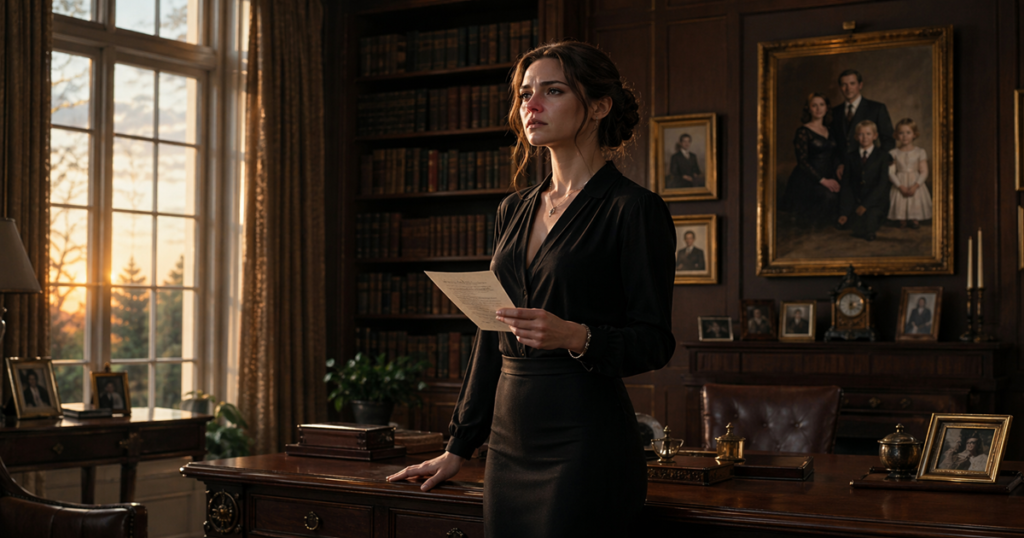
The room smelled of old books, cedar polish, and the faint medicinal scent of the lozenges he kept in a crystal dish. Tall shelves lined the walls. Two windows overlooked the side garden. His desk, massive and dark, was so organized that even the stacks of paper looked intentional.
He lowered himself carefully into his chair and gestured for her to sit.
“You’re angry,” he said.
She almost laughed. “That’s a strong word.”
“It’s an accurate one.”
Elena folded her hands in her lap. “I’m fine.”
Daniel’s expression softened, but only slightly. “You’ve been saying that since you were twelve.”
That knocked something loose in her chest.
She looked away, toward the window. The garden beyond it shimmered in late afternoon sunlight.
“I don’t know what you want me to say.”
“The truth.”
The truth.
The truth was that she was tired.
Tired of being useful but not valued.
Tired of being spoken to as if gratitude should replace dignity.
Tired of birthdays that made her feel less loved instead of more.
“The truth,” she said at last, “is that I don’t know why I stay.”
Daniel studied her face.
“Yes,” he said quietly. “You do.”
She swallowed.
Because this house, for all its coldness, still held the only pieces of her mother she had left.
Because Daniel had made sure she never felt completely abandoned.
Because leaving with no degree, little savings, and no real sense of where she belonged had once felt more frightening than staying.
Because some part of her still believed that if she endured long enough, the family might someday see her as more than the girl who took up space at the edge of their lives.
He opened the top drawer of his desk and took out a small velvet box.
Elena frowned. “What is that?”
“A birthday present,” he said.
He pushed it across the desk.
Inside lay a key.
Old-fashioned, brass, with a round head engraved with a tiny M.
“What does it open?” she asked.
“You’ll know when the time comes.”
She looked up. “That sounds ominous.”
“It is practical,” he said. “Which people often mistake for ominous.”
Despite everything, she smiled.
He watched that smile like it mattered.
“Elena,” he said, voice lower now, “if there comes a day when people say cruel things in the name of truth, remember this: blood reveals very little about character.”
Something about the way he said it made her uneasy.
“Why are you talking like this?”
“Because I’m old,” he said. “And because I have wasted enough time hoping other people will become what they should have been long ago.”
She wanted to ask what he meant. She wanted to ask whether he was sick again, whether the recent fatigue was more than age, whether she should call his doctor and not his assistant. But he had the particular look he wore when he had decided a conversation was over.
He stood, more slowly this time.
“Now go enjoy the last hour of your birthday,” he said.
She rose too. “That’s generous, considering I’m still expected to clean after it.”
He almost smiled. “Then disappoint them.”
She tucked the key into her pocket and left the office.
Two weeks later, Daniel Marlowe was dead.
It happened on a Thursday just after dawn.
A housekeeper found him in the conservatory, slumped in his chair beside the lemon tree he had insisted on keeping alive every winter. His reading glasses had fallen to the floor. A half-finished cup of tea sat on the table beside him.
By the time Elena came downstairs, the paramedics had already gone quiet in the way that told everyone the outcome before anyone spoke.
She stood in the foyer barefoot, one hand gripping the banister, while Lydia cried too loudly, Thomas cursed under his breath, and Richard stared at the front door as if leaving again might somehow be less shameful than staying.
Elena did not cry immediately.
She walked into the conservatory when no one was looking, stopped beside the chair, and stared at the folded blanket over the armrest, the tea gone cold, the morning light falling across the stone floor.
Then she put her hand over her mouth and bent forward like something had struck her in the ribs.
He had been the one steady thing in a house built on conditions.
And now that steadiness was gone.
The funeral drew half the city.
Executives, charity directors, former employees, board members, neighbors, old family friends who called him a difficult man with respect in their voices. The church was full of dark wool and careful expressions. Lydia wore a black hat and cried at the appropriate moments. Thomas shook hands like a man auditioning for sympathy. Marcus was suddenly attentive. Vanessa posted nothing for three days and called it grief.
Elena wore a simple black dress and sat in the second row beside Celeste, who squeezed her hand only once but held it long enough to mean something.
After the burial, everyone returned to the house for the reception.
There were flowers everywhere. White lilies, white roses, white hydrangeas. Too much whiteness. Too much food. Too many voices lowered for effect.
Elena escaped to the back corridor near the pantry and stood there until she heard Richard behind her.
“You should try to be seen,” he said.
She turned. “I was at the funeral.”
“That’s not what I mean.”
“No,” she said. “I know.”
He put his hands in his pockets. His eyes were red, but whether from grief or drinking she could not tell.
“He cared about you,” Richard said after a moment.
“Yes.”
Richard nodded once. “More than he cared about most people.”
The sentence landed strangely.
She looked at him carefully. “What is that supposed to mean?”
He opened his mouth, closed it again, and looked past her toward the kitchen.
“There are things I should have told you years ago,” he said.
Her stomach tightened.
“Then tell me now.”
But before he could answer, Lydia called his name sharply from the dining room.
He stepped back as if the sound itself had pulled him.
“Not here,” he said.
He walked away.
Elena stood still for several seconds, heart beating too hard.
That night, after the last guest left and the florists came to collect rental vases, the house felt larger and emptier than ever. She went upstairs, shut her bedroom door, and finally opened the department store gift bag Richard had given her on her birthday.
Inside was a scarf still tagged and wrapped in tissue.
At the bottom sat an envelope she had not noticed before.
For Elena, written in his uneven hand.
She tore it open.
I know I have no right to ask for patience, but I need to speak to you before the reading of the will. Meet me tomorrow at eleven. My office. Alone.
She stared at the note until the words blurred.
The next morning his office was not the polished downtown suite she remembered from childhood. It was a narrow rented room on the third floor of an aging building above a dental practice. A fake ficus sat in the corner. The carpet was worn. There was a coffee stain on the windowsill.
Richard looked older there.
Less like a man from the Marlowe family and more like a man who had spent years pretending his choices had not narrowed his life.
He closed the door behind her and gestured to the chair opposite his desk.
“Elena—”
“No,” she said. “Not until you tell me why you’ve been acting like there’s something I don’t know.”
He sat slowly.
For a moment he rubbed both hands over his face. When he dropped them, he looked like he had run out of excuses.
“Your mother,” he said, “told me something before she died.”
Elena went still.
Her mother’s name was Marian. She had died in a car accident when Elena was eleven. Every story Elena had ever been told about her life began there. The accident. The funeral. Daniel bringing Elena into the house because Richard was too unstable to care for her alone and because “family takes care of its own.”
“What about her?”
Richard stared at the desk.
“She told me,” he said, each word forced, “that the man who raised me was not my biological father.”
Elena frowned. “What?”
He looked up at her then, helpless and ashamed.
“Daniel was.”
The silence between them was so sharp it felt physical.
“No,” Elena said.
He nodded once, miserable.
“My mother had an affair when she was young. She married the man who gave me his name, but Daniel knew. So did my mother. They kept it quiet. The family could never survive the scandal, they said. Daniel provided for us from a distance. Paid school fees. Opened doors. Then when I was older, he brought me into the company as if it were generosity instead of guilt.”
Elena stared at him.
“No,” she repeated, but this time it sounded less certain.
Richard’s voice cracked. “That made me his son. Which made you—”
“His granddaughter,” she whispered.
He shut his eyes.
The room tilted.
All those years of being in the house but not of it.
All those glances that seemed to measure her against some unspoken standard.
All those careful legal phrases about guardianship, responsibility, duty.
“You knew,” she said.
“Yes.”
“And he knew?”
“Yes.”
“How long?”
“Since before you were born.”
She stood so quickly the chair legs scraped.
“You let them treat me like that.”
Richard flinched.
“You knew I wasn’t some burden he took in out of pity. You knew I belonged to him just as much as they did.”
“I thought telling the truth would destroy everything.”
She laughed once, sharply, incredulously. “Destroy what? This family?”
His face folded in on itself.
“I was weak,” he said.
“Yes,” Elena said. “You were.”
She walked to the window because if she didn’t move she might scream.
Below, people crossed the street with umbrellas against a thin gray rain. Ordinary lives. Ordinary mornings. No one looking up at a third-floor office where a woman had just learned that the shape of her entire life had been decided by other people’s cowardice.
“Why now?” she asked.
“Because the will is being read tomorrow. Because Daniel said if I did not tell you first, he would speak for me from the grave.”
She turned back.
“He expected this?”
Richard gave a bleak smile. “He planned for everything.”
The reading of the will took place in Daniel’s attorney’s office at noon the next day.
The office occupied the top floor of an old limestone building downtown. Heavy doors, brass fixtures, framed degrees, dark carpet that swallowed footsteps. Everything about the place suggested discretion and old power.
Elena arrived alone.
The conference room was already half full. Lydia sat with her back straight and her pearls perfectly aligned, as if grief were a posture she could control. Thomas paced near the window. Marcus leaned over Vanessa’s shoulder as she whispered something into her ear. Celeste sat quietly at one end of the table, hands folded. Richard stood near the coffee tray, looking like a man awaiting sentence rather than paperwork.
No one greeted Elena warmly.
Vanessa’s eyes dropped briefly to Elena’s black coat, then to the simple leather bag over her shoulder.
“You came,” she said, sounding surprised.
Elena met her gaze. “Why wouldn’t I?”
Vanessa gave a small shrug. “Some people find these things uncomfortable.”
“I imagine some people should.”
Before Vanessa could respond, the attorney entered.
Harold Whitmore had served Daniel for thirty years. He was in his late sixties, silver-haired, deliberate, with the kind of calm that only comes from long practice around other people’s greed.
He took his seat, adjusted his glasses, and opened a thick folder.
“Thank you all for coming,” he said. “As you know, Mr. Marlowe’s estate plan is comprehensive. We will begin with the primary bequests and continue to the attached statements. I ask that everyone allow me to finish before interrupting.”
Thomas exhaled through his nose. “Just get on with it.”
Whitmore inclined his head but did not hurry.
He began with charitable donations, endowments, staff pensions, and legacy gifts. The family listened politely at first and then impatiently. Lydia received a trust distribution and several personal items. Thomas received a substantial but restricted amount tied to debt repayment and treatment obligations for his gambling history, a revelation that made Marcus smirk. Marcus received nothing directly except forgiveness of a private loan and a statement about responsibility. Vanessa received a smaller trust with strict conditions tied to employment and conduct. Celeste received Daniel’s mother’s jewelry and a letter.
Then Whitmore paused.
“The residuary estate,” he said, “including the controlling interest in Marlowe Holdings, the river property portfolio, the family residence, and the majority of liquid assets, passes in full to Elena Marian Marlowe.”
The room did not simply go silent.
It stopped.
Even the air felt altered.
Elena heard her own name as if from a distance.
Lydia spoke first, too stunned to conceal her contempt. “That is absurd.”
Whitmore continued, unshaken. “Additionally, Mr. Marlowe names Ms. Elena Marlowe as sole executor and grants her immediate authority over estate administration, subject to standard legal oversight.”
Thomas slammed both palms on the table. “There has to be some mistake.”
“There is no mistake,” Whitmore said.
Vanessa stared at Elena as though seeing her for the first time and not liking what she found. “Why would he do that?”
Because he knew what you were, Elena thought.
But she said nothing.
Lydia turned slowly toward Richard. Something like horror crossed her face before anger replaced it.
“You knew.”
Richard did not answer.
That was answer enough.
Whitmore removed a sealed envelope from the folder.
“Mr. Marlowe left a statement to be read aloud if any beneficiary contested Ms. Marlowe’s standing.”
He broke the seal.
Daniel’s words entered the room in Harold Whitmore’s steady voice.
If you are hearing this, then I was correct in believing some of you would mistake inheritance for entitlement. Elena Marian Marlowe is my lawful granddaughter. Her father, Richard Marlowe, is my son. This fact has been known to me for decades and concealed out of cowardice, vanity, and fear of scandal by adults who preferred comfort to truth. Elena has borne the cost of that silence most of her life.
Lydia made a strangled sound. Thomas cursed. Vanessa covered her mouth.
Whitmore kept reading.
You may tell yourselves that blood matters now because money has made it convenient. I rejected that logic while living and reject it in death. I leave the estate to Elena not merely because she is my granddaughter, but because among all of you, she alone has shown discipline, dignity, restraint, and concern for others when no reward was offered. She has been asked to serve without being honored, to remain silent without being protected, and to endure without bitterness. She has done more to deserve this legacy than those born expecting it.
Thomas snapped, “That old man was manipulated.”
Whitmore looked up. “Mr. Marlowe anticipated that accusation as well.”
He turned the page.
Any challenge to this will by a named family member shall trigger immediate forfeiture of that person’s remaining bequest and redirect those assets to the Marian Trust for scholarships and housing support for young women exiting unstable homes. Consider carefully whether your pride is worth funding a cause you would never choose yourselves.
For the first time in her life, Elena almost laughed in that room.
It was so exactly Daniel. Severe, strategic, and utterly finished asking permission.
Lydia’s face had gone white with rage.
“This is monstrous,” she said. “After everything this family has done—”
“For her?” Elena said.
The words came out before she planned them, calm and sharp.
Everyone turned.
Elena had not raised her voice. She did not need to.
Lydia stared. “Excuse me?”
“You said ‘after everything this family has done,’” Elena said. “I just wanted to know whether you meant the years I spent taking your coat, serving your lunches, and pretending not to hear the things you said about me in my grandfather’s house.”
Lydia stood. “How dare you speak to me that way.”
Elena rose too.
A strange stillness had come over her. Not numbness. Not anger. Something clearer. The feeling of finally standing on ground that belonged to her.
“How dare I?” she asked. “You called me ungrateful when I was doing work you would never ask your own daughter to do. You discussed family matters in front of me as if I were furniture. You corrected the way I sat, dressed, spoke, walked, and breathed, while never once treating me like I belonged in the room.”
Thomas cut in. “Oh, spare us the martyr act. You lived in that house for free.”
Elena turned to him. “And what did you live on?”
Celeste’s eyes dropped to hide a flicker of satisfaction.
Thomas reddened. “Watch yourself.”
“No,” Elena said. “You watch yourself. All of you. I spent years making myself smaller so you could remain comfortable with your version of me. I’m done doing that.”
Vanessa rose halfway from her chair. “You think a name and a bank account make you one of us?”
Elena looked at her for a long second.
“No,” she said softly. “I think your behavior made me grateful I never was.”
Whitmore cleared his throat.
“There is more,” he said.
Reluctantly, everyone sat.
The remainder of the reading detailed trust structures, voting control, governance conditions, and one final instruction: Elena was to open a safety deposit box at First National Bank using a key Daniel had given her privately.
The brass key in the velvet box.
Her fingers went cold.
After the meeting, the room broke into fragments of outrage.
Thomas demanded a copy of every document. Lydia announced she would speak to her own counsel. Marcus muttered that Daniel had lost his mind years ago. Vanessa cried without tears. Richard stayed near the door, unable to meet Elena’s eyes.
Celeste approached Elena quietly while the others spiraled.
“He knew what he was doing,” she said.
Elena looked at her.
Celeste’s expression was composed, but there was kindness in it. “For what it’s worth, I’m sorry. Not for the will. For the years before it.”
That simple sentence almost undid her more than the shouting had.
“Thank you,” Elena said.
Celeste nodded once and stepped away.
The bank manager met Elena privately that afternoon.
The safety deposit box contained three things: a sealed letter, a stack of legal papers, and an old photograph.
In the photograph, a much younger Daniel stood beside a woman Elena recognized from faded albums as Richard’s mother. They were both smiling. The expression on Daniel’s face was tender in a way Elena had never seen in public. On the back, in careful handwriting, were the words: Some truths begin as mistakes and become responsibilities.
The legal papers were DNA results dated years earlier, affidavit copies, and sealed instructions confirming Elena’s lineage in case any dispute arose.
The letter was addressed to her.
My dear Elena,
If this reaches your hands, then events have moved exactly as I expected, which is regrettable but not surprising.
I failed you first by allowing silence to govern what truth should have corrected. I told myself I was protecting the company, the family, your father, even you. In reality, I was protecting the weakness of adults. For that, I ask forgiveness I have not earned.
I watched you grow into a woman of uncommon self-command in a house that offered you too little tenderness. You learned restraint where others practiced indulgence. You learned work where others relied on inheritance. You learned how to observe character, which may prove more useful than any education money could purchase.
If you are angry, keep enough of it to remain honest. Do not let it make you cruel.
If you are afraid, remember that competence is often quieter than confidence.
The house is yours now if you wish to keep it. Sell it if you do not. Restore what deserves restoring. Remove what poisons peace.
In the locked drawer of my desk is a red ledger. Read it before you make decisions about the company. There are things there even Harold does not know.
And one more thing: whatever they told you, you were never less. They needed you to believe that. I did not.
With love I should have shown more openly,
Daniel
Elena read the letter twice in the back seat of the town car Whitmore had arranged for her. By the time she reached the house, her face felt stiff from holding herself together.
She went directly to Daniel’s office.
No one stopped her now.
The red ledger was exactly where he said it would be, hidden beneath a false bottom in the right drawer. Inside were records of quiet settlements, failed ventures, personal loans, and a series of board side agreements that explained why Thomas and Marcus had remained close to the company despite repeatedly proving themselves unfit. Daniel had been containing damage for years.
Near the back of the ledger was a set of notes on a charitable housing initiative he had wanted to expand but had never gotten full board approval for. In the margin beside one page he had written, in firm blue ink: Ask Elena. She sees what matters.
She sat at his desk until sunset, reading, thinking, breathing through wave after wave of memory.
The next week was war fought in clean clothes.
Lydia’s lawyer sent letters questioning Daniel’s mental state. Whitmore responded with medical evaluations, witness statements, signed amendments, and enough documentation to sink a fleet. Thomas tried to call board members directly and discovered Elena had already scheduled a special governance review. Marcus tried charm and then resentment. Vanessa sent a message that began with I know things have been emotional and ended with a request to discuss “what fairness might look like.”
Elena did not answer.
Instead, she worked.
She met with auditors. She reviewed debt structures. She interviewed senior staff. She sat across from executives who had expected a frightened young woman and gave them prepared questions they had not bothered to prepare for themselves.
At the first board meeting after the will reading, three directors visibly relaxed when she spoke. Not because they liked her, exactly, but because they recognized competence.
The chairman, a retired judge named Edwin Cole, studied her for most of the meeting. Afterward he approached while others packed their papers.
“Your grandfather spoke highly of your memory,” he said.
Elena closed her folder. “Was he right?”
Cole’s lined face shifted into the suggestion of a smile. “Annoyingly so.”
He lowered his voice. “Half the people in this building expected you to fold within a month. I advised them not to underestimate anyone who has spent years listening instead of talking.”
She thought about that long after he walked away.
Meanwhile, the house changed.
Not all at once. Not dramatically. But deliberately.
Elena dismissed the revolving door of relatives who had treated the place like a private club. She retained the long-serving house staff at higher wages. She turned Lydia’s favorite sitting room into a reading room open to scholarship recipients during foundation events. She removed portraits from the upstairs gallery that had always made the family lineage look neat and unquestioned, and replaced them with a fuller history curated by an archivist.
One evening, Celeste came by unannounced carrying lemon pastries from a bakery across town.
“I thought you might forget dinner,” she said.
Elena let her in.
They sat in the kitchen, the same kitchen where Elena had spent so many years standing while others ate.
Celeste sipped tea and looked around. “It already feels different.”
“I had the dining room chairs reupholstered,” Elena said. “Turns out resentment is not a neutral color.”
Celeste laughed, and the sound was so unexpected that both women paused.
After a moment, Celeste said, “Thomas won’t change, you know.”
“I know.”
“He keeps saying you stole his father.”
Elena looked into her tea. “Your husband lost his father long before I inherited anything. He just prefers a villain.”
Celeste nodded.
Then, after a long hesitation, she said, “For what it’s worth, there were times I should have spoken.”
Elena looked up.
Celeste held her gaze. “I saw things. Not everything, but enough. I told myself it wasn’t my place. That peace was better than conflict. It wasn’t.”
The honesty in it mattered because it asked for nothing.
“Thank you,” Elena said again, and meant it.
A month later, Richard came to the house.
He did not arrive in a suit this time. Just a dark jacket, open collar, uncertain hands. He stood in the foyer like a guest who feared he might be turned away.
Elena had considered refusing to see him.
Instead, she led him to the library.
He looked around slowly. “You changed the curtains.”
“They were ugly.”
He almost smiled.
There were too many years between them to mistake this meeting for repair. But they sat across from each other anyway, a low table between them and history everywhere.
“I’m not here to ask for money,” he said first.
“That’s good.”
He absorbed the edge in her tone without protest.
“I’m here because I know I cannot undo what I failed to do. But I needed to say it plainly.” He drew a breath. “I was a coward. I let my fear of losing place, name, approval—whatever scraps of belonging I thought I had—matter more than your dignity. You were a child. And I left you to carry consequences that belonged to adults.”
Elena said nothing.
His eyes were wet now, though his voice held. “You do not owe me forgiveness. I would not, in your position. But I am sorry in a way that sits with me every morning and every night.”
She studied him.
For the first time, he did not look like a disappointing father trying to excuse himself. He looked like a man who had finally run out of places to hide.
“That doesn’t fix it,” she said.
“I know.”
“You let me grow up believing I was almost-family. Close enough to serve, not close enough to claim.”
He closed his eyes briefly. “Yes.”
She felt anger rise again, old and familiar, but it had changed shape. Less fire now, more ache.
“I don’t know what to do with you,” she admitted.
Richard nodded slowly. “That’s fair.”
She leaned back in her chair and looked toward the window.
Outside, rain tapped lightly against the glass.
“When Mom died,” she said, “I waited for you to become someone I could rely on. I think part of me kept waiting even after I told myself I wasn’t.”
He bowed his head.
“I can’t give you a father-daughter ending,” she said. “Not now. Maybe not ever.”
“I understand.”
“But if there is going to be any relationship at all, it starts with truth. No more evasions. No more disappearing.”
He looked up. “All right.”
“And you will not come into this house acting entitled to anything in it.”
A flicker of shame crossed his face. “I won’t.”
She nodded once.
That was all. Not reconciliation. Not healing. Just the first honest boundary either of them had ever respected.
Summer turned slowly.
The legal challenge Lydia threatened never fully materialized. Whitmore’s paperwork, Daniel’s recorded statements, and the penalty clause had made courage expensive. Thomas blustered. Marcus sulked. Vanessa reinvented herself online as a misunderstood victim of family politics, but public sympathy only carried her so far when no one with actual knowledge backed her version.
Elena spent her days restructuring the company’s charitable arm and reducing financial exposure Daniel had long concealed for the sake of appearances. She hired a housing policy director for the Marian Trust. She established scholarship funds in her mother’s name. She restored pension benefits Thomas had once tried to cut quietly. She also did something much smaller, but somehow more personal: she took cooking lessons on Thursday nights because she realized she wanted to learn how to cook for joy, not service.
One evening, months after the will reading, the house hosted its first fundraiser under her leadership.
The guest list was smaller. The flowers were simple. The speeches were short. The purpose was clear: launch the Marian Initiative, a housing and education program for young women aging out of foster care, unstable guardianship, or family displacement.
Elena stood at the front of the drawing room in a dark green dress Maya had practically forced her to buy.
“You look like authority,” Maya had said earlier while fixing the clasp at Elena’s neck. “Try not to frighten philanthropists too much.”
Now, facing donors and staff and community leaders, Elena rested her fingers lightly on the podium and began.
“When people are treated as though they should be grateful merely to survive,” she said, “they often learn to confuse endurance with belonging. This initiative exists because shelter should not cost someone their dignity, and support should not depend on silence.”
The room was utterly still.
At the back, Edwin Cole watched with approval. Celeste stood beside a foundation director. Whitmore nodded once, almost imperceptibly. Maya, seated near the front, already had tears in her eyes and made no effort to hide them.
Elena finished the speech to warm applause.
Later, while guests moved through the rooms, Vanessa appeared near the terrace doors.
She wore white, which was either poor judgment or a strategy. With Vanessa, it could be either.
“Elena,” she said, tone careful. “May we talk?”
Elena considered saying no.
Instead, she stepped aside into the quieter hall.
Vanessa folded her arms. “I know things haven’t been easy.”
“That’s an interesting choice of words.”
Vanessa looked irritated but pressed on. “I’m trying.”
“Are you?”
“Yes.” She exhaled. “Look, maybe we all got things wrong.”
Elena waited.
Vanessa’s expression hardened when the silence offered no rescue. “Fine. More than wrong. Cruel, maybe. But you have to understand how it looked to us.”
“How what looked?”
“You were always there. Daniel watched you. Protected you. Deferred to you in ways he never did with the rest of us. Of course people noticed.”
Elena felt something cold and clear settle in her.
“So you punished me for being favored,” she said.
Vanessa opened her mouth, then closed it.
“You were jealous of the girl you made serve you.”
Vanessa’s cheeks flushed. “It wasn’t like that.”
“It was exactly like that.”
For a second, Vanessa looked younger than Elena had ever seen her. Not softer. Just stripped of polish.
“I didn’t think it mattered that much,” she said quietly.
Elena stared at her.
That was the sentence. More than any insult. More than any command barked across a room.
I didn’t think it mattered that much.
Years of humiliation summarized by someone who had never needed to measure its cost.
“It mattered,” Elena said.
Vanessa nodded once, but whether from understanding or defeat, Elena could not tell.
She left without another word.
Late that night, after the last guest departed and the staff finished clearing glasses, Elena wandered through the quiet house.
Moonlight silvered the entry floor. The grandfather clock ticked from the hall. Somewhere in the distance, a faucet dripped once and stopped.
She ended up in Daniel’s office.
She still called it that in her mind, though it was legally hers now.
On the desk sat the framed photograph from the safety deposit box. Beside it, the red ledger. Behind it, new files for the Marian Initiative and company reforms that would probably outlive every argument the family had ever used to justify themselves.
She sat in his chair.
Months ago the room had felt like a place she entered by permission. Now it felt like responsibility.
Not triumph. Not revenge.
Responsibility.
She thought about the girl she had been at twelve, stepping into this house after her mother’s funeral with one suitcase and a terrible determination not to be inconvenient. She thought about birthdays spent carrying trays. Holidays spent washing dishes while laughter drifted from other rooms. The thousand small humiliations that had once seemed impossible to name because they were made of tone, omission, glance, habit.
Then she thought about the other things too.
The quiet way Daniel had set aside the best peach at breakfast because he noticed she liked them.
The times he had asked her opinion and actually listened.
The velvet box with the key.
The letter.
The sentence that returned to her now with almost painful clarity: Whatever they told you, you were never less.
A knock sounded lightly on the open door.
Maya leaned against the frame, heels in one hand, hair falling loose from its clip. “I had a feeling you’d be hiding in here.”
Elena smiled. “Observant as ever.”
Maya came in and sank into the chair opposite the desk. “You were brilliant tonight.”
“I was terrified.”
“You were composed while terrified. Which is honestly more impressive.”
They sat in companionable silence for a moment.
Then Maya looked around. “Do you ever think about leaving it?”
“The house?”
“All of it.”
Elena considered the question seriously.
“Yes,” she said. “Sometimes.”
“And?”
She rested her palm on the desk.
“And then I think about all the years this place taught the wrong lesson. That power belongs to whoever speaks loudest. That family status excuses cruelty. That endurance should happen quietly behind closed doors.”
Maya watched her.
“I don’t want the house for what it was,” Elena said. “I want it for what it can become.”
Maya smiled, slow and proud.
“That,” she said, “sounds very much like an heir.”
Elena laughed softly.
Not the bitter laugh from the attorney’s office. Not disbelief. Something freer.
After Maya left, Elena opened the top drawer and took out a blank sheet of paper.
She began writing a list.
Scholarship review committee.
Board ethics policy.
Staff education fund.
House archive project.
Youth fellowship residency.
Kitchen renovation.
She paused at the last one and smiled to herself.
Because maybe someday this kitchen would become the kind of room where no one was handed a plate and told to stand.
Maybe it would be noisy and warm and equal.
Maybe girls who had once been made to feel temporary could sit at the center of the table and know they did not need permission to remain there.
She set down the pen and looked out the window.
The lawn below lay quiet under the night sky, the chairs from the fundraiser already gone, the lanterns dimmed, the river beyond the trees moving steadily in darkness.
For the first time in years, the future did not feel like a hallway she was expected to clean for someone else.
It felt like a door opening.
And this time, when she stepped through it, no one could send her back to the kitchen.