My baby was only minutes old.
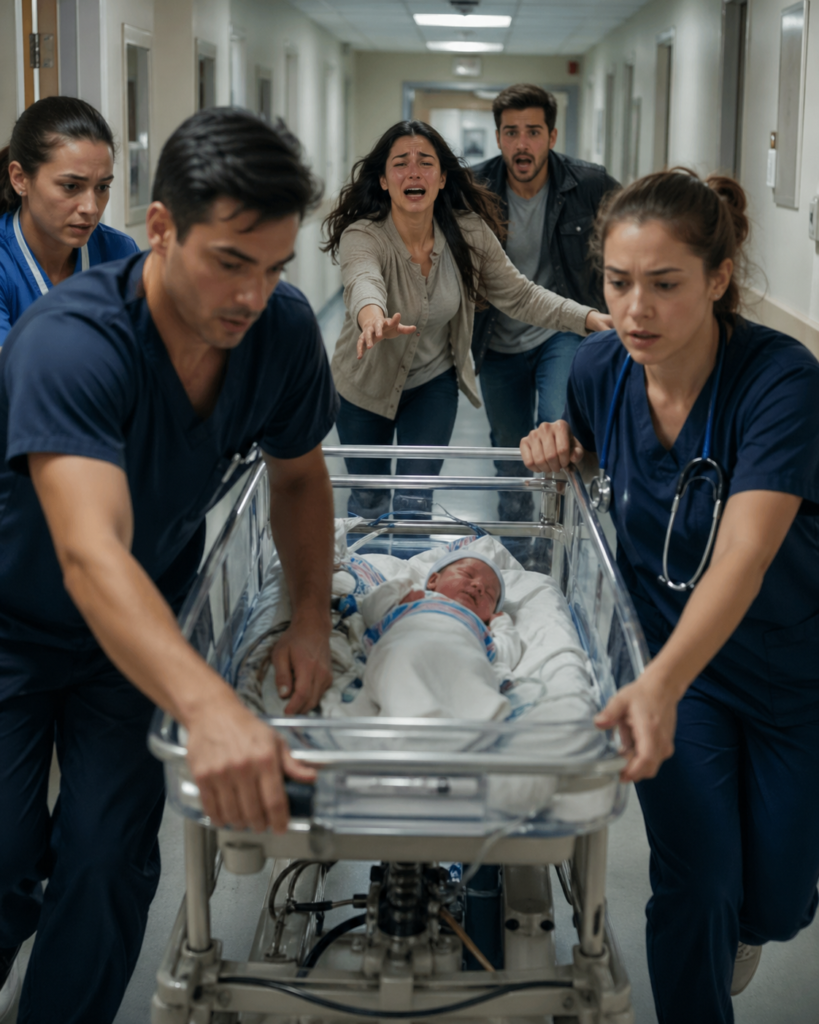
Wrapped in a white blanket, wearing a tiny blue cap, he looked too small for the panic around him. Two nurses pushed the clear hospital crib while a doctor walked beside them, calling out instructions I could barely understand.
I tried to run after them.
My legs felt weak. My body still hurt from giving birth. But none of that mattered. My son was being taken away from me, and nobody would tell me why.
“Please,” I cried, reaching toward the crib. “That’s my baby. Tell me what’s happening.”
My husband, Daniel, grabbed my arm from behind, his face pale and frightened.
But his mother stood near the delivery room doors with her arms crossed, staring at me like this was somehow my fault.
“She was warned,” she said coldly. “Now look what happened.”
The nurse turned around sharply.
And what she said next made the entire hallway go silent.
The nurse looked at Daniel’s mother with a kind of anger I had never seen from a hospital worker before.
“Ma’am,” she said firmly, “this is not the time for blame.”
Daniel’s mother, Margaret, lifted her chin as if she had been personally insulted.
“I’m only saying what everyone is thinking,” she replied. “My son should have chosen more carefully.”
I felt the words hit me, but I did not have the strength to answer. My eyes stayed fixed on the clear crib moving down the corridor. My baby’s tiny face was turned to one side. His little hand slipped out from the blanket for one second, then disappeared again as the nurse tucked him in.
“Where are they taking him?” I asked.
The doctor stopped just long enough to look at me.
“To the neonatal unit,” he said gently. “We need to monitor his breathing and run some tests. We are moving quickly because he needs help right now, but he is with the right team.”
My chest tightened.
“Can I go with him?”
“Not yet,” the nurse beside me said. “You need to be checked first.”
“No,” I whispered. “I need my baby.”
Daniel put both hands on my shoulders. “Emily, please. Let them help him.”
I turned toward him, hoping to see the same fear I felt. I did see fear—but there was something else in his face too. Something hidden. Something that looked almost like guilt.
Before I could ask him, Margaret stepped closer.
“This is what happens when secrets follow people into a family,” she said.
I stared at her.
“What secrets?”
Daniel’s grip on my shoulders tightened.
“Mom,” he said in a warning voice.
But she did not stop.
“For months, I told him this pregnancy didn’t feel right. I told him there were things he needed to know before putting our family name on that birth certificate.”
My mouth went dry.
The hallway lights hummed above us. Nurses moved around us, but for a moment, all I could hear was my own heartbeat.
“Daniel,” I said slowly, “what is she talking about?”
He looked away.
That small movement told me more than any answer could have.
The nurse beside me stepped between us. “Mrs. Carter, we need to get you back to the room. Stress is not safe for you right now.”
But I could not move.
My baby was somewhere down that corridor, fighting for every breath, and my husband’s mother was standing in front of me talking about secrets.
Then Daniel finally looked at me.
His eyes were wet.
“Emily,” he said, his voice breaking, “there’s something I should have told you before today.”
And at that exact moment, a doctor came rushing back down the hallway with a folder in his hand.
He did not look at Daniel.
He looked directly at me.
“Mrs. Carter,” he said, “we need to speak privately. It’s about your son.”
The words should have made me move faster, but for a second, they froze me in place.
My son.
Not our son. Not the baby. My son.
The doctor’s expression was serious, but not cold. He looked like a man trying to protect me from too much at once.
Daniel stepped forward. “I’m her husband. I should be there.”
The doctor’s eyes moved to him, then to Margaret, then back to me.
“Mrs. Carter may choose who comes with her,” he said.
Margaret let out a small bitter laugh. “Of course. Now we’re all being treated like strangers.”
I looked at Daniel. His face had gone pale again. He reached for my hand, but I pulled it away.
“Emily,” he whispered.
I wanted to ask him what he had done. I wanted to ask why his mother was acting like my baby’s emergency was proof of something. I wanted to scream until someone gave me a straight answer.
But the only thing that mattered was my son.
“I’ll go alone,” I said.
Daniel looked hurt, but he did not argue.
The nurse helped me into a wheelchair. I hated it. I hated feeling weak. I hated being pushed away from the hallway where my newborn had disappeared. But my legs trembled so badly that standing felt impossible.
The doctor led us into a small consultation room near the neonatal unit. The walls were pale blue. There was a box of tissues on the table. I noticed that first, and somehow it terrified me more than anything.
Doctors did not put tissues on tables unless they expected people to cry.
“Is my baby alive?” I asked before he could sit down.
“Yes,” he said immediately. “Your son is alive.”
My breath shook out of me.
“He is receiving support. His breathing was unstable after delivery, but he responded to oxygen. We are still watching him closely.”
I pressed both hands over my mouth. Tears came before I could stop them.
“Can I see him?”
“Soon,” the doctor said. “But there is something I need to discuss with you first.”
He opened the folder.
“We ran urgent bloodwork because of his condition. Some results came back faster than expected. There is a blood compatibility concern.”
I tried to understand, but my mind felt foggy.
“What does that mean?”
“It means we need more information to treat him safely. We need accurate family medical history. Yours and the father’s.”
I looked down at my hands.
“Daniel filled out the forms.”
“I know,” the doctor said carefully. “But there is information missing.”
A cold feeling moved through me.
“What information?”
The doctor hesitated. “Mrs. Carter, did anyone discuss any inherited blood condition with you during your pregnancy?”
“No.”
“Any family history of severe newborn jaundice, rare blood disorders, or immune-related complications?”
“No,” I said again. “Nobody told me anything like that.”
The doctor nodded slowly.
“Your son’s condition may be connected to something inherited from the father’s side. We need to confirm it quickly.”
I stared at him.
“Then ask Daniel.”
“We did,” the doctor said. “He said he was unaware of any such condition.”
Something about the way he said it made me grip the armrest.
“But you don’t believe him?”
The doctor did not answer directly.
“I believe there may be information he has not shared, or may not fully understand.”
I remembered Daniel’s face in the hallway. His fear. His guilt. His mother saying he should have told me things before today.
The room seemed smaller.
“Can my baby be treated?”
“Yes,” the doctor said. “We are already treating what we see. But the more we know, the faster and safer we can make decisions.”
I wiped my cheeks with the back of my hand.
“What do you need from me?”
“Permission to run additional tests. And, if possible, we need a truthful family history from Daniel’s side.”
I almost laughed, but there was no humor in it.
Truthful.
That one word sat in the room like another person.
The nurse wheeled me out a few minutes later. I signed every form they placed in front of me. I would have signed anything if it helped my son.
Daniel was waiting near the doors. Margaret stood beside him, her handbag hanging perfectly from her arm as if we were at a business meeting instead of a hospital.
“What did he say?” Daniel asked.
I looked at him for a long moment.
“Is there a blood condition in your family?”
Margaret’s face changed first.
It was quick. So quick most people would have missed it. But I saw it.
Her lips parted. Her eyes flickered toward Daniel.
Daniel swallowed.
“Emily, not here.”
My heart sank.
“Not here?” I repeated. “Our baby is in the neonatal unit, and you’re worried about where we talk?”
Margaret stepped in. “You’re emotional. You just gave birth. This isn’t the time to create drama.”
The nurse beside me looked like she wanted to say something, but she held herself back.
I turned to Margaret. “You don’t get to call this drama.”
Her eyes narrowed.
“For two years, I tried to be respectful to you,” I said. “I ignored the comments. I ignored the way you checked my clothes, my job, my family, my accent, my apartment, my cooking, everything. I let you treat me like I was never enough for your son. But today, my baby needs help. If there is something you know, you will tell me.”
Daniel closed his eyes.
Margaret looked away.
And that was when I knew.
They knew something.
“Daniel,” I said, my voice breaking. “Tell me.”
He ran both hands through his hair.
“When I was a child,” he said slowly, “I had a sister.”
The hallway seemed to tilt.
“A sister?”
He nodded, eyes wet.
“Her name was Lily. She was born before me. She only lived three days.”
I stopped breathing for a moment.
“You never told me you had a sister.”
“I was told not to talk about it.”
Margaret’s face hardened. “Because it was private family pain.”
“No,” Daniel said, turning on her. “Because you were ashamed.”
Margaret flinched.
Daniel looked back at me. “There was a condition. Some kind of blood issue. My father wanted testing after Lily passed, but my mother refused to talk about it. She said it would ruin the family’s reputation if people thought something was wrong with us.”
I gripped the wheelchair so hard my fingers hurt.
“You knew there was a chance?”
“I didn’t know enough,” he said quickly. “I swear, Emily, I didn’t understand it. I thought it was something from decades ago. I thought it wouldn’t matter.”
“You thought our baby’s life wouldn’t matter?”
He recoiled as if I had struck him.
“No. Never.”
Margaret stepped forward. “Do not twist this. Plenty of families have old medical stories. You cannot blame Daniel for not remembering every little detail.”
“Every little detail?” I repeated. “A baby died.”
Her mouth closed.
The nurse spoke gently. “We need to inform the neonatal team.”
Daniel nodded immediately. “Tell them everything. I’ll answer anything.”
Margaret grabbed his sleeve. “Daniel.”
He pulled away.
“No, Mom. Not this time.”
That was the first moment I saw the son Margaret had controlled begin to separate from the man he needed to become.
The next hour passed in pieces.
A nurse took Daniel to speak with the doctors. Another nurse brought me to a recovery room, checked my blood pressure, adjusted my blankets, and told me again that my son was receiving care.
But I could not rest.
Every time I closed my eyes, I saw the crib moving down the hallway. I saw his tiny hand. I heard the wheels rattling.
Finally, a nurse named Carla came in.
“Emily,” she said softly, “would you like to see your baby?”
I burst into tears before I could answer.
She helped me into the wheelchair again and took me through double doors into the neonatal unit.
The world changed there.
Everything was softer and sharper at the same time. The lights were dimmer. Machines beeped quietly. Nurses moved with calm focus. Behind clear walls and plastic covers, tiny babies slept, fought, breathed, waited.
Then I saw him.
My son.
He lay under a warmer, still wrapped in part of his blanket, with little monitors attached to him. A small tube helped him breathe. His face was red and peaceful, as if he had no idea that adults outside his tiny world were breaking apart over him.
My hand flew to my mouth.
“He looks so small,” I whispered.
Carla placed a chair beside him.
“You can touch his foot gently.”
I reached through carefully and touched the bottom of his tiny foot with one finger.
He moved.
Just a small movement.
But it felt like a promise.
“Hi, baby,” I whispered. “It’s Mommy. I’m here.”
For the first time since they took him away, I felt my body remember how to breathe.
Daniel came in a few minutes later.
He stopped at the doorway, as if he was afraid he no longer had the right to stand beside me.
I did not look at him.
“His name is Noah,” I said.
We had chosen the name months earlier, but suddenly it felt different. Noah. A child carried through a storm.
Daniel’s voice broke. “Noah.”
He came closer slowly.
“I told them everything I know,” he said. “They’re contacting a specialist.”
“Good.”
“I called my father too.”
That made me turn.
Daniel’s father, Robert, had been out of the picture for years. Margaret always said he was unreliable, selfish, and emotionally weak. Daniel rarely spoke to him.
“You called Robert?”
Daniel nodded.
“He knew more than my mother did. Or maybe she knew and refused to say it. He’s coming.”
Margaret appeared behind him at the glass door.
Her face twisted when she heard that.
“You had no right to call him.”
Daniel turned around. “He is my father.”
“He abandoned this family.”
“No,” Daniel said quietly. “You pushed him out because he wanted the truth.”
Margaret’s eyes flashed. “You don’t know what you’re talking about.”
Robert arrived two hours later.
He looked older than I expected. Tired, thin, carrying a worn leather folder under one arm. He did not enter the neonatal unit with pride or drama. He stood in the hallway and cried silently when Daniel told him he had a grandson.
Then he handed the folder to the doctor.
“These are Lily’s records,” he said. “I kept copies.”
Margaret looked like the floor had disappeared beneath her.
“You kept those?”
Robert looked at her with an exhaustion that seemed years old.
“I kept them because someday someone might need them. I begged you to tell Daniel when he was old enough. You said it would only frighten him.”
“It would have,” she snapped.
“It could have protected his child,” Robert said.
Silence fell between them.
The doctor took the records.
Within minutes, the neonatal team had more answers. The old records did not solve everything, but they gave the doctors direction. They knew what to test for. They knew what risks to watch. They knew how to treat Noah with more confidence.
For the first time that day, someone said, “This helps.”
Those two words almost made me collapse.
By evening, Noah was still in critical monitoring, but stable.
Stable.
I held that word like a candle in the dark.
Margaret tried to come into my room later that night.
I was sitting up in bed, too tired to sleep, my body aching, my heart still in the neonatal unit.
She knocked once and opened the door before I answered.
“We need to talk,” she said.
“No,” I replied.
She stopped.
“I am still Daniel’s mother.”
“And I am Noah’s mother.”
Her face tightened.
“I know today was emotional.”
I looked at her, amazed by how small she tried to make everything sound.
“Emotional?”
She placed her handbag on the chair as if preparing to stay.
“I said things I should not have said.”
“You blamed me while my newborn was being rushed away.”
She looked down, but I could not tell if it was shame or calculation.
“I was frightened,” she said.
“So was I. I didn’t hurt people with it.”
She pressed her lips together.
“I lost a child too, Emily.”
That softened something in me for half a second.
Then I remembered.
She had lost a child and used that loss as a locked door instead of a warning light. She had hidden the truth so deeply that another baby almost paid the price.
“I’m sorry for Lily,” I said quietly. “I truly am. But your grief does not give you the right to hide medical history, insult me, or control what Daniel knows.”
Her eyes filled, but her voice stayed hard.
“You don’t understand what it was like. People judged families for things like that. They whispered. They blamed mothers.”
“And so you became someone who blamed mothers?”
She looked at me sharply.
The words landed between us.
For once, Margaret had no answer.
Daniel came in then. He looked from me to his mother.
“Mom,” he said, “you need to leave.”
Margaret’s mouth opened.
He shook his head. “Not forever. But tonight, yes.”
“I came to help.”
“No,” he said. “You came to manage the damage.”
Her face crumpled with anger and pain.
“You would choose her over me?”
Daniel looked at me. Then toward the neonatal unit down the hall.
“I choose my son,” he said. “And I choose the truth.”
Margaret left without another word.
The next three days were the longest days of my life.
Noah had good hours and difficult hours. Doctors adjusted treatments. Nurses explained every number on every monitor. I learned to wash my hands the neonatal unit way. I learned the sound of his breathing machine. I learned how to read the faces of doctors before they spoke.
Daniel stayed.
He slept in chairs. He brought me water. He cried when he thought I was asleep. He apologized again and again until I finally told him that apologies were not medicine.
“I don’t know how to fix this,” he said.
“You start by never hiding truth from me again,” I said.
He nodded.
“And you get counseling,” I added. “Because your mother’s fear cannot keep living inside our marriage.”
He agreed.
On the fourth morning, the doctor smiled when he entered.
Not a big smile. Not a promise. But a real one.
“Noah had a better night,” he said.
My hands shook.
“What does that mean?”
“It means he is responding well. We still need time, but today is a good day.”
Daniel covered his face and cried.
I touched Noah’s tiny hand through the opening in the warmer.
“Did you hear that, baby?” I whispered. “Today is a good day.”
A week later, I held my son properly for the first time.
The nurse placed him against my chest, wrapped warm and snug, his cheek resting below my collarbone. He made one soft sound and settled.
I had imagined that moment during pregnancy. I thought it would happen in a quiet room with flowers and photos and Daniel smiling beside me.
Instead, it happened under hospital lights, with wires nearby and my hair unwashed and my heart bruised from fear.
But it was still perfect.
Because he was there.
Because he was breathing.
Because he was mine.
Margaret did not visit again until Noah was moved out of intensive monitoring.
When she came, she looked different. Smaller. Less polished. She stood outside the room holding a tiny blue blanket still in its store packaging.
Daniel met her in the hallway first.
I watched through the glass.
They talked for nearly twenty minutes. I could not hear every word, but I saw Margaret cry. I saw Daniel shake his head. I saw him point toward Noah’s room and then toward me.
When he came back inside, he said, “She wants to apologize.”
I looked at Noah sleeping in the hospital bassinet.
“Does she want to apologize,” I asked, “or does she want access?”
Daniel absorbed that.
“I don’t know,” he admitted.
That honesty mattered more than the perfect answer.
I let her come in.
Margaret stood at the foot of the bassinet and looked at Noah for a long time.
“He looks like Lily,” she whispered.
Daniel inhaled sharply.
I did not speak.
Margaret turned to me.
“I was cruel to you,” she said. “Before today. During today. Many times.”
“Yes,” I said.
She nodded, tears slipping down her face.
“I thought if I controlled everything, nothing could hurt us again.”
“But people were hurt anyway.”
“I know.”
Her voice cracked.
“I am sorry, Emily. I am sorry for blaming you. I am sorry for what I said in the hallway. I am sorry for keeping the past buried when it should have protected your child.”
I looked at her for a long moment.
Forgiveness did not arrive like music.
It did not wash over the room.
It stood far away, possible but not ready.
“Thank you for saying that,” I said. “But things will be different now.”
She nodded quickly. “Of course.”
“No,” I said. “I need you to understand. Different means boundaries. Different means no insults. No private conversations with Daniel about me. No decisions about Noah without me. No family secrets that affect his health. And if you blame me again for something outside my control, you will not be welcome near us.”
Margaret looked stunned.
Daniel stood beside me and said, “I agree.”
For the first time since I had met her, Margaret did not argue.
Two weeks after Noah was born, we brought him home.
There were no dramatic speeches. No perfect ending. Just a tiny baby in a car seat, a stack of discharge papers, and two exhausted parents who had learned that love without truth is fragile.
Robert came by the next morning with groceries and a folder of updated family medical records.
He did not stay long.
“I should have fought harder years ago,” he told Daniel.
Daniel hugged him.
“You’re here now,” he said.
Margaret began therapy. Daniel did too. Our marriage did not magically heal because Noah survived. Trust had to be rebuilt in small, ordinary moments: every honest conversation, every appointment attended, every record shared, every boundary kept.
Some nights, I still woke up hearing the wheels of that hospital crib.
I would reach over and touch Noah’s blanket, just to feel him breathing.
Daniel would wake too.
“He’s okay,” he would whisper.
And I would say, “I know.”
But part of me would always remember that hallway.
The cold lights. The running nurses. My baby’s tiny hand. The truth chasing us from behind.
Months later, when Noah was strong enough, we visited Lily’s grave.
Daniel had not been there since childhood. Robert brought flowers. Margaret stood a few steps back, quiet and pale.
I held Noah in my arms.
His eyes were open, staring at the sky as if the world was something he had fought hard to see.
Daniel knelt and placed a small white flower near the stone.
“I’m sorry,” he whispered.
I knew he was not only speaking to Lily.
He was speaking to the past.
To the silence.
To the frightened little boy who had been taught not to ask questions.
To the husband who had nearly repeated a family mistake.
To the father he was choosing to become.
Margaret stepped forward last.
She touched the stone with trembling fingers.
“I thought silence would keep the pain away,” she said. “But it only carried it forward.”
No one answered.
There was nothing to add.
The wind moved softly through the grass. Noah made a small sound in my arms, and everyone turned toward him.
That was the moment I understood something.
Healing was not pretending the past had never happened.
Healing was choosing not to pass the same pain to the next child.
I looked down at my son.
He was safe now.
Not because our family was perfect.
But because the truth finally had room to breathe.
- The Letter My Grandmother Left Before the Family Trust Burned Open
- My Sister Called Me Legally Stupid, Then Her Lawyer Learned Who I Was
- My Mother Left Me Protection, Not Obligation
- MY PARENTS KICKED MY 14-YEAR-OLD DAUGHTER OUT—THEN I CAME HOME WITH PROOF THE HOUSE WAS MINE
- GRANDPA STOPPED EATING WHEN HE FOUND OUT I PAID RENT WHILE MY SISTER LIVED FREE
- [Part 2] My In-Laws Mocked Me—Then One Car Made Them Panic
- At My Mother-In-Law’s 70th Birthday Dinner in Rome, There Were 12 Seats — And None for Me
- TWO LITTLE GIRLS SAVED A BILLIONAIRE IN THE PARK—THEN ASKED HIM TO SAVE THEIR MOTHER
- MY EX SAID OUR CHILDREN WERE GOING HUNGRY—THEN MY DAUGHTER OPENED HER GLITTER SHOEBOX IN COURT
- My Husband Left Me for a 28-Year-Old on Christmas Eve…
- MY SON THOUGHT THE HOUSE WAS HIS—UNTIL I SOLD IT WHILE HE SAT IN HIS OFFICE