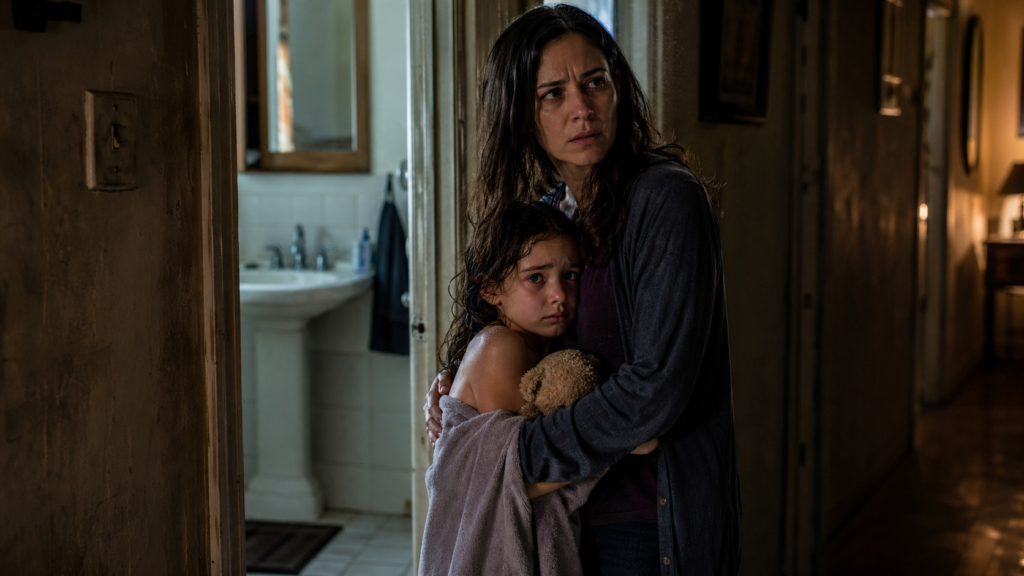
I found my seven-year-old daughter sitting on the bathroom floor, wrapped in a towel, holding her teddy bear so tightly her little fingers had turned pale.
At first, I thought she had slipped in the tub.
Then she looked up at me.
Her eyes were red from crying. Her hair was wet. There were faint marks on her arms and legs that had not been there that morning.
“Lily,” I whispered, dropping to my knees. “Baby, what happened?”
She shook her head so quickly that water dripped from the ends of her hair onto the tile.
Behind me, my sister’s voice called from the hallway, calm and almost annoyed.
“She’s being dramatic again. Kids fall. You know how they are.”
But Lily did not look at my sister.
She looked at the doorway.
And when I followed her eyes, I saw my sister’s boyfriend standing there, holding her pink hairbrush in one hand, smiling like nothing was wrong.
That was the moment my whole house went silent.
I do not remember standing up.
One second, I was kneeling beside my daughter with my hands trembling around the towel on her shoulders, and the next, I was between her and the doorway.
My sister, Marla, folded her arms. “Don’t start, Anna. She’s always sensitive. You know Lily.”
I turned slowly and looked at her.
Sensitive.
That was the word everyone used when a child cried and adults did not want to listen.
Lily’s small hand reached for the back of my shirt. She did not grab hard. She barely had the strength to curl her fingers into the fabric. But that tiny movement told me more than any explanation could have.
“Marla,” I said, keeping my voice low, “take Daniel and leave my house.”
Her boyfriend’s smile disappeared.
Daniel leaned one shoulder against the doorframe. “That’s a little extreme, don’t you think?”
I looked at the hairbrush in his hand.
“Put that down.”
He glanced at it as if he had forgotten he was holding it. Then he laughed softly and placed it on the sink. “You’re making this weird.”
Lily pressed her face against my back.
My sister stepped forward. “Anna, you are embarrassing yourself. Daniel was helping me watch her while you were at work. You should be grateful.”
Grateful.
I had worked a double shift at the clinic because rent was due. Marla had begged me to let her stay for a few weeks after she said she had nowhere to go. I had trusted her. I had trusted my own sister inside my home with my child.
And now my daughter was shaking behind me in a bathroom that smelled like soap, damp towels, and fear.
I reached for my phone on the counter.
Marla’s face changed.
“What are you doing?”
“Calling someone who knows how to ask the right questions.”
Daniel straightened. “Careful, Anna.”
It was the first honest thing he had said all night.
Because the softness was gone from his voice.
I looked at Lily through the mirror. Her eyes were wide, but when she saw the phone in my hand, she gave the smallest nod.
Not a big one.
Not dramatic.
Just enough.
And that tiny nod broke something inside me.
I dialed with shaking fingers.
Marla started crying before anyone even answered, but not because she was sorry.
Because she knew.
She knew the quiet little girl on the bathroom floor had finally found a way to tell me the truth.
And what happened next changed our family forever…
The dispatcher’s voice came through calm and steady.
“Emergency services. What is your location?”
For one second, I could not speak.
My throat closed around the address I had said thousands of times before. This house was supposed to be safe. It was supposed to be the small, warm place Lily and I rebuilt our lives after her father left when she was two. It was supposed to be the place where she taped drawings to the fridge, spilled cereal on Saturday mornings, and slept with a night-light shaped like a moon.
Now I was standing barefoot on cold bathroom tile, staring at my sister and the man she had brought into my home, and I felt like the walls had betrayed me.
“Ma’am?” the dispatcher said gently.
I swallowed. “My name is Anna Mercer. I need help for my daughter. She’s seven. She’s scared, and I found marks on her after she was left with my sister and her boyfriend.”
Marla gasped loudly, as if I had slapped her with the words.
“How dare you say that?”
I turned my back to her. “Lily is in the bathroom with me. She’s conscious. She’s crying. I need someone here now.”
Daniel gave a short laugh, but it came out wrong. Too sharp. Too forced.
“This is ridiculous,” he said. “I’m leaving.”
“No,” I said, without looking at him. “You will wait outside.”
He moved anyway.
I heard his shoes shift against the hallway floor, and something ancient and fierce rose inside me. I had never thought of myself as brave. I was the woman who apologized when someone bumped into me at the grocery store. I was the woman who worked extra shifts instead of asking for help. I was the woman who kept family peace even when it cost me sleep.
But motherhood draws a line inside you that you do not know exists until someone steps across it.
I looked over my shoulder.
“Daniel,” I said, “if you walk out that front door before help arrives, I will tell them you ran.”
He stopped.
Marla stared at me with eyes full of anger and fear. “You are destroying my life.”
I almost laughed.
Not because anything was funny, but because the sentence was so wrong it made the room tilt.
“Your life?” I whispered.
Behind me, Lily made the smallest sound. Not a cry. Not a word. Just a little breath that caught in her chest.
I turned back to her immediately.
“It’s okay, baby,” I said, kneeling again. “You’re safe with me.”
Her lips trembled. “Are they mad?”
The question nearly ended me.
Not “Am I okay?”
Not “What happened?”
Not “Will you help me?”
Are they mad?
That was the question of a child who had learned to measure a room by adult moods. A child who had learned that silence sometimes felt safer than truth.
I brushed wet hair from her forehead. “Nobody who matters is mad at you.”
Her eyes moved toward the hallway again.
“At me?” she whispered.
“No,” I said firmly. “Never at you.”
The dispatcher stayed on the phone with me until two officers and a paramedic arrived. Those minutes stretched forever. Marla paced in the hallway, whispering things under her breath. Daniel sat on the living room couch with both elbows on his knees, his face blank now. No more smiling. No more pretending to be charming.
Lily stayed wrapped in the towel, her teddy bear pressed between her chest and mine.
I wanted to ask her questions.
Every question.
What happened?
How long?
Why didn’t you tell me?
But some part of me knew that my need for answers could not be louder than her need for safety. So I did what I could do. I held her. I told her she was loved. I told her she was not in trouble.
When the knock came at the front door, Marla flinched.
I carried Lily out of the bathroom.
The paramedic, a woman named Renee with kind brown eyes, crouched low so she would not tower over my daughter.
“Hi, Lily,” she said softly. “My name is Renee. Your mom called because she loves you and wants to make sure you’re okay. Is it alright if I sit right here?”
Lily looked at me first.
I nodded. “Only if you want, sweetheart.”
Lily gave a tiny nod.
Renee sat on the floor outside the bathroom like she had all the time in the world. She did not grab. She did not rush. She did not speak over Lily. She let my daughter decide when to look at her.
One officer spoke with Daniel in the living room. The other asked Marla to step into the kitchen.
Marla’s voice rose immediately.
“This is a misunderstanding. My sister is emotional. She’s exhausted. She works too much. Lily has always been clumsy.”
I stood in the hallway holding my daughter’s hand and listened to my sister list every excuse she could find.
Clumsy.
Sensitive.
Dramatic.
Tired.
Anything except hurt.
Anything except scared.
Anything except the truth.
Renee checked Lily gently and asked simple questions. Some Lily answered with a nod. Some she did not answer at all. When Renee asked if she felt safe with everyone in the house, Lily’s whole body stiffened.
That was enough.
The officers noticed.
Renee noticed.
And Marla noticed too, because her voice from the kitchen suddenly dropped quiet.
They took Daniel outside first.
He protested, but not loudly. That frightened me more than shouting would have. A man who knows how to perform innocence also knows when to save his energy.
Marla rushed toward me as soon as he was out the door.
“Anna, please,” she whispered, her face pale now. “Don’t do this. You don’t understand what you’re starting.”
I looked at her hand reaching for my arm.
For most of our lives, Marla had reached for me only when she needed something. Money. A place to stay. Someone to cover for her. Someone to believe the newest version of her story.
This time, I stepped back.
“No,” I said.
Her mouth fell open.
It was such a small word.
No.
But I realized I had not said it to my sister enough.
No, you cannot move in without helping.
No, you cannot bring a man I barely know into my home and call me judgmental for asking questions.
No, you cannot dismiss my child’s fear because it makes your life inconvenient.
No, you cannot stand in my hallway and ask me to protect you from the truth.
Lily tightened her hand around mine.
Marla saw it.
For a moment, something like shame crossed her face. It was quick, gone almost as soon as it appeared, but I saw it. And I think that made me angrier, not less. Because shame meant she understood there was something to be ashamed of.
“Did she try to tell you?” I asked quietly.
Marla looked away.
That was the answer.
My knees almost gave out.
“She’s a child,” I said.
“I didn’t know,” Marla whispered.
But the words had no strength.
“You didn’t want to know.”
The officer came back inside and asked if Lily and I could go to the hospital for a proper checkup. I said yes before he finished the sentence.
Marla started crying again. “What about me?”
I stared at her.
For years, my sister had trained the whole family to make her the center of every emergency. If Marla lost a job, everyone discussed Marla’s stress. If Marla borrowed money and did not return it, everyone discussed Marla’s intentions. If Marla chose another unstable man, everyone discussed Marla’s loneliness.
But my daughter stood beside me in a towel, trembling in a house that should have protected her.
So I said the sentence that changed our family forever.
“This is not about you anymore.”
At the hospital, Lily sat on the exam bed with a blanket around her shoulders and her teddy bear in her lap. The room was painted a soft pale blue. Someone had stuck smiling animal decals on the wall, and under any other circumstances, Lily would have pointed at the giraffe and told me its neck was too long to fit in our car.
That night, she said almost nothing.
A nurse brought apple juice with a bendy straw. Lily held it but did not drink.
Renee, the paramedic, had ridden with us. Before she left, she bent close and said, “You did good, Lily. You were very brave.”
Lily looked confused by that.
After Renee left, Lily whispered, “I didn’t do anything.”
I sat beside the bed and took her hand. “Sometimes brave means letting someone help.”
She thought about that for a long moment.
“Will Aunt Marla be sad?”
I closed my eyes for a second.
I wanted to say no. I wanted to say Marla did not deserve space in Lily’s mind right now. But children do not stop loving people because adults fail them. Their hearts are generous in ways that can break you.
“She might be,” I said carefully. “But her feelings are not your job.”
Lily turned the straw around in the juice cup.
“She said if I made trouble, you would lose work.”
My lungs froze.
There it was.
The first sentence.
The first crack in the wall.
I kept my face still, though inside I felt everything in me shaking.
“You are not trouble,” I said. “You hear me? You are never trouble.”
Her eyes filled again.
“She said you were tired.”
“I am tired sometimes,” I said. “But not of you.”
“She said you needed help.”
“I needed safe help. Not help that made you feel scared.”
Lily looked down.
The nurse came in with a social worker named Ms. Claire. She had gray-streaked hair, a soft cardigan, and a voice that felt like warm tea. She explained everything before she did it. She asked permission before sitting down. She told Lily she could answer questions with words, nods, drawings, or not at all.
That mattered.
Because Lily had been taught, in some quiet way, that adults owned the room.
Ms. Claire gave her paper and crayons.
“Can you draw your house?” she asked.
Lily drew our small yellow house with the crooked mailbox, the rosebush by the steps, and her bedroom window with purple curtains. Then she drew herself very small in the bathroom.
She drew me outside the house in my blue clinic scrubs.
She drew Marla in the kitchen.
She did not draw Daniel.
When Ms. Claire asked if anyone was missing, Lily picked up the black crayon, held it for a long time, and placed it back in the box.
“I don’t want him in my picture,” she whispered.
Ms. Claire nodded like that was a perfectly acceptable answer.
“That’s okay,” she said. “Your picture belongs to you.”
I had to look away.
Because nobody had ever told me that as a child. Marla and I grew up in a house where feelings were treated like bad weather: inconvenient, embarrassing, something everyone should ignore until it passed. Our mother was not cruel, but she was tired. Our father was present in body and absent in every other way.
Marla learned to be loud so someone would notice her.
I learned to be useful so no one would leave.
And now, somehow, both of those survival habits had led us to this hospital room.
By morning, the first official reports had been made. Temporary protective measures were put in place. Daniel was not allowed near Lily. Marla was told not to contact us until investigators had spoken with everyone.
I thought I would feel relief.
Instead, I felt hollow.
At six in the morning, I drove home with Lily asleep in the back seat, still clutching her teddy bear. The sky was pale and gray, the kind of morning that looks too gentle for what the night has held.
Our house looked normal when we pulled into the driveway.
That almost made me angry.
The rosebush was still there. The neighbor’s cat still slept on the porch railing. The trash bins still leaned against the fence. Nothing outside showed that our lives had split into before and after.
Inside, the silence felt different.
Daniel’s jacket was gone from the chair. Marla’s purse was gone from the counter. The blanket she had been using on the couch was folded badly, like she had left in a hurry but still wanted credit for trying.
I carried Lily to my bed because I could not bear to put her alone in her room. She woke just enough to ask, “Can the door stay open?”
“Yes,” I said.
“And the hall light?”
“Yes.”
“And can you stay?”
I lay down beside her, still wearing the clothes from the night before.
“Yes.”
She fell asleep with one hand resting on my sleeve.
I did not sleep.
I stared at the ceiling and replayed every moment from the past month.
Marla arriving with two suitcases and red eyes.
Daniel carrying one box and calling me “family” before he even knew where the cups were.
Lily becoming quieter at dinner.
Lily asking if she could come with me to the clinic.
Lily wetting the bed once and crying so hard from embarrassment that I told her accidents happened.
Lily saying she did not like baths anymore.
Lily hiding her pink hairbrush under her pillow.
Every memory turned sharp.
Every sign I had missed became a stone in my chest.
By eight, my phone began ringing.
Mom.
Aunt Carol.
Cousin Elise.
Mom again.
I did not answer until the fifth call, when my mother left a voicemail that said, “Anna, your sister is hysterical. What is going on?”
Hysterical.
Not Lily.
Marla.
I listened to the message in the kitchen with both hands wrapped around a mug of coffee I had not touched.
Then I called my mother back.
She answered immediately. “Anna, thank goodness. Marla says you called the police on Daniel. She says there was some kind of misunderstanding with Lily. Tell me you didn’t make this official.”
I looked down the hallway toward my bedroom, where my daughter slept with the light on.
“I did.”
My mother inhaled sharply. “Anna.”
“One word,” I said.
“What?”
“If you tell me to think about Marla before Lily, I will hang up.”
Silence.
Then my mother said, “I’m not saying that.”
But she was.
Maybe not with those words, but with every pause. Every sigh. Every careful sentence about “ruining lives” and “waiting for facts” and “family matters.”
I gripped the mug tighter.
“Lily had to go to the hospital,” I said. “She was terrified in her own home. I am not discussing whether protecting her was too harsh.”
My mother began crying.
I felt sorry for her. I truly did. No mother wants to hear that one daughter failed another. No grandmother wants to imagine a child afraid in a bathroom while adults made excuses.
But her pain could not become my responsibility either.
For the first time in my life, I did not soften the truth to make it easier for someone else to hold.
“Mom,” I said, “I love you. But if you call me to defend Marla, I will not answer.”
“Anna, she says she didn’t know.”
“Then she can explain that to the people asking questions.”
I ended the call before my courage disappeared.
The next weeks were not dramatic in the way people imagine. There were no sudden courtroom confessions. No single moment where everyone understood and apologized. Real life moves slower than that. It moves through appointments, paperwork, missed work, whispered questions, and nights when your child wakes up crying but cannot explain the dream.
Lily began seeing a child counselor named Mrs. Elena.
The first time we went, Lily refused to leave the waiting room. She sat with her knees pulled to her chest, staring at the carpet.
Mrs. Elena did not force her.
She sat on the waiting room floor, took out a small basket of toy animals, and lined them up between them.
“This turtle is new here too,” she said. “He doesn’t know if this is a safe place yet.”
Lily looked at the turtle.
“He can stay in his shell,” Mrs. Elena said.
Lily touched the turtle’s plastic back with one finger.
For three sessions, Lily barely spoke. She played with the turtle, the rabbit, and a tiny wooden house. On the fourth session, she asked if the turtle could lock its door.
Mrs. Elena said, “Yes. And the turtle gets to choose who comes in.”
That night, Lily asked for a lock on her bedroom door.
The request hurt me.
Not because she wanted privacy, but because my little girl thought safety had to be built with metal.
I bought a child-safe privacy lock the next day and installed it while she watched.
“This lock is not because you have to hide,” I told her. “It’s because your room belongs to you.”
She nodded seriously.
“Can you still come in if I need you?”
“Always.”
“Even if it’s nighttime?”
“Especially then.”
At school, Lily’s teacher, Mrs. Patel, became part of our quiet circle of protection. She moved Lily’s seat closer to the front, not in a way that embarrassed her, but in a way that let Lily feel seen. She let her visit the reading corner when the classroom got too loud. She called me every Friday, not with complaints, but with gentle updates.
“She smiled during art today.”
“She played with Maya at recess.”
“She asked to read aloud, just one sentence, but she did it.”
I saved those messages like treasures.
Healing did not look like a straight road. It looked like one sentence read aloud. One full night of sleep. One bath taken with the door open and me sitting outside reading a magazine so she could hear my voice.
It looked like Lily choosing yellow socks because “they feel happy.”
It looked like her leaving the teddy bear on the bed for an entire afternoon.
Meanwhile, the family divided itself exactly the way painful truths often make families do.
Some people chose Lily immediately.
My cousin Elise came over with groceries and said, “I don’t need details. Tell me where to put the milk.”
My neighbor, Mrs. Alvarez, started walking Lily home from the bus stop on days I worked late.
My coworker Beth covered two shifts and left a note in my locker that said, “You are not alone.”
Others chose comfort.
Aunt Carol sent a message saying, “I hope this doesn’t get blown out of proportion.”
I deleted it.
My mother called less often after I refused to discuss Marla. When she did call, her voice sounded smaller.
“Can I see Lily?” she asked one afternoon.
“Not if you are going to mention Marla.”
“I won’t.”
“Not if you are going to ask Lily questions.”
“I won’t.”
“Not if you are going to cry in front of her and make Lily comfort you.”
My mother was quiet for a long time.
Then she said, “I understand.”
I wanted to believe her.
So I let her come.
She arrived with a small stuffed rabbit and a casserole dish. Lily was coloring at the kitchen table. When she saw my mother, she froze for just a second.
My mother noticed.
To her credit, she did not rush forward.
She placed the rabbit on the table and said, “I saw this and thought of you. You don’t have to hug me.”
Lily looked at me.
I nodded.
She took the rabbit.
“Thank you, Grandma.”
My mother’s eyes filled with tears, but she blinked them back.
That was the first time I saw her choose Lily over her own emotions.
It mattered.
After dinner, Lily went to bed, and my mother stood at the sink washing dishes though I told her not to.
“I failed you girls,” she said quietly.
I leaned against the counter. “Mom.”
“No, let me say it.” She kept her hands in the soapy water. “I taught you to keep peace. I thought I was teaching you kindness. Maybe I was teaching you to stay quiet.”
I did not know what to say.
She looked at me then, older than I had ever seen her.
“Marla called me from a friend’s phone. I told her I would not speak to her until she told the truth.”
My chest tightened.
“And?”
My mother looked back at the sink.
“She hung up.”
It was not victory.
None of this felt like victory.
It felt like standing in the ruins of a family house and realizing which walls had always been weak.
Two months later, I received a letter.
Not from Daniel.
Not from the authorities.
From Marla.
It arrived in a plain white envelope with my name written in her looping handwriting. I knew it before I opened it. I stood by the mailbox for a full minute, breathing cold air, trying to decide if I had enough strength to read it.
I waited until Lily was at school.
Then I sat at the kitchen table and opened it.
Anna,
I know you hate me.
I won’t ask you not to.
I have started this letter twelve times and thrown it away because every version sounds like an excuse. Maybe everything I say will sound like an excuse anyway.
I should have listened to Lily.
There. That is the only sentence that matters.
She tried in little ways. I see that now. She asked not to be alone with Daniel. She stayed close to me when he was in the room. She went quiet when he joked with her. I told myself she was shy. I told myself she was spoiled. I told myself I had finally found someone who loved me and that you were judging him because you always judge my life.
But the truth is worse.
I saw enough to feel uncomfortable, and I chose not to look closer.
I am not asking you to forgive me.
I am asking you to tell Lily, someday when she is older and only if it helps her, that I am sorry I was not the adult she needed.
I put the letter down.
My hands were shaking.
For weeks, I had imagined Marla denying everything forever. I had imagined anger, blame, dramatic speeches. I had not imagined this strange, small confession arriving between a grocery flyer and an electric bill.
I did not show Lily.
Not then.
Mrs. Elena had told me something important early on: “Adults often want a child’s healing to include adult forgiveness. It does not have to. Lily’s healing belongs to Lily.”
So I put the letter in a folder with the other documents.
Not hidden.
Not destroyed.
Just saved for a future Lily who might one day ask questions I could not answer alone.
The investigation continued quietly. Daniel’s past began to unfold in pieces. Other people came forward with stories that sounded too familiar. Different towns. Different women. Different children who had gone quiet around him. Some reports had been dismissed as misunderstandings. Some had never been reported at all.
When the officer told me that, I sat in my car outside the station and cried until my chest hurt.
Not only for Lily.
For every child whose silence had been mistaken for moodiness.
For every adult who had seen discomfort and called it drama.
For every warning sign softened by politeness.
That night, I watched Lily sleep with her new stuffed rabbit tucked beside the old teddy bear. Her face looked peaceful under the glow of the moon night-light.
I whispered, “I’m sorry.”
She did not hear me.
Maybe that was for the best.
Because apologies are important, but they do not replace action. So I kept acting. I went to every appointment. I answered every hard question. I changed my work schedule. I stopped letting relatives visit without notice. I made our home predictable.
Monday was pasta night.
Wednesday was library day.
Friday was movie night with popcorn in the big blue bowl.
Every evening, I asked Lily three questions.
“What was something good today?”
“What was something hard today?”
“Is there anything you want me to know?”
At first, she answered with shrugs.
Then one-word replies.
Then small stories.
“Maya shared her purple marker.”
“The boys were loud at lunch.”
“I don’t like when people stand behind me.”
That last one came on a Thursday while I was folding laundry.
I paused with a towel in my hands, but I did not make my face big with alarm.
“Thank you for telling me,” I said. “What helps?”
She thought about it.
“When you say my name before you touch my shoulder.”
So I did.
From then on, I said, “Lily, I’m behind you,” before reaching past her. I said, “Lily, can I fix your collar?” before touching her shirt. I said, “Lily, do you want a hug?” instead of assuming.
Some people might think that sounds like too much.
Those people have never watched a child rebuild trust from the ground up.
Trust is not demanded.
It is returned slowly, one safe moment at a time.
Spring arrived.
The rosebush by the front steps bloomed earlier than usual, bright pink against the yellow house. Lily helped me pull weeds one Saturday morning, wearing gardening gloves too big for her hands.
A car slowed near the curb.
I looked up immediately.
So did Lily.
It was my mother.
She got out carefully, holding a paper bag from the bakery. She had started visiting once a week, always calling first, always leaving when Lily got tired, always following the rules.
“Good morning,” she called softly.
Lily looked at me.
“Grandma brought cinnamon rolls,” I said.
Lily considered this.
“With icing?”
My mother smiled. “Extra.”
Lily stood. “Okay.”
That was how healing looked too.
Not a dramatic reunion.
Just a child deciding a grandmother with cinnamon rolls could come up the walkway.
Later, while Lily ate icing with a fork because she did not like sticky fingers, my mother asked if she could speak with me on the porch.
I left the kitchen door open so Lily could see us.
My mother handed me a folded newspaper clipping.
Daniel had been formally charged in connection with another case, one that gave investigators enough to move forward more firmly. The article did not name Lily. It did not name us. But it described a pattern that made my stomach turn.
“I’m sorry,” my mother said.
I nodded.
“I keep thinking about all the times Marla brought him around.”
“Don’t,” I said.
She looked startled.
“I don’t mean don’t care,” I continued. “I mean don’t drown in thinking. Do better. That’s what Lily needs from us.”
My mother looked through the open door at my daughter.
“I can do that,” she said.
For the first time, I believed her.
That summer, Lily asked to take swimming lessons.
I almost cried when she said it.
Baths had been hard. Showers had been hard. The bathroom door had been hard. Water had become tangled with memory, and I had wondered if it would always carry fear for her.
But one afternoon, while we watched children at the community pool from a shaded bench, Lily said, “Maybe I could learn to float.”
I kept my voice casual.
“Sure. We can ask about lessons.”
She looked at me seriously. “Only if the teacher is nice.”
“Only if the teacher is nice.”
The instructor was a cheerful college student named Nora who wore a whistle and asked every child before helping them adjust their arms. Lily watched her for a long time before agreeing to step into the shallow end.
The first lesson, she held the railing the whole time.
The second, she put her face near the water but not in it.
The third, she laughed when Nora made a rubber duck race across the pool.
The fourth, Lily floated on her back for five seconds.
I stood behind the fence with tears running down my face, pretending to search for something in my purse so no one would ask.
Lily saw me anyway.
After class, wrapped in a towel, she said, “Mom, why are you crying?”
“Because you floated.”
She smiled shyly.
“I was scared.”
“I know.”
“But I did it.”
“You did.”
She leaned against me, damp and warm from the sun.
“I think my body remembered it could be safe.”
I held her carefully, the way she liked.
“Yes,” I whispered. “I think it did.”
The official outcome with Daniel took longer than I wanted and ended with more complexity than stories usually admit. There were statements, hearings, delays, and decisions made by people behind desks. I learned that justice is not a single door swinging open. Sometimes it is a hallway of locked rooms, and you celebrate every key you manage to turn.
But Daniel never came near us again.
That mattered.
Marla did not return to my home.
That mattered too.
Almost a year after the night in the bathroom, Mrs. Elena asked if I would consider joining a support group for parents. I resisted at first. I did not want to sit in a circle of strangers and say the hardest parts of my life out loud.
But I went.
The first meeting, I said my name and cried before finishing the sentence.
No one rushed me.
No one looked uncomfortable.
One father across the circle passed me a box of tissues without a word.
Week by week, I learned something I wish every parent knew: guilt is common, but guilt cannot become the whole story. If guilt is the only thing you carry, it leaves no room for learning, protection, or love.
So I learned.
I learned warning signs.
I learned about safe adults.
I learned to teach Lily that respect does not mean obeying every adult without question.
We made a family safety list together.
Safe people.
Safe places.
Words she could use if she needed help.
We practiced sentences.
“No, thank you.”
“I want my mom.”
“I don’t want to be alone.”
“That makes me uncomfortable.”
At first, she whispered them.
Then she spoke them.
Then, one day, when a man at the grocery store leaned too close and said, “Aren’t you a pretty little thing?” Lily stepped behind me and said clearly, “I don’t like that.”
The man laughed awkwardly.
I did not.
I looked him in the eye and said, “Then move back.”
He did.
In the car, Lily was quiet for several minutes.
Then she asked, “Was I rude?”
“No,” I said. “You were honest.”
“Will people get mad when I’m honest?”
“Sometimes.”
She looked worried.
I reached over and squeezed her hand.
“But their anger does not mean you were wrong.”
She stared out the window, thinking.
Then she said, “I like honest better than quiet.”
“So do I,” I said.
By the time Lily turned nine, she had grown taller, lost two front teeth, and developed strong opinions about pancakes. She loved art. She hated peas. She kept the turtle from Mrs. Elena’s office in her memory like a symbol.
On her ninth birthday, she asked for a small party in the backyard.
“Only safe people,” she said.
So that was what we had.
Maya from school.
Mrs. Patel.
Grandma.
Cousin Elise.
Mrs. Alvarez.
Beth from my clinic.
No loud music. No surprise guests. No relatives who thought boundaries were insults.
Just paper lanterns, cupcakes, and a sprinkler running across the grass.
Lily wore a yellow dress and laughed so hard when Maya slipped near the sprinkler that she had to sit down.
My mother stood beside me holding a plate.
“She looks happy,” she said.
“She is happy today,” I corrected gently.
My mother nodded. She understood now. We did not turn healing into a permanent label. We let it be true in the moment.
That evening, after everyone left, Lily helped me collect paper plates from the yard.
“Mom?”
“Yeah?”
“Can I ask something?”
“Always.”
She twisted a paper napkin in her hands. “Do you still have the letter from Aunt Marla?”
I went still.
Mrs. Elena had prepared me for this possibility, but preparation did not stop my heart from aching.
“Yes,” I said. “I do.”
“Can I read it?”
I looked at her face. She seemed nervous, but not fragile. Curious. Serious.
“Do you want to read it with me or with Mrs. Elena?”
She thought about it.
“With you first. Then maybe with Mrs. Elena.”
So we sat at the kitchen table, the same table where I had first read Marla’s words alone.
I took the folder from the top shelf of my closet and placed the letter between us.
Before I opened it, I said, “This letter does not decide what you have to feel. You do not have to forgive anyone. You do not have to feel sorry for anyone. You can feel many things at once.”
Lily nodded.
I read it aloud because she asked me to.
When I finished, she was quiet for a long time.
Then she said, “She knew a little.”
I closed my eyes.
“Yes.”
“But not everything?”
“I don’t know.”
Lily looked at the letter.
“I’m mad at her.”
“That makes sense.”
“I miss when she made pancakes shaped like hearts.”
“That also makes sense.”
Her eyes filled, but she did not cry.
“Can both be true?”
I reached across the table and held her hand.
“Yes, baby. Both can be true.”
She folded the letter carefully and pushed it back toward me.
“I don’t want to see her.”
“Okay.”
“Maybe when I’m older.”
“Okay.”
“Maybe never.”
“Also okay.”
She nodded, relieved.
That night, I realized healing was not about turning pain into a perfect lesson. It was about giving Lily ownership of her own story. What she remembered. What she shared. Who she allowed near her. What she chose to do with the pieces.
Years passed.
Not easily. Not perfectly.
There were still hard days. A smell, a tone of voice, a closed door, an unexpected hand on her shoulder could pull her back into fear. But those moments became fewer. And when they came, Lily had words for them.
By twelve, she joined the school art club.
By thirteen, she painted a series of small canvases: a turtle, a yellow house, a locked door with sunlight under it, a girl floating on blue water.
The art teacher entered one painting into a local student exhibit without knowing its history. The painting showed a bathroom window cracked open, with a beam of morning light falling across the tile. No person. No darkness. Just light reaching a place that had once held fear.
The title Lily gave it was “After.”
I stood in the gallery staring at it while people walked around me.
A woman nearby said, “This one feels hopeful.”
Lily, standing beside me, heard her.
She did not explain.
She just smiled.
At fifteen, Lily was asked to speak during a school awareness assembly about trusted adults and asking for help. She almost said no. Then she asked if she could speak without sharing details.
Her counselor said yes.
The night before the assembly, she practiced in the living room while I sat on the couch.
“My name is Lily Mercer,” she began, holding note cards in both hands. “When I was younger, I learned that being quiet can feel safer than telling the truth. But I also learned that safe people listen when your voice shakes.”
She stopped.
“Is that too much?” she asked.
“No,” I said, trying not to cry. “That is powerful.”
She looked down at her cards.
“I don’t want people to think I’m broken.”
I stood and walked to her slowly, giving her time to decide if she wanted a hug.
She stepped into my arms.
“You are not broken,” I said. “You are telling the truth in a way that might help someone else feel less alone.”
The next day, I sat in the back of the school auditorium.
Lily walked onto the stage wearing a blue sweater and black flats. Her hair was pulled back with a yellow clip. She looked nervous, but she did not look small.
She looked like herself.
She spoke clearly.
She did not tell the whole story. She did not owe anyone that. She talked about listening to children. She talked about safe adults. She talked about how a child might say “I’m scared” in ways that do not sound like those exact words.
“They might get quiet,” she said. “They might avoid a room. They might ask to go with you everywhere. They might seem dramatic. Please don’t call them dramatic before you ask why they’re afraid.”
My hand flew to my mouth.
Beside me, my mother silently reached over and held my other hand.
On stage, Lily took a breath.
“And if you are a kid listening to this,” she said, “I want you to know something. You are not trouble. You are not too sensitive. You are not ruining anything by telling someone you trust. Keep telling until someone listens.”
The auditorium was silent.
Then the applause began.
Lily looked startled at first, then overwhelmed. Her eyes found mine in the back row.
I stood.
Not because I wanted attention.
Because once, years before, my daughter had sat on a bathroom floor and looked at me with silent fear.
Now she was standing under bright lights, using her voice.
When she came off the stage, I met her in the hallway. For a second, she was fifteen and seven at the same time. Tall, brave, trembling, still my baby.
“Was it okay?” she asked.
I pulled her close.
“It was more than okay.”
She exhaled against my shoulder.
“I was scared.”
“I know.”
“But I did it.”
I smiled through tears.
“You did.”
That evening, we came home to the yellow house with the rosebush, the crooked mailbox, and the porch light glowing warm against the dark.
Lily paused at the front door.
“Mom?”
“Yeah?”
“Do you ever still feel guilty?”
The question was honest, so I gave her honesty back.
“Yes,” I said. “Sometimes.”
She looked at me.
“But not because you did something wrong,” she said.
I blinked.
She sounded so certain.
I had spent years teaching her that what happened was not her fault. Somehow, along the way, she had learned to offer that truth back to me.
“No,” I whispered. “Not because I did something wrong.”
“You came when I needed you.”
My eyes filled.
“I wish I had come sooner.”
She took my hand.
“You came.”
Two words.
Not forgiveness exactly.
Not erasing the past.
But something gentler.
Something I had not known I needed.
We went inside. Lily dropped her backpack by the stairs. The house smelled like laundry soap and the soup I had left simmering. The bathroom door down the hall was open. The light inside was soft. Ordinary.
For years, I could not pass that doorway without remembering the towel, the teddy bear, the fear in my daughter’s eyes.
Now I still remembered.
But memory no longer owned the whole room.
Lily walked past it without stopping.
Then she turned back.
“Can we paint the bathroom yellow someday?”
I laughed softly. “Yellow?”
“It feels happier.”
So the following weekend, we did.
We opened the windows. We taped the trim. We played music. My mother came over with sandwiches. Mrs. Alvarez brought lemonade. Lily rolled bright yellow paint across the wall, leaving uneven streaks that made her laugh.
By sunset, the bathroom looked completely different.
Warm.
Bright.
New.
Lily stood in the doorway with paint on her cheek and her hands on her hips.
“It’s better,” she said.
I stood beside her.
“Yes,” I said. “It is.”
She leaned her head against my arm.
Not shaking.
Not hiding.
Just resting.
And in that small yellow room, I finally understood something I had been too afraid to believe.
What happened to my daughter would always be part of our story.
But it would never be the ending.
The ending was not the bathroom floor.
It was not my sister’s excuses.
It was not Daniel’s smile or my mother’s fear or the long nights when guilt sat beside me like a second shadow.
The ending was Lily floating on her back in blue water.
Lily choosing yellow socks.
Lily saying, “I don’t like that,” in the grocery store.
Lily painting sunlight across a canvas.
Lily standing on a stage, telling other children they were not trouble.
Lily walking past the open bathroom door without fear.
And me, finally learning that protecting peace sometimes means breaking silence.
- We Went on a Cruise. You Take Care of Grandpa.” Then Grandma’s Letter Fell From Her Bible, and the Whole Kitchen Went Silent
- [PART 2] We Went on a Cruise. You Take Care of Grandpa….
- [FULL STORY] The old man sat in the living room with one hand pressed gently against his face, trying not to let his son see how badly his heart was shaking.
- [FULL STORY] The morning their children left, Harold and Mae stood in the backyard holding hands, pretending to smile for a family photo that no one wanted to take.
- [FULL STORY] The nurses were running so fast that the wheels of the newborn crib rattled against the hospital floor.
- I found my seven-year-old daughter sitting on the bathroom floor, wrapped in a towel, holding her teddy bear so tightly her little fingers had turned pale.
- The ambulance lights were still flashing when I saw my little boy lying on the stretcher, his small hand reaching for me like he was afraid I might disappear.